



Abstract
Samuel Hoon Kye on Asian American enclaves and ethnoburbs.
Keywords
Chinatown, Koreatown, Little Saigon—Asian ethnic neighborhoods are well known in America’s largest cities. Today, though, more Asian ethnic neighborhoods can be found in the suburbs than could have been found inside city limits in 1980. To capture the contemporary Asian American experience, our picture of ethnic enclaves must evolve.
Ethnoburbs and Urban Enclaves
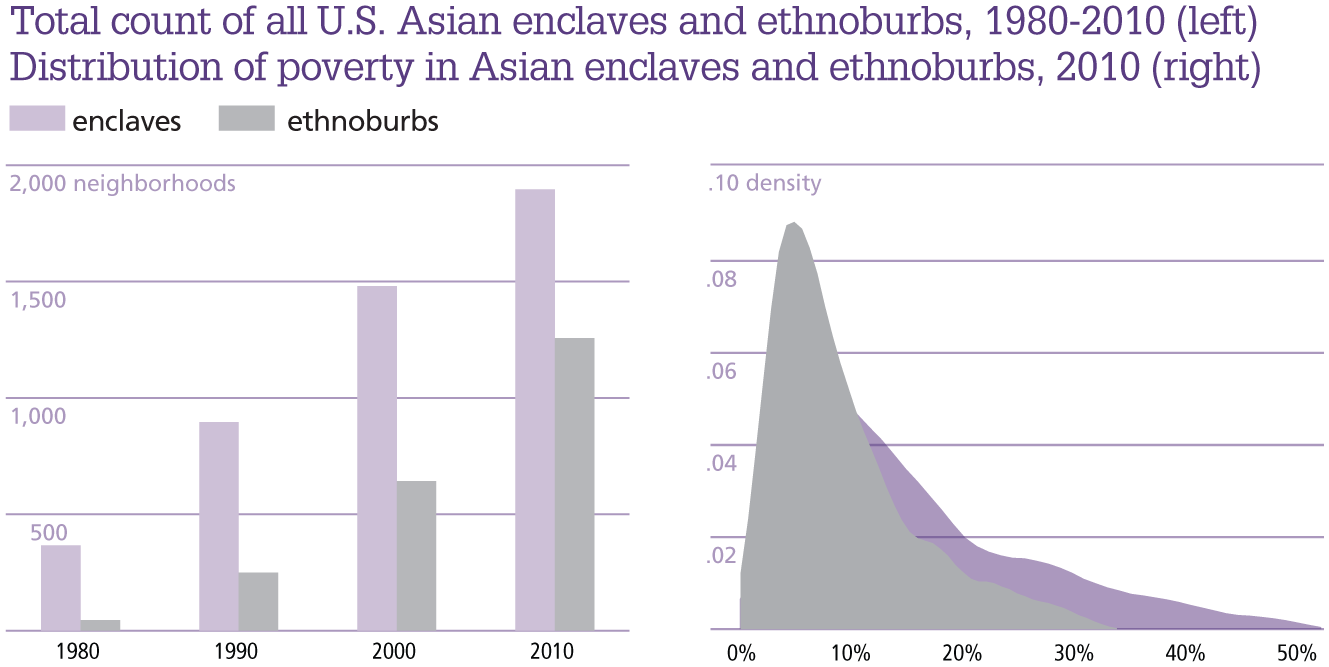
The graphic below uses U.S. Census data from 1980 to 2010 to summarize the total number of Asian neighborhoods in urban and suburban areas (“enclaves” and “ethnoburbs”, respectively). I define a neighborhood as “Asian” if Asian residents composed at least 20% of the neighborhood population and the percentage of Asians was at least double the percentage of Asian residents in the broader metropolitan area. The data are limited to include only the 50 metropolitan areas with the largest Asian American populations in 2010 (together, these account for over 75% Asian Americans in the United States).
The left panel below shows an increase in the total number Asian neighborhoods during the past 30 years. In 1980, there were only 412 Asian communities across both urban and suburban areas. By 2010, there were 3,153. This trend reflects the rapid rise of ethnoburbs, which grew from 45 communities in 1980 to over 1,250 by 2010, a near thirty-fold increase. Ethnoburbs accounted for merely 10% of all Asian American ethnic neighborhoods in 1980, but 40% in 2010. The trends show the geographic reconfiguration of Asian American neighborhoods in the contemporary metropolis.
The Economics of Ethnoburbs
The trend of suburbanization should bode well for Asian Americans. Scholars like John Logan have argued that suburban ethnic communities are stable and socioeconomically viable destinations compared to the traditionally more transitory and poorer urban ethnic enclaves. This discrepancy is thought to be driven, in part, by the larger share of recent immigrants in urban areas. Consistent with this view, urban enclaves in this sample average a slightly higher share of foreign-born residents (at 41% compared to their ethnoburb counterparts’ average, 35%).
Relatedly, ethnoburbs tend to have lower poverty than urban enclaves. The right panel below shows that the distribution of ethnoburb poverty levels falls toward the lower end of the distribution, while urban enclaves’ poverty levels tend to be higher (a majority fall in the range of 15-50% poverty). While the poorest ethnoburbs reach levels of poverty comparable to poor urban enclaves (over 10% of ethnoburbs have poverty rates in excess of 20%), ethnoburbs, broadly speaking, appear to be more middle-class than urban enclaves.
Variations Among National Origin Groups
The treatment of “Asian Americans” as a monolithic group can gloss over important variation, with significant implications for individual national origin groups. To address this shortcoming, the figures on the next page present the same analysis for each of the five largest Asian national origin groups in the United States.
Chinese ethnic neighborhoods are most common, with 115 total nationwide, and Korean neighborhoods the least common with 33 (note the different y-axis for Chinese neighborhoods). Ethnic neighborhoods for all national origin groups grew, particularly in ethnoburbs, between 1980 and 2010. Consider, for example, that only Filipinos lived in ethnoburbs in 1980, but by 2010, at least a quarter of all five groups’ neighborhoods were ethnoburbs.
The right column (next page) indicates that the distribution of poverty between urban enclaves and ethnoburbs varies by national origin group. Chinese, Filipino, and Korean ethnoburbs have much lower poverty than their urban enclaves. For Asian Indians, poverty rates in ethnoburbs are only slightly different from the rates in their ethnic enclaves—for this group, poverty is low in both ethnoburbs and enclaves. Vietnamese neighborhoods run to the opposite end: Vietnamese ethnoburbs tend to have higher rates of poverty than Vietnamese urban enclaves and higher rates of poverty than ethnoburbs for any other group.
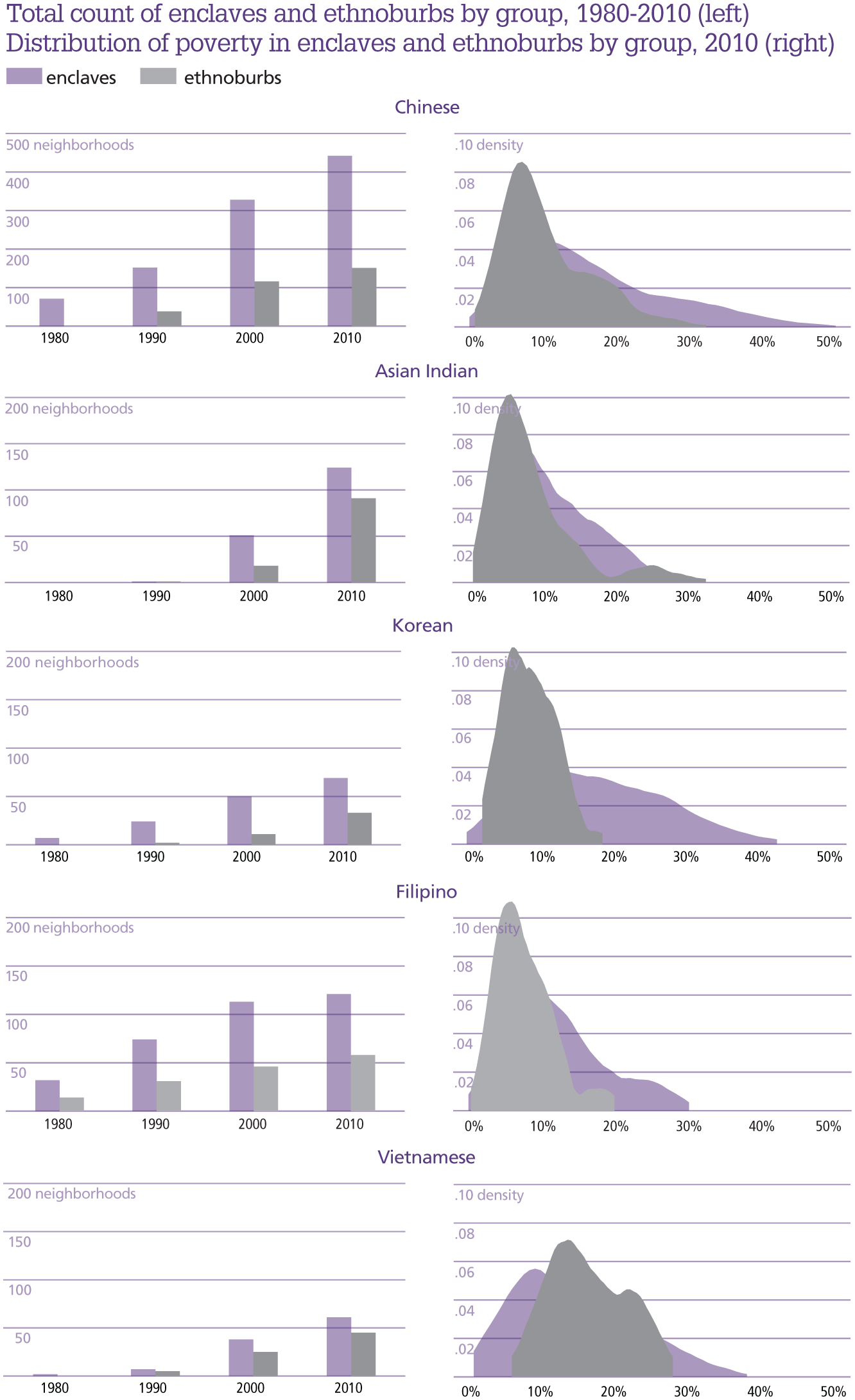
The unique immigration histories and structural conditions that characterize each national origin group explain some of these differences. Chinese and Filipino immigrants represent the two largest Asian immigrant groups in the United States today, and these groups migrated to the United States the earliest. Established chains of social relationships create a cohesive system of migration into middle-class ethnic neighborhoods. In contrast, despite their similarly sized population, Asian Indians enter the United States through extremely hyper-selective migration streams; in 2010, Asian Indians accounted for more than half of all H1-B visas granted. This group of Asian Indian immigrants, who receive H1-B visas for being highly skilled or working in specialty occupations, attain the highest levels of income and education of any Asian immigrant group.
The high rates of poverty in Korean and Vietnamese neighborhoods are at the other extreme end. At 24%, Korean immigrants have an extraordinary rate of self-employment, more than doubling the rate of the next highest group according to the U.S. Census Bureau. The re-settlement of successful entrepreneurs into suburban neighborhoods may explain the bimodal pattern of many high- and many low-poverty Korean neighborhoods.
Vietnamese Americans, however, are less likely to be self-employed. When they are, their businesses tend to garner the lowest revenues among all Asian groups’ ventures. Vietnamese rank as the most isolated of all Asian national origin groups—both from Whites and other Asian Americans. As a result, this isolation concentrates Vietnamese Americans’ poverty in both their ethnoburbs and urban ethnic enclaves.
The Future of the Ethnoburb
Ethnoburbs are here to stay. As Asian Americans continue to migrate into the suburbs, this contemporary variant of the classic enclave community introduces several challenges. For scholars, these trends demonstrate the necessity of expanding the scope of ethnic neighborhoods beyond their traditional urban bounds. Considering each group’s circumstances will generate new insights about how ethnoburbs and enclaves affect groups’ American experience. Future work should account for the fact that the ethnic neighborhood may now represent both the beginning and final destinations of the Asian American assimilation process. This is assimilation on the immigrant groups’ own terms, no longer solely based on assimilation into White neighborhoods.
Policymakers, too, must pay attention to two trends. Ethnoburbs represent a welcome and viable set of diverse, suburban neighborhoods in which Asian Americans can retain access to a dense concentration of ethnic economies and services. Ethnoburbs have consistently lower rates of poverty relative to urban enclaves. At the same time, the growing disparities between ethnoburbs and enclaves provide evidence of emerging residential stratification. As Asian Americans continue to settle into ethnoburbs, policymakers should recognize that a significant share of residents for each group still live in poorer neighborhoods of the metropolis. And, while ethnoburbs may be a positive development for some, they remain an extension of poverty for others, especially for Vietnamese Americans.
Asian American neighborhoods—and the experiences of Asian Americans who reside within them—are far from uniform. By recognizing nuances now, we will be better positioned to understand the significance of ethnoburbs moving forward.