



Abstract
María A. Cabrera Arús on Emma González’s sartorial symbolism.
Six weeks after the tragic shooting that left 17 of her classmates dead at Marjory Stoneman Douglas High School in Parkland, FL, Emma González walked onto the massive stage anchoring the 2018 March for Our Lives in Washington, D.C. Her jeans were torn, and she wore a green bomber jacket with a Cuban flag sewn onto her right sleeve. Patches with “We call B.S.,” “Change,” and a Vitruvian Man, and Women’s March and anti-gun violence pins peppered her lapel. On her left sleeve, she wore an Apollo 11 patch. After reading off the names of the massacred students and staff, she led the audience in painfully poignant silence for more than four minutes. She allotted six minutes and 20 seconds on the stage, the length of time it took the gunman to kill her friends.
Various U.S. media outlets reflected on González’s use of silence to convey deep emotion and clamor. Mother Jones dubbed it “the loudest silence in the history of US social protest.” “In just one day,” Forbes noted, “the speech ran up nearly half a million views on YouTube, was excerpted on all the news broadcasts, and made the front pages of all the major publications, all of them lauding her dramatic silence.”
Republican Congressperson Steve King (R-IA) paid attention, instead, to González’s clothes. “This is how you look when you claim Cuban heritage yet don’t speak Spanish and ignore the fact that your ancestors fled the island when the dictatorship turned Cuba into a prison camp after removing all weapons from its citizens, hence their right to self-defense,” he tweeted. Numerous Cuban-Americans commented on social media that wearing a green military jacket with the Cuban flag was an unmistakable allusion to the Castro regime and thus revealed González’s leftism.
Emma González walks onto the March for Our Lives stage. March 18, 2018.
Getty Images
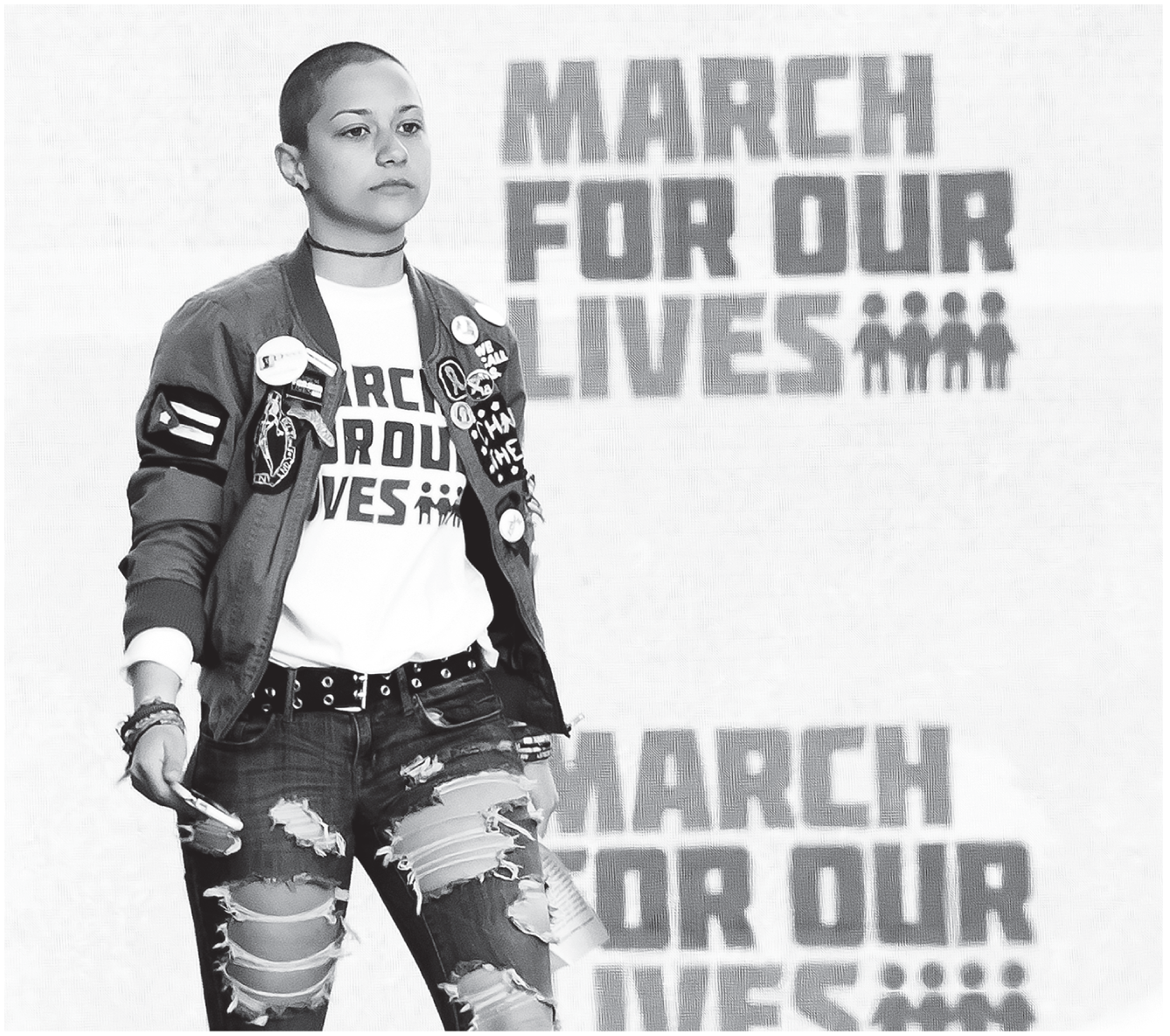
Attacks on González’s sartorial choice turned so bitter that her father, José González, an attorney who arrived in the United States from Cuba in 1968, intervened on her behalf. On March 27, Representative Ileana Ros-Lehtinen (R-FL) tweeted that José had contacted her and “explained that @Emma4Change is proud of her dad and abuela’s #Cuban heritage and in no way was [wearing a Cuban flag] a sign of support for the #Castro dictatorship.” Ros-Lehtinen added: “Many #Miami homes also have Cuban flags, @SteveKingIA. That doesn’t equal support 4 Castro.”
These debates tap into the larger question of what Gonzalez’s sartorial choices represent, historically and sociologically. The Cuban flag was designed in 1849, more than a century before Castro seized power, and, like all independent nations’ flags, reflects both the sovereign state and imagined community, domestic and diasporic, that choose to display it. Yet, in combination with an olive-green outfit, it might be seen as a broader allusion to political issues tied up in Castro’s regime. This connection can be traced to media representations, including those in the New York Times, Life, and CBS News, which during Cuba’s insurrectionary war centrally commented on the rebel forces’ sartorial attributes. After the revolutionary victory, the ascendant leaders also communicated their radicalism and working-class penchant by remaining attached to their iconoclastic guerrilla identity, which also distinguished them from past ruling elites. “Ah no; this uniform and this beard represent the rebelliousness of the Sierra Maestra and our Revolution, and I absolutely won’t get rid of them, look for another Prime Minister,” Castro responded confrontationally when he was advised to change his clothes before being sworn in as Prime Minister on February 16, 1959—he had been told his drab green could evoke the Latin American military dictatorships.
Recent history offers ample evidence of fashion as vehicle for ideology and catalyst for political change. After WWI, for instance, Italian volunteer militias wore black shirts—reflecting the paramilitary wing of the National Fascist Party—to convey their fascist ideology. And historian Mary Neuburger notes that the Bulgarian state socialist regime campaigned against Muslim veils in an effort to transform Muslim peasants under socialist modernization programs. In the late 1970s, Iranian female demonstrators wore hijabs to protest the Shah’s politics and the country’s westernization. In the United States, during the 1960s and early 1970s, members of the Black Panther Party conveyed their political affiliation through a “uniform” of black berets, dark sunglasses, Afros, and black leather jackets. And just recently, under the Trump administration, female protesters wore knitted pink “pussy hats” as a symbol of gender identity and a critique of the president’s derogatory stances toward women.
However, as Roland Barthes explains in The Language of Fashion, clothing is an intrinsically social phenomenon that takes on different meanings in various times and places. In other words, context matters. While a black or a brown shirt spoke of fascism in Mussolini’s Italy and Nazi Germany, it would not carry the same weight in today’s United States. Whereas fashion allows people to construct their identities and communicate (or conceal) their status and aesthetic preferences, these functions are possible “because fashion is situated within a context that makes it intelligible,” as philosopher and religious scholar Elizabeth Bucar argues in her recent book Pious Fashion: How Muslim Women Dress. Not even Arab women’s choices to wear heads-carves have straightforward meanings: the scarves can represent gender and religious oppression, but they can also facilitate women’s agency and, in some contexts, express cultural diversity, religious freedom, and resistance.
Fashion is a vehicle for ideology and a catalyst for political change.
Sticker with the image of Fidel Castro wearing an olive-drab campaign uniform and a backpack, atop a Cuban mountain. Circa 1962.
Author courtesy
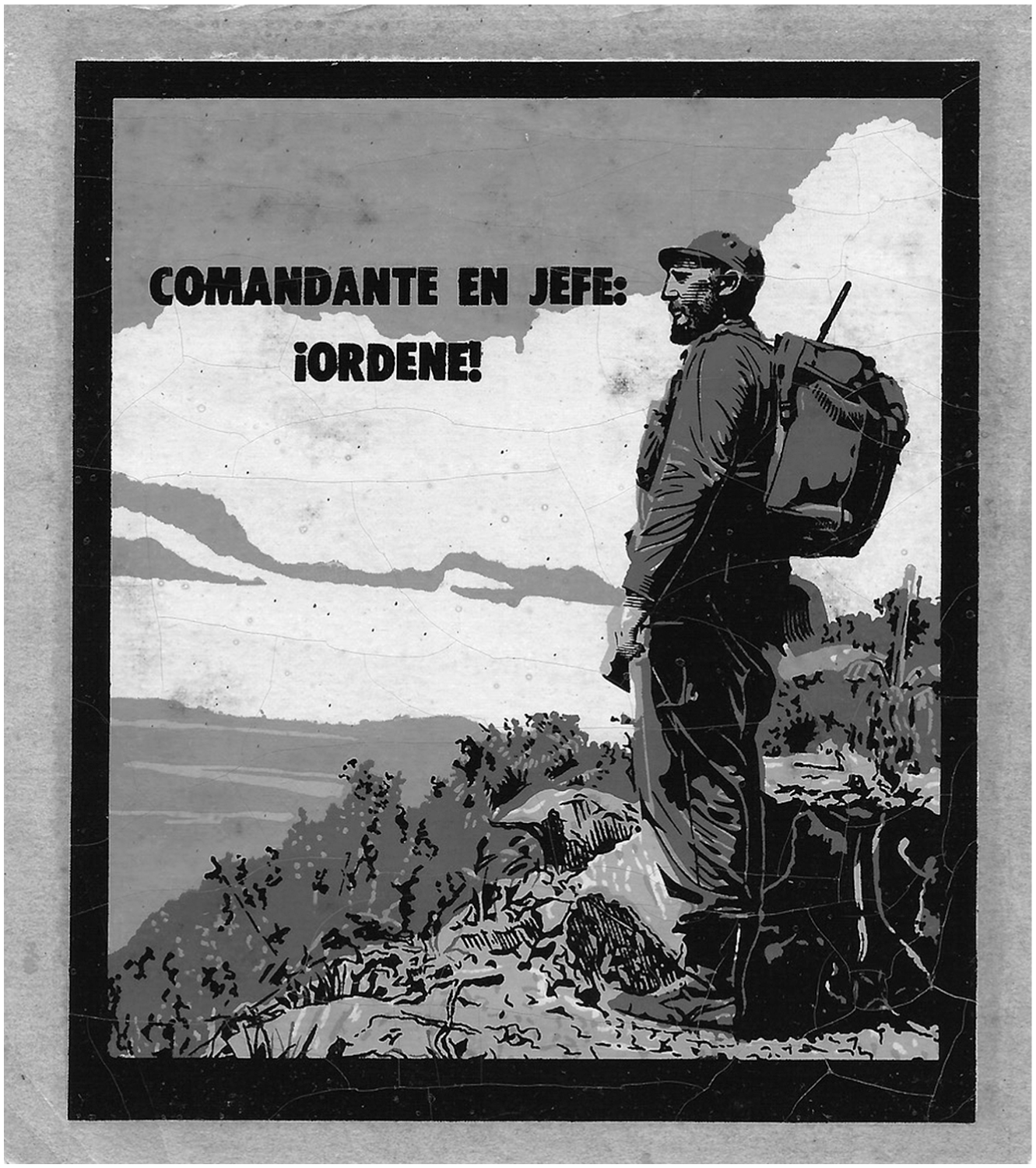
So, a Cuban flag stitched to a green military jacket certainly does evoke the oppressive Cuban regime for nationals who fled the country. It is an all too familiar symbol of a Revolution that devolved into a communist totalitarian regime that greatly limited individual freedoms—such as the rights to free expression and movement that Emma González and her father have determinately exerted—and forced even former revolutionaries into exile. Indeed, in my research on the politics of fashion under Cuban socialism I have met many Cuban refugees who cannot come to terms with military-chic fashion trends; it’s too close, in their views, to the regime they despise. “The men who seized power and repressed—who burst into homes to search without warrants and confiscated businesses, homes, lands, and guns—wore olive green fatigues,” comments journalist Fabiola Santiago in The Miami Herald. The association of green military fatigues with the Cuban post-revolutionary political order is so powerful that Miguel Díaz-Canel, Cuba’s recently appointed president, declared in his first presidential speech that “the Cuban Revolution continues in olive-green,” explicitly signaling political continuity with the Castro regime through clothing and color.
Even so, in the context of the March for Our Lives protest, Emma González’s clothes had little to do with a 50-odd-year-old regime that greatly succeeded in criticizing difference, repressing dissidents, and exporting exiles. Yes, what she wore on that day is politically charged, but the meanings of González’s sartorial “activism” go hand-in-hand with her advocacy promoting political participation, diversity, and human rights. The buttons and patches she wears in most of her public appearances and photo ops communicate inclusion, humanism, and freedom. On April 20, on the occasion of the anniversary of the Columbine massacre and National School Walkout day, she tweeted: “Orange is the color for gun violence survivors, and we wear it today in solidarity of one another,” adding: “This prisoner jumpsuit was my Halloween costume 2 years ago (OITNB) but I wore it today because our schools are looking more like prisons and bomb shelters and less like the learning institutes our parents had the privilege of enjoying.”
González’s clothes articulate meanings diametrically opposed to what the Cuban communist regime has traditionally represented. By defining herself as “Cuban and bisexual,” she works to subvert dominant meanings and give visibility to the 40% of the U.S. population that is non-White (mostly Hispanic and Black), the 13% of U.S. citizens born abroad, and sexual and gender minorities. González’s sartorial symbols help transform these underrepresented groups into visible participants and agents of change in mainstream political debates. These efforts should remind all Americans that diversity is an asset in public discussions when the common good is at stake. Donning the Cuban flag on the sleeve of her military jacket in front of a crowd of thousands at the D.C. March for Our Lives rally, González was saying with her body what she has also said with her words, that democracy “started with, has been about, [and] will always be for all of us.”