




Abstract
The 2018 Winter Olympics saw Korean adoptees celebrated as global ambassadors bridging Korea and the U.S. Yet, in their daily lives, Korean adoptees often feel they are not quite full members of either country or culture. What does it mean for these adoptees to be inbetween, historically and contemporarily, and how do they fit into Asian America?

Thirty years ago, Korea hosted the Summer Olympics for the first time. While the global spotlight highlighted Korea’s miraculous transformation from destitute to highly developed, not every headline was celebratory. Among critical commentary from a variety of countries, North Korea took advantage of the political stage, characterizing Korea’s sending of its children to adoptive families in Western countries as the “ultimate form of capitalism.” In response to this global shame, Korea’s Minister of Health and Social Welfare announced that the country would cease international adoption. Afterward, Korea’s international adoption slowed, but even today, Korean children continue to be adopted to the United States.
Since the 1950s, U.S. families have adopted over 125,000 Korean children. Adoption from Korea was the first sustained intercountry adoption program to the United States. To date, Korean adoptees comprise about 25% of all international adoptions to the United States and are the largest group of transnational transracial adoptees in adulthood. It should come as little surprise, then, that during the 2018 Winter Olympics in Korea, Korean adoptees were again the subject of Olympic headlines. Rather than demonstrate ire from the global community, however, these human interest stories followed U.S. Korean adoptees who had been scouted to South Korean teams and were returning to their birth country, often for the first time.
Over the past three years I surveyed, interviewed, and joined hundreds of Korean adoptees across the United States and in Korea to understand how this unique group of Asian Americans navigates belonging. Whereas in the United States popular press have portrayed Korean adoptees as evidence that we are “beyond race,” in Korea, government officials herald adoptees as global ambassadors bridging the two nations. Yet Korean adoptees often report feeling in-between races, cultures, and identities. To learn how Korean adoptees fit in to United States, Korea, and Asian America, we must first go back to when Korean adoption began.
From Past to Present
Over honey citron tea and melon cream bread at a local Korean bakery, Mary*, 54, told the story of the day she was chosen by her (adoptive) mom. Mary had been at an orphanage for the first 10 years of her life. Older children often age-out of orphanages, as adoptive families tend to want younger children, infants if possible. However, Mary’s mother specifically requested an older child. “I remember they chose 10 kids, ages ranging from 8 to 11, and that’s the age range she wanted,” Mary reflected. “I remember going through that process. It was almost like American Idol, being picked out.”
Although the idea of selecting children paraded on display reduces family-building to simple consumerism, Korea’s selection of healthy children and the ease of its adoption process established it as the “Cadillac of adoption programs.” Prior to adoption from Korea, international adoptions were carefully controlled family-making meant to minimize difference through matching children and adoptive parents by physical features, religion, and temperament. The goal was that these adoptions appear “as if begotten.”
Adoption from Korea changed these norms. White adoptive families were sold on adopting Korean children directly after the Korean War. Newspapers and television showed images of abandoned children, missionaries returned from Korea bringing news about these children in need, and U.S. G.I.s stationed in Korea set up some of the first Korean orphanages, often writing home to their families in the United States asking for donations.
So Korean orphans flooded American consciousness. But, it was after Harry and Bertha Holt’s very public 1955 adoption of eight Korean children, “seeds from the East,” fulfilling what Harry called a “mission from God,” that adoption from Korea soared. Through media framing, first-hand accounts from Christian missionaries to church congregations, and the Holts, Korean adoption became linked to Christian ideals of helping the fatherless.
Social work best practices at the outset of Korean adoption were that no attention be given to transracial adoptees’ racial difference or heritage culture.
On the geopolitical stage, U.S. aid to Korea secured the country’s position as “big brother” to a fledgling Korean nation-state, while, within the United States, White American families’ adoption of Korean children affirmed U.S. perceptions of East Asians as “model minorities.” Adopted Korean children joined their White adoptive families during a time of otherwise exclusionary Asian immigration policies. The juxtaposition emphasized Korean adoptees’ exceptional status.
Though Korean children were obviously racially different from their White adoptive parents, mainstream press and adoption agencies portrayed this difference as negligible. Korean children were seen as having a racial flexibility and benign exoticism. The assumption was that Korean children would, and could, assimilate totally into their White families. Social work best practices at the outset of Korean adoption were that no attention be given to transracial adoptees’ racial difference or heritage culture. These transnational transracial adoptees were seen simply as family members, not racially different and not immigrants.
Once Mary was adopted, her ties to Korea were essentially severed. Her mother wanted her and her sister to learn English fluently without an accent. They took ESOL (English to Speakers of Other Languages) courses in an American school and also had an English tutor. “She forbid me and my adopted sister to speak Korean to each other,” Mary recalled. “It was just like going from being a Korean to American overnight. From culture point-of-view to language point-of-view in every way.”
Though international adoption is often seen as a firmly middle-class phenomenon, given the timing of early adoption from Korea (before the policies and practices of today), families from a range of socioeconomic backgrounds were able to adopt. Working-class, middle-class, and wealthy families from cities, suburbs, and rural areas across the United States adopted Korean children. The two constants across these adoptive families were that the overwhelming majority were White and most resided in predominantly White communities. I interviewed over 100 Korean adoptees (these survey and interview respondents were identified through Korean adoptee organizations, adoptee activities, Korean adoptee list servs, and snowball sampling, and though this is a convenience sample, the demographic data and experiences mirror previous research on Korean adoptees), and virtually all had been adopted by White adoptive parents and 92% reported growing up in a predominately White community. These factors, combined with parents’ approaches to their Korean children as devoid of racial difference, posed challenges to Korean adoptees’ racial and ethnic identity development.
Neither Quite White nor Completely Korean
Like the majority of Korean adoptees, Stacey, 38, grew up in a predominantly White town. As a child, when people asked where she was from, she would tell them Ireland. “I thought I was Irish,” Stacey recalled. “Then, I thought I was Italian for a little while. I really was so confused. I had no idea, but it didn’t last very long because people would look at me and go, ‘What?’”
Stacey was the only Asian person in her otherwise Irish-Italian community. It seemed logical to her that she was Irish or Italian like everyone else, particularly because, like other adoptive parents, her parents took a colorblind approach to her upbringing. Still Stacey found that neither of those identities was fully available to her.
When she was in the fifth grade, two Japanese boys moved into Stacey’s neighborhood. Even though, by then, she “was always reminded that [she] was Asian and adopted by everyone else,” Stacey wanted to separate herself from other Asians, especially these two classmates. Dozens of other Korean adoptees I interviewed echoed this experience. Most grew up in predominantly White neighborhoods, attended predominantly White schools, and identified as White during childhood. Almost none identified as immigrants when they were growing up. Their experiences and ways of thinking about themselves lined up with the social work best practices of the time, aimed at minimizing transnational transracial adoptees’ racial, ethnic, and immigrant status difference from their adoptive families.
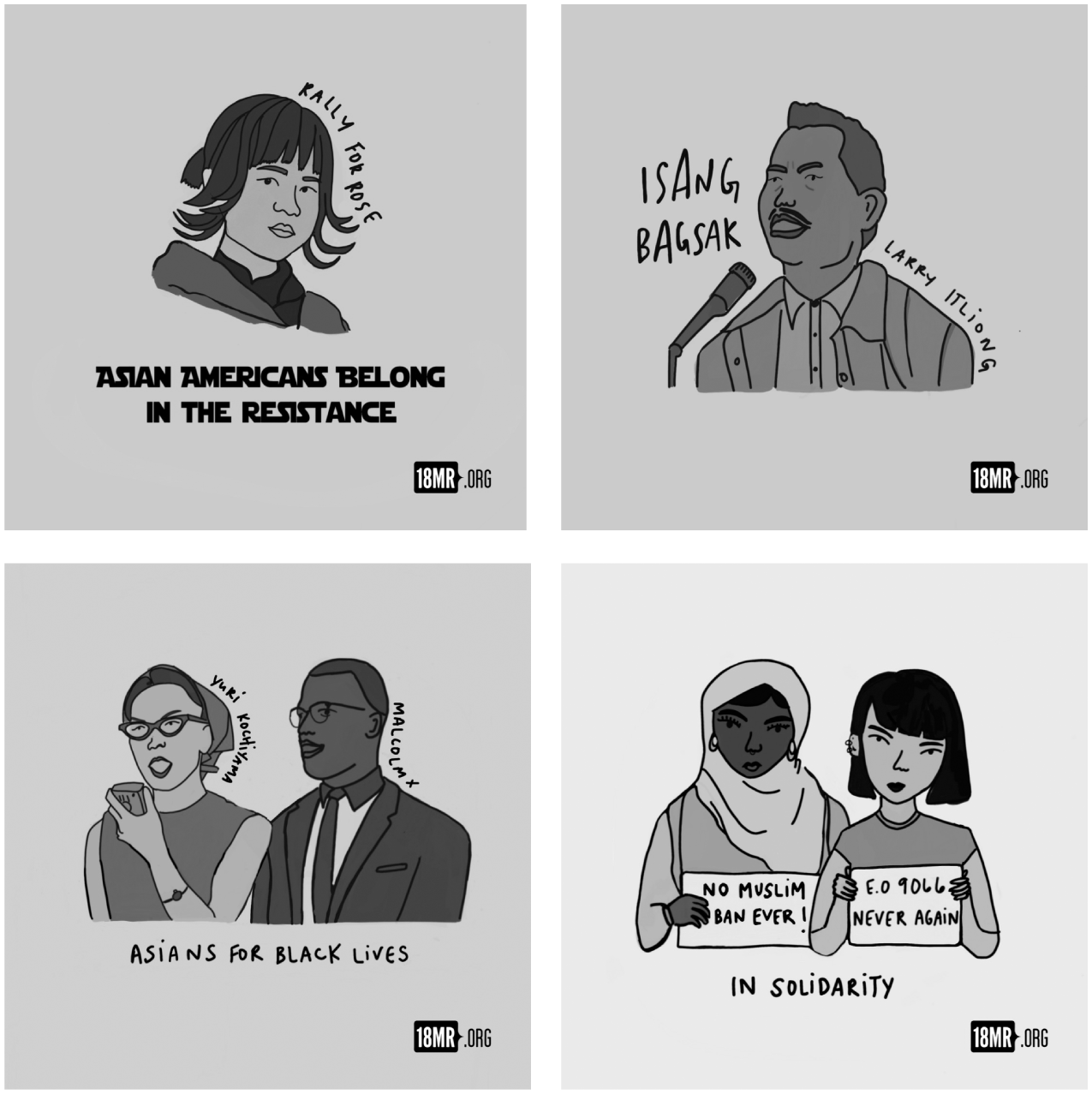
An #18MillionRising sticker pack shows the range of issues Asian American activist networks undertake, including, but also going far beyond Adam Crapser’s individual deportation case. (Available for purchase at store.alliedmedia.org/products/18-million-rising-sticker-set.)
@18MillionRising, images by Natalie Bui (Instagram: @nataliepbui)
Though over 60% of the adoptees I surveyed characterized their parents’ attitude toward their Korean heritage culture as “not important,” they nonetheless learned that their Asian group membership was important to how they were perceived by others. As they interacted with people outside of their immediate neighborhoods, even with extended family members, respondents reported encountering the expectation that they were knowledgeable about their heritage culture, spoke their heritage culture language, or had ties to Asian American communities. In my interviews, Korean adoptees also relayed common experiences of racialization, such as being told to “Go back to where you came from!” or being bullied because of their racialized physical features. These experiences taught respondents that even though they felt firmly rooted within their White adoptive families, the expectation beyond their homes was that they were accountable for their racial group membership—the very identity social workers had downplayed, diminished, and ignored.
So adoptees were reminded that they were Asian, but they didn’t exactly know how they fit into Asian America. For some, this came out of unfamiliarity with other Asian Americans; for others, from internalization of negative perceptions about their racial group.
Creating Community
What happens when you don’t feel fully part of either of the communities you are expected to belong to?
A critical mass of Korean adoptees was coming of age as the internet’s mainstream expansion took hold in the mid-1990s. Korean adoptees started to use online message boards to find people like themselves. Facilitated first by Yahoo! Groups and now by Facebook Groups, Korean adoptees created spaces to find one another, share their experiences, and explore their Korean heritage culture. For some, these online spaces offered their first connections to other adoptees. Due to geographic constraints, some Korean adoptees’ interactions remain constrained to the online groups, while for many others, in-person meet-ups extend their connections into “real-world” spaces.
“Where did you grow up?”
“Have you been back to Korea?”
“Have you done a birth family search?”
“Any suggestions for where to take Korean [language] classes?”
Over a family-style meal at a local restaurant, a flurry of questions and recommendations filled the air. About a dozen adult Korean adoptees, women and men ranging in age from their late 20s to early 50s, were bonding. Some were new to the Korean adoptee community and others more established, but they were coming together over experiences such as being the “only one”—the only Asian, the only adoptee—when they were growing up, addressing race or avoiding race altogether with their White family members, and visiting Korea for the first time.
Korean adoptee groups like these can be found across the United States. Some have only a handful of members, like the newly formed Tennessee Korean Adoptees group, while others, like the New York City based Also-Known-As group that began in 1996, count hundreds of members. These groups have a sustained online presence, but also meet up for monthly dinners, weekly workshops, and other events based on the members’ self-identified needs and interests. Through these groups, Korean adoptees normalize their family formation but also carve out space to express an Asian American identity often missing from mainstream understandings. The impact of these groups is demonstrated by the 32% of my survey respondents who participated in Korean adoptee group activities and identified distinctly as “Korean adoptees,” a reference to their Korean heritage culture, American upbringing, and adoptee background.
Korean adoptees articulate feeling in-between the Whiteness of their adoptive families and the Korean-ness of their heritage culture, yet I had heard similar feelings expressed by second-generation Korean Americans. At a panel on “Korean American Influencers in the Age of YouTube” at the Council for Korean Americans’ annual summit, for example, Korean Americans, the second-generation sons and daughters of Koreans who immigrated to the U.S., described feeling as if they didn’t fit into mainstream American culture because of their assumed foreignness. They also felt disconnected from Koreans of their parents’ generation, because they grew up in America. As I listened to these second-generation Korean Americans articulate their dual exclusions, I was struck by how comparable they sounded to Korean adoptees.
There are an estimated 35,000 international adoptees without citizenship. The majority of these are Korean adoptees.
What both the Korean adoptees and the second-gen Korean Americans were expressing were feelings of conditional acceptance within Asian communities and a lack of visibility in mainstream American culture. Though their conversations seemed to miss one another, they were responding in similar ways—through YouTube and other online platforms.
While these Korean Americans were leveraging user-generated media to create alternative Asian American content, in mainstream news, another headline was forming.
American… Without Citizenship
In early 2015, U.S. Immigration and Customs Enforcement (ICE) served deportation paperwork to Adam Crapser, a 40-year-old Korean adoptee who had come to the United States as a toddler. Crapser had recently applied for a green card. His background check was flagged for a crime he had committed and for which he had served time. By the spring of 2015, the New York Times was covering his “bizarre deportation odyssey.” In the article, Crapser is quoted: “I was told to be American. And I tried to fit in. I learned every piece of slang. I studied everything I could about American history. I was told to stop crying about my mom, my sister, Korea. I was told to be happy because I was an American.”
Yet Crapser was, in fact, not an American. His adoptive parents never took the necessary steps to secure his U.S. citizenship. Though currently, under the Child Citizenship Act of 2000 (CCA), international adoptees adopted by U.S. citizens receive automatic U.S. citizenship, that was not always the case. At the time of Crapser’s adoption (and up until the enactment of the CCA) it was incumbent upon adoptive parents to know they needed to naturalize their adopted children and to follow the necessary steps to do so. Many parents either did not know or, if they did know, did not do so due to the high costs or out of neglect. There are an estimated 35,000 international adoptees without citizenship. The majority of these are Korean adoptees.
Crapser’s case sent shock waves through the Korean adoptee community. Korean adoptees had been told all their lives that they were American, yet here was the most absolute refutation of that. Almost immediately after Crapser’s deportation paperwork was served, Kevin Vollmers of Gazillion Strong, an adoptee-created advocacy group, began advocating for Crapser. Korean adoptee groups across the United States joined in supporting Crapser’s case and called for a legislative fix. Their goal was “citizenship for all adoptees.” Crapser’s case activated a communal Korean adoptee identity, as adoptee organizers emphasized that he “could be any of us.” The specter of deportation emphasized Korean adoptees’ immigrant status in a way previously unimaginable.
Joining the mobilization efforts were Asian American activism networks such as 18MillionRising and the National Korean American Service and Education Consortium (NAKASEC). In the spring of 2015, 18MillionRising launched a campaign to #KeepAdamHome, which included a petition against Crapser’s deportation and fundraising for his legal defense. By the fall, NAKASEC had taken over Crapser’s legal defense and was scheduling meetings on Capitol Hill to reintroduce a bill that would retroactively grant U.S. citizenship to international adoptees not covered under the CCA. This bill would be known as the Adoptee Citizenship Act.
In addition to NAKASEC’s support for the Adoptee Citizenship Act, within the organization, they also developed a position to solely focus on Korean adoptee needs. Though Korean adoptees often feel separate from other Asian Americans, the advocacy by these groups demonstrated Korean adoptees’ inclusion within Asian immigrant communities.
Despite the organizing around his case and for adoptee citizenship rights, in October of 2016, an immigration judge ordered Crapser deported to Korea. Unfamiliar with the language or culture, Crapser’s outlook was bleak. Deportation intensifies the precarious position of those who are already vulnerable, and with little financial, social, or cultural support, deportees face enormous hurdles to integration into their new country. For many, integration is nearly impossible. It can lead to fatal outcomes, such was the case for Philip Clay, another Korean adoptee who was deported back to Korea and committed suicide in July 2017.
In the midst of continued advocacy for adoptees, NAKASEC also began a 22-day, 24-hour vigil in front of the White House to draw attention to other immigrant rights. From August 15-September 5, 2017, NAKASEC led “DREAM Action” or #DreamAction17 to protest the end of the Deferred Action for Childhood Arrivals (DACA) and the Temporary Protective Status (TPS) programs. DREAM Action drew together wide-ranging members of the immigrant community. Korean adoptees, who have typically not considered themselves immigrants, joined this around-the-clock action. In the current political climate, heightened immigration scrutiny and adoptees’ precarious citizenship rights appear to have facilitated an awareness of “linked fate,” whereby the conditions and outcomes for one are connected to the many, among and between immigrant groups.
Support for a legislative fix for adoptee citizenship continues, and in April 2018 a new version of the Adoptee Citizenship Act was introduced in the House and the Senate. Ironically, although it was Crapser’s case that reignited support for citizenship for all adoptees, this version excludes the most vulnerable—those adoptees who, like Crapser, have been found guilty of a violent crime and have already been deported.
Adoptees and Asian America
Korean adoption began at a time of exclusionary Asian immigration policies, yet, until recently, Korean adoptees were excluded from Asian immigration history. An appropriate corrective must also incorporate an inclusion of Korean adoptees in how we think about contemporary Asian American community and identity. Though adoption from Korea has slowed considerably, international adoption from other Asian countries to the United States continues. Like the critical mass of Korean adoptees before them, other Asian adoptees will soon be coming of age. Not only will issues of identity and belonging likely still be key, but the new contours of this cohort of Asian adoptees, who were adopted at older ages, often have identified medical issues, and hail from countries across Asia, will necessitate examinations of age, disability, colorism, and adoption within and across Asian America.
As my respondents’ experiences growing up and the fight for adoptee citizenship rights demonstrate, adoption into White American families does not translate into complete social or legal U.S. citizenship. Korean adoptees still experience the world and are treated as hyphenated Americans. By incorporating Korean adoptees within our understandings of Asian America, another layer of the Asian American experience is illuminated. Korean adoptees face many of the same realities of belonging and non-belonging as Asian Americans more broadly, but their adoptive status provides an additional lens through which to view the Asian American experience.
Footnotes
* All names, except Adam Crapser’s, are pseudonyms.