



Abstract
Representation in media matters–so why is prime time still so white?

Like many other Americans of our generation, we spent countless childhood hours in front of the television watching family sitcoms like The Brady Bunch, Family Ties, The Wonder Years, and Married with Children. Images of Whites dominated the television landscape, normalizing their privilege by making their experiences more prominent, relatable, and powerful than others. The introduction of ABC’s
All-American Girl in 1994 was a historic moment, centering a Korean American family. Its portrayal of Asian Americans, however, drew widespread criticism and bad reviews; the show, starring comedian Margaret Cho, was cancelled after only one season, and television networks would not greenlight another Asian American family sitcom for 20 years. Despite its short run, All-American Girl crystallized one very important message: representation matters.
Fast forward to 2015: the fast-paced growth of Asian American audiences, a gradual increase in people of color behind the scenes in Hollywood, and the rising success of Asian American comedians and actors signaled an era in which more diverse representations could be welcomed. In fact, NBC News heralded it as a “banner year” for Asian Americans on television, noting several shows featuring AAPI (Asian American and Pacific Islander) cast members. Fresh Off the Boat (ABC) premiered in February 2015. Based on a memoir by chef Eddie Huang, it depicts a Taiwanese American family relocating from D.C. to Orlando in the 1990s. Now in its fifth season, it is the longest running Asian American family sitcom. In October 2015, Dr. Ken premiered with comedian and writer Ken Jeong playing a Korean American physician and father of two, married to a Japanese American therapist. Streaming shows also featured Asian American leads, with Hulu’s The Mindy Project starring Mindy Kaling, one of the few female South Asian American writers, creators, producers, and lead actors. Netflix’s Master of None had two Asian American lead characters and writers and won a 2016 Emmy for Best Writing (comedy).
All this stands in contrast with our pioneering 2005-2006 study of broadcast network television, Asian Pacific Americans in Prime Time: Setting the Stage. In it, we found that AAPI tv characters were either missing or one-dimensional. It would seem that AAPIs have made significant progress since that time, when not a single show focused on their stories. Still, it’s useful to ask whether the triumphs of 2015 were truly cause for celebration—was the success of a few shows masking continued AAPI underrepresentation?
We conducted an expanded 2015-2016 follow-up study to uncover the extent to which AAPI representation in television had changed and what inequalities remained. Our study captures shifts in the television landscape resulting from the proliferation of original content, not only from network television but also cable and streaming services. And ultimately, our research examines the degree to which Asian Americans and Pacific Islanders “belong” as citizens in the cultural landscape of television and the United States as a whole.
Television’s Influence and Representations of Race, Ethnicity, and Citizenship
According to a University of Southern California report, “How Much Media? 2013 Report on American Consumers,” Americans were projected to consume, annually, “traditional and digital media for over 1.7 trillion hours, an average of approximately 15-and-a-half hours per person per day in 2015.” That is a lot of media, and it is more than just popular entertainment. Television programming can shape how we see the world, including our perceptions of racial and ethnic groups and our understanding of societal inequalities. Elites use mass media to maintain particular social groups’ supremacy over others. Hollywood’s dominant narratives of Whites as heroes and actors of color as sidekicks, villains, and foreigners legitimize and reproduce the racial hierarchies in U.S. society, according to studies by Shoba Sharad Rajgopal and Nancy Wang Yuen.
Furthermore, representation on television is significant because it can affect our sense of what Lori Kido Lopez refers to as “cultural citizenship”—the extent to which a group belongs to a common understanding of what is “American” and whether their cultural practices and identities are recognized by others in the larger society. Similarly, media scholars Riva Tukachinsky, Dana Mastro, and Moran Yarchi have found negative stereotypes regarding people of color on television are associated with White people’s negative public opinions of those respective groups. As they noted, not only are Asians underrepresented on TV, but they are also depicted as less likable than non-White characters. Lacking fair and realistic representation in television can have far-reaching implications by suggesting AAPIs are not, in fact, truly American. This can perpetuate stereotypical notions that AAPIs are “forever foreign,” unable to fully integrate into American society, whether in politics, the workforce, or popular culture.
Representation on television is significant because it can affect our sense of “cultural citizenship”—the extent to which a group belongs to a common understanding of what is “American”.
Our research compares Asian Americans and Pacific Islander representation in 2005-2006 and 2015-2016 with that of Whites to examine the quantity, quality, and complexity of images of AAPIs on television. In the earlier study, we analyzed prime time shows on national network channels. Our analysis of the 2015-2016 season expanded the scope by including national network channels, basic and premium cable channels, and streaming sites. We analyzed series regulars, or lead roles played by actors given title credit and whose characters regularly appear in episodes with the potential for developing depth and complexity over time. These series regulars are the characters audiences identify with most. For example, when actor Steven Yeun’s character, Glenn, died on The Walking Dead (AMC) in 2015, the Daily Mail reported that many fans tweeted sentiments along the lines of, “Someone in my family died.” Series regulars are the most impactful figures on television and streaming services.
For each regular character, we determined race and gender by referencing cast member photos, biographies, network websites, and commonly used industry databases such as imdb.com. We also examined general program characteristics, including program setting. For shows with at least one monoracial AAPI regular (person of a single or multiple Asian ethnicity or Pacific Islander heritage) or multiracial AAPI (person of Asian or Pacific Islander descent plus one or more non-AAPI race), we tabulated screen times and qualitatively analyzed the episode for salient themes. The 2005-2006 study included 102 shows and 615 series regulars, with 14 shows featuring 16 AAPI regulars. The 2015-2016 study includes 242 television shows and 2,052 series regulars, including 87 AAPI shows with 142 AAPI regulars.
TV so White
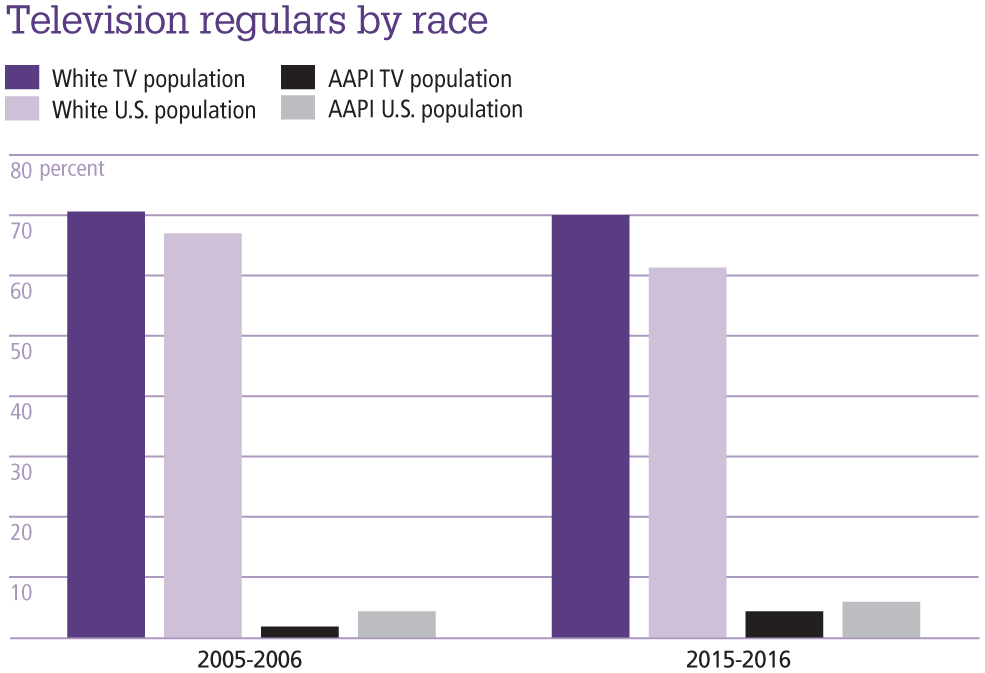
Though the numbers have improved for AAPIs on TV in the last decade, they remain underrepresented. In fact, Whites are overrepresented relative to their actual U.S. population. For example, in 2015-2016, Whites made up 70% of all series regulars, but only 61.3% of the U.S. census population (see above). Monoracial AAPI actors in this period were 4.3% of series regulars, while they were 5.9% of the U.S. census population. Pacific Islanders were the least represented, at only four series regulars (0.2%, half of their U.S. census population). To be sure, AAPI underrepresentation was far worse in 2005-2006, when there were no Pacific Islander series regulars and monoracial Asian Americans comprised only 1.8% of the broadcast series regulars, well below the census estimate of 4.3% AAPI population. Still, numerically speaking, AAPIs have yet to “make it” in the shows we watch.
Breaking the data down by media platform reveals how improvements inconsistently impact the television landscape. In 2005, AAPIs appeared on 14% of broadcast network shows. A decade later, AAPIs appeared on 36% of shows across all platforms, but only about 25% of premium cable shows. In contrast, a whopping 96% of all shows had at least one White regular, virtually guaranteeing audiences would see significant White characters, regardless of where they consumed such shows. Given the political context of increasing (and increasingly visible) anti-immigrant sentiment and White nationalism, an overly White representation of American society is a huge cause for concern. When AAPIs are effectively erased from television culture, it undermines the audience’s exposure to the true diversity of American society.
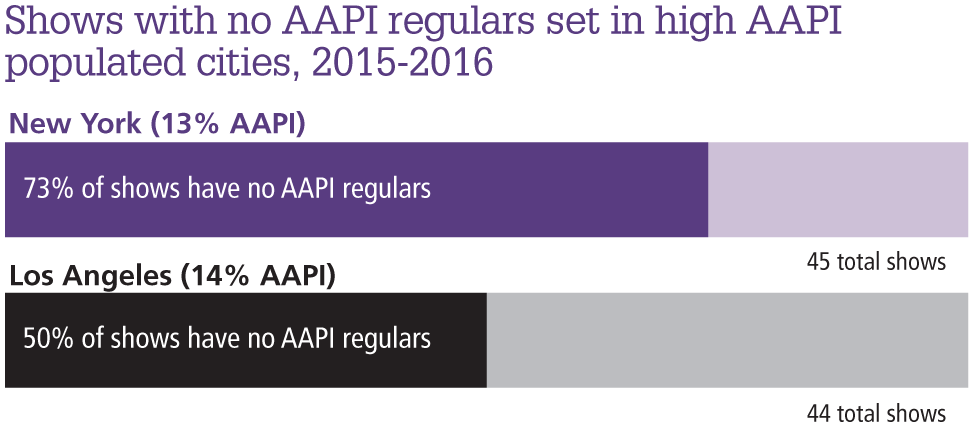
This erasure is even more severe when we consider specific locations in television programming. The AAPI population in the United States is not evenly dispersed. Cities such as Honolulu, San Francisco, Los Angeles, New York, and Seattle have higher-than-average concentrations, so television shows set in these cities should therefore depict more AAPI regulars. Yet, similar to our study from ten years ago, the 2015-2016 season was rife with “missed opportunity programs”—shows set in cities with large AAPI populations but lacking a single AAPI regular. Nearly three-quarters of the shows set in New York and half the shows set in Los Angeles did not feature a single AAPI regular, although both cities are renowned for their racial diversity (see above). Though an improvement from 2005-2006, when not a single show set in Los Angeles and only one in New York cast an AAPI regular, this continued underrepresentation renders AAPIs invisible even in spaces where they are actually numerous.
This absence continued in other locales. After Sandra Oh’s departure from Grey’s Anatomy (ABC) in 2014, the show’s cast no longer featured an AAPI regular, despite being set in Seattle (14% AAPI). Fuller House (Netflix) also lacked an AAPI regular, though set in San Francisco where a third of the population is AAPI. While Hawaii Five-0 (CBS) featured two Asian American series regulars (who have since departed the show), the series did not originally include a single Pacific Islander regular in the 2015-2016 season, despite their high concentration in the state (10% Pacific Islander population).
This whitewashing of locations with significant AAPI populations erases their prominence and power, particularly in shaping the political landscape. For example, political commentator Alex Wagner notes Asian Americans are consistently undervalued politically, despite being the fastest growing voting bloc. The Asian American National Election Eve Poll found 57% of Asian Americans had not been asked by any campaign, political party, or civic organizations to vote or register to vote.
We also found AAPI series regulars underrepresented in terms of screen time. Our original study revealed AAPI regulars were on screen for less than a third of the episode and the collective screen time for all AAPI regulars totaled a mere 1 hour and 42 minutes (compared to a screen time total for Whites of 10 hours and 12 minutes). This meant AAPI regulars had just 16.7% of the screen time Whites had. Our 2015-2016 study showed ongoing screen time disparities, with AAPI regulars collectively logging 20 hours to Whites’ 65. In short, AAPI regulars had 31% of the screen time of Whites. The overall invisibility remains stark: 87% of the AAPI regulars were on-screen for less than half of the episode, and 17% of them ranked last in their shows’ screen time.
Amid increasingly visible anti-immigrant sentiment and White nationalism, an overly White representation of American society is a huge cause for concern. When AAPIs are effectively erased from television culture, it undermines our exposure to the true diversity of American society.
Even when AAPIs appear, they are barely visible. Low screen times suggest AAPIs are rarely their shows’ leads—a lack of presence that mirrors the lack of leadership positions held by AAPIs in U.S. society. Demonstrating what executive coach Jane Hyun calls the “bamboo ceiling,” we note that, among the 2017 Fortune 100 CEOs, only one Asian American surfaces: Indra Nooyi, the female Indian American CEO of PepsiCo. Whites make up 92% of CEOs, according to marketing expert Brandon Gaille. In addition, a 2011 Center for Work-Life Policy report found that Asian American men feel more “stalled in their careers than men in any other racial group.” The underutilization of talented AAPI actors on screen parallels the career impediments AAPIs face in U.S. society as a whole.
Tokenized, Stereotyped, and Breaking the Mold
In the Emmy award-winning Master of None (Netflix), Aziz Ansari’s character exposes the racial barriers in Hollywood when he explains how “there can’t be two” Asians cast on a show, even though entire casts filled with White actors abound. Both of our studies add ample evidence of this racial tokenism. In 2005-2006, only one broadcast network show had more than one AAPI regular—Lost (ABC), a supernatural drama that starred Daniel Dae Kim and Yunjin Kim as a Korean couple. A decade later, this tokenism persisted, with only 11% of all shows featuring more than one AAPI regular. When television limits AAPI casting, producers are not allowing audiences to see authentic intra-racial interactions, including encounters with family and friends that characterize most AAPI’s actual relationships.
Stereotypes can contribute to structural inequalities and even adversely affect how people of color see themselves: AAPI viewers can internalize negative stereotypes, ultimately limiting their sense of belonging and aspirations in American society.
In addition to being numerically underrepresented, AAPIs were often seen in stereotypic roles that mask the diversity within the community. Perpetuating the model minority trope that typecasts AAPIs as highly educated, wealthy, and nerdy over-achievers, the majority of AAPIs on television in 2005-2006 had high-status careers requiring advanced degrees, such as doctors and lawyers. This stereotypic narrative continued in 2015-2016, with other model minority characters like astrophysicist Rajesh Koothrappali from The Big Bang Theory (CBS) and software engineer Dinesh Chugtai from Silicon Valley (HBO). Characters like these can perpetuate the myth that all Asians are natural high achievers in the workplace and school, and they mask the wide range of differences among various Asian ethnic groups. In fact, Sono Shah and Karthick Ramakrishnan have reported three-quarters of Taiwanese and Asian Indians in the United States have a bachelor’s degree or higher, but less than a quarter of their Burmese, Hmong, Cambodian, Laotian, and Bhutanese peers have earned a college degree.
AAPI portrayals also invoke “Yellow Peril” when characters represent morally corrupt physical or cultural threats to the fabric of American society. Criminal Minds: Beyond Borders (CBS), Major Crimes (TNT), and The Last Ship (TNT) all featured plot-lines involving AAPIs playing criminals or gang members. In an overlapping pattern, accents were wielded as either a symbol of foreignness or a punchline for the audience. Though AAPIs have lived in the U.S. for generations, characters such as Jian Yang on Silicon Valley and The Big Bang Theory’s Koothrappali speak with heavy accents that signify their foreignness. As historian Robert G. Lee found, representations such as these reinforce the notion that Asians are not part of American society—that they warrant suspicion as threatening, unassimilable foreigners. Such images contribute to the long-standing tradition of anti-immigrant sentiments, policies, and actions including the Chinese Exclusion Act, Japanese internment, and the murder of Vincent Chin.
When examining the intersectionality of race and gender in AAPI roles, we found stereotypic examples of exoticized Asian women and emasculated Asian men. In Vikings (History), the Chinese female character Yidu is an exotic slave who briefly becomes King Ragnar’s lover. In Two Broke Girls (Fox), the male character Han is an emasculated and accented buffoon, ridiculed for his short stature and inability to attract women. These stereotypes reduce AAPI women to objects of non-AAPI male desire, while AAPI men are depicted as unworthy of the dignity and respect afforded to “real” men.
As Nancy Wang Yuen notes, unidimensional characters can become a stand-in for all AAPIs, especially among people who have little real life contact with AAPIs. With few AAPI regulars to offset the pervasiveness of stereotyped characters, audiences may assume all AAPIs embody these problematic portrayals. The persistence of these stereotypes also can contribute to structural inequalities that discriminate against AAPIs in classrooms, workplaces, and other social spheres. Perhaps more pernicious, negative media portrayals of people of color can even adversely affect how people of color see themselves: AAPI viewers can internalize negative stereotypes, ultimately limiting their sense of belonging and aspirations in American society.
In rare, exemplary cases, AAPI regulars were complex leads of their series, including Priyanka Chopra in the ABC drama-thriller Quantico, Lucy Liu holding her own next to Sherlock Holmes in CBS’s Elementary, and Emmy-winner Riz Ahmed portraying a prison inmate trying to prove his innocence in HBO’s The Night Of. These roles offered viewers nuanced characters with ample screen time, intriguing romantic relationships, and complex storylines that built empathy. Moreover, when TV series featured more than one AAPI regular, that multiplicity helped broaden the general perceptions of AAPIs in society. With one of the largest AAPI casts, Fresh Off the Boat showed viewers the intergenerational dynamics of the Huang family as they navigated being both Asian and American. Such stories help challenge the recycled Asian stereotypes of the past.
All in all, and true to the headlines, there has been progress with regard to both the proportional number and percentage of AAPIs in television compared to a decade ago. However, when considering the prime time television landscape in its entirety, this is only a partial truth. The improvements are more symbolic than indicative of holistic diversity and inclusion. In fact, our studies indicate many viewers consume programming comprised of all-White and nearly-all-White casts that exclude AAPIs. Missed opportunity data reveal that non-AAPI casts exist even when the stories are set in places with larger than average AAPI populations, including Los Angeles and New York. When AAPIs appear on-screen, they are often the lone AAPI on their show, and they get extremely low screen time, contributing to their tokenization. Taken along with the persistently ubiquitous stereotypes portrayed on these shows, the lack of AAPI representation demonstrates their continued exclusion from the U.S. cultural landscape. The broad-stroke erasure of AAPI communities on television amounts to the denial of cultural citizenship, shortchanging viewers of all races and ethnicities.