



Abstract
Ashley C. Rondini on the scripts justifying and reinforcing supremacy.
One year ago, James Fields, Jr. drove his car into a group of anti-racist protestors in Charlottesville, Virginia. In a widely circulated press photograph taken earlier that day, Fields, a White man with a history of domestic violence against women, is holding up a homemade, cardboard shield as he stands alongside other members of the neo-Nazi group Vanguard America. This White nationalist group attempts to recruit “men of action” with slogans including “Blood and Soil,” “Imagine a Muslim-Free America,” and “For Race and Nation.” In an effort to reach women, their website urges: “White women make the call—for race, family, and nation!”
Fields took the life of Heather Heyer, a 32-year-old White anti-racist counter-protestor, and caused injuries to 19 others. He is now charged with a federal hate crime. Given that he was the uncontested perpetrator of the violence, Fields’ defensive posturing earlier in the day—as he held a symbolic shield—is ironic, but not surprising. The shield represents a purported need for protection against an imminent threat, consistent with the racialized fear mongering upon which White supremacist politics have long relied in their justifications for violence and terror. Such “danger narratives” cast racially and religiously oppressed groups as innately violent, uncivilized, and threatening to the (White) public.
The belief that White violence against people of color should be viewed as a legitimate form of “pre-emptive self-defense” comprises a core principle through which Whiteness has long been constituted. In particular, images depicting men from racially, ethnically, and religiously minoritized populations as sexual and physical threats to “White society”—specifically to White women— have been invoked to support both historical and contemporary expressions of violent White masculinity. This was evident in 2015, when Dylann Roof, a young White man who relished Confederate memorabilia and White supremacist ideologies, murdered nine Black people in a Charleston, South Carolina church. In what sociologist Lisa Wade characterizes as a lethal display of White male “benevolent sexism,” Roof told his victims: “I have to do it. You rape our women, and you’re taking our country. And you have to go.”
Danger narratives justify state-sanctioned and vigilante forms of violence against oppressed communities while also implicitly functioning to assert the “rightful” place of White men in positions of power. By casting men of color as innately predatory, White men set themselves up as the logical defenders of a civilized White society. History bears out this pattern repeatedly.
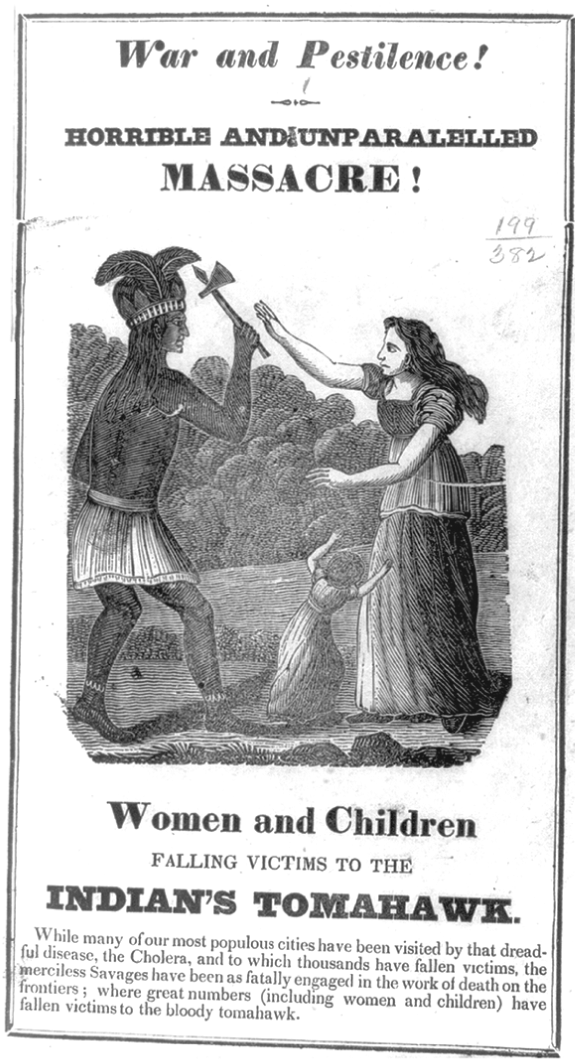
Under settler colonialism, “moral” justifications for the displacement and genocide of Indigenous populations during westward expansion relied upon similar ideas. Depictions of “savage” Native American men attacking “civilized” White women vindicated the brutal consequences of Whites’ “manifest destiny” for Indigenous peoples. At the same time, as Evelyn Nakano Glenn’s work illustrates, Native women suffered well-documented physical and sexual abuse at the hands of White colonizers, for which no consequence would ever be met.
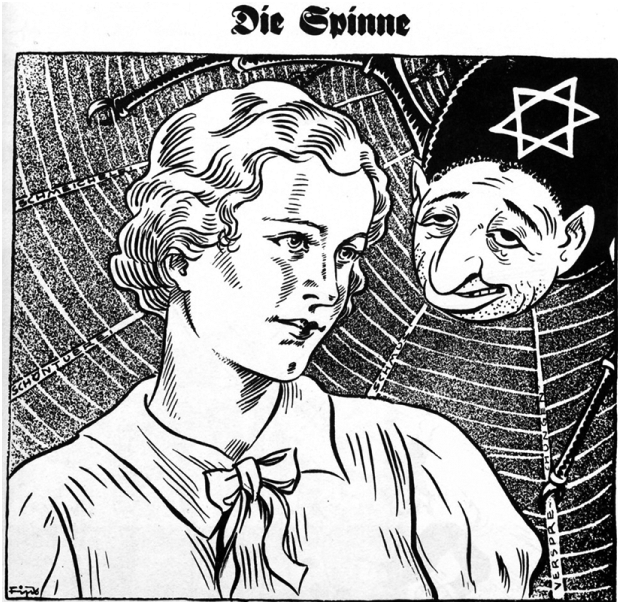
Years before the genocidal mass murders of the Holocaust, the Nazi party distributed Anti-Semitic propaganda depicting caricatures of animal-like Jewish men with exaggerated facial features and darkened skin. They were often portrayed preying on White, Aryan women, who were depicted as either virtuous maternal figures or as sexualized “pinup girls.” As historians Claudia Koonz (1988) and Jill Stephenson (2001) illustrate, these images became both symbols of the “pure” ideals soldiers were purportedly protecting and the sexualized “reward” they would receive for their efforts. In the same era, an estimated 2 million of the 6 million Jews systematically murdered by the Third Reich were women.
“War and Pestilence! Horrible and Unparalelled Massacre! Women and Children Falling Victims to the Indian’s Tomahawk.” ca. 1800
Library of Congress, 2007678059. No known copyright restrictions.
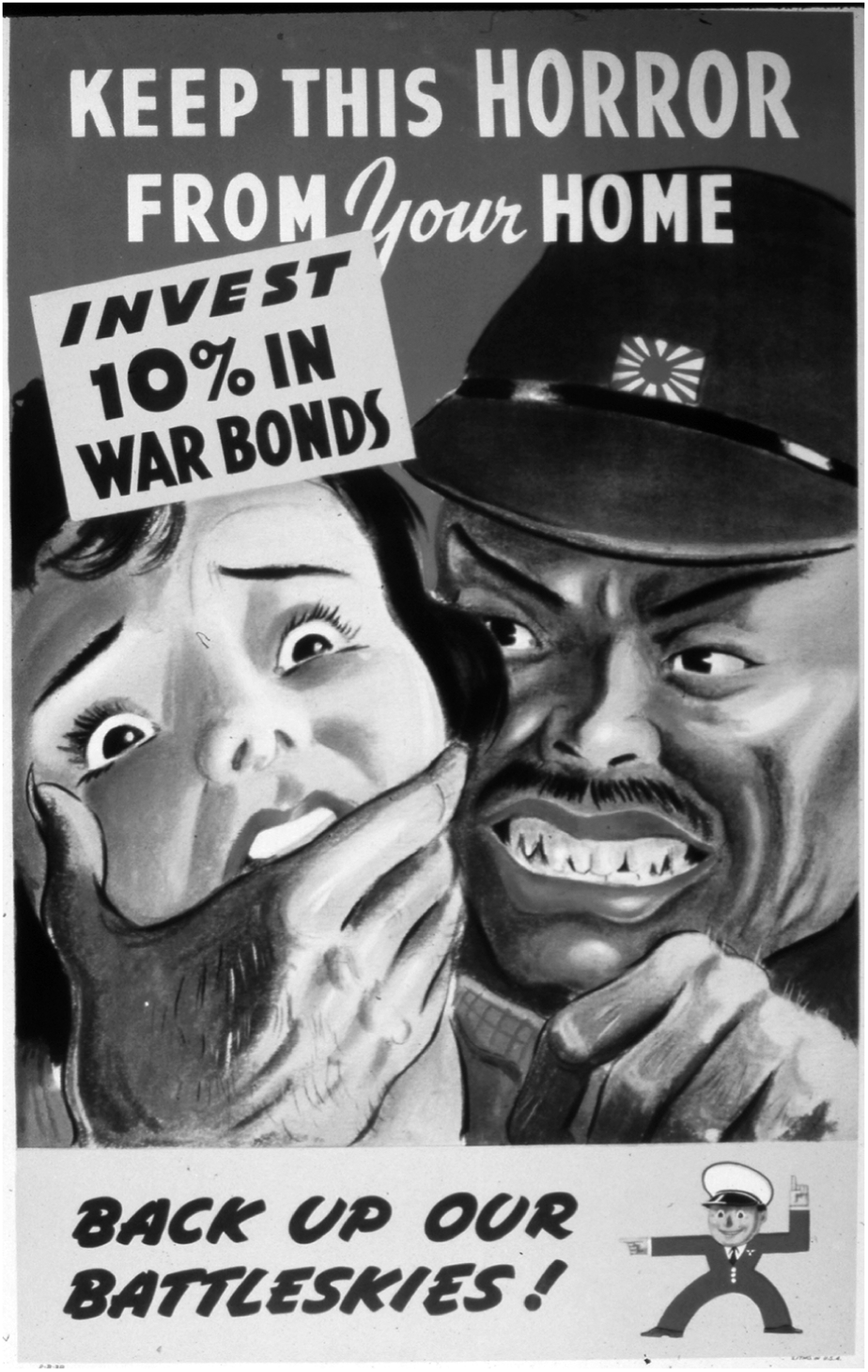
As ethnic studies scholar Yen Le Espiritu highlights, early 20th century popular culture depicted dark-skinned caricatures of Japanese men attacking or abducting White women. The ideologies reflected in these images helped pave the way for the mass internment of Japanese American men, women, and children during the Second World War. U.S. war bonds evoked fears of the “yellow peril,” with messages such as, “Keep This Horror From Your Home.”
“Die Spinne,” WWII-era cartoon by Philipp “Fips” Rupprecht for Nazi publication Der Sturmer.
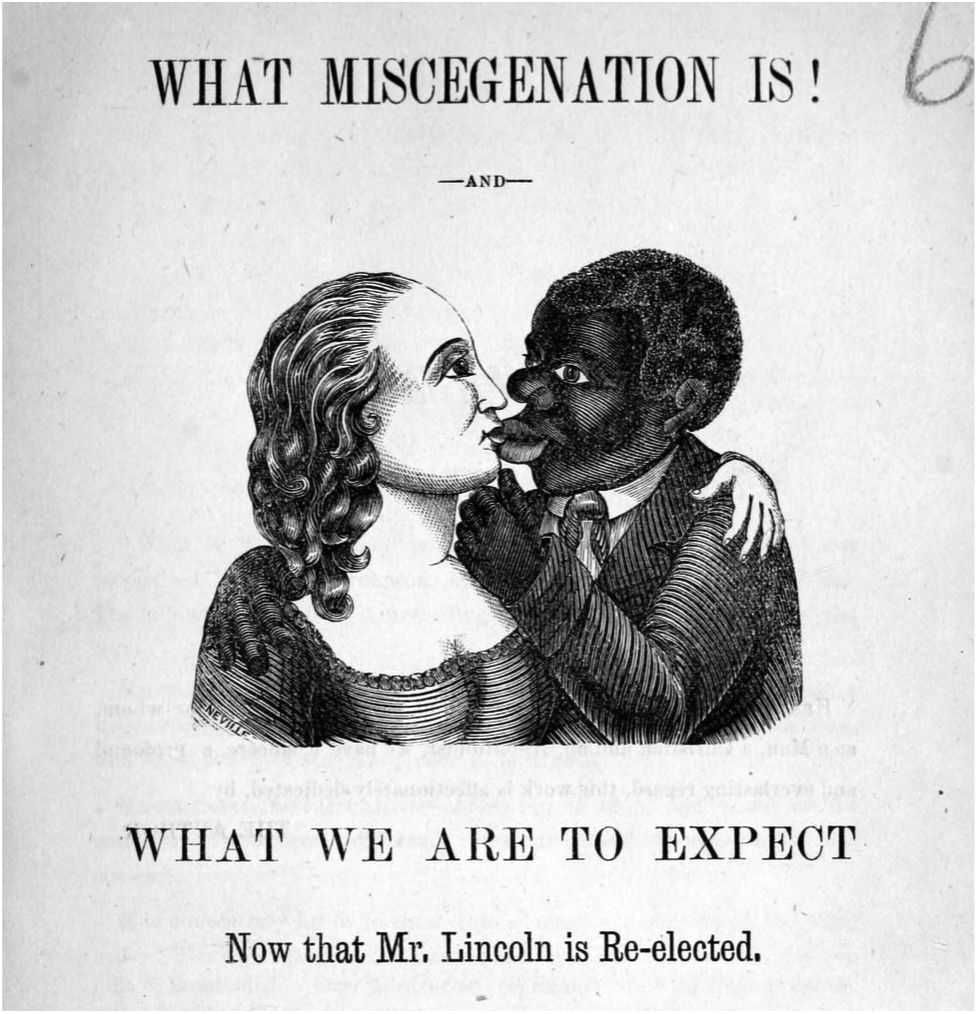
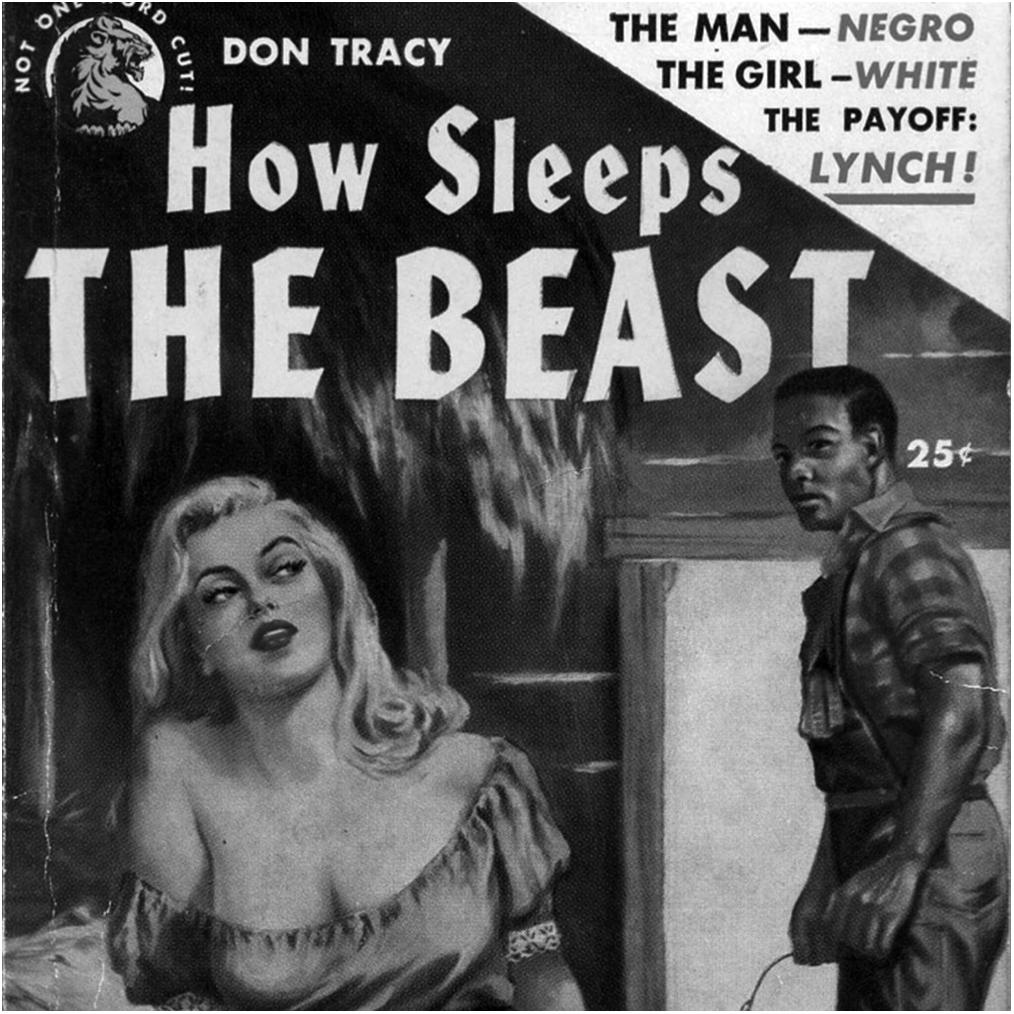
Decades of scholarship—by Angela Davis, bell hooks, Patricia Hill Collins, and others— document that U.S. history is rife with the consequences of widespread White complicity in the propagation of racist stereotypes portraying Black men as beast-like sexual predators, lying in wait to violate White women. White people have used this particular danger narrative as the ultimate “pre-emptive self-defense” rationale behind maintaining a White supremacist social system through which the state has justified slavery, segregation, and complicity with White-mob lynching.
In addition to the potentially fatal consequences of what Davis famously called “the myth of the Black male rapist,” characterizations of Black sexuality as animalistic and uncontrollable have rendered the sexual violence perpetrated against Black women invisible. There was no legal recourse for enslaved Black women who were systematically raped by the White men who claimed their bodies as chattel. Historian Danielle McGuire’s work further details how White men’s pervasive sexual violence against Black women has persisted well past emancipation, functioning as a cornerstone of Jim Crow segregation and bolstered by racist legal systems that shielded perpetrators from accountability.
Scholars including Michelle Alexander, Victor Rios, and Abigail Sewell now document the disproportionate rates of arrest, police violence victimization, and incarceration experienced by men of color in the U.S. Modern-day iterations of the “Black men as violent predators” trope have been deployed to justify the non-indictment of White police officers such as Darren Wilson, Timothy Loehmann, Frank Garmback, and Daniel Pantaleo in the deaths of the Black victims they, respectively, killed: Michael Brown (age 18), Tamir Rice (age 12), and Eric Garner (age 43). Despite their victims having been unarmed, these police officers claimed that they feared for their lives in these encounters, and grand juries found insufficient evidence to prosecute them for criminal behavior. These cases again legitimated the pre-emptive selfdefense rationales behind the White men’s deployment of lethal violence. Contemporary social movement activism demanding accountability for fatal police brutality against Black men and women vis-à-vis #BlackLives- Matter and #SayHer- Name is thus situated in the context of longstanding ideological and structural legacies.
As evidenced by Donald Trump’s 2016 election, danger narratives continue to function as a powerfully effective political strategy for mobilizing a White, Christian constituency fearful of racial, ethnic, and religious others. Long before he ran for office, Trump leveraged his race, class, and gender privilege to take out a full-page ad in the New York Times, in which he demanded the death penalty for the “Central Park Five”—a group of young men of color falsely convicted and wrongly imprisoned for allegedly raping a young White woman in 1989. When the men were exonerated by DNA evidence 13 years later, Trump defiantly clung to his assertions of their guilt, critiquing the civil rights settlements they were awarded by the city of New York as a “disgrace.” In a 2014 op-ed addressing the settlement, he asserted, “These young men do not exactly have the past of angels,” despite the fact that none had a criminal record, and implied that, if they were not guilty of these charges, surely they had committed--or would have committed--other crimes..
U.S. Office for Emergency Management, U.S. War Production Board, 1942-1943.
National Archives at College Park, 534105, U.S. Gov’t Work
Title page, What Miscegenation Is!, by L. Seaman, LL. D., Waller & Willetts, Publishers. 1864.
Boston Public Library, Call #39999056770959, no known copyright restriction
Now, from the White House, Trump draws upon the legacy of White supremacist danger narratives to garner support for “tougher” policing practices, racial and religious profiling, militarized border security, xenophobic immigration restrictions, family separation protocols, and child detainment as necessary measures to “Make America Great Again.” Trump’s espousal of racialized pre-emptive self-defense policy strategies relies upon the implicit assumption that the “real” America is homogenously White— and, as such, in need of his protection from racial and religious “others.” An advertisement released by Trump’s reelection campaign in 2018 drives this point home: the video shows the murder trial of an undocumented Mexican man ranting unrepentantly about killing police officers, while the voiceover accuses Democratic lawmakers who oppose Trump’s border wall of being “complicit” in this violence. Meanwhile, the administration has issued new guidance for border officials to automatically reject asylum requests of migrants claiming domestic or gang violence, many of whom are Latinx women and children.
When Trump calls for a wall to keep out Mexicans—to whom he has publicly referred as “bad hombres,” “rapists,” and “animals” who “slice and dice” young girls—he invokes racist danger narratives. This rhetoric stokes nationalist fears that position Trump as a “righteous” crusader for Whites and as a paternalistic protector of White women in particular. Considering his own public record of degrading and assaulting women, Trump’s posturing with regard to women’s safety recalls the insidious ways in which hetero-patriarchal White supremacist political tactics have long underscored White men’s claims of entitlement to control women’s bodies. Like James Fields, Jr. and Dylann Roof, Donald Trump demonstrates, through his actions, how danger narratives can be invoked to obscure White men’s violence and abuse against those that they claim to “protect.”
How Sleeps the Beast, Don Tracy, 1937. Lion Books.
Jim Crow Museum of Racist Memorabilia, Ferris University
It has always been those groups targeted by danger narratives that have faced the greatest societal dangers—whether the dangers of systematic economic marginalization; political disenfranchisement; ideological dehumanization; eugenic population control policies; family separation; structural, interpersonal, and state violence; or the denial of civil rights, civil liberties, and protections of law with regard to physical safety and bodily autonomy. Contrary to his hyperbolic self-assessments of extraordinary political acumen and leadership skills, Trump cannot claim credit for his own primary rhetorical strategy. His xenophobic and racist grandstanding is not unlike the cardboard shields held by Neo-Nazis in Charlottesville: despite being substantively flimsy, both signal a position of defense against a supposedly dangerous enemy on behalf of a purportedly threatened majority. When violence and injustice are “justified” by the fears of the privileged, it is actually the feared who should be most fearful.