



Abstract
How an academic research became a public school reformer, applying sociological insights as he works toward meaningful racial and socioeconomic integration and the revitalization of urban schools.
Owing to an exhausted body politic, an unsympathetic Supreme Court, decades of large-city White and middle-class flight, and residential segregation among those left behind, our nation’s schools are nearly as segregated as they were in the 1960s. A great many children—mostly minority and low income—are trapped in hyper-segregated, poor-performing schools. The Thurgood Marshall Alliance (TMA), an organization I helped launch in Baltimore, Maryland, aims to bolster diversity and achieve meaningful integration within the city’s public schools, where 90% of the enrolled students are minority youth and 85% are low-income. This is the story of how an academic researcher transitioned into school reform.
Background
“Inclusiveness” was a founding ideal in the creation of state-funded public education in the U.S. (the first such system anywhere). In 1838, Horace Mann, an advocate for public education in the Commonwealth of Massachusetts, opined: “Education is best provided in schools embracing children of all religious, social, and ethnic backgrounds.” He had a point: research shows that segregated schools with high poverty rates do not serve their pupils well. The principal beneficiaries of school desegregation are low income students of color, but racial majority, socioeconomically advantaged students who attend segregated schools also suffer disadvantages. Nearly two centuries after Mann, John King, U.S. Secretary of Education under President Obama, argued that “the best thing we can do for all children—Black or White; rich or poor—is give them a chance to attend strong, socioeconomically diverse schools.” If we have learned anything in those intervening years, it is that the forces that sustain residential and school segregation will not yield easily. Still, if we are to do well by our children, they must. What is more, breaking through the barriers that divide us from one another builds stronger communities.
The Baltimore Backdrop
As the nation’s seventh most segregated city, Baltimore might not seem like fertile ground for a diversity initiative. In 1910, the nation’s first racially restrictive zoning covenant was introduced here, and historian Amy Bentley reveals how little changed in the following decades: “even in the 1940s, Baltimore was most decidedly Southern in character. Jim Crow was alive and well; Blacks and Whites lived in separate and unequal worlds.” Today, the scaffolding that sustains segregation has changed—restrictive covenants and redlining practices have both been banned—but the end result is much the same. As sociologist Eduardo Bonilla-Silva writes, “The racial practices and mechanisms that have kept Blacks subordinated [have] changed from overtly and eminently racist to covert and indirectly racist.”
Baltimore’s spatial divide is unusual in one respect though: many of the city’s segregated neighborhoods are in close proximity to one another, separated by a commuting artery, commercial strip, green space, or custom. The city’s Housing Authority identifies some 300 neighborhoods with clear boundaries and readily identifiable names (by way of comparison, a similar map of Philadelphia, with nearly three times the population of Baltimore, distinguishes just 45 neighborhoods).
This uncommon geography is key to TMA’s diversity initiative: in many parts of the city, communities of very different characters share a school attendance zone. We have identified more than 20 elementary schools that would be among Baltimore’s most diverse if they enrolled a cross-section of in-zone children. Yet many of these schools are segregated in practice: disproportionately African-American and low-income. These are the TMA’s target schools.
Millennials and the City’s Future
Millennial parents are more cosmopolitan than their parents and grandparents, and many are flocking to the vitality and amenities of urban life. A 2016 Stateline article (“Millennials Bring New Life to Some Rust Belt Cities”) uncovered a potentially revolutionary development: the city’s loss of 28,000 residents since 2000 was substantially offset by an increase of 22,000 young graduates. The city’s attractions include its many fine colleges, affordable housing, an expanding tech sector, a growing creative class, and the allure of a modern urban vibe. Still, while these young people embrace big-city diversity, they do not embrace big-city education. Many of the millennial parents who live near TMA’s target schools send their children to independent or charter schools. Others abandon the city to enroll in a suburban school system. These are families of means who have options, and they exercise choice by voting with their feet. TMA’s success and Baltimore’s revitalization both hinge on winning over a critical mass of these parents. If they could be convinced to commit to Baltimore and its public schools, that would be transformative.
The vast majority of the 80,500 children currently enrolled in Baltimore public schools attend neighborhood schools, including so-called conversion charter schools with residentially bounded attendance zones. TMA’s strategy is to encourage more young families to choose such neighborhood schools for their children. As indicated in surveys and TMA’s fact-finding, millennial families value both diversity and academic excellence, and they want to be part of Baltimore’s rebirth. These insights are at the heart our plan.
The author’s view of millennials strolling in Baltimore.
Author courtesy

The TMA Backstory
I founded and became executive director of TMA after I retired from Johns Hopkins University in 2014 after 42 years on the sociology faculty. My academic research had centered on schools and social inequality, and much of my work came out of research conducted in Baltimore. The Long Shadow, for example, tracked the educational and life progress of some 800 Baltimore city public school children from their first days of first grade in 1982 to almost age 30. Our team also conducted seminal research on summer learning loss through a Baltimore lens. So, as a retired professor with expertise and an interest in the city, its children, and its schools, I turned toward applied sociology.
In my teaching, I often channeled Secretary King’s call for “strong, socioeconomically diverse schools.” More than 50 years of research affirms that poor and minority children perform best when they are not trapped in schools weighed down by concentrated poverty. That understanding is background; my personal call to action was prompted by experiences captured in several images here.
The first, looking down from my downtown 7th floor balcony, is a scene I see daily: of young families out-and-about with toddlers and infants. What would it take to encourage more of these families to commit to the city when their children reach school-age? For answers, I thought to engage some of them in conversation, using my skillset as a survey researcher. Maybe I could glean some insights beyond the obvious. But, for reasons that will become evident in the next images, I never got around to doing that project—at least, not in that way.
Baltimore Magazine took me to a distressed neighborhood in East Baltimore for a photo shoot for an article on The Long Shadow. They positioned me in front of a lovely mural on the side of what had once been someone’s home, but now was propped up to keep from collapsing. In its way, the image captures both the beauty and the scars of the city.
More than 50 years of research affirms that poor and minority children perform best when they are not trapped in schools weighed down by concentrated poverty.
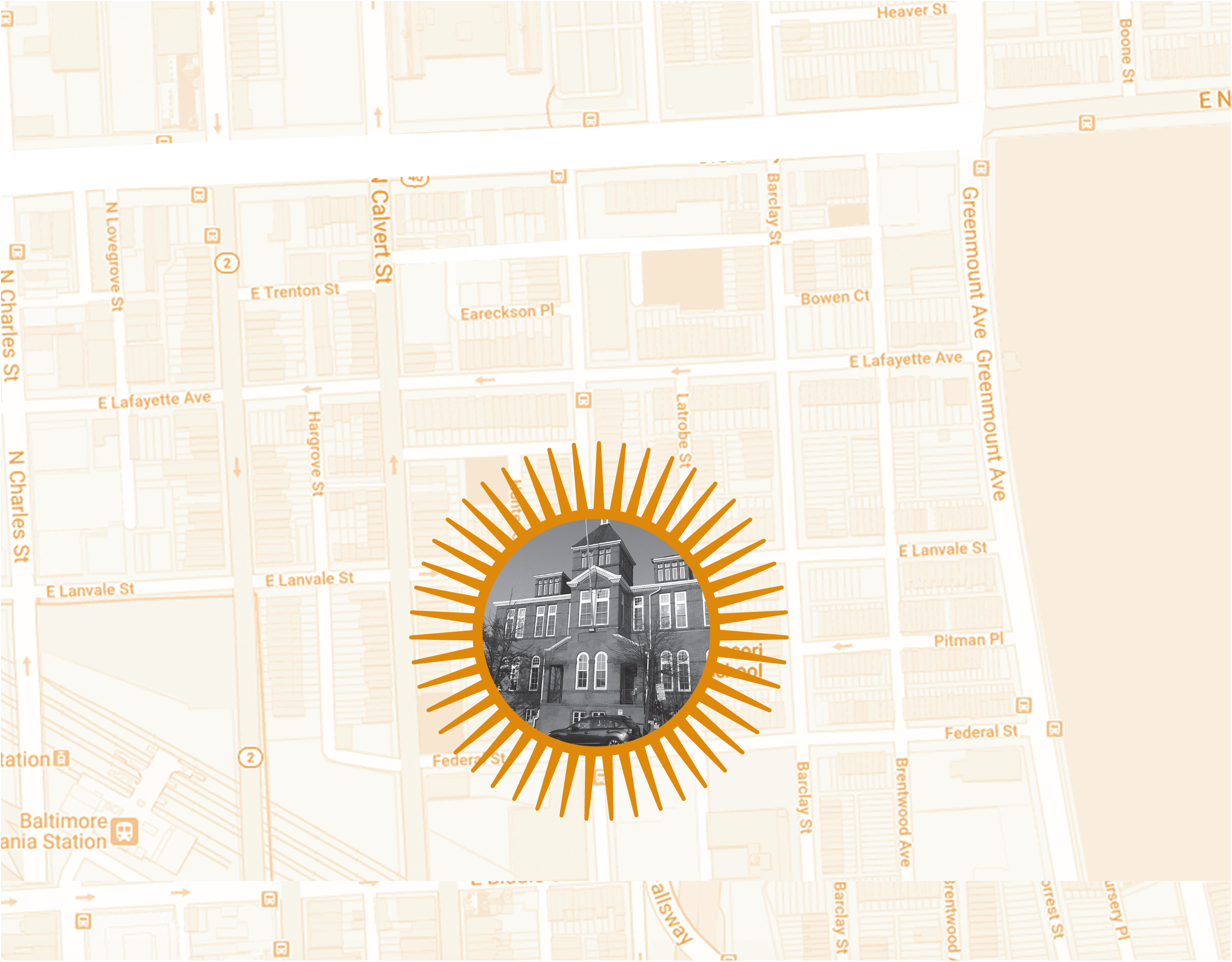
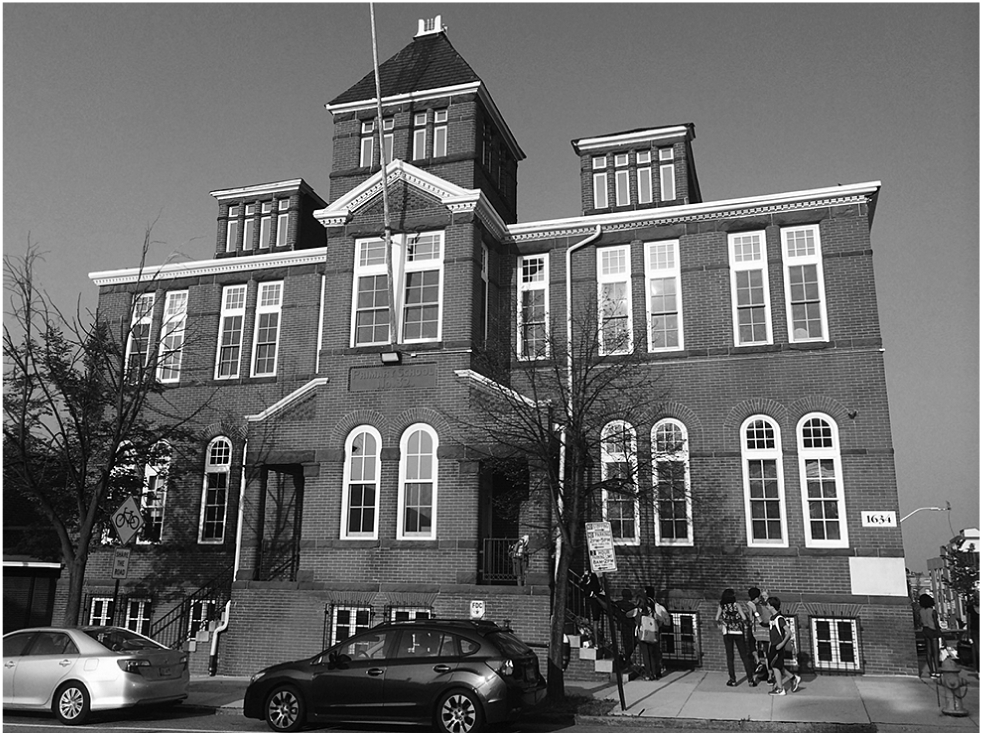
Across the way, beyond the picture’s boundaries, stood an old school building with lots of character. As school let out for the day, I saw that the school had a relatively integrated student body. I wondered what kind of public school could bring all these different kinds of families into a distressed neighborhood. The answer? It was Baltimore’s Public Montessori Elementary/Middle School. In a school system that is 81% African-American and 85% low-income, the Montessori’s middle school enrollment is 42% White, 39% low-income and, at the elementary level, it is 47% White, 36% low-income. I wasn’t looking for a huge project, but once the idea set in, I couldn’t shake it: Could this racial and socioeconomic diversity be accomplished in schools that lack the Montessori cachet?
TMA’s Theory of Action
A diversity initiative for neighborhood schools would have to overcome the reality of resource constraints and unflattering perceptions of the city’s schools, while exploiting the competitive advantages of the kinds of schools and locations I had in mind. TMA schools would afford parents and their children the opportunity to be part of a vibrant urban community, be walkable (the quintessential urban experience), and include classmates of different backgrounds and cultures, while offering strong academic programming and an attractive array of enrichment opportunities.
A strong research base informs the critical elements of school success for a diverse student body with different learning styles, different levels of preparation, and different cultural experiences: strong school leadership and teaching; academically inclusive educational programming; a supportive school climate; prioritizing attendance; strong family supports and engagement; health screenings and interventions to identify undiagnosed health challenges; and enrichment beyond the formal curriculum, including after-school and summer programming. The research also points to one additional element of successful diverse schools: a commitment to authentic integration.
Many similar initiatives founder when desegregation is the end game. They fall victim, for example, to segregation within schools through educational tracking—dubbed “second generation segregation” by sociologist Roz Mickelson. Desegregation is about the mix of children and families enrolled in a school, but it says nothing about the inner workings or life of the school—is it is a welcoming place for children and families of different backgrounds, with programming and practices keyed to the needs of a diverse student body? That kind of commitment is a heavy lift, but when done well, prospects are vastly greater for achieving stable desegregation around a shared sense of community in which all children thrive in their academic and social development.
The key to encouraging more families of means to commit to Baltimore and its schools is in growing the base of genuinely high-quality schools that look like all of Baltimore in their makeup, are excellent in their academic and enrichment programming, and present a welcoming, supportive climate. That is TMA’s vision for its partner schools.
The Means toward those Ends
TMA’s school support framework has two key elements. First, we provide technical assistance in areas of programming and practice identified as priorities through consultation with school leadership, parents, and other stakeholders. Second, we undertake vigorous community outreach to elevate the profile of TMA schools and attract prospective parents to them. Because diversity is the unifying thread, all TMA schools will receive support in the area of Equity and Inclusion. Other focus areas, and our approaches to addressing them, are school-specific. For one school, the priority areas might be climate, attendance, and after-school programming; for another, it might be family engagement, health screenings, and discipline.
The photoshoot for an article about the author’s book, The Long Shadow, took place across from Baltimore’s Public Montessori Elementary/Middle School.
Author courtesy

TMA has partnered with the Mid-Atlantic Equity Consortium in this work. A Department of Education Equity Assistance Center, MAEC has 25 years of experience providing technical assistance to schools throughout the region in the areas of equity and inclusion, family engagement, and principal and staff development. For other domains, TMA coordinates the work of technical support consultants with the specific expertise and local hands-on experience—the After-School Time Network and Attendance Works are excellent examples of these partners.
TMA also collaborates with strong local partners on community outreach and engagement. Currently, these include Live Baltimore, the Downtown Baltimore Family Alliance, and Strong City Baltimore. The strategic planning for this phase of TMA’s work begins with a community resource inventory to identify TMA’s target audiences (daycare and preschool centers, church groups, and parent play groups), the best means for reaching out to them (community listservs, social media, school and community festivals), and additional partners who will help support the initiative and spread the word (community leaders, the small business community, and neighborhood associations and community activists).
The implementation of these carefully crafted plans will be monitored in relation to targeted performance metrics, including changes in the school’s diversity profile, results of school climate surveys, and the trajectory of test scores, grades, attendance, and suspensions/expulsions. “Facts on the ground” will guide mid-stream corrections to the strategic plan. The expectation is for slow but steady positive change in the performance metrics in three to five years.
Implementation
What I have just described are TMA’s plans. After nearly three years of planning, TMA launched with three partner schools in the fall of 2017. Our first partner schools, Govans Elementary, Federal Hill Preparatory (“Prep”), and Mount Royal Elementary/Middle, were selected from the 20 target schools identified by our earlier research. Their school leadership teams, Parent-Teacher Organizations, and other stakeholders have embraced TMA’s vision.
Govans, in north Baltimore, is a pre-K through 5th grade conversion charter school operated by the Baltimore Curriculum Project. It offers STEM-focused after-school programming, instrumental music instruction, and a broad range of other enrichment opportunities, and its attendance zone takes in much of the wealthy Homeland neighborhood, as well as the middle-class Lake Walker and Belvedere neighborhoods. Its current enrollment is 92% low-income and 95% African-American. Prep, in south Baltimore, is a pre-K–5 zoned elementary school in the Federal Hill neighborhood. Prep is a Green School with a Gifted and Talented Program and an emphasis on STEM programming. It serves middle-class and professional communities around the Inner Harbor, Otterbein, and Federal Hill, as well as the lower-income, predominantly African-American communities of Sharp-Leadenhall and the Spring Garden Industrial Area. At 74% low-income and 62% African-American, Prep’s enrollment underrepresents the area’s White and middle-class families. Finally, Mount Royal is located in midtown in the city’s upscale Bolton Hill neighborhood. It enrolls students in kindergarten through 8th grade. The school’s elementary programming includes one of the city’s 10 Gifted and Advanced Learning sites; at the middle grades, it is an Ingenuity Project school. The school offers a rich array of after-school activities including yoga, chess, theater, and three foreign language clubs (French, Spanish and Italian). Its enrollment is 88% low-income and 93% African-American—a very different demographic profile than the makeup of its attendance zone would anticipate.
The Montessori school in East Baltimore that inspired the Thurgood Marshall Alliance.
Author courtesy
Each of these is a fine school, yet they are off the radar of many of the middle-class families living nearby. TMA’s goal, shared by school leadership and parents, is to attract more of those families, so that, over time, school and neighborhood profiles come into closer alignment to the benefit of all students and their home communities.
This first year is being devoted to strategic planning. Our priorities are informed by conversations with school and community stakeholders, and “Listening Tour” focus group conversations have been conducted with the parents of enrolled children and others living nearby with preschool age children, along with Opportunity Inventory (aka Needs Assessment) interviews with school leadership and surveys of parents and teachers. These discussions reinforce our sense that TMA’s agenda is shared by a critical mass of parents. A Govans parent, for example, told us that she wants to live in the community where her child attends school and to “contribute to the restoration of the city;” another that “being invested in the community is really attractive” and that it is “huge” for her kids to learn to relate to children of different backgrounds. We heard much the same from parents at Mount Royal. One said she wants those living nearby “to have confidence in the public school system,” and another that she wants her daughter to “know different people from different backgrounds.” And a Prep parent recounted a telling experience at a school event: “…. my son sat at a table and my husband said, ‘That’s why we’re here.’ His table was all colors and creeds, like a little Benetton ad.” Another observed, “If you are going to live in the city, going to public school is important in order to make the city stronger,” and a third, “there are things that you learn from your peers and their community that cannot be learned if everybody looks the same in the classroom. We put a higher premium on that than everybody having an iPad.”
These are the voices of middle-class parents, yet we heard much the same at Federal Hill from lower-income African-American parents who said things like, “It is good for kids to have friends from different backgrounds;” it is “good for children to learn about different nationalities and cultures;” it is “good to see how different families live, it helps them get along with others;” and, “it is important for [my children] to know that people are people.”
An unanswered question is how middle-class parents of color will respond to TMA’s initiative. Nationally as well as locally, their children attend schools with a much higher enrollment of lower-income students than do White children of comparable family background. This form of downward socioeconomic integration leaves them badly disadvantaged. Against this backdrop, we were cautioned by a number of prominent African-American leaders that Black parents of means who favor elite independent schools for their children are unlikely to reverse course. This is how one community leader put it: “These parents know that they have to prepare their children to navigate in a world of White privilege, and they send their children to private schools for contacts that can open doors of opportunity and to gain access to top-flight colleges. With that motivation, why should they send their children to zoned schools that enroll lots of poor kids?” Fair enough. But a member of TMA’s Advisory Board, an African-American parent whose children attend one of TMA’s three partner schools, countered: “there are Black parents with means who already have contacts and want to make the city schools a place where they can leverage those contacts with their diverse neighborhood counterparts … after many interviews and tours with the top private schools (Friends, Gilman, Park, Country Day, etc.) I was completely convinced that my children’s experience would be void of cultural competence and true inclusion.”
TMA’s goal is for its member schools to bring together families of all backgrounds in common purpose. Not all of Baltimore’s young families are likely to embrace this vision, but our discussions suggest there exists a critical mass of like-minded parents that is large enough to be transformative. We aim to help these parents feel comfortable doing that which they are already disposed to do: commit to the city and their neighborhood school without compromising their children’s education.
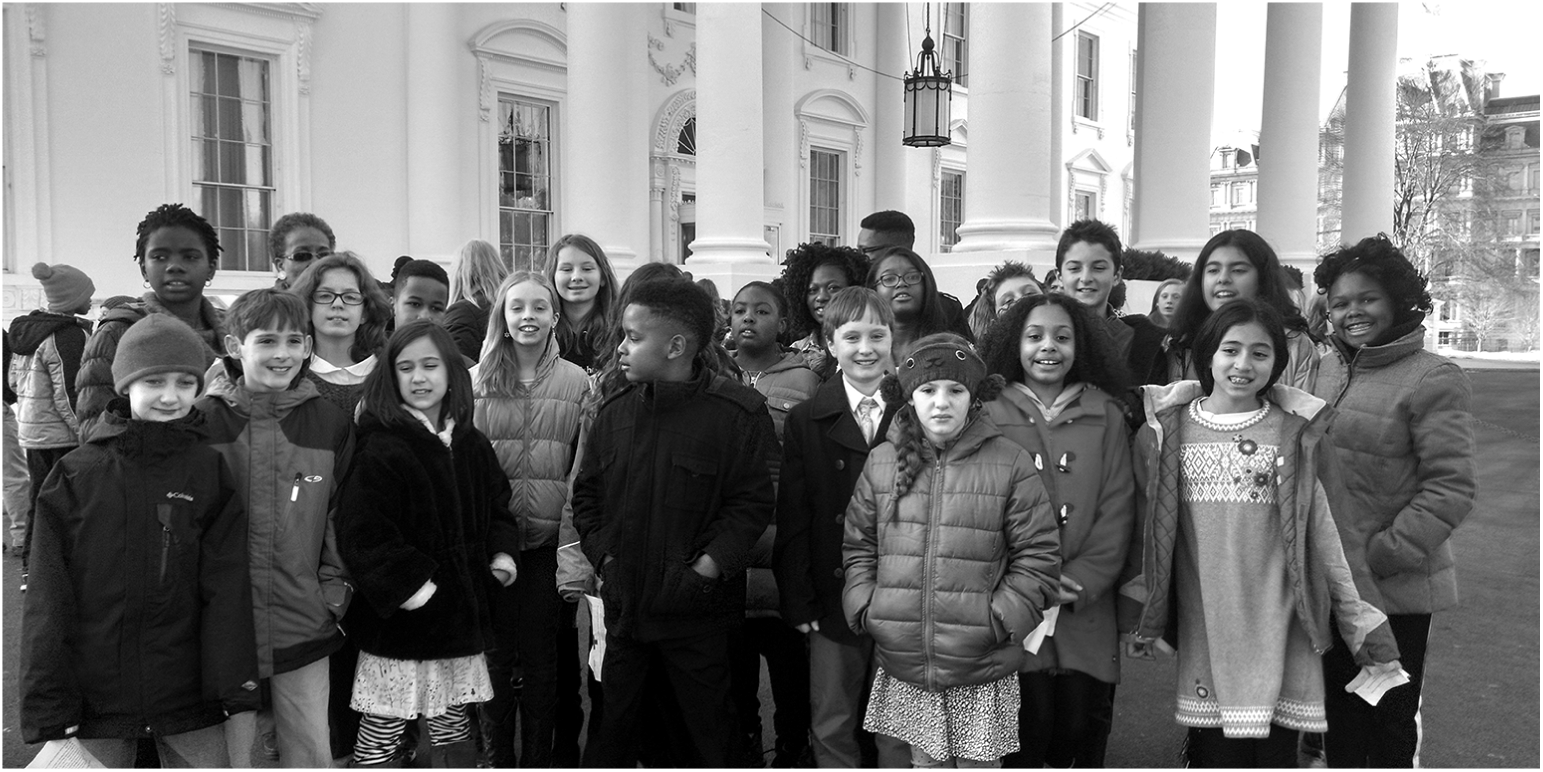
Montessori students on a fieldtrip.
Author courtesy
Looking Ahead
The nonpartisan Century Foundation identifies five strategies being used to promote socioeconomic school integration throughout the U.S.: adjusting attendance zone boundaries, district-wide choice, magnet or themed school admissions, charter school admissions by way of weighted lotteries, and flexible transfer policies. TMA’s approach offers a sixth: encourage parents to consider their neighborhood school with an open mind. No tweaking of attendance zones; those already in place are conducive. No elaborate admissions formulas or lotteries; parents simply have to sign up. And no need to trek across or beyond the city to find a quality school. It’s a simple concept that’s challenging to execute: we must overcome negative perceptions of Baltimore’s schools and demonstrate that TMA schools deliver on their promises.
Millennial parents say they value diversity, but not if it consigns their children to a second-rate school. The key to encouraging more families of means to commit to Baltimore and its schools is to grow the base of genuinely high quality, welcoming schools that “look like” all of Baltimore and offer excellent academic and extracurricular programming. TMA’s network of partner schools will strengthen educational opportunities for low-income families, expose all of Baltimore’s children to others of different background, bring together in common purpose communities separated by residential segregation, and encourage middle-class families of diverse racial and ethnic backgrounds to make Baltimore home. We have a sound plan, three partner schools, and an array of local allies who stand ready to help as we begin our work.
It will be several years before TMA and its school support framework can prove ourselves. If the indications are positive, TMA will expand to other schools and communities in Baltimore. On an even larger canvas, a successful diversity initiative in Baltimore could be a model for other high-poverty cities struggling with the divides caused by segregated housing and segregated schooling. Sadly, there is no shortage of cities that could benefit from a local initiative to revitalize the promise of American public education.