



Abstract
Christopher Todd Beer on trends in police killings of unarmed citizens.
The Black Lives Matter movement surged in 2014 after a White police officer, Darren Wilson, shot Michael Brown, an unarmed African American teenager in Ferguson, MO. At the time, there was no available data on the national prevalence of such incidents, so two major newspapers, The Washington Post and The Guardian, began collecting data. The Washington Post continues to collect this data and makes it available on its web site; the figures below use this dataset to examine trends in 2015, 2016, and 2017. (Note: Data for 2017 covers only the first eleven full months of the year. Find updates at sociologytoolbox.com)
In the broadest (and most uncritical) sense, the role of the police is to maintain public safety and to apprehend suspects who are innocent until proven guilty by a court. Do police face violent encounters often? Yes. Should police have the right to defend themselves and protect the public? Certainly. But police in the U.S. also kill people who are not carrying a gun or are completely unarmed, and this has generated the greatest outrage and protest mobilization. When we examine the racial and ethnic distributions of those killed by police under all circumstances, compared to the racial and ethnic distribution of the population as a whole, we see that Blacks remain disproportionally impacted.
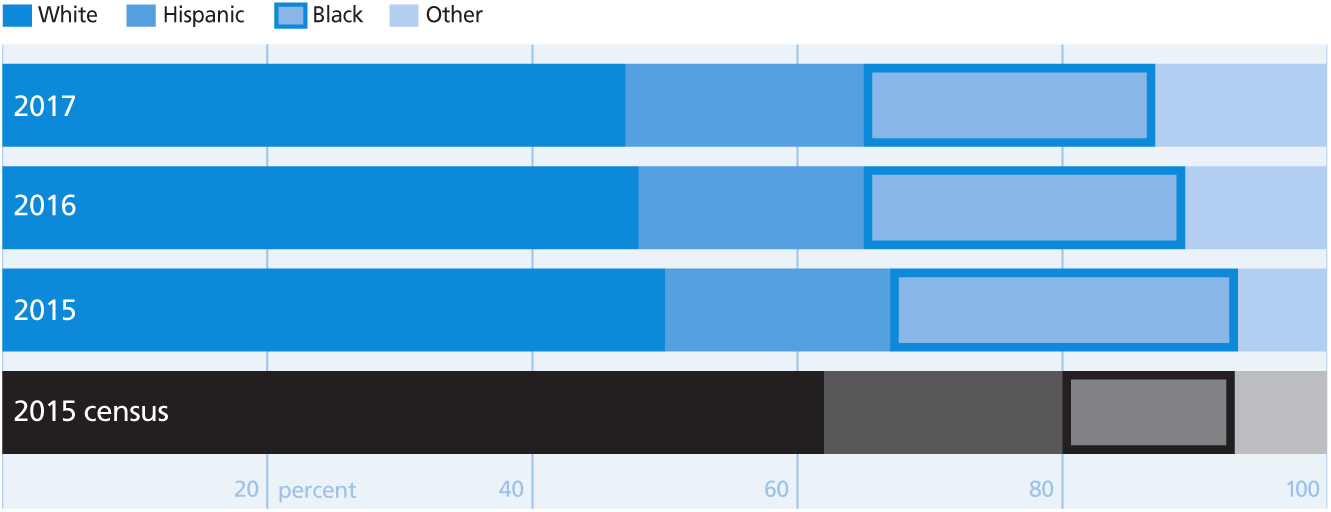
The figure below shows that Blacks made up around a quarter of all those killed by police in 2015, 2016, and 2017, but, according to most recent U.S. Census estimates, Blacks constitute only 13% of the U.S. population. There is a slight decline visible since 2015, yet Blacks remain disproportionately impacted by police use of lethal force. Further, while Whites make up the largest percentage of victims of police use of lethal force (47% in 2017), non-Hispanic Whites are a majority of the population (62% in 2015). Relative to their portion of the population, Whites are killed by police at a lower rate; Blacks are killed at nearly twice the rate relative to their representation in the population (albeit a slightly decreasing portion in the last three years).
Race and ethnic distribution of all those killed by police under all circumstances 2015, 2016, 2017 compared to portion of U.S. population 2015
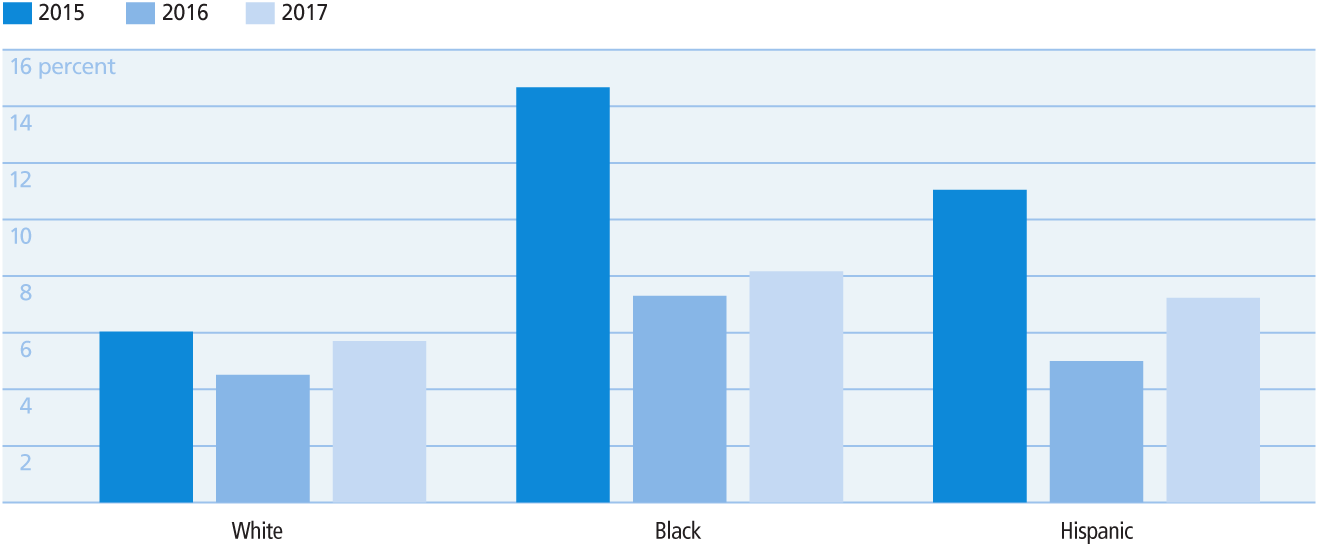
Race/ethnicity that were unarmed when killed by police, 2015-2017
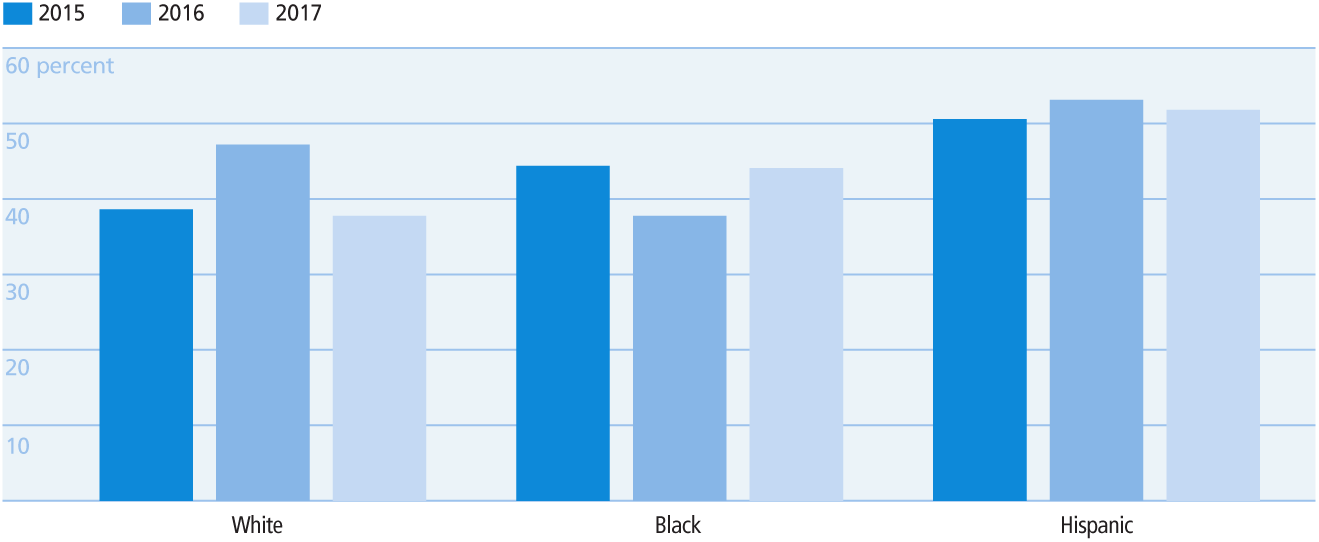
Race/ethnicity that had no gun when killed by police, 2015-2017
The top figure on p. 91 looks at the number of people who were completely unarmed when killed by police in 2015, 2016, and 2017 by race and ethnic category. By November 2017, rates were slightly higher than in 2016, when the numbers were far lower than the 2015 rate (especially for Blacks and Hispanics). Among those killed by police, a smaller percentage were unarmed compared to 2015. When we examine the trends by race and ethnicity, it is evident that, in 2015, a much higher portion of Black victims (14.67%) were unarmed compared to White victims (6.04%). While the percentage of all Blacks killed by police while unarmed dropped by 50% in 2016 and remained relatively steady in 2017, it was still 43% greater than the rate for Whites and 13% greater than the rate for Hispanics. A higher percentage of Black people killed by police are completely unarmed compared to Whites and Hispanics.
Few of the explanations offered for this decline have been rigorously examined. The “real answer” is likely a complex combination of increased awareness among police departments and city officials generated by the Black Lives Matters movement in all its iterations—community organizing, disruptive protest, direct advocacy, attention generated by Colin Kaepernick and other professional athletes, and more. In the last three years, some police departments have adopted the use of body cameras, made nonlethal tools like Tasers more available, and/or sought training to reduce officers’ implicit racial bias (which arguably leads to such incidents). Other departments have continued business as usual. As with the patterns explored here, national trends are difficult to parse: police departments are municipal level actors required to report very little data to federal agencies. We don’t know exactly how many departments and officers have undergone new training to reduce the disproportional use of lethal force, have widely adopted body cameras, or have more widely distributed non-lethal tools. Nor can we know whether the trend evident in this brief, three-year survey will continue.
Things look less hopeful when we look at the portion of each race/ethnicity killed by police who had no gun, but had something else deemed a weapon. When police confront someone who clearly has a gun, that suspect is a high risk. A lack of cooperation can result in lethal force (this is complicated by conceal and carry laws, as in the case of the Minnesota killing of lawfully carrying Black motorist Philando Castile). If we add to the category “unarmed” those who were “armed” with anything other than a gun (ranging widely, from knives to toy guns to a stapler to a flag pole), we see a less distinct pattern of change since 2015. In the second figureon this page, the three year average for Blacks and Whites comes within one percentage point (42.09% to 41.20%, respectively). Additional data and subsequent years will tell us whether 2016, in terms of non-firearm bearing victims, was an anomaly with its high rate of Whites and low rate of Blacks killed by police. The most distinct pattern emerges among Hispanics. Over 50% of the Hispanics killed by police in 2015, 2016, and 2017 had no gun—a rate higher than both Whites and Blacks.
So, do Black lives matter more in recent years? Yes and no. Blacks remain disproportionally represented among those killed by police under all circumstances. However, in police encounters that end in the use of lethal force, the rate of Blacks and Hispanics who were unarmed has declined. This is good news in need of rigorous examination. Police in the U.S. need far more training and tools to avoid killing a suspect who may have a weapon, but not a gun. After all, with their superior firepower, police should be able to avoid killing a person wielding nearly any weapon less lethal than a gun—and that would likely cause a dramatic reduction in the number of people of all races whose names make their way into such datasets.
