



Abstract
Essays explore Americans’ construction and deconstruction of collective memory as White supremacists take to the streets.
<< A makeshift memorial to Heather Heyer, killed by a White supremacist in Charlottesville, VA, Aug. 12, 2017.
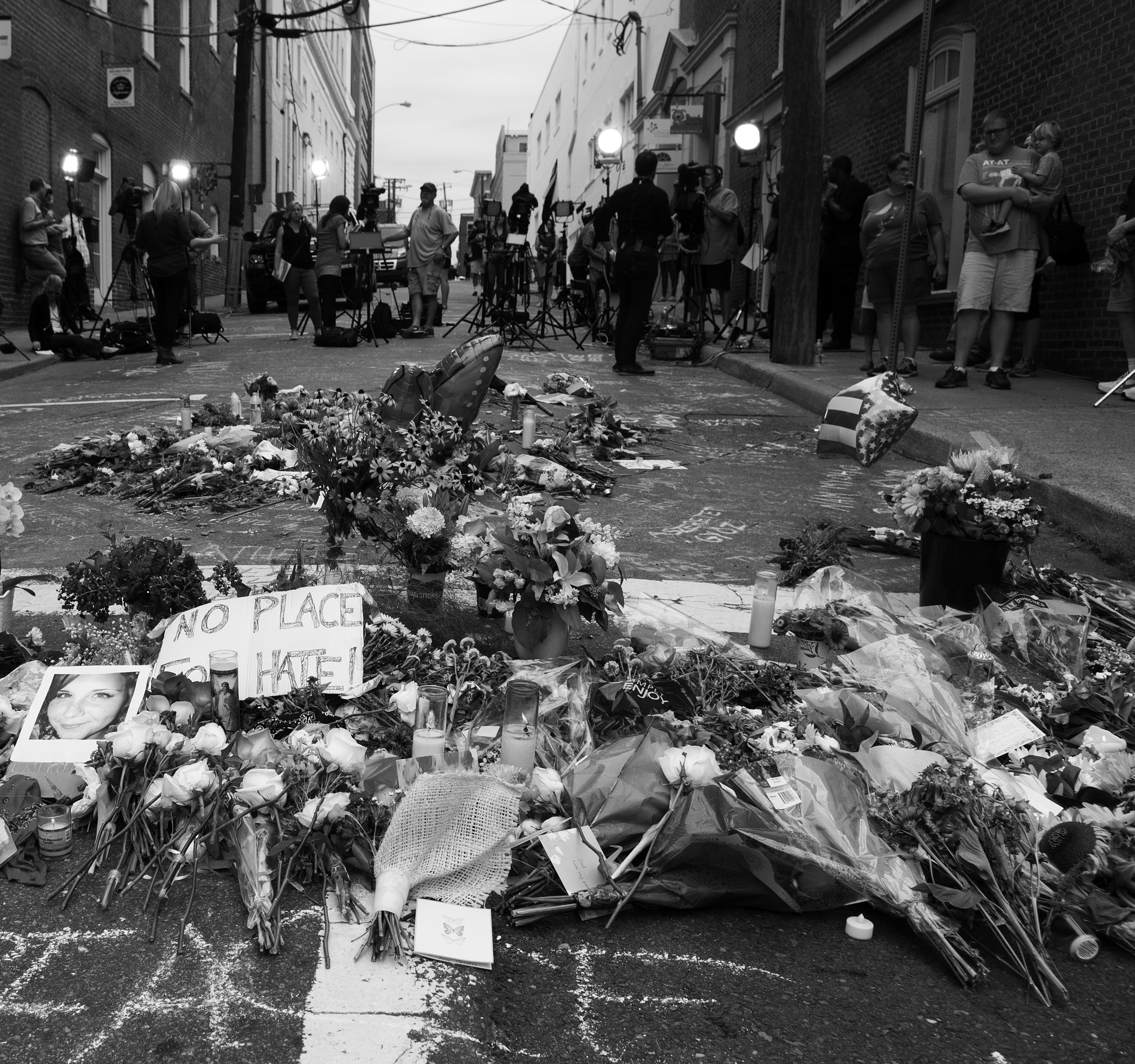
In February 1939, American Nazis held a rally in Madison Square Garden. The nation was shocked. In 1977, neo-Nazis marched in Skokie, Illinois, pushing the freedom of speech to its limits and again drawing the nation’s ire. In August 2017, White nationalists held a rally in Charlottesville, Virginia to “Unite the Right.” Violence erupted, life was lost, and most of the nation was shocked once more: The persistence of White nationalism undermines the principles of freedom and political equality that the United States has so long professed to represent.
Charlottesville is now tied to arguments about the place of racism in American society. Are the neo-Nazis and militias of Charlottesville symptoms of a permanent racial hierarchy? Or, are they isolated extremists whose voices have been amplified by the contentious and unusual Presidential election of 2016? Has anything changed since 1939?
Pessimists can easily point to a long, despondent history inextricably woven with slavery, racial segregation, and terrifying violence. America’s landscape unfolds with places that haunt our collective conscious; the Rosewoods, the Tulsas, and the Fergusons are more common than many of us care to admit. Yet, the optimists also have a case. Slavery ended, as did Jim Crow, lynching, and segregation. Many fine people put their lives on the line to make sure that everyone could vote and everyone could take the same bus. There are more opportunities for progress and equality than ever before.
W.E.B. DuBois famously wrote that the color line was the primary question of the 20th century. After Charlottesville, perhaps we can say that “the” question of the 21st century is the resolution of divergent histories and the blurring of color lines. The racial optimist and pessimist stand on the same ground, pointing to the same events. Brown protects the Black student from legalized segregation, but it doesn’t shield her from a school system that routinely expects the worst.
Charlottesville, again. How do these tendentious events fit into an America sundered by a racialized present and an optimistic future? President Trump’s inflammatory words foreground the tension. Rather than praise violence, the President tried to downplay the responsibility that lay at the feet of White nationalists. “Both sides,” he claimed, were accountable. That is, those promoting racial purity are moral equals with those who promote racial equality. Yet, Trump did not say that violence was justified, suggesting that he would not publicly cross the line that separates post-Civil Rights society from its segregationist predecessor.
What lies on the road winding from our broken past to our tortured present? Behind us, we see Confederate statues and neo-Nazi marches. Indeed, White nationalists themselves will allude to a hypothetical golden age of European immaculacy. They are attracted, as moths to flame, to anyone or anything that satiates their fear of the non-White. Sadly, they are abetted by parties who barter and trade in resentment and anger. In the present, we see movements for progress and equality. We see people fighting for the right—the privilege—to create a new world, both mindful of the past and hopeful for the future. This struggle is often painful, but vital.
Our Viewpoints writers explore this boundary between past and present and the way that our imagination and intellect interrogate this moment. Wanda Rushing’s essay critically examines the meaning of a most contentious symbol, the Confederate statue, and reminds us that these statues create safe spaces for illiberal actors. James Thomas offers a thoughtful exploration of universities and their complex histories, while Milton Vickerman offers a reflection on troubled racial pasts. Speaking to the present, Victor Ray addresses the need to be wary of those who would make racism and White supremacy a central feature of our nation’s culture, and Dawn Dow’s essay is an important reminder that anti-racism can never be taken for granted, but requires the concerted effort of those citizens who remain, in 2018, shocked to see White supremacists marching in our streets. Finally, Eduardo Bonilla-Silva addresses the need to build crucial links among the vast majority of Americans who reject White nationalism.
Setting the Record Straight on Confederate Statues
By Wanda Rushing
These scenes of actual and threatened violence may frighten us, but they also should remind us that our silence will not protect us.
Monuments embody, impose, and transmit messages about political power and social hierarchies. Efforts to establish and protect these memorial landscapes in prominent public spaces serve powerful minority interests—past and present. Protests and counter-protests about collective memories and their representation and misrepresentation in public spaces create long-overdue opportunities for understanding and contesting historically embedded institutional processes affecting all Americans. So removing Confederate monuments and symbols and presenting counter-narratives about them serves the public interest by challenging both messages and practices of exclusion, discrimination, and racism.
Supporters of Confederate monuments defend their historical significance. Yet, most scholars view claims of historical continuity as largely fictitious and self-serving. Most Confederate monuments in public spaces today appeared forty to fifty years after the Civil War ended. Decades of fund-raising campaigns, conscious design, and lavish ceremonies produced public spaces for promoting an exclusively White, elite southern view of the Civil War. Most memorials appeared between 1890 and 1920, a period in which African Americans lost many of the civil rights gained from the outcome of the war and Reconstruction and White supremacists gained control of southern governments through disenfranchisement and racial violence. Determined to disrupt Black and White political coalitions, White elites commissioned and displayed these public monuments to legitimate their tenuous authority. They also created regional narratives about heroes, distorted historical facts, and encouraged the abandonment of post-war goals including social justice and steps toward racial integration.
For roughly one hundred years, these spaces have mediated public memory and operated as centers of White identity politics. Functioning much like today’s online neo-Nazi forums, these memorial parks and statues established a symbolic and cultural web of belonging for economically discouraged and politically marginalized Whites. And though many defenders of Confederate monuments claim they support “heritage, not hate,” studies show that the strongest supporters of monuments know less about Civil War history than their opponents (with regard to knowledge of specific battles and leaders). These narratives grew directly from those created in the war’s aftermath, and they are just as incorrect.
“Appomattox” in Alexandria, VA.
SabreGuy29, Flickr CC
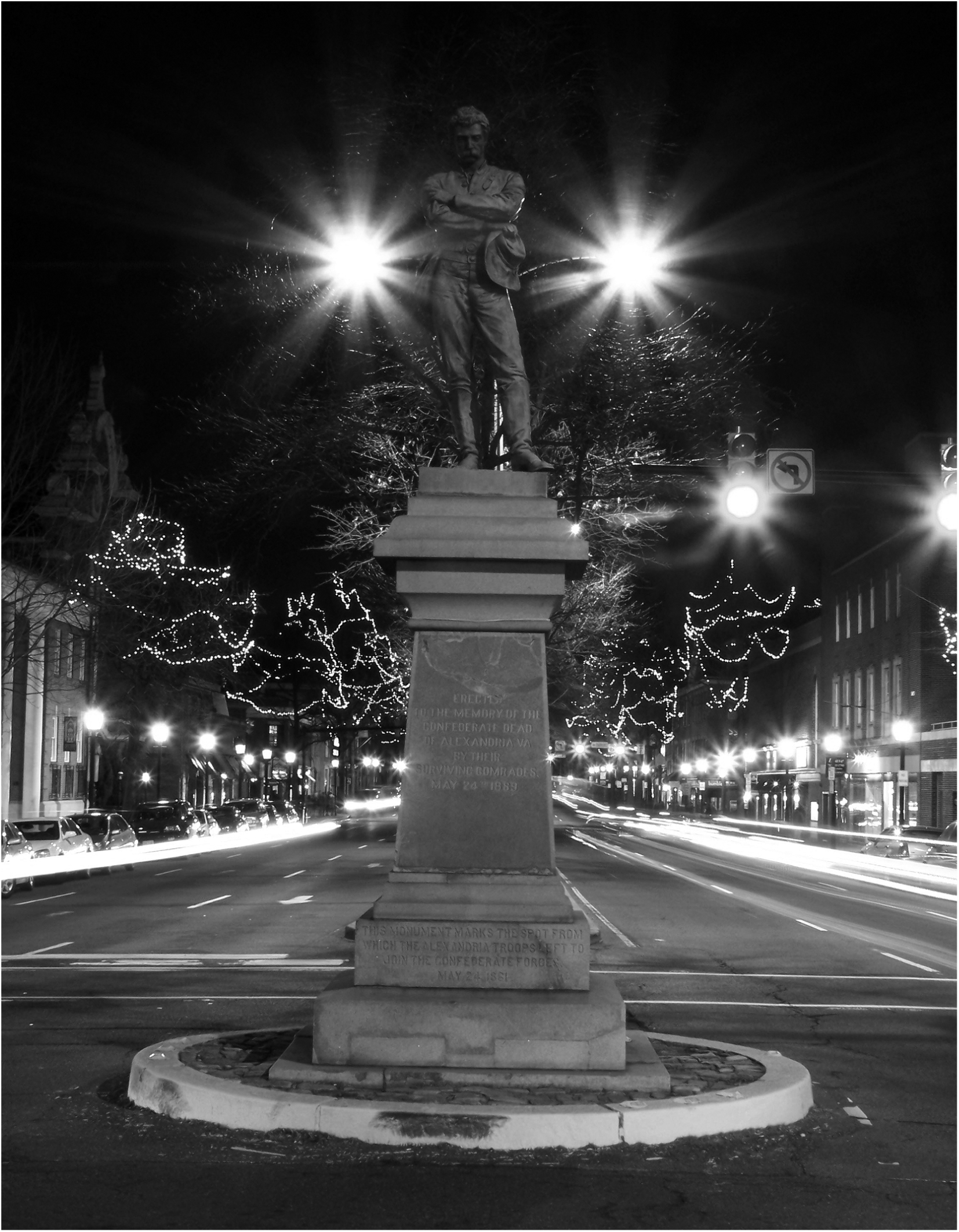
Because of America’s ongoing engagement with these physical and symbolic spaces, they continue to establish what is “prescribed or proscribed,” as well as “scene and obscene” in the social order. The statuary over-representation of generals, coupled with the paucity of ordinary foot soldiers and the absence of women and people of color defines the class, gender, race, and power relations of the antebellum social hierarchy.
In my book, Memphis and the Paradox of Place, I discuss how the physical likenesses of the monuments, including the equestrian monuments to General Nathan Bedford Forrest (leader of the Fort Pillow Massacre and founder of the KKK) in Memphis, Tennessee and General Robert E. Lee in Richmond, Virginia symbolize the salience of patriarchy and idealized masculinity. Statues of men displaying Anglo-Saxon features, athleticism, and heroic bearing poised on pedestals require that everyone look up to them, both physically and symbolically. Even the equestrian format represents a classic allegory of power: Forrest and Lee hold their reins gently, making light contact with the horse’s mouth, suggesting that but a touch on the reins will exercise power. Their poses provide a symbol of idealized master-slave, male-female relations of the past, as well as a model of elite hopes for future leaders: White, male military authority figures.
White supremacist rallies in public parks that memorialize a mythical and divisive confederacy agitate many Americans, including this White, southern, woman sociologist. We may even find the sight of White supremacists waving torches and neo-Nazi symbols, defending Confederate monuments obscene and unacceptable. These scenes of actual and threatened violence may frighten us, but they also should remind us that our silence will not protect us. In the words of Audre Lorde: “It is not difference which immobilizes us, but silence. And there are many silences to be broken.”
A Sociological Note to the Political Elite
By Victor Ray
When armed White supremacists and Nazis marched against the removal of Confederate statues and their protests culminated in the murder of Heather Heyer, a 32-year-old anti-racist counter protester, President Trump’s response was predictably vile. And when the president claimed “both sides” were responsible for the violence, the implied moral equivalence was a clear victory for open White supremacists, their ideology validated by the world’s most powerful office holder.
Racist dog-whistles—Clinton’s “super-predators” or Reagan’s “welfare queens”—are used by both parties, and everyone knows exactly who is targeted. But Trump’s campaign punctured the bipartisan political consensus on “colorblind” race talk that had governed public discourse for decades. Crude, open White supremacy was denounced. Trump violated that consensus with seeming impunity. But it seems that drawing an equivalence between Nazi killers and antifascists is apparently a red line; Republican politicians, business leaders, and even the President’s Committee on the Arts scrambled after Charlottesville to distance themselves from a president who seems incapable of distinguishing between fascists and the rest of us.
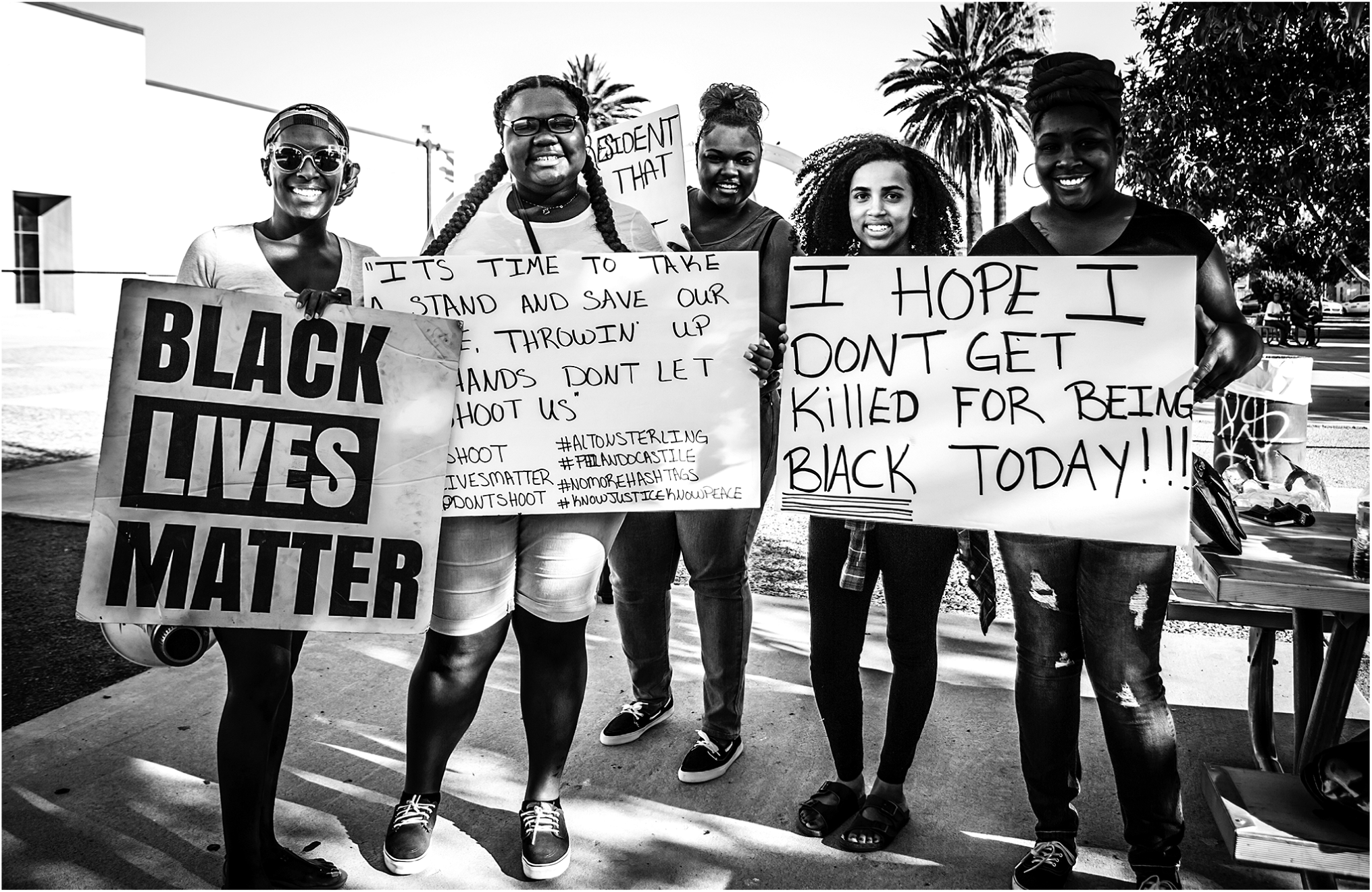
By only recognizing swastika-draped, torch-bearing racists, we miss the ways White supremacy is in the very sinews of U.S. politics. Here, Black Lives Matter activists in 2016.
Johnny Silvercloud, Flickr CC
Of course, Nazis and White supremacists must be fought by any means necessary. I am heartened by the defections of political and business elites, and I cheer with each newly falling Confederate monument. But these defections leave me wondering why these business leaders, politicians, and artists had been accommodating the White supremacy of this administration in the first place. One message I take is that these business and cultural leaders were potentially willing to work with anything short of outright Nazism.
There is nothing particularly hidden, or surprising, about Trump’s tacit acceptance of White supremacists. He inaugurated his campaign claiming Mexican migrants are rapists and murderers, called for violence against non-White protestors, and repeatedly instated a ban on Muslim entry to the U.S. (whatever he might call it). The slogans “America First” and “Make America Great Again” aren’t that far removed from the White supremacists’ motivating chant of “blood and soil.” And Trump was slow to repudiate former Klansman David Duke during his campaign. Trump’s equivocation surrounding Charlottesville was a difference of degree, not of kind.
Rather than lauding the bravery or moral clarity of those distancing themselves from the administration in the wake of Charlottesville, we should be asking what took them so long? By only recognizing swastika-draped, torch-bearing racists, we miss the ways White supremacy is in the very sinews of U.S. politics. White supremacy has always been mainstream. The electoral college, the dilution of non-White political power through gerrymandering and voter suppression, attacks on affirmative action, disparate lending practices, and residential segregation all contribute to intractable racial inequalities and are, in many cases, more consequential in shaping the lives of people of color than the far right.
White supremacy has always been mainstream in the U.S. The electoral college, the dilution of non-White political power through gerrymandering and voter suppression, attacks on affirmative action, disparate lending practices, and residential segregation all contribute to intractable racial inequalities and are, in many cases, more consequential in shaping the lives of people of color than is the far right.
If politicians and business leaders are serious about fighting Nazis and White supremacy, they will move beyond the profitable (and easy) symbolism of condemning statements and support policies that can provide material resources for people of color. Affirmative action in admissions and hiring, the desegregation of public schools, greatly expanded affordable housing, and the end of a myriad of discriminatory policing practices are just a few of the policy changes that would need to occur to truly dismantle White supremacy.
The Many Sides Implicated in Charlottesville
By Dawn M. Dow
Trump was right! There are many sides that we must consider in relation to the recent events in Charlottesville, Virginia. But while Trump’s comments equated White supremacist groups with those standing in opposition to them, I am referring to a different set of sides—the dynamics and practices of silence, reframing, and focusing on individual actors that, when conditions are right, facilitate the actions and side-taking we witnessed in Charlottesville.
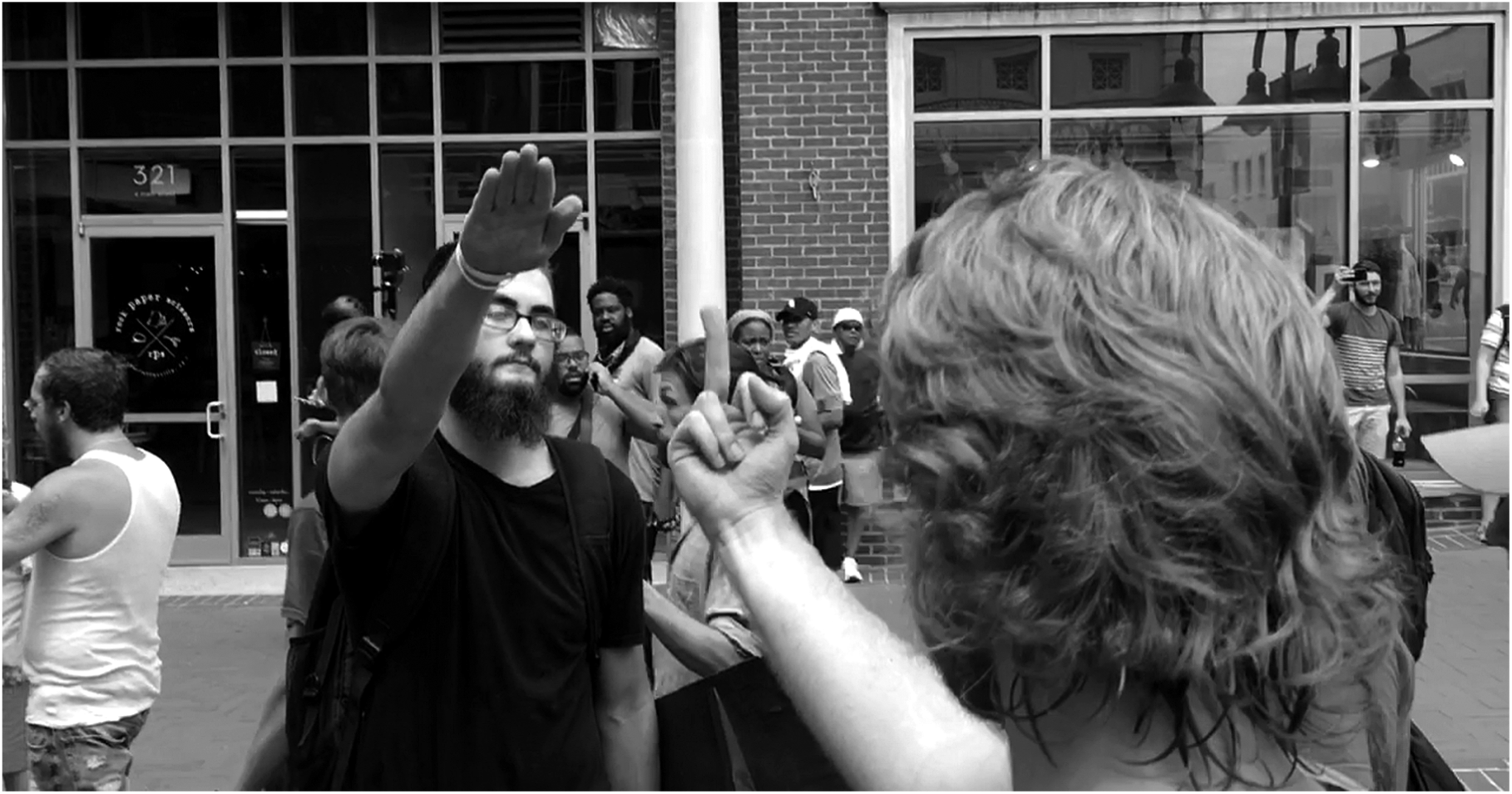
The practice of silence: Silence may seem passive, but it is powerful as a concerted action. Concerted silence from Whites communicates that fighting racism and prejudice is someone else’s job—“not my problem.” Silence teaches our children that they should accept and not confront racism and that racism is a legitimate ingredient of society worthy of toleration. There are a range of ways to break silence: by speaking to friends and families in person or on social media, saying you oppose the hatred and violence at the protests in Charlottesville, or by displaying a lawn sign that welcomes diversity, rejects hatred, or affirms that Black Lives Matter. These gestures may seem small, but they are first steps toward emboldening yourself and others to further action. The the aim of speaking up is not solely to change another’s mind, but also to de-normalize offensive, racist statements and actions.
Refusing silence, a Charlottesville counter-protestor meets a Nazi salute with a “salute” of their own.
Evan Nesterak, Flickr CC
The practice of reframing: Reframing, downplaying, or not directly addressing racial bias, intolerance, or hatred in everyday social interactions is another practice that is implicated in these events. Some avoid calling something racist because it may hurt someone’s feelings or believe calling out racism is too divisive or too extreme. A common defense to racism is that no one can know what is in someone else’s heart. But, we don’t need to know what is in someone’s heart to judge if their words were racist or if something they did produced a racist outcome. It is potentially worse to deprive someone of the opportunity to understand how their statements are perceived and why they are perceived that way. If I say something offensive, I want to know, like spinach caught in my teeth or an unzipped zipper. But unlike those mild embarrassments, racism, whether deliberate or inadvertent, can produce lasting negative impacts in the lives of others.
White supremacists are a part of American society and we must look at how they have been produced through systemic and structural racism in the U.S., educated in American institutions, and provided safety in segregated neighborhoods.
The practice of focusing on individual actors: Focusing on individuals or groups of bad actors while ignoring the systemic and structural processes that produce racism is also to blame for these events. A common statement is that these White supremacists and neo-Nazis are not “who America is”—they are not us. They may not stand for you, but unless we all take a hard look in the mirror and recognize in our reflection how their activities are enabled, they may as well. They are a part of American society and we must look at how they have been produced through systemic and structural racism in the U.S., educated in American institutions, and provided safety in segregated neighborhoods. The desire to view racial bias and intolerance as the products of bad apples who, if removed, will not ruin the bunch fails to address the underlying social processes that produced them.
To be sure, the White supremacist organizers and participants in Charlottesville were responsible for the violent events that led to the death of one civilian and the injury of countless others. But to address the virus of racism and hatred that exists within American society, we must also understand what dynamics and practices produced the fertile grounds from which these horrific events emerged.
What are Our Universities’ Obligations?
By James M. Thomas
Like many, I watched in horror as neo-Nazis and other White supremacists marched across the University of Virginia campus in Charlottesville on a Friday evening. Like many, I felt heartache, anger, and sadness on Saturday when one of the White supremacists drove his vehicle into a crowd of peaceful protestors, injuring dozens and killing 32-year-old Heather Heyer.
That Sunday, I thought a lot about Oxford, Mississippi and the University of Mississippi, where I live and where I work. Neither are strangers to White supremacy. In front of our courthouse in Oxford stands a 35-foot-tall marble statue of a Confederate soldier holding a rifle. The monument’s text, etched into its base, honors the local Confederate soldiers who “gave their lives in a just and holy cause.” A half-mile west, at the entrance to the University, stands another 35-foot-tall statue of a Confederate soldier. A short walk from the statue is Lamar Hall, the building in which my office is housed and where I teach most of my classes, named for L.Q.C. Lamar, an enslaver who later became a chief dismantler of Reconstruction in Mississippi. My building is one of many on this campus that honors enslavers and architects of Jim Crow.
That Monday, my university joined several dozen others around the country in issuing its own condemnation of the “racism, bigotry, and acts of violence committed by hate groups in Charlottesville.” When classes resumed the following week, our campus received a more detailed communiqué that checked all the right boxes: identify and condemn the perpetrators of racial violence (check!); remind everyone of the positive benefits of diversity (check!); declare that our own campus is no place for the racial violence that occurred elsewhere (check!); and remind everyone of all of the positive work we are doing on our own campus to promote dialogue on matters of national importance (check!). The response was both expected and woefully inadequate.
It is a standard practice for universities to treat White supremacy as a matter of public relations rather than a public crisis. They claim a commitment to progressive values, like antiracism, without actually engaging in any real transformative work within the university or its existing power structure. In my own work, I highlight what I term a diversity regime: a set of practices that institutionalizes a benign commitment to diversity, but in doing so obscures, entrenches, and even intensifies existing racial inequality.
A statue of Thomas Jefferson on the campus of UVA.
John Sonderman, Flickr CC
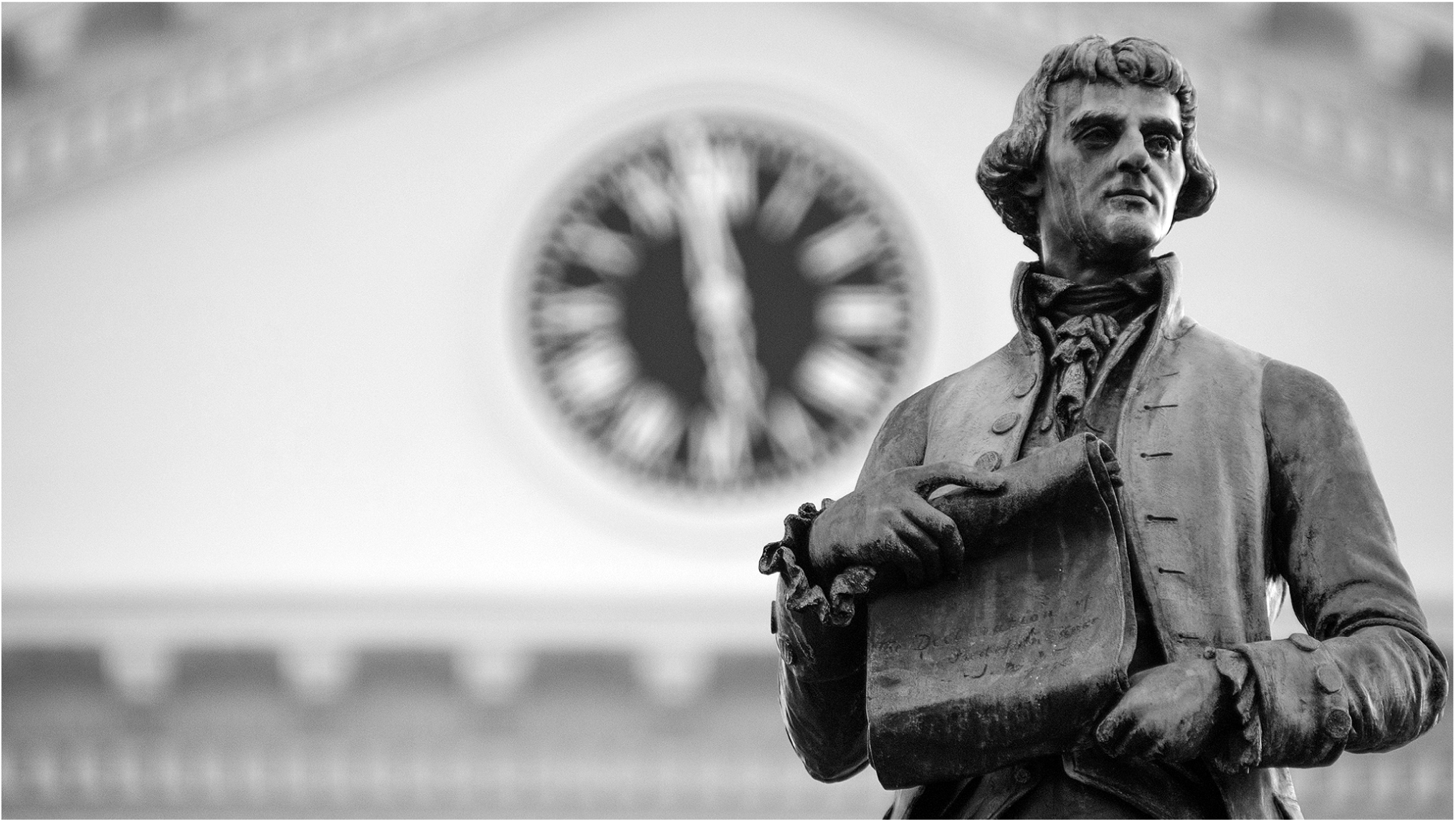
Charlottesville could have been Anywhere, USA. Campuses like the University of Virginia, the University of Mississippi, and others where White supremacist symbolism run rampant are especially vulnerable. These campus landscapes function as nature preserves for White supremacy, and we should expect campuses like mine to serve as rallying points. These realities require more than a PR strategy from university administrators. When our nation’s values and institutions, including higher education, are under assault by an organized and emboldened White supremacist front, what are our obligations as colleges and universities that profess to cultivate our nation’s highest ideals?
Ethical leadership means that Nazis and other White supremacists are not welcome on our college campuses because our universities recognize our right to dignity and personhood as more important than any poorly argued right to free speech.
If White supremacy has no place on an American college campus, then we cannot continue to provide place and space to their symbolism. If universities are going to be agents of change, then we must think about our role beyond promoting dialogue. In this moment, in this context, we need our universities to show ethical leadership, to promote the highest of human values through direct, affirming action. Ethical leadership means that Nazis and other White supremacists are not welcome on our college campuses because our universities recognize our right to dignity and personhood as more important than any poorly argued right to free speech.
Staking Post-Racialism in Charlottesville
By Milton Vickerman
Charlottesville is a self-consciously liberal bubble—a blue dot in a red state (barring Northern Virginia) in which students routinely volunteer for charitable causes, refugees from across the globe are a growing presence, and where the City Council, in March 2017, voted to remove two imposing monuments to the southern secessionism that was the Civil War. Ironically, this act, meant to signal the city’s progressivism, has instead underscored the persistence of racism in the nation and in Charlottesville. The torchlight march, anti-Semitic and racist chants, and racially inspired violence, culminating in murder, that we saw in Charlottesville raised the uncomfortable question, not easily embraced by city residents, of whether local White supremacists, and not just out-of-city hatemongers, participated in the August chaos.
In fact, far from merely participating, at least two of the organizers of that rally are known to have local connections and used these to focus supremacist rage against the city and the University of Virginia. They used the statues of Robert E. Lee and Thomas “Stonewall” Jackson to make a bold political statement: that the marginalization of far-right ideas that occurred because of the development of powerful post-civil rights norms of public tolerance has ended. To make this statement, it was necessary to “unite the right” by overcoming the tendency of supremacist groups to pursue specific agendas and to focus on the fact that they have core interests and common enemies—the creation of a White ethno-state shorn of Jews, people of color, and post-civil rights era ideas that the far-right perceives as antithetical to a “pure” White polity.
The direct connection to Nazi-era Germany and its atrocities is unmistakable, and this has amplified claims in Charlottesville that the White supremacists were outsiders. The underlying question is how to reconcile the city’s proud liberalism that emphasizes tolerance with the other possibility: that some of these White supremacists, not just two organizers, live in or around Charlottesville. Though liberal now, Charlottesville was not always so. It was home to Thomas Jefferson who mixed his notable contributions to the nation with a legacy of slavery. The University of Virginia, his institutional progeny, remained racially segregated until the 1950s and did not fully admit women until 1972. Moreover, the university and Charlottesville lay at the heart of the American eugenicist movement, bequeathing history with possibly the most famous case to stem from that movement: Buck v Bell (1927).
Charlottesville clergy and IWW members stand together in counter-protest. Bringing this work to everyday life may be the less visible but vital work of true change.
Anthony Crider, Flickr CC
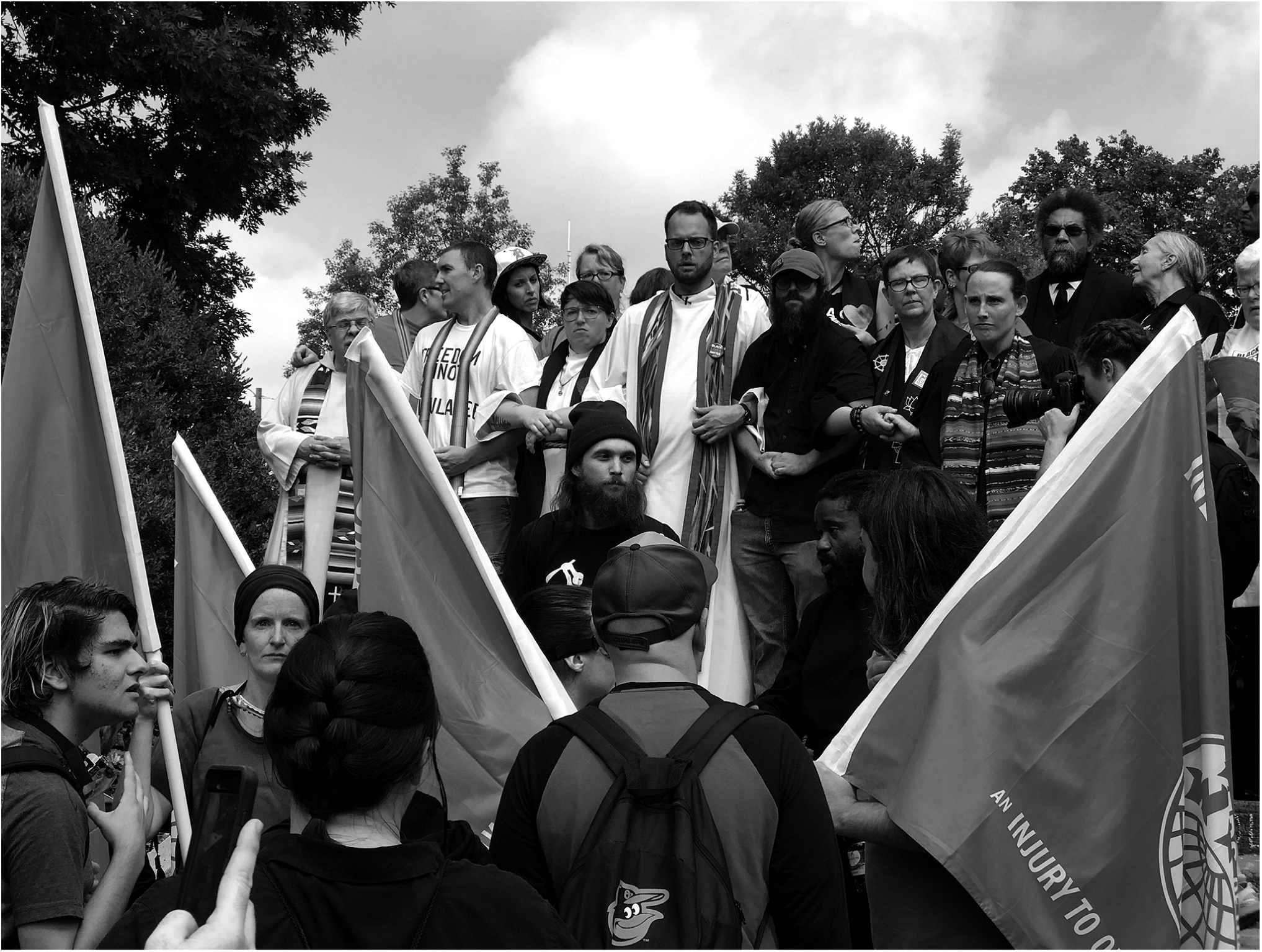
Clearly, a precedent for extreme racism exists in the city, but one also needs to take seriously the city’s claim that it has become a much more tolerant place. The outstanding characteristic of modern-day racism is its complexity. Racism co-exists with apparent positive changes in racial attitudes, operates culturally through colorblindness, and persists in structures that disproportionately harm people of color. Also, increasingly, in backlash against ever-increasing immigrant-fueled diversity, racism is reverting to its brutal, atavistic form.
In the case of Charlottesville, all this means a conscious effort in some institutional spheres to make amends for past racism (e.g., the March 2017 City Council decision on monuments), express opprobrium at public acts of racism, and profess a deep investment in the idea that Charlottesville is a friendly, diverse, welcoming city. Thus, city residents were deeply shocked that this violence could happen in Charlottesville. Also lending substance to the city’s claim to tolerance is the fact that the growing Hispanic population, which contains large numbers of undocumented individuals, feels welcomed in the city. In contrast, some Northern Virginia counties have organized campaigns to drive out these immigrants.
The outstanding characteristic of modern-day racism is its complexity. Racism co-exists with apparent positive changes in racial attitudes, operates culturally through colorblindness, and persists in structures that disproportionately harm people of color.
Racism persists even as a liberal ethos of tolerance can paper over the fact. Although they make a disturbing sight, violent White supremacists are not the norm, and so they are not the real danger. Of greater concern is the ordinary everyday racism of American life, whether living in rural or urban areas, large cities or small: micro-aggressions directed at people of color, casual slurs, and the persistent patrolling—and occasional brutalization—of Black males (UVA students included). Also, although the city is less segregated that many in the Northeast and Midwest, poverty, crime, and less desirable housing and amenities still fall hardest on African Americans and Hispanics. A few years ago, a potential graduate student recruit described Charlottesville to me as “Pleasantville.” In many ways, the city and its surroundings match this description, but their standing in the racial and class hierarchy tends to temper how people of color perceive Charlottesville.
“Hilando Fino”
By Eduardo Bonilla-Silva
How do we respond to Neo-Nazis marching with torches through Emancipation Park in Charlottesville, parading past a synagogue shouting “Jews will not replace us,” and to a terrorist car attack against a crowd of protesters that left anti-racist activist Heather Hayer dead and 19 others injured? How do we respond to a President who immediately stated that “many sides” were responsible for the violence and, a few days later, that there “is blame on both sides”? The easy analysis goes something like this: The U.S. harbors a pocket of racists that is growing and getting more vocal thanks to Trump’s equivocations and flirtations with racism. While this analysis contains some truth, it does little to help us plumb the depths of our racial problems. We need to “hilar fino”—perform a careful and subtle analysis—to appreciate the weight of racism in contemporary America.
Racial domination is never the product of a few bad apples, but the collective effect of the actions and inactions of the many. The more we focus on just poor, uneducated Whites, the less we study and fight against structural racism.
First, I remind readers that the largest segment of White America fueling the rise of the Alt-Right is also the core of Trump supporters. They are mostly poor and working-class Whites who feel left behind. They detest their elite White brethren for their elitism and feel betrayed by their government which, in their view, has violated the rules of the American Dream by helping “undeserving” groups such as Blacks, “illegals,” women, and gays and lesbians.
Second, the class-race anxieties of this group are nothing new. For instance, Al Ricardi, a taxi driver quoted in Lillian Rubin’s Families on the Fault Line (1994), stated,
“Those people, they are hollering all the time about discrimination. Maybe once a long time ago that was true, but not now. The problem is that a lot of those people are lazy. Theirs is plenty of opportunities, but you’ve got to be willing to work hard.” When pressed to define who “those people” are he said: “Aw, c’mon, you know who I am talking about. It’s mostly the Black people, but the Spanish ones, too.” These views are not limited to poor Whites; sociological work documents that middle-class, educated Whites have similar views.
Third, as problematic as the rise of KKK-style racism is, we must be clear that this version of the racial game is not dominant in the nation. At the crux of structural racism in contemporary America, even after Trump’s election, are practices and behaviors that are seemingly “color-blind” or “beyond race.” After all, today’s racial order is not maintained through Apartheid-like practices, but through the actions of tolerant, liberal Whites and seemingly non-racial policies.
Fourth, politically and analytically, we must be careful not to take a position of protective superiority by “hunting for the ‘racists’.” Racial domination is never the product of a few bad apples, but the collective effect of the actions and inactions of the many. The more we focus on just poor, uneducated Whites, the less we study and fight against structural racism. Furthermore, many of the clean-cut leaders of the White nationalist movement are educated and come from middle and upper-middle class backgrounds. More significant, while poor, uneducated Whites were Trump’s most ardent supporters, all Whites supported Trump, with the exception of college-educated White women (51% for Clinton and 46% for Trump).
Racial order in contemporary America is not maintained primarily through Apartheid-like practices, but through the actions of tolerant, liberal Whites and seemingly non-racial policies. Here, counter-protestors before violence ensued in Charlottesville.
Susan Melkisethian, Flickr CC
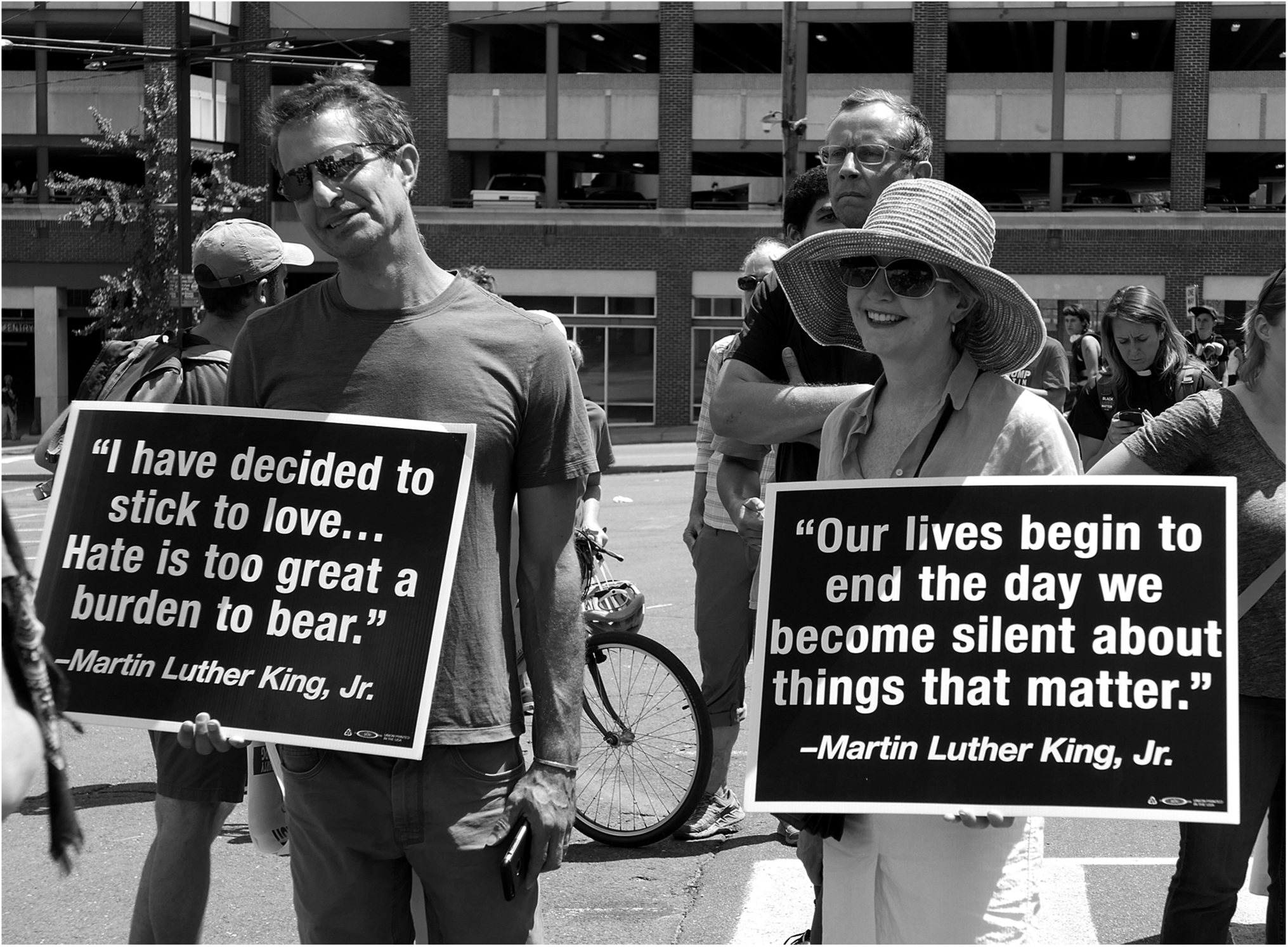
This is the larger racial context surrounding Charlottesville. And here are some things we should consider doing to fight back. First, we must find ways of dealing with the perceived race-class interests of the White masses. While they are wrong in blaming other, similarly oppressed peoples for their plight, we must acknowledge that this is how they feel. Demonizing or ignoring the White masses is not an option if we are still in the business of building the “new society.” Engaging and working politically with them to change their consciousness ought to be the plan of action. Second, focusing only on traditional racism and ignoring hegemonic racism is a huge mistake. The more we focus on the “racists,” the less we deal with the deeper strains of racism in America. Third, Whites’ racial perceptions are not static; the support Bernie Sanders received from Whites in the last election suggests an economic populist message, which, if wedded to a clear race and gender politics, might be the key to developing a people’s movement to fight Trumpismo and advance social justice. The task at hand is to address both Alt-Right racism and structural racism; we will need a large social movement for racial and social justice.
I know full well most sociologists are content with simply examining the world in various ways, but the times require us to be more action-oriented. Sociologists should provide wonderful analyses and write beautiful books and articles, but at this juncture, we must do much more. We must become sociologically-driven citizens concerned with building a more democratic, inclusive, and just society.
Sociologists must become sociologically-driven citizens concerned with building a more democratic, inclusive, and just society.