



Abstract
Michael Lounsbury on Society and Economy: Framework and Principles.
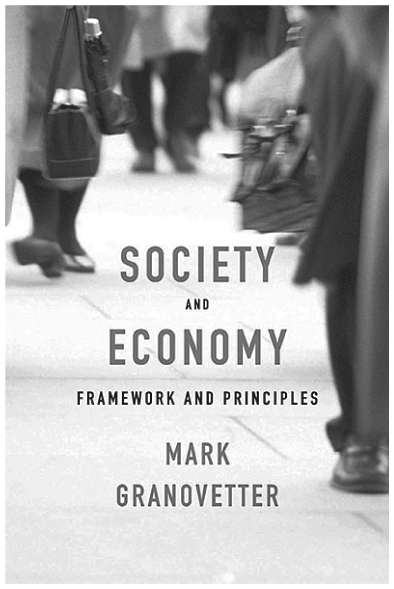
Society and Economy: Framework and Principles by Mark Granovetter Balknap Press of Harvard University Press, 2017 243 pages
One of the most perverse trends of the past half-century has been the dramatic rise of neoliberal ideas and policies. Market logics have invaded almost every aspect of social and economic life, not only refashioning conventional for-profit industries, but also the non-profit sector and even the state. This is to say, the principles of market fundamentalism have a powerful grip over society and culture, despite considerable evidence that market solutions often exacerbate the problems they’re intended to ameliorate.
Cultivating alternatives to market fundamentalism can help us avoid perverse and even dystopian outcomes in economic life. Through his scholarship and his intellectual commitment to encouraging thoughtful and constructive trans-disciplinary dialogue, Mark Granovetter has been at the forefront of pioneering such alternatives.
Granovetter’s influential early scholarship on the strength of weak ties highlighted how getting a job and career mobility were enhanced by having rich networks of acquaintances rather than a denser network of close friends in which information about potential opportunities was more limited. His 1985 paper, “Economic Action and Social Structure: The Problem of Embeddedness,” was equally influential—a powerful theoretical statement against economic theories that conceptualized markets as driven by atomized decision-making in which he argued that the economic decisions of individuals and firms were better understood as embedded in ongoing social relationships (thus social institutions are consequential in shaping economic life). In subsequent work, Granovetter has built on these ideas to, for instance, highlight the importance of “business groups”—sets of legally separate firms bound together in persistent formal and/or informal ways—to the social organization of economic life. To the extent that these arguments are true, the foundation for market fundamentalism feels a bit shaky.
In the ensuing decades, Granovetter has continued to develop a distinctive sociological approach that aims to engage economists directly—and on their own turf. And he has championed the idea that we sociologists must constructively engage economists if we want to see them embrace more sociologically rich approaches in their work. While the jury is still out on the usefulness of this strategy, there is no doubt that, given the depth of his engagement with economic theory, Granovetter’s critiques have more credibility than most sociological efforts to debunk economic analyses. Since economists are seen as the high priests in the social sciences, perhaps more of us would be wise to follow Granovetter’s lead.
Granovetter’s latest book, Society and Economy, masterfully fleshes out his approach to economic sociology. It is the product of a lifelong journey to cultivate a viable sociological alternative to the economic theories that underlie market fundamentalism. The book is a labor of love and, as he acknowledges, has been in the making for a long time. I had the pleasure of reading early draft chapters as a graduate student under his supervision at Northwestern University in the early to mid-1990s. He helped guide my early work on the environmental movement and the rise of the recycling industry, as well as the then-current economic sociology conversations on the social construction of markets and industries. Of course, Granovetter’s work on threshold models of collective behavior still provides useful guidance for those of us trying to understand how social movements catalyze institutional change.
Granovetter also helped guide me toward my next big project that catalogued how the professionalization project of money managers unfolded differently in Boston and New York, but provided the engine by which competing logics emerged and differentially shaped practice and behavior in the U.S. mutual fund industry. I recall the conversation as if it were yesterday. He said, “That’s great that you demonstrated the role of social movements in industry creation with recycling. But that is an easy case. Next, you should see if you can find the same processes at work in the heart of Capitalism—finance.” A former student of both Carl Gustav Hempel and Harrison White, Granovetter always encouraged historical comparisons to cultivate generalizations that would hold across time and space. Despite his commitment to generalizable knowledge, he believed strongly that such knowledge emerged from deep, carefully detailed research.
So, as one of many who have been greatly influenced by and appreciative of Granovetter’s scholarship, mentorship, and astute but gentle critiques and advice, I was delighted to see his efforts come to fruition in this excellent new book. And I was not disappointed. Well, except for the fact that this grand achievement will be divided into two book installments and so far we only have volume one. Nonetheless, we should all be grateful that the initial statement—in many ways a theoretical treatise laying the groundwork for the sequel in which Granovetter applies the theoretical framework to cases related to corruption, organizational forms, and corporate governance.
In Society and Economy, Granovetter continues in his efforts to develop an understanding of the economy that transcends disciplinary boundaries. Building on his earlier work, he proposes a multi-level framework that emphasizes the interplay between purposive individual action and social institutions as a way to avoid a reductionist approach that relies on the notion of homo economicus—a stylized imagery of decision-making that depicts people as lightning-quick rational calculators. Much of the book offers a theoretical engagement between sociology and economics in a way that argues that an adequate understanding of economic action requires attention to the importance of value-rational action (and emotion) including behavior shaped by such factors as sense of duty, honor, a religious call, or personal loyalty. Granovetter emphasizes mental constructs including norms, values, and morality and provides detailed treatments of the role of trust, power, and social institutions in shaping economic behavior. Echoing his previous arguments on embeddedness, he stresses that we must avoid both under- and oversocialized accounts of economic behavior.
The principles of market fundamentalism have a powerful grip over society and culture, despite considerable evidence that market solutions often exacerbate the problems they’re intended to ameliorate.
For example, he critiques economic approaches to trust that attribute trust at the macro level (for example, between firms) to micro-level processes of socialization determined by nation-state cultures of either “low trust” (China, France and Italy) or “high trust” (Japan, Germany, and the U.S.). In contradistinction, he leverages his research on the strength of weak ties to highlight how community-level variation in the nature of networks has implications for whether a person trusts a given organizational leader andargues for more detailed inquiries into “how the nature of trust at a small scale might translate into the capacity to structure larger-scale economic organizations” (p. 85). Given that his work documents how trusting relationships can concatenate across wider spheres via indirect relationships, he asserts that a little trust goes a long way.
The last two chapters of the book develop these arguments in detail, offering the freshest update to the embeddedness approach. For example, in his discussion of institutions, Granovetter embraces recent theoretical developments related to justification and the institutional logics perspective to argue against older Parsonsian uses of all-dominating, reified, and coherent norms and to encourage new approaches to how we conceptualize and employ cultural elements (a la Ann Swidler’s culture as a toolkit approach). Not surprisingly, for Granovetter, an adequate understanding of the influence of mental constructs (including logics) on behavioral outcomes requires a concrete analysis of the social networks within which individuals negotiate their life chances. As such, Granovetter’s deployment of recent developments in the study of culture is made consistent with his pragmatist epistemology that encourages research that deeply probes the interplay of individuals, networks, and institutions.
Especially in their focus on cultural multiplicity, scholarship at the frontiers of cultural sociology, put to work in this way, open up exciting opportunities to further develop the embeddedness perspective. For instance, in noting the importance of flexible, small-firm networks in the making and success of Silicon Valley, Granovetter also casts his eye toward the prominent role played by large firms like Apple and Google, suggesting that such different forms undergird distinctive, yet complementary, cultural models that constitute an innovation ecosystem. He stresses the need to study the fragility and contingency of such cultural models, as well as how they influence the ways in which alternative cultural models are constructed. While there is much interest in contemporary sociology about how culture creates change, he warns that we must not fall into the historicism of unique cases, but develop higher level theories of, for instance, how the available menus of cultural elements are created and curtailed.
In Society and Economy, Granovetter proposes a multi-level economic framework that emphasizes the interplay between purposive individual action and social institutions.
The book is chock full of examples to illustrate his arguments about culture, networks, and historical process, including a detailed case discussion of the rise and fall of the modularity movement in automobile manufacturing. He argues that its widespread adoption in the early 2000s paradigmatically aimed to diminish the need for close working relationships between firms, as well as the idiosyncratic interactions between components in systems by creating more standardized, “plug-and-play” modules. A fad driven, in part, by management gurus evangelizing disruption (e.g., Clayton Christensen), the automotive approach to modularity was transposed from the computer industry where it was pioneered. Granovetter catalogs how the dramatic failure of this theorized version of modularity was precipitated by the emergence of a competing cognitive frame constructed by product engineers that restored the primacy of close trusting collaborations between firms aiming to develop viable and safe next-generation, high-performance product architectures.
As Granovetter passionately argues, and convincingly shows, economic accounts of socio-economic life that embrace ideal-typical conceptualizations of markets and interests are, at their best, incomplete; in many cases, they are fundamentally wrong. Ultimately, if the policy prescriptions that emanate from the ideology of market fundamentalism are based on flawed knowledge and conceptualizations, it should not surprise any of us that the intrusion of market logics into all aspects of socio-economic life has generated so many maladies (from growing inequality to middle-class insecurity, declining health, etc.). Granovetter is too humble to claim that he has provided the definitive alternative theoretical framework to displace neoclassical economics, so I will make the claim: his path-breaking work provides a guiding light for those of us who have embraced the project of disentangling neoliberal ideologies and simplified forms of economic theory from our complex and interdependent socioeconomic lives.