



Abstract
Trisha L. Crawshaw on a rock camp helping eqip kids to resist gender norms, acknowledge privilege, and confront racism.
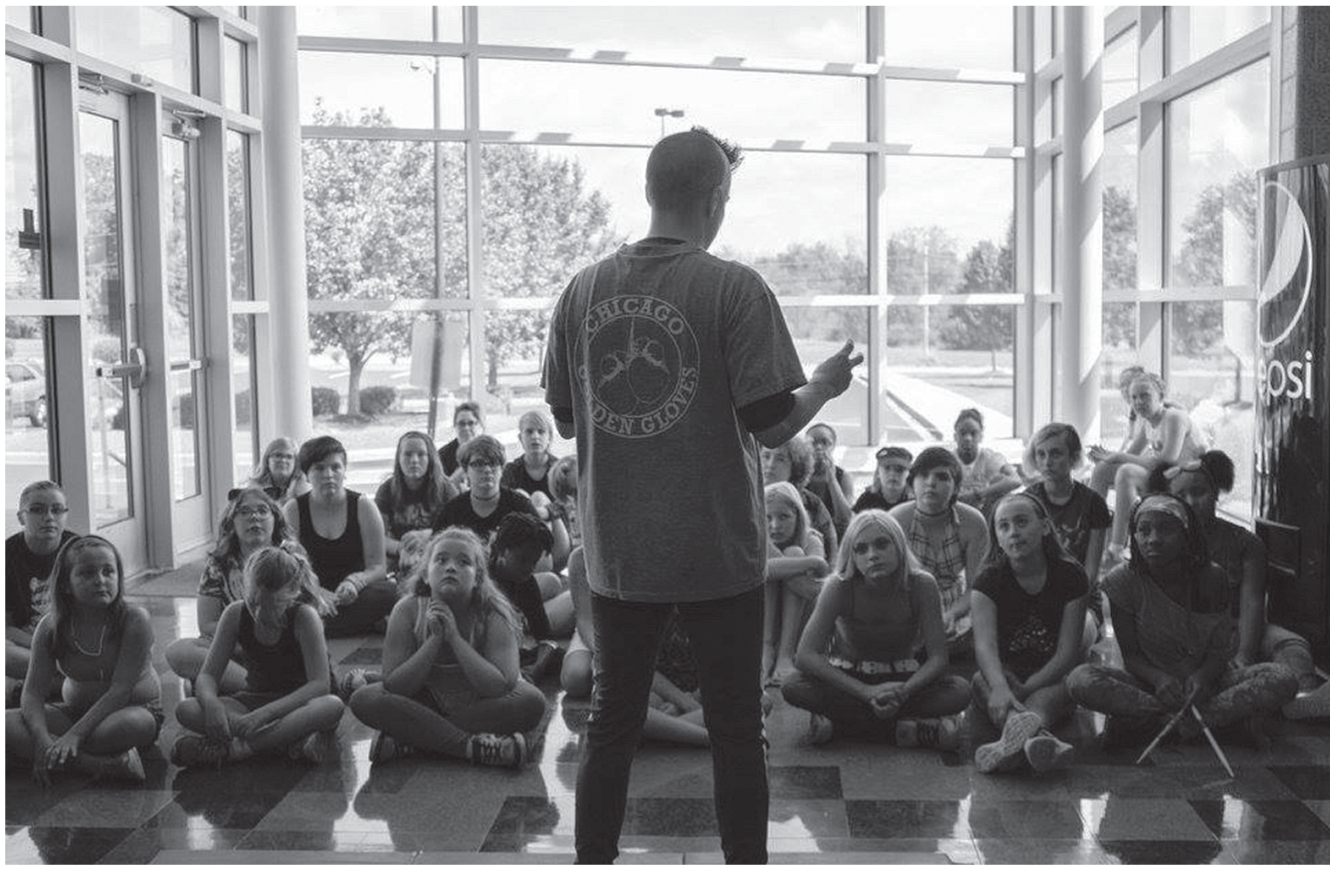
Twenty-eight young girls gather around the self-defense instructor who directs, “OK, repeat after me. Your whole body is a weapon!” The girls assume power poses and shout, in unison, “YOUR WHOLE BODY IS A WEAPON!!!” As the instructor repeats, “Your body is a weapon,” she adds, “Let’s learn how to use it.” The room becomes quiet and focused. The instructor guides the girls through a series of directed motions. The campers follow suit: pulling, tussling, twisting. They succeed. They resist.
Girls Rock Camp is a weeklong summer camp for girls and gender non-conforming kids to come together to learn music, make noise, use their voices, and engage in self-expression. The camp prides itself on helping kids build self-esteem through music education, performance, collaboration, and social justice workshops like the self-defense clinic.
The rules here remind campers to be responsible people—not gendered dolls. And although everyday acts of resistance might seem small, they help to build necessary pressure in the coming—and persistent—waves of change. Our bodies and actions and voices are weapons. Let’s rock.
In all those ways, Girls Rock is an enclave of resistance. Designed to empower kids at an early age, the program shows how, among other things, rock-and-roll can help young people recognize and resist the structural forces that promote systems of privilege and oppression. And Girls Rock focuses on building these kids up and providing them with the tools they’ll need to resist gender norms, acknowledge privilege, confront racism, and fight the patriarchy that too often keeps women, girls, and so many others submissive on the sidelines of society.
Campers are attentive during a self-defense workshop.
© Mitch Mitchell, used with permission
Make no mistake, these are ambitious goals. They are, however, imperative if we hope to change the social script. After all, in her recent study of tenth-graders’ confidence, sociologist Kimberly Mahaffy showed that the odds are still stacked against young girls. Girls are less likely than boys to report high self-esteem, for instance, and a deficiency in that area can lead to self-doubt and insecurity. Mahaffy also found a positive correlation between reported levels of self-esteem and lifelong socioeconomic achievements, which translate into more independence and choices for girls and women. When a girl’s self-expression is stifled, she is less likely to be ambitious and creative, to pursue success in her personal and professional life. Because girls are not structurally or socially supported, we must make room for them to find and practice amplifying their voices. Their future success depends on interventions like these.
At Girls Rock, kids find a safe place in which to express themselves without censure or judgment, where nobody polices their volume or their clothes. Altogether, it’s a rare opportunity for girls and non-conforming children. Psychologist Elizabeth Daniels’ study of kids’ social media profiles shows that young girls not only face overwhelming criticism based on physical appearance, but also on their personal decisions. For example, boys reported that girls who dressed in modest attire were uninteresting and less attractive. But if girls dressed in more revealing clothes, they were more likely to be criticized by other girls. Based on nothing but the profile photos, their female peers suddenly considered them less socially attractive and competent. Girls Rock confronts these stereotypes head-on and provides campers with resources that will help them develop strategies to challenge institutional barriers and everyday sexism.
Campers at Girls Rock talk about some of the obstacles they face because they are girls. “I’m tired of hearing that I play well ‘for a girl,’” a sixth-grade camper shares during band practice. “Like, I’m a girl and a musician. I just play well.” Her band coach responds thoughtfully, “I know how you feel,” continuing, “People ask me all the time if I am ‘big enough’ to handle my instrument.” I watch as the coach steadies an electric bass against her petite and sturdy frame. “And you know what? I am.” They share a grin before she demonstrates how to hold the instrument while strumming on its taut guitar strings. The camper follows suit. Shifting her body and widening her stance, this girl is ready to rock.
Microaggressions that translate women’s size to assumptions about their abilities question and undermine female competency. Symbolic annihilation in so many spheres—that is, the absence of representation—perpetuates assumptions. In music, that means it can be “taken for granted” that girls can’t play, and they certainly can’t rock. Modeling other women is thus important at Girls Rock, ,howing campers that women can be loud, make noise, and be noticed as talented musicians is an important first step in dismantling systems that try to keep women and young girls silent. The coaches teach campers how to play music, sure, but they also instruct campers on how to set up their own instruments, demystify music gigs, and demonstrate how to execute successful merchandise operations. These lessons in self-sufficiency build gender equality by taking girls seriously as musicians.
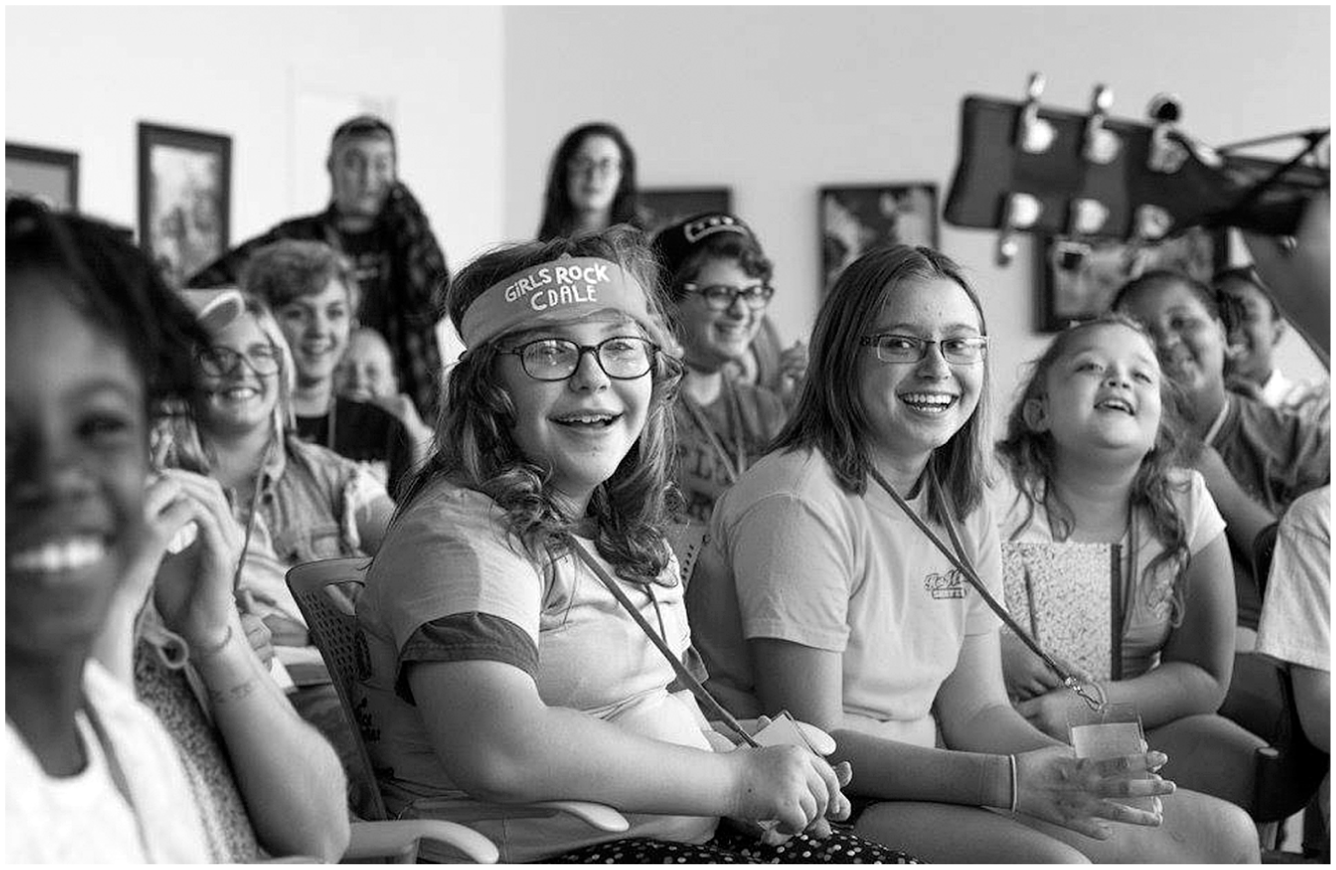
Campers laugh during a musical, mad-libs styled icebreaker.
© Mitch Mitchell, used with permission
Camp counselors rock out during an Open Mic session.
© Mitch Mitchell, used with permission
Sexism is not the only structural culprit that camp organizers ask the kids to confront. Counselors are also invested in dismantling essentialized notions of sex and gender. After all, while girls can definitely rock, you don’t need to be a cisgender girl to participate. Girls Rock is actively trans-inclusive and open to gender non-conforming individuals.
“What’s a ‘pronoun’?” a young camper asks. It is day one and we’re circling the room, asking everyone to introduce themselves with their preferred names and pronouns.
“It’s a part of speech that takes the place of a noun or a person’s name,” one camp counselor explains. “For example, I use she and her pronouns.”
“And I use they/them pronouns,” another volunteer adds.
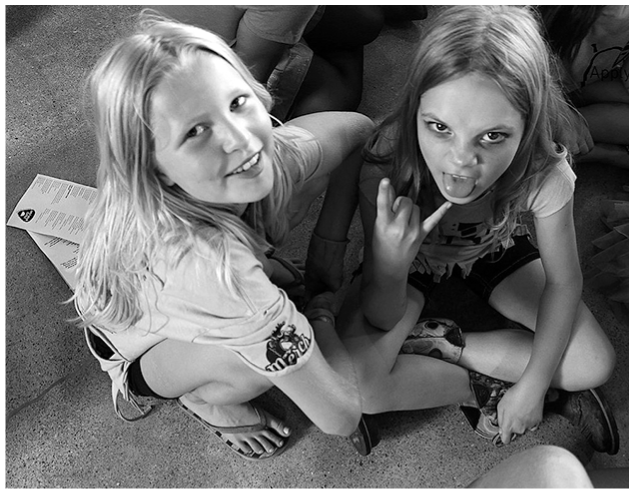
Campers pose for the camera before their band’s performance.
© Mitch Mitchell, used with permission
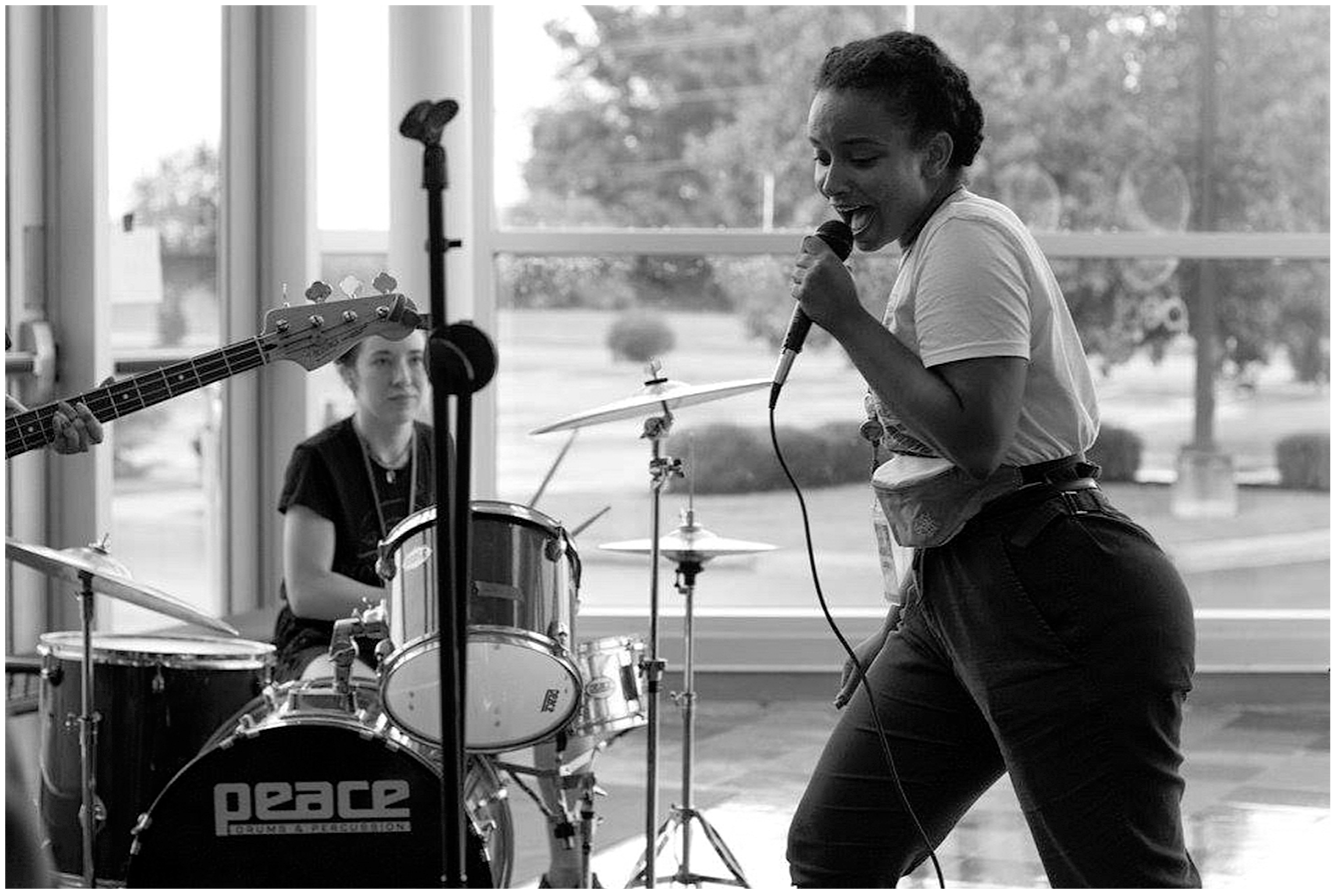
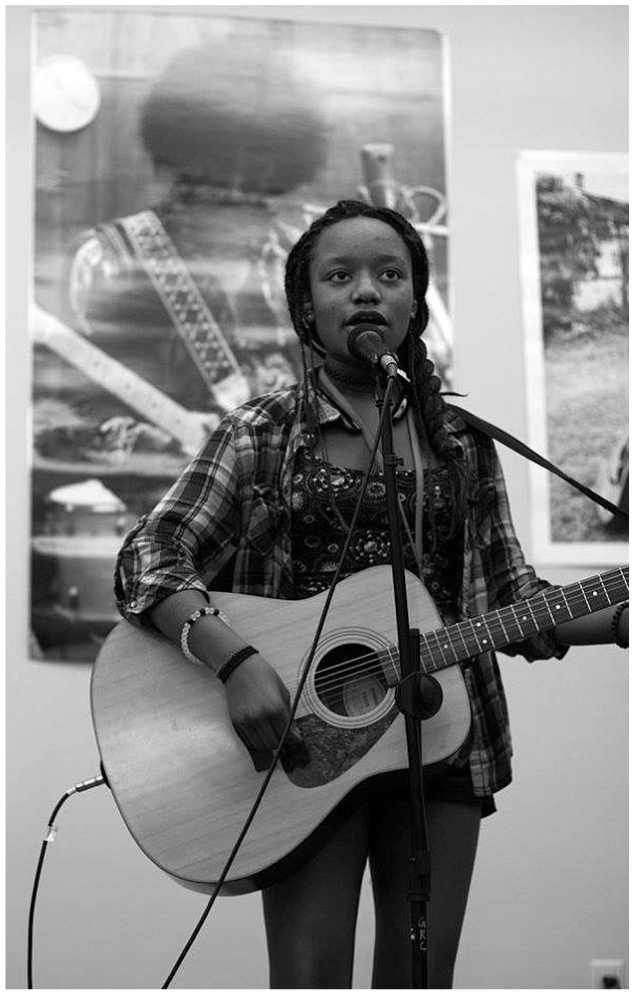
A camper leans into the microphone during band practice.
© Mitch Mitchell, used with permission
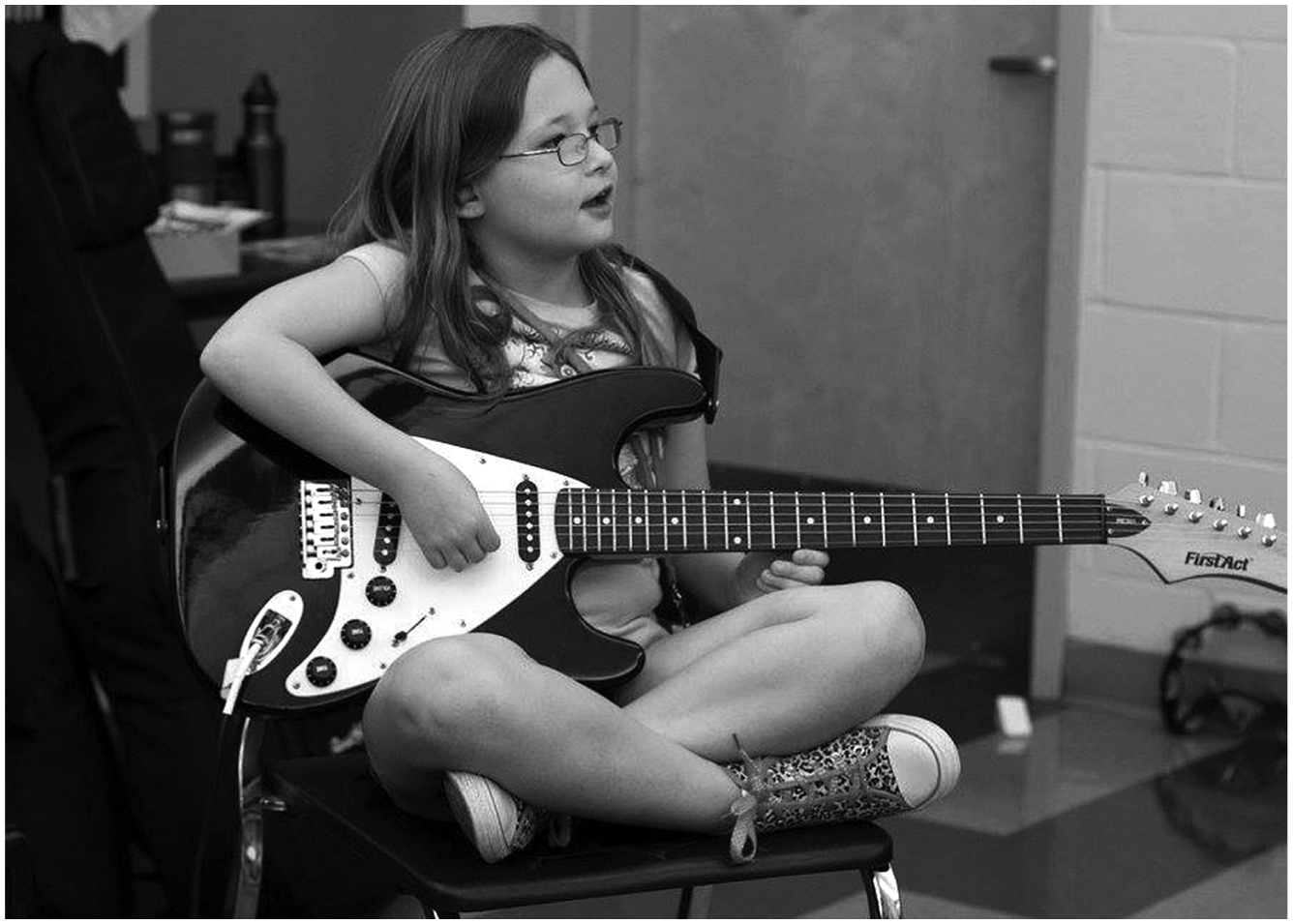
A camper plays the guitar during instrument instruction.
© Mitch Mitchell, used with permission
“I use they/them, too!” An older camper beams. They lean in, moving closer to the center of the circle.
This exercise is simple, but the mindful practice challenges essentialized assumptions about bodies and identities. Girls Rock staff encourage all campers to ask for each other’s pronouns and offer their own so as to normalize gender variation among all of the participants. These practices, performed over and over, help pave the way for future discourse about binary gender identities, cisgender privilege, and resistance.
Social justice workshops at Girls Rock provide more opportunities for counselors to discuss topics like racism. These sessions involve facilitated discussions and activities that make big concepts more accessible to a younger audience. In the art room, for instance, I saw an over-full, slightly cramped room as campers started one day’s workshop. Everyone was attentive as a counselor read aloud from a ‘zine about being left-handed in a world that privileges right-handed people. Extending the conversation, the counselor brought up her White privilege.
“Whiteness is privileged in our society. It’s not right or fair,” she said. “What are some of the consequences when we treat White people better than other folks?”
The room was silent and uneasy, but the counselor simply adjusted to the campers’ introspection. A young Black girl eventually raised her hand to ask shyly, “Why don’t they like us? We just have different color skin.”
Counselors don’t always have answers to the tough questions, but they open up dialogues around racism, sexism, and cisgender privilege to counteract the oppressive silence that protects these systems. They can help campers confront structural obstacles in place to keep them quiet, docile, and invisible by, for instance, teaching them that the stage should be available to all bodies and identities (and, by extension, so should all spaces). These bounded interactions demonstrate the importance of vulnerability, expression, and speaking up (and out).
It’s liberating for kids to be thinking about and rethinking social norms at Girls Rock Camp, but that isn’t to say the day-to-day experience is without guidance or rules. Counselors, like they’ve done at summer camps for generations, have to remind the kids to stay hydrated, not to play in the parking lot, clean up after themselves, respect their fellow campers, and (occasionally) Get. Off. The. Tables. These rules, however, remind campers to be responsible people—not gendered dolls. And although everyday acts of resistance might seem small, they help to build necessary pressure in the coming—and persistent—waves of change. Our bodies and actions and voices are weapons. Let’s rock.