



Abstract
Who’s the most important character in the Iliad? That depends. Using the poem, Rossman illustrates how to understand related but conceptually distinct concepts through social network analysis.
The Iliad is one of the classic works of the western tradition, and many people are vaguely aware that it’s about the role of the warrior Achilles in the last year of the Trojan War. These people are generally surprised when they read the poem, however, and discover that for the first two-thirds of the book, Achilles does nothing. For the first 18 of the 24 books of the Iliad, Achilles just sits in his tent and throws a tantrum as the war rages on. Meanwhile, Homer (or, at least, the generations of singer-poets collectively billed as “Homer”) narrates the war by repeatedly describing pairs of warriors who may or may not give each other speeches before they fight; first described in clinical detail (“he slashed his right nipple, clean through the shoulder”*) and then an evocative simile (“down in the dust he fell like a lithe black poplar …the trunk trimmed but its head a shock of branches.”).
In many respects, this is a culturally alien narrative style. Social network analysis can help make sense of the poem, as the poem in turn illustrates how to understand related but conceptually distinct concepts in social network analysis.
Any social network analysis requires defining the network in terms of “nodes” or who is connected (shown as dots) and “edges” or the relationships or interactions that connect them (shown as lines connecting the dots). Since the Iliad is a poem about combat, it makes sense to treat the warriors as nodes and edges as fights between warriors. (My data are based on Ian Johnston’s Deaths In the Iliad).
One of the simplest analyses we can perform of a network is to ask who is connected to the most others. This is what social network analysts call “degree centrality,” and it is a simple if sometimes misleading way to summarize the importance of nodes in the network. For purposes of understanding who is the greatest warrior, we don’t care as much who has the most fights as we do about who wins the most fights. In social network analysis, counting only the connections an actor receives is “in-degree centrality.” Eight warriors each have at least 10 combat victories in the Iliad. This threshold of at least 10 victories roughly corresponds to what the Greeks called an aristeia, which literally means moment of excellence but basically refers to a battleground killing spree. By raw size of number of defeated foes, these great warriors are: Patroclus (54), Diomedes (33), Hector (29), Achilles (24), Odysseus (18), Ajax the Greater (16), Teucer (16), and Agamemnon (12). Thus, degree centrality implies that Patroclus is the greatest warrior in the Iliad and twice the hero that Achilles is. But Patroclus is Achilles’s sidekick, so this is sort of like reading a Batman comic book and deciding that Robin is the most important character because he fights dozens of anonymous thugs while Batman only fights the Joker, the Penguin, and Two-Face. This is clearly wrong, so if simply counting victories implies such a conclusion, we need to apply a more subtle analysis.
Social network analysis can help make sense of the poem, and the poem, in turn, illustrates how to understand related but conceptually distinct concepts in social network analysis.
At this point it can be helpful to take in a broad overview of the network, as social network analysis techniques more subtle than degree centrality all consider information from the entire network in one way or another, and not just a node’s immediate neighbors. A computer algorithm (Fruchterman-Reingold as implemented in the R library igraph) draws the network in such a way as to minimize overlapping nodes or edges and ensure that nodes that appear close to each other visually are close to one another in terms of social connections. Note that for visual clarity, arrows point from winner to loser, but analytically it makes more sense to think of victory flowing from loser to winner, not defeat flowing from winner to loser.
A few features of the network stand out in this visualization. First, Greeks (black nodes) fight Trojans (pink nodes) and vice versa, but Greeks don’t fight Greeks and Trojans don’t fight Trojans. Networks in which nodes of one type only connect to the opposite type are called “bipartite” networks. The most obvious example of a bipartite network is heterosexuality, but this structure also characterizes affiliation networks like corporate board networks and the Kevin Bacon game. Actors can be in films and films can have actors, but the only way actors can be connected to each other in the Bacon game is by a mutual appearance in a single film.
Second, some nodes are much more connected than other nodes. The modal number of victories is zero, the mean is about one, and (as seen above) eight nodes have at least 10 victories. This extreme level of inequality in social connection is called a “preferential attachment network.” Networks with this structure form when nodes make new links with a probability proportional to a potential partner’s degree centrality. It’s as if a Trojan node looks around the battlefield and notices that Diomedes has killed a lot of people and might be an attractive person by whom to be slain.
Third, the network resembles an archipelago, with one big island and many moderate or small islands. Whereas many networks form a single large structure, the Iliad’s network is weakly connected. This weak connection stems from the low average degree: Most combat events are fatal and this means most warriors are only defeated once, limiting how connected the network can be. The single biggest part of the network—the “giant component”—includes a little under half of the total nodes, and understanding its structure will give us our next attempt at measuring who is the most important warrior in the Iliad.
A plurality of the network consists of five major warriors, a total of 135 lesser warriors defeated by these major warriors, and a total of 4 warriors defeated by 2 of the lesser warriors. The giant component mostly consists of the following:
– Teucer has an aristeia in Book 8 that ends when Hector wounds him
– Hector has an aristeia in Book 5 and another in Book 11
– Ajax the Greater has an aristeia in Book 11
– Ajax the Greater wounds Hector in Book 14
– Patroclus has an aristeia in Book 16 that ends when Hector kills him
– Achilles has an aristeia from Books 20-22 that concludes with killing Hector
Combat victories in the Iliad.
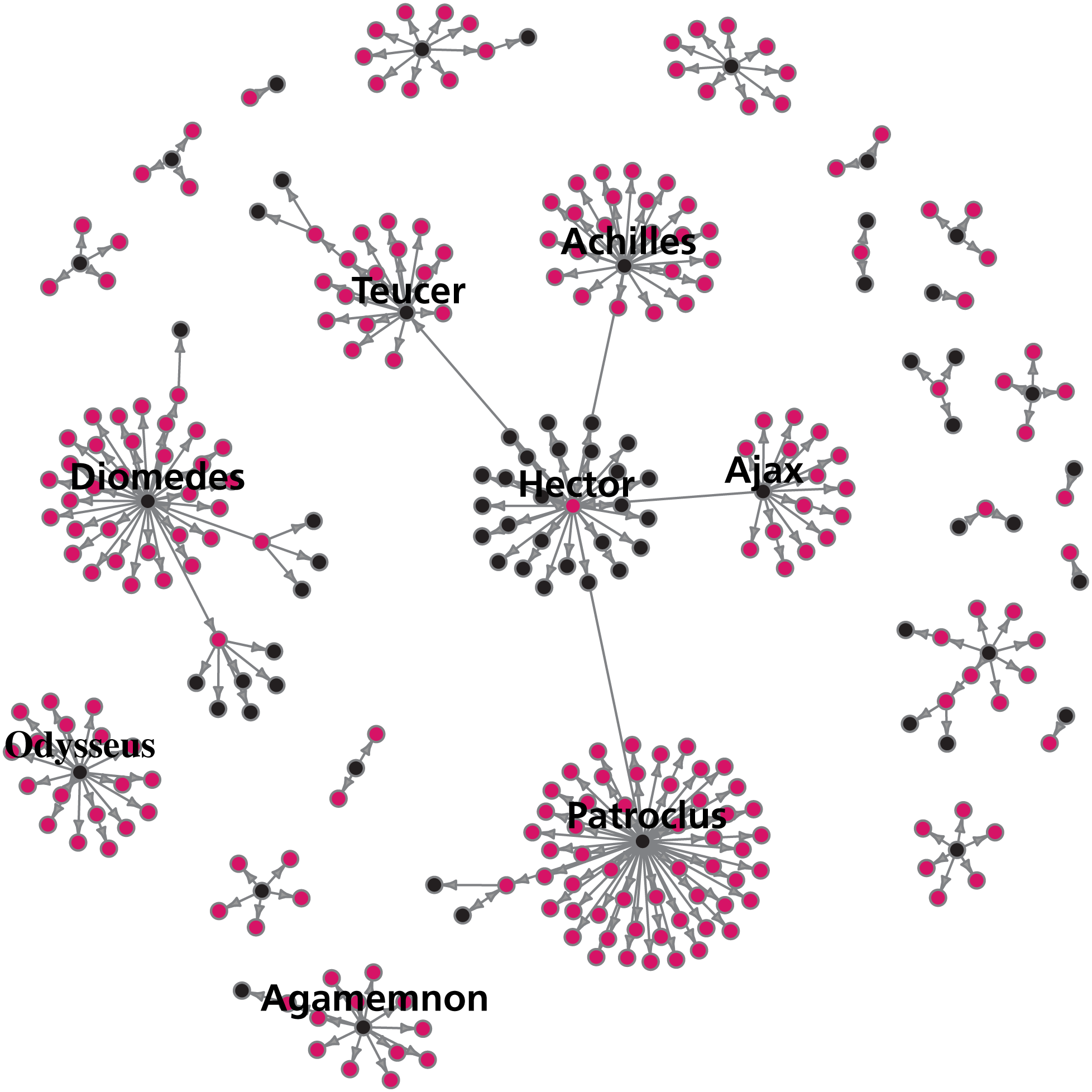
What these stories have in common is that most involve Hector, the only Trojan among our five great warriors. In this respect, Hector is the most important character in the story; he uniquely connects the single largest part of the network. If we were to take Hector out of the story it would have a much more episodic structure and no major plot arc. This approach of finding the node without which the network falls apart (or at least becomes much more decentralized) is the logic of “betweenness centrality.” And Hector is an extremely important character in the poem, heir to the Trojan throne and general of its army. Hector is also the most sympathetic character to modern readers in that he displays complex motivation and a full gamut of human emotions. He is the only warrior we see at length in an intimate domestic context as a dutiful son and a loving husband and father.
Still, Hector is just as clearly not the most important character. Betweenness is telling us something important, but misleading.
In the opening line, the poem declares that it will be about the wrath of Achilles, and the structure of the poem highlights his importance. Its first two-thirds consists of the Greeks hoping that Achilles will rejoin the fight and enduring the problems caused by his absence. The last third consists of the devastation Achilles inflicts on the Trojans once the death of Patroclus redirects his anger from Agamemnon, leader of his own army, to Hector, leader of the enemy. In a real sense, Hector is important because he has to be important enough that it matters when the really important character, Achilles, kills him.
Achilles is important not because he has the most victories (by which logic Patroclus would be the most important), nor because he connects the story (by which logic Hector would be the most important), but because Achilles kills the second most important person in the story and this puts him at the top of the pecking order.
An entire class of network analysis and sociological theory models how people and organizations derive importance from association with others who themselves are important. The sociological literature on “status” focuses on social interactions where one party is in some sense deferring to another. The person or organization that receives deference is raised in status (We are important because everyone sees us being acknowledged by others who are themselves widely acknowledged). In his book Status Signals, Joel Podolny demonstrates this phenomenon through examples including how the order of banks listed in “tombstones” (advertisements for securities offerings) is a strong predictor of how many basis points that bank can charge for offering debt. With my own coauthors, I’ve found that status in the network of who outranks whom in Hollywood screen credits is a good measure of star power, being strongly associated with who gets Oscar nominations and appears on magazine covers. Sociologists often measure status with “alpha centrality,” a measure that allows for status to be transitive, such that receiving deference from someone who himself receives deference from others is more consequential than receiving deference from an obscure person. Google’s PageRank algorithm works similarly in ranking how important a website is by how many important websites link to it, with their own importance being defined recursively.
The logic of status can verify that Achilles is the most important character in the Iliad. Understanding why requires backtracking several books before Achilles ever leaves his tent. Patroclus and Teucer gain status by killing many obscure Trojans. Hector derives status not only from the many obscure Greeks he kills, but when he wounds Teucer and kills Patroclus he derives status from the Trojans they killed. And when Achilles kills many obscure Trojans as well as Hector, he derives most of the status from the Greeks Hector killed as well as (to a slightly lesser extent) most of the status from the Trojans killed by Teucer and Patroclus. Achilles is important not because he has the most victories (by which logic Patroclus would be the most important), nor because he connects the story (by which logic Hector would be the most important), but because Achilles kills the second most important person in the story and this puts him at the top of the pecking order.
Although algorithms for quantifying status like sociologist Phillip Bonacich’s eigenvector centrality, Google’s PageRank, and Bonacich and Paulette Lloyd’s alpha-centrality were invented in recent decades, the abstract concept of status is absolutely key to understanding Homeric epic. And not only in the sense that millennia later a sociologist can apply social network algorithms that verify what every first-year classics undergraduate already knows, but also in the sense that the characters in the Iliad talk about status frequently. The Homeric tradition doesn’t use the term “status,” but “kleos,” meaning glory or fame and pronounced “clay-os,” along with such closely related concepts as “kudos,” “euchos,” “géras,” and “tîme.” Nor is this distinctive to the Iliad; cognates to kleos are found throughout Indo-European epic poetry. Kleos is fundamentally why the warriors fight in epic poetry, and it follows the same logic of establishing a ranking of recognized greatness through transitive deference that status does in sociology. In Book 12, the Trojan hero Sarpedon tells his comrades that by going into battle and facing death we will “give our enemy glory (euchos) or win it for ourselves!” (indeed, both are true: Sarpedon kills two Greeks but is himself killed by Patroclus). And while Achilles withdraws from the army out of anger at Agamemnon for confiscating his prize of honor, the concubine Briseis, throughout the middle parts of the poem he is not angry but depressed, contemplating two destinies: death and eternal fame (kleos aphthiton) at the gates of Troy or a long but meaningless life at home in Phthia. (Toy Story 2 is so moving because Woody faces a similar choice: whether to return to Andy for a few years of playtime before being broken and abandoned or to live forever behind glass at the Konishi Toy Museum). Like status, kleos is not about who you are, but what you are acknowledged as being. The term is etymologically related to “hearing,” and in Books 8 and 9 of the Odyssey, Odysseus coyly remains nameless until the Phaeacians sing songs about his deeds at Troy; then he rejoices that not only does he have a name, but that his “kleos reaches the heavens.”
It is not important that Odysseus is a crafty sacker of cities, but that he is recognized as a crafty sacker of cities. It is not important that Achilles has the potential to be the greatest warrior in the Trojan War, but that he publicly puts this potential to the test by killing a great warrior who has himself slain many notable Greeks.
That status and betweenness are two ways to look at a network and that both are valid illustrates a general point about networks: how to measure the characteristics of a network or a node in a network cannot be answered in the abstract but depends on the substantive or theoretical interpretation to which one puts it.
Of course, status is only one way of looking at the network. It is an important one, but if we only paid attention to status we would miss that there is a completely different way of reading the poem in which Hector is the most important character. That status and betweenness are two ways to look at a network and that both are valid illustrates a general point about networks: how to measure the characteristics of a network or a node in a network cannot be answered in the abstract but depends on the substantive or theoretical interpretation to which one puts it. If one wishes to know who has the highest status, one needs to use one set of approaches. To understand who is most important at connecting the structure, another set of approaches are appropriate. In the case of the Iliad, both are informative for telling us, respectively, who is important to the theme versus who is important to the plot.
*Note: All translations from Fagles’s 1990 edition for Viking Press.