



Abstract
Barbara Risman on National Geographic’s “Gender Revolution.”
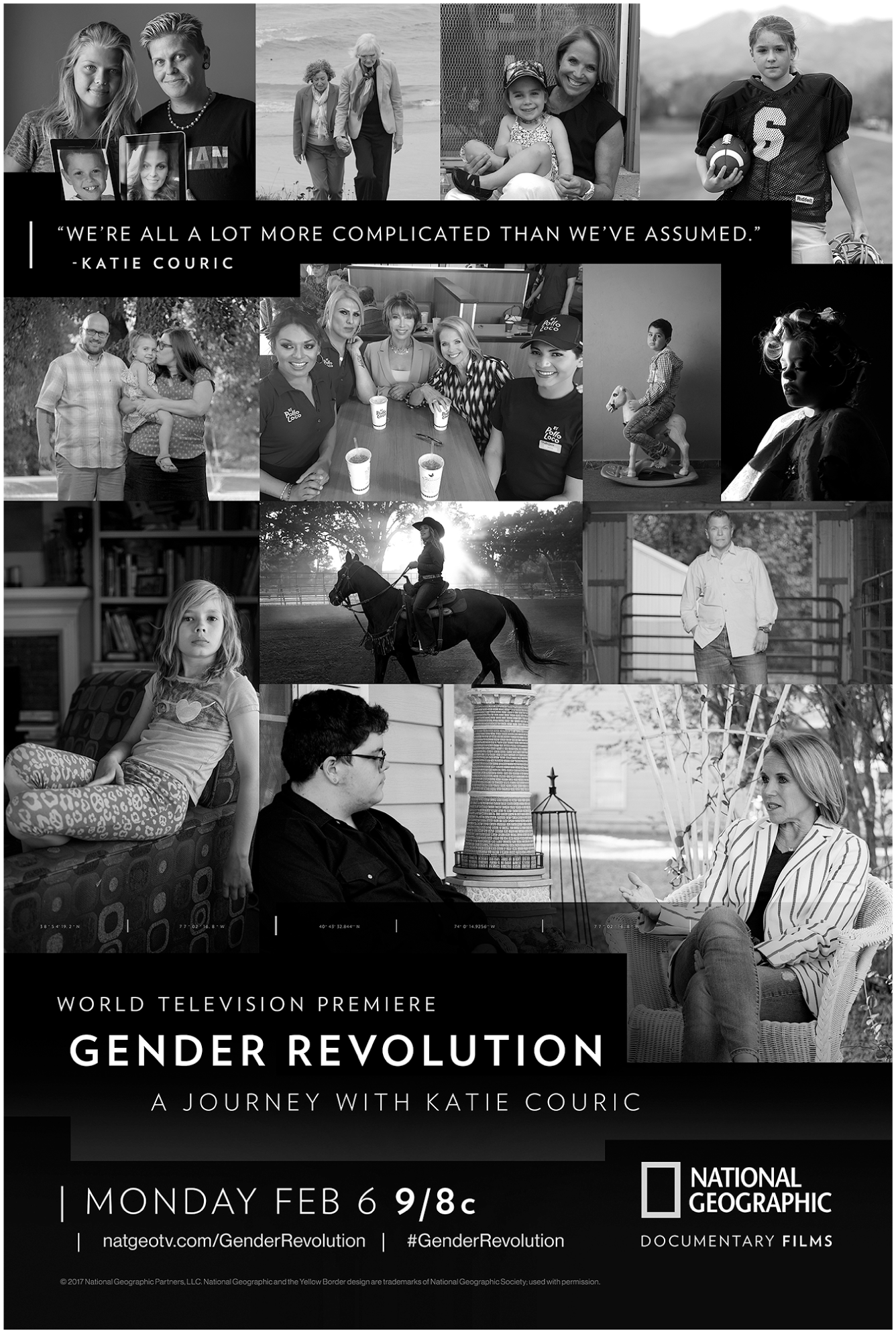
The National Geographic film Gender Revolution: A Journey with Katie Couric is a narrative report from an ongoing but seemingly somewhat successful revolution. And yet, within weeks of its debut, Trump’s Office of Civil Rights rolled back federal support for the legal protections of transgender youth in schools. How better to illustrate the culture wars of 21st century America? I wish I could require every member of Trump’s cabinet had to watch this 90-minute film and write an essay on experiences of those who do not fit easily into a gender binary. Since that’s not going to happen, I will discuss the possibilities for using this NatGeo documentary in sociology classrooms.
This documentary is really less about any gender revolution than about acknowledging the existence of a wide range of gender identities. It is about raising trans and intersex visibility in the hope of reducing discrimination against trans and intersex people.
Katie Couric begins the film talking about her childhood, when everything was “so simple”: girls wore pink, boys wore blue. Girls played with dolls, boys played with trucks. Born in 1957, Couric explains, she grew up in a world with only two kinds of people—boys and girls—and every aspect of society was organized to be sure they lived very different kinds of lives. Then, she narrates, things began to change. Mary Tyler Moore was Couric’s role model, a sitcom catalyst that fueled her career in journalism. Thus, almost emulating the TV show, Couric doggedly worked to establish a successful career in journalism, breaking gender barriers along the way. Couric then talks about how the gender revolution has changed: when she was young, the revolution was about changing gender “roles.” Now, she says, it is about gender itself. This may be true—indeed, I argue in my forthcoming book Where The Millennials Will Take Us: A New Generation Wrestles with the Gender Structure that the fourth wave of feminism should be a movement beyond gender. And yet this documentary is really less about any gender revolution than about acknowledging the existence of a wide range of gender identities. It is about raising trans and intersex visibility in the hope of reducing discrimination against trans and intersex people.
Most of the film involves Couric’s interviews with people who do not fit into a simple sex or gender binary, their parents (and in one case, their adult child), and experts on the topic. Each intersex and transgender person interviewed, from four-year-old Ellie to senior citizen Kate Rohr, illustrates the drive and need to live authentically according to their inner selves, not the external body that nature provided. Anyone watching the film will see Couric learn a whole new vocabulary: cisgender, pangender, bigender, non-binary, and more. She learns that “transtrender” is a slur and not a new identity, that “gender fluid” means that identity changes by days or weeks or over time, and that questioning and changing one’s identity from time to time is also legitimate. As Sam Killermann, the author of the “genderbread person” meme, tells Couric, in any Gender 101 course, you will learn that “gender is who you go to bed as, sexual orientation is who you go to bed with.”
Biological theories for gender identity are offered throughout the film, usually focused on the determinative effects of atypical quantities of testosterone and estrogen in utero, although one expert, endocrinologist Dr. Joshua Safer, suggests that transgender people may one day be identifiable by the shape of the hypothalamus. During Couric’s journey, the audience is introduced to the tale of psychologist John Money’s failed experiment to prove “nurture over nature” with the Reimer twins. We see a clip of David Reimer, the twin boy who lost his penis in a circumcision accident and was reared as a girl but who returned to being a man once he was told the truth as a teenager. Reimer hopes no one else will have to suffer as he did and his words are amplified when we learn of his subsequent suicide. The revelation is followed directly by an expert describing a “landmark” study that showed that two-thirds of these “genetic boys” born without penises and raised as girls with surgically constructed vaginas chose to return to their genetic sex when told the truth as teenagers. While a third remained girls, the study ended. We are left wondering about their choices over time. Whatever the strengths or weaknesses of this study’s design—its sample size was just 16—it surely provides good evidence that surgeries should not be imposed on children too young to determine their own gender identity. Indeed, we meet baby Rosie, whose 21st century parents refused surgery to cosmetically “fix” her intersex trait. Sociologist and intersex activist Georgiann Davis is interviewed and argues convincingly that unnecessary surgery to force intersex children into the sex binary is a violation of their human rights. Unfortunately, Professor Davis’ appearance is the only appearance of any sociology or sociologist throughout the entire film.
In a movie clearly designed to educate and inspire its audience, every family we meet is loving and supportive of their transgender member, but civil rights issues are not entirely ignored. We get to meet Gavin Grimm, the incredibly articulate young man whose fight to use the bathroom of his identity at his high school was on its way to the Supreme Court (until the Trump administration’s directives induced SCOTUS to reverse its willingness to hear the case). It is heartbreaking to watch clips of the schoolboard meeting in which adults called Gavin a freak, cheering each other on in their rudeness. it is powerful to watch Gavin’s calm, adult-like response. The narrative always remains positive. When we learn, briefly, that many transgender people of color are poor, unemployed, and targets of violence, our attention is quickly shifted to the California fast food company, El Pollo Loco, and a transwoman who is committed to hiring other transwomen to work in the franchises she owns.
Gender Revolution is heavily U.S. focused, though viewers are introduced to global cultures in which there is greater acceptance of people who do not fit into a gender binary. For example, in Samoa, there are people born male who grow up “in the manner of a woman” and look feminine. They are referred to as fa’afafine and are allegedly fully integrated into society and play important roles in their family of origin. Similarly there is a third sex in India and in Mexico, and a Talmudic scholar informs us that there are six genders in classical Jewish texts (although this is certainly not something I was ever taught in Hebrew school).
The final scene is a conversation between one of the earliest Americans to undergo gender affirmation surgery, Renee Richards, and Hari Nef, a transwoman who is a model, actress, and activist. A generation gap quickly emerges, because Richards endorses a gender binary. She was a male, and now she is a female. She thinks boys should wear blue and girls should wear pink. She even uses pink golf tees. She justifies the gender binary by referring to chromosomes and argues that binary is the “reality” of human life. Nef agrees that we live in a binary world, but thinks that itself is the problem. In colorful language, Nef argues that “gender is a fetish” and that the “world has a hard-on” for the binary, for man/woman, pink/blue. She wants a “gender chill” future where we “chill out about the freaking gender thing.” Richards admits that this conversation is an education for her, but maintains that a “gender chill world” sounds like an unattainable utopia.
And so we return to the question Couric raised at the outset: Just where is the gender revolution now? Have we left behind the need to fight for gender equality between women and men? Is the gender revolution now about ending discrimination against transgender, intersex, and genderqueer people, affirming everyone’s right to identify their own gender? Or is it, as Hari Nef argues, about moving beyond gender? Couric doesn’t attempt any answers, but she ends the film by suggesting that we live in a brave new world that will take some time getting used to.
National Geographic’s new documentary is a natural choice for sociology courses covering concepts like discrimination, stigma, social change, identity, and social movements. Of course, the relentlessly positive narrative showcasing supportive parents, doctors, and families will need to be balanced with whatever realpolitik is in the headlines at the moment. The film will spark great conversations in courses on gender, but here while the terrain is even more relevant, it is also more pedagogically challenging. In my view, sociology of gender courses should, and usually do, include some attention to the social construction of gender and also to how gender inequality is embedded in social organization beyond individual identities. The meta-message in the film is that femininity and masculinity are gender, that everyone should have the freedom to be the gender of their identity, and that atypical quantities of testosterone and estrogen in utero explain the existence of a gender spectrum. These are not the meta-messages that are usually thematic in sociology courses.
Couric’s version of the gender revolution is the acceptance of nature’s diversity in humankind. This is a great goal, and one which I wholeheartedly endorse. But I also challenge my sociological colleagues to use this film to spark harder conversations in gender courses. Once we affirm everyone’s right to identify their own gender, what then? Doesn’t gender remain a social structure that legitimates inequality? We socialize boys and girls differently: boys are expected to be athletic and excel in science, girls at the arts and humanities. Women are expected to shoulder primary responsibility for caretaking, men are often not seen as valuable family members if they are not “breadwinners” employed in stable jobs. In my interviews with millennials for my new book, most seemed confused about the norms and expectations attached to gender in the 21st century, but they were all sure that gender structures exist and shape their lives. Sociologist Kathleen Gerson’s research suggests that while most young, heterosexual people today want to share family and economic labor with their partners, women would rather go it alone then become economic dependents and the men would settle for wives who fall back into more traditional wifely roles if equality proved too tough.
As sociologist Paula England has argued, the gender revolution has indeed stalled. This film is an important educational tool to teach about the diversity of gender identity, the civil rights of those who cross the gender binary, and those who reject gender entirely. And yet, it challenges us as sociologists to engage our students with a more theoretically complex conversation about gender as a social structure that legitimates inequality.
Footnotes
Watch clips and read excerpts from the National Geographic special issue on gender at channel.nationalgeographic.com/gender-revolution.