



Abstract
In “manvertising,” satirical masculinity is used to sell men on products they presumably avoid for fear of what it might say about their gender and sexual identities. The satire obscures the consequences of hybrid masculinities though they’re on full display.
<< Foam Cowboy, Isaiah Mustafa, in an Old Spice advertisement.
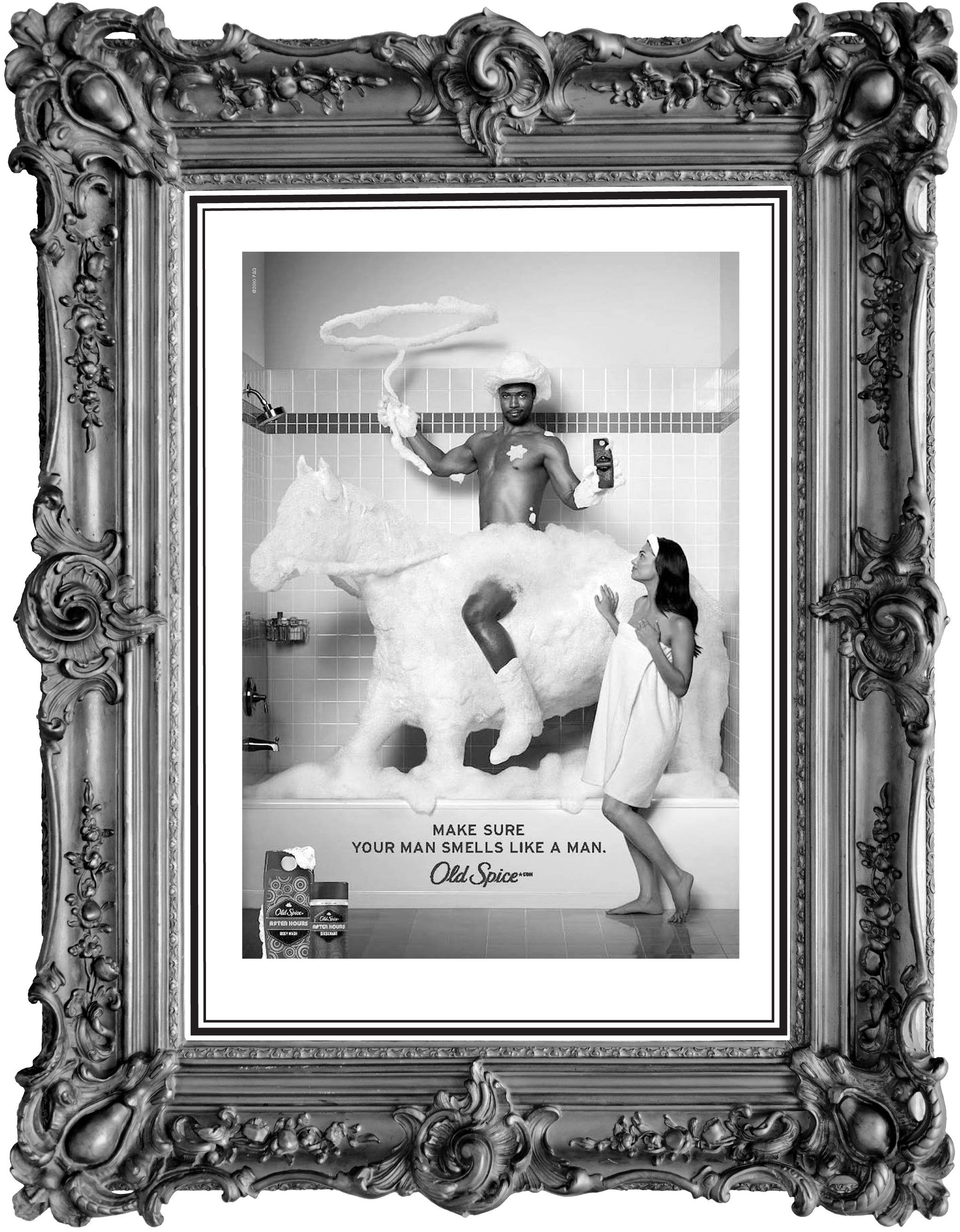
Isaiah Mustafa, shirtless, rises from a bubble bath on a white foam horse to spread the word: “Make Sure Your Man Smells Like a Man.” This slogan appears at the bottom of the page, implying there is indeed such a thing as a “manly” scent. He wears foam cowboy boots, chaps, and gloves, as well as a foam hat and sheriff’s badge. In his left hand, he displays a red bottle of Old Spice body wash. A woman, wrapped in only a towel, gazes at Mustafa as he whips his foam lasso in the air, sardonically engaging the iconic image of the American cowboy. With a subtle smirk that suggests a casual confidence, the meanings of Mustafa’s gender display are diverse. Aimed at men and women alike, this advertisement identifies a potentially deficient man and offers a solution to shore up his masculinity. While the story of transformation through consumption is not new, the jocular exaggeration, wit, and satire seen here are unique features of a popular portrayal of men in advertising today.
In recent years, Old Spice has relied on a satirical display of masculinity to rebrand its merchandise. Satire mocks while also revealing a supposed truth about some group, idea, thing, or behavior—here, who men are and who they can and should be. While Mustafa has achieved widespread recognition as the “Old Spice Guy,” the satirical masculinity he helped to make famous is used to market an incredibly diverse array of products. Consider Kraft’s “Let’s Get Zesty” campaign for a line of salad dressings. Like Mustafa, actor Anderson Davis is presented as both a farce and a representative of a masculine ideal. Similarly, Yoplait features square-jawed, furrowed-brow actor Dominic Purcell in marketing its “fluffy,” low-calorie Greek yogurt. When he produces a tiny spoon from his pocket, we see that men can maintain masculinity while enjoying a whipped, fruity treat.
All of these advertisements proceed from the assumption that masculinity is naturally at odds with anything even vaguely associated with women, like body wash, salad, and yogurt. Satirical masculinity produces a set of facetious cultural scripts that bridge this divide to create a new consumer base that “mans up” to purchase otherwise “feminine” products.
All of these advertisements present recognizable markers of what sociologist Raewyn Connell calls hegemonic—or culturally celebrated—masculinity, but they also poke fun at those very same markers. The joke plays on the use of contrasting symbols, behavior, and products associated with femininity alongside enactments of hypermasculinity. For instance, in the Yoplait commercials, Purcell’s size suggests strength and the ability to dominate others (consistent with his television roles in “Prison Break” and “Legends of Tomorrow”), and his deep voice thrums as he tells us in all seriousness: “It’s like a little fluffy cloud in my mouth. Fluffy, fluffy cloud.” Kraft’s “Let’s Get Zesty” uses the tagline, “The only thing better than dressing is undressing,” playing on the advertising cliché that “sex sells”—no matter what you’re selling. And Mustafa conjures images of intentionally over-the-top romance novel covers. These representations of masculinity are so distant from most men’s everyday lives that they are laughable. But scholars who study humor have found that jokes allow for the perpetuation of sexism, as well as racism, homophobia, and classism.
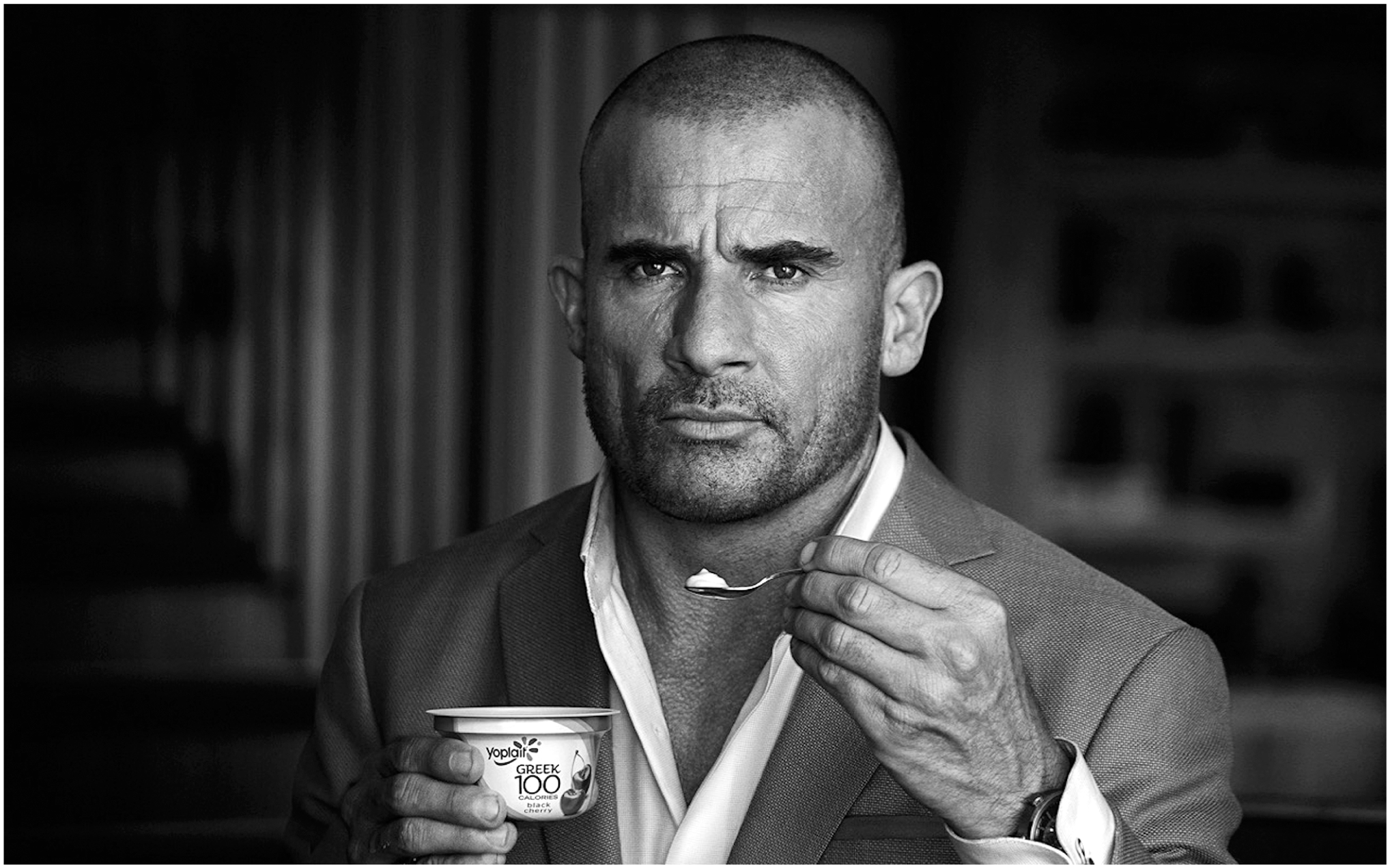
A still of Dominic Purcell in Yoplait’s “Hunger” television commercial for Yoplait Greek 100 yogurt.
It’s worthwhile to ask whether these satirical representations of masculinity are indeed subversive—by making outdated cultural ideals comical—or whether they help to reproduce the very forms of inequality they seem to mock. By analyzing three popular advertising campaigns in the satirical masculinity genre, we connect a cultural phenomenon to the emerging theory of “hybrid masculinities,” which considers shifting definitions of manhood in terms of their larger consequences for equality.
The material evidence of masculinity has shifted, from steady paychecks to sudsy products.
Satirical Masculinity and Hybridity
Satire is part of a larger cultural shift in masculinity and gender relations. Both social theory and empirical scholarship challenge the claim that certain historical periods are marked by masculinity crises, proceeding, as it does, from some idea of a stable masculinity. On the contrary, what we think of as “manly,” “macho,” or “masculine” varies by society, subculture, and time. But shifts in masculinity do follow a curious pattern: they are reactive rather than anticipatory. Masculinities scholar Michael Kimmel argues that anxiety about what masculinity actually is tends to follow transformations in femininity. Though the idea is counter-intuitive (we don’t think of groups in power as being “pushed around” in this way), the historical record bears out Kimmel’s point. When women enter into historically “masculine” arenas, like sports or the workplace, they shift the boundaries of femininity. And those are the moments when we get anxious about masculinity, claim that it is “in crisis,” and find groups rallying around “solutions” to this suddenly pressing social issue.
Sociologists studying culturally dominant groups are often interested in how these groups retain power and under what circumstances their claims to dominance are challenged. When challenges to inequality fail to produce lasting change, sociologists want to know why. C.J. Pascoe and Tristan Bridges, who theorize hybrid masculinities, have surveyed the masculinities literature and argue that it shows White, straight, and well-to-do men sometimes adopt various elements of “other,” more socially marginalized masculinities (and sometimes femininities, too) into their own performances of masculinity. This behavior produces the impression that social change has occurred without any real shifts in privilege.
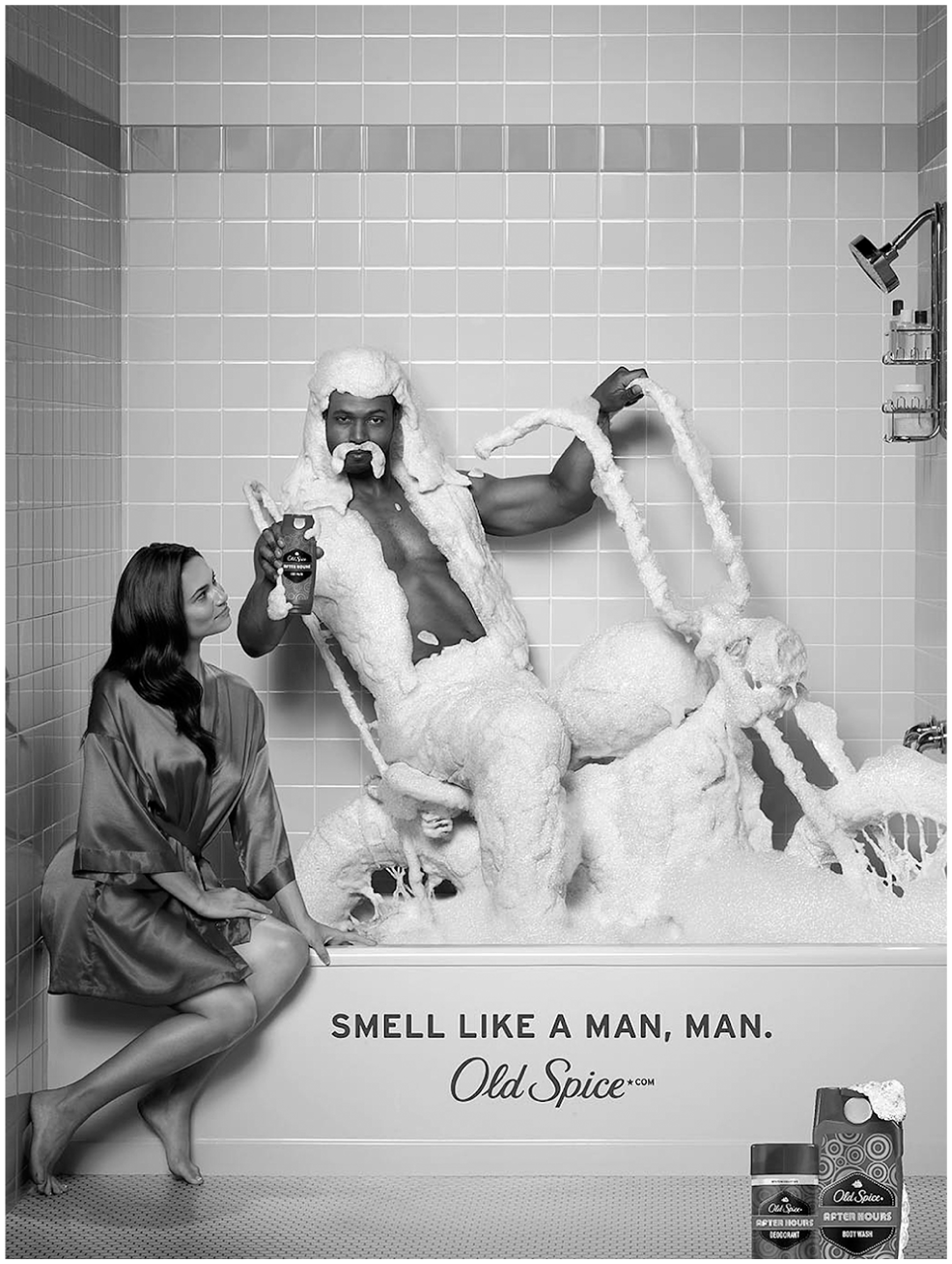
Isiah Mustafa as a biker for the Old Spice “Smell Like a Man, Man” campaign.
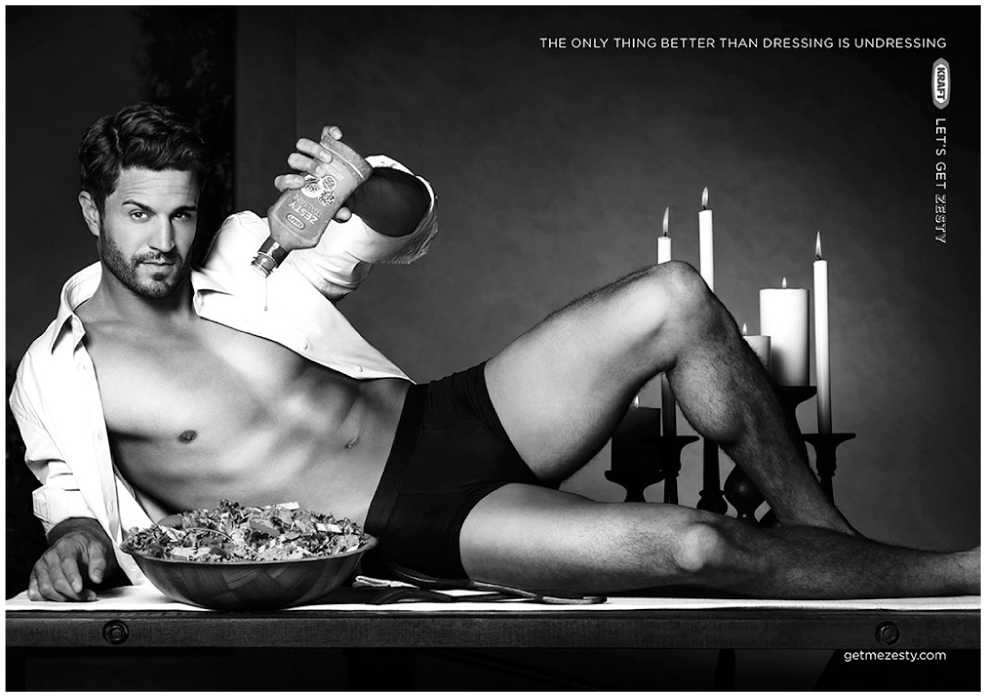
Anderson Davis in Kraft’s “Let’s Get Zesty” campaign.
Inequalities that persist, adapt. The theory of hybrid masculinities suggests that adaption takes place via three interrelated processes. First, hybrid masculinities produce symbolic distance between men and hegemonic forms of masculinity. Michael J. Murphy, for example, shows that public service campaigns like “Real Men Don’t Rape” or “My Strength is Not for Hurting” allow some men to position themselves as beyond reproach. Second, hybrid masculinities involve men “strategically borrowing” elements from disadvantaged groups, such as when White men adopt elements of African-American culture. Third, hybrid masculinities fortify boundaries between groups in ways that obscure the inequalities defining those boundaries. So, when straight men play with “gay” culture, it can create the appearance that incredible change has occurred. But if structural inequalities between straight and queer men remain intact, playfulness accomplishes little more than expanding their gender repertoires via a kind of identity tourism.
As a heuristic device, the satirical masculinity in so much contemporary advertising aimed at men is a powerful illustration of hybrid masculinity. These ads show us one way that current forms of inequality persist even as popular and academic critiques of “toxic” masculinity gain attention.
In 2008, Old Spice began a drastic rebranding effort with its “Swagger” advertisements featuring football player Brian Urlacher and musician LL Cool J. The brand has long been associated with older men, partially because it was a trailblazer in personal care products aimed at men; the reliable red packaging with a white sailboat has been available in drugstores since 1938.
As market research companies like Euromonitor International encourage cosmetic companies to appeal to young men and their wallets, though, we have seen a proliferation of commercials and print advertisements that engage satirical masculinity. (Super Bowl commercials have become particularly famous for this.) But satirical humor has not been analyzed much by social scientists, perhaps because its tongue-in-cheek character makes it difficult to take seriously.
Once-popular markers of adulthood such as marriage, children, and breadwinning jobs are less accessible to younger generations of men. In step, retail companies offer consumption as the new rite of passage to manhood. In the case of Old Spice, tackling the femininity of self-care and the association of its products with older men, the company’s advertisements play with masculine stereotypes to widen its consumer base. And proceeding from the notion that men perceive themselves as deficient when it comes to masculinity, Old Spice facetiously provides everyday men the potential to feel masculine. The material evidence of masculinity has shifted, from steady paychecks to sudsy products.
Old Spice’s “Smell Like a Man, Man” campaign offers young men something they are presumably lacking—manhood—embodied by the cowboy, the biker, and the lumberjack. Culturally salient and rewarded, these representations symbolize power and dominance.
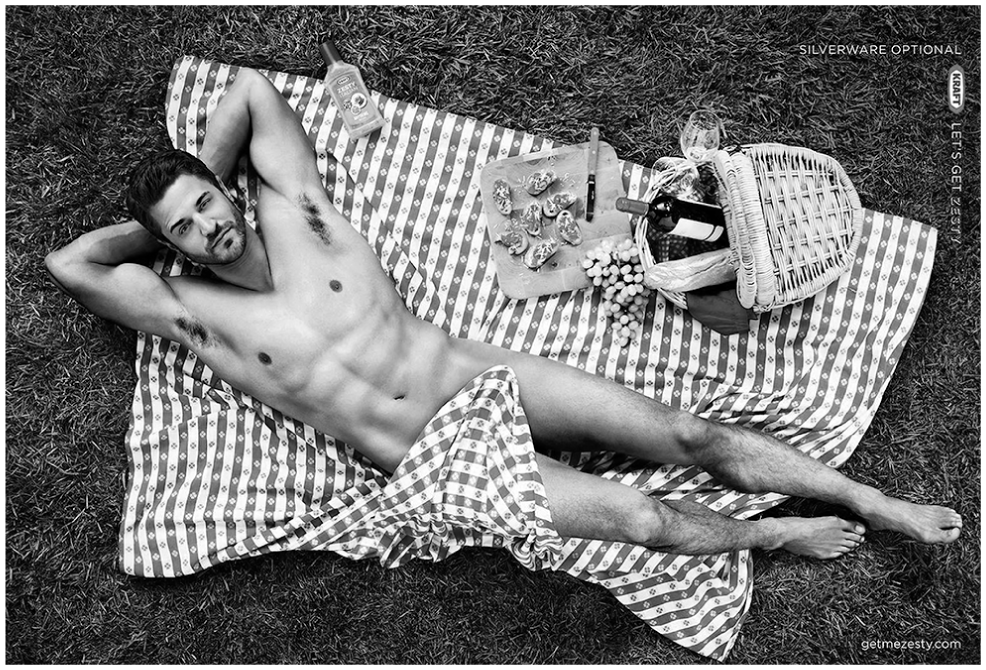
Kraft print advertisement for zesty Italian dressing.
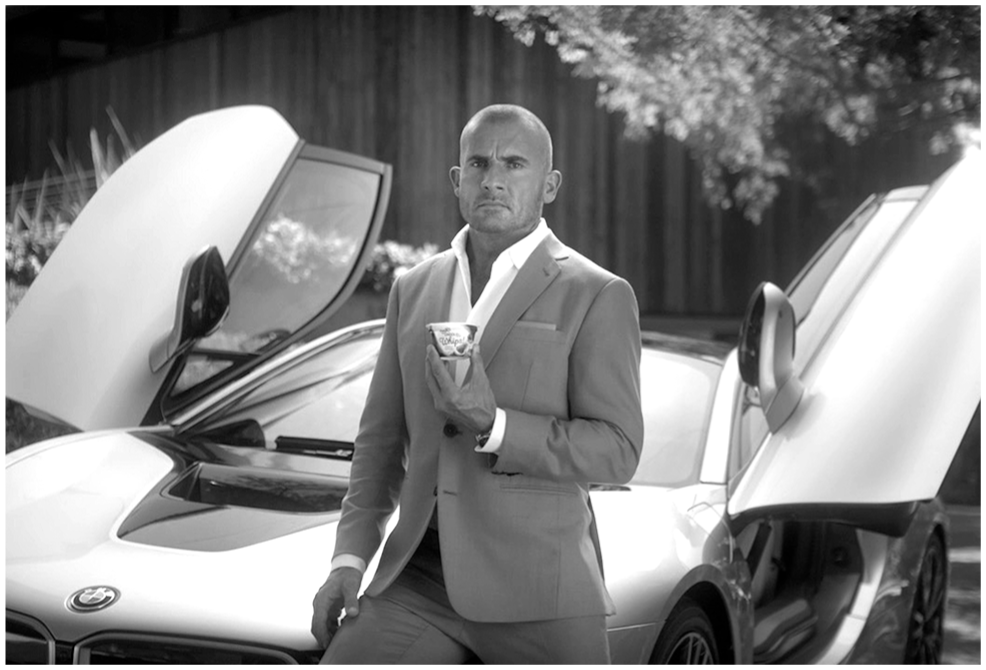
Dominic Purcell eats “fluffy” Yoplait yogurt.
Yet Mustafa’s presentation of manhood is complicated. His cowboy is not all macho; it could even suggest a queer sensibility. It’s not hard to imagine him as a member of The Village People, an exaggerated presentation of masculinity echoing the clone culture among gay men in the 1970s and ‘80s. The clone pulled from working-class fashions while emphasizing the buff, masculine body. At the same time, the presence of a woman in the ads allows for the potential of dual advertising, a strategy originated by Calvin Klein to produce a more subtle resonance with gay men alongside a more overt pitch to straight men. This queerness creates a contradiction in masculinity, making it difficult to take seriously the hegemonic markers of power. In this symbolic murkiness, Pascoe and Bridges explain how hybrid masculinities make existing inequalities hard to identify.
Playing on the White, working-class, biker aesthetic in another of the series’ ads, Mustafa dons a long, foamy handlebar mustache and mullet. In line with hybrid masculinity, however, this manly, “white trash” look is undermined by the comedic mismatch of Mustafa’s serious facial expression. His masculinity is intentionally outlandish, a characteristic of this type of gender play. And if that’s not enough, his raised eyebrow and slight smirk underline this playfulness to viewers.
Satirical masculinity is used to sell men on products they presumably avoid for fear of what it might say about their gender and sexual identities.
“Oh, hey ladies. Are you in the mood to do something special?” Actor Anderson Davis slowly sucks on a wooden spoon he’s just used to toss a salad. “I sure am.” The camera pans to a stick of butter that melts under his smoldering gaze. “You know, once you go Italian, you never go back.” It’s unclear if Davis is talking about himself or the sausages in the skillet. With a backdrop of the Tuscan countryside behind him, Davis steps over to a pot of boiling water. He lifts the lid: “Steamy.” His tight white t-shirt clings to his chest, wet from the condensation. The idea is that this will be a romantic dinner and, drawing from larger cultural ideas that women are lucky if their husbands or boyfriends do the cooking, Davis is presented as the perfect man. He’s presumably a reflection of just how far feminism has come.
But in the three-part series of Kraft ads starring Davis, the romantic man appears ridiculously cliché. It might be more accurate to call his performance of masculinity a caricature. With his faintly raised eyebrow, Kraft represents Davis as simultaneously—if awkwardly—celebrating and mocking domestic, hetero-romantic masculinity. This simultaneity illustrates change and continuity in relations between men and women—the audience is primed to see it as funny that a “manly-man” is enacting tropes about women’s sexual desire (stoked by the fantasy of temporarily surrendering “their” domestic tasks).
In a print advertisement, Kraft depicts a naked Davis on a red and white-checkered picnic blanket. A corner of the blanket keeps him modest by covering his genitals, and a picnic basket overflows next to him. Women, and perhaps men, are invited to imagine themselves at this picnic—curiously absent any salad. The image plays on tropes about hetero-romantic masculinity, and especially on stereotypes about women’s desires.
This campaign celebrates gender relationships and sexual practices that feminists have shown perpetuate gender inequality, but with a wink and a nod. They are the exception that proves the rule in that they revive heterosexist assumptions of masculine subjectivity that structure unequal relations between men and women. Again, the humor is in the presentation of women as sexual subjects rather than as the objects of desire.
General Mills, co-owner of Yoplait, declares that “Dominic Purcell is a Man of Yogurt.” He is “noted for acting rugged and tough,” the company’s blog post states, but he can still tuck into a “smooth, creamy, and sometimes fluffy” treat.
Indeed, Purcell is built like a linebacker, and he doesn’t smile in any of the Yoplait advertisements or television commercials. “You see this look on my face?” He asks the audience in one commercial, “It’s not anger; it’s hunger.” And apparently, a cup of 100-calorie yogurt will take the edge off. He promises that as he eats it, “a look of satisfaction and contentment [will] blossom across my face.” His deep, sober tone remains flat, as does his expression. “Yum. See?” That’s the joke: that Purcell has only one mode: stoic, serious, possibly dangerous. Eating yogurt doesn’t compromise it a bit.
Like both the Old Spice and Kraft campaigns, Yoplait is attempting to bridge a gender gap in consumption by acknowledging yogurt is culturally coded as “feminine” and potentially emasculating. Successful representations of hybrid masculinities that mitigate the gender of these products require strategic framing to be understood as “masculine” among intended audiences.
Recall that satirical masculinity is used to sell men on products they presumably avoid for fear of what it might say about their gender and sexual identities. In response, all of these advertisements share a common feature: the intentionally excessive displays of masculinity. Through this, Yoplait’s depiction of Purcell—like Kraft’s use of Anderson and Old Spice’s reliance upon Mustafa—appears to simultaneously celebrate and mock his masculinity. After commenting on the “fluffy cloud” quality of the yogurt, the lambo doors wing open on a silver sports car. By contrasting feminine yogurt with the phallic muscle car, this commercial appears to indicate some change, perhaps a softening of masculinity or a calling-out of unrealistic masculine types. But it also continues to celebrate elements of masculinity that feminist scholars argue are in dire need of change.
Satirical masculinity offers viewers the appearance of something progressive by seemingly mocking or deriding configurations of masculinity that have sustained feminist criticism, including hetero-romantic and hard-bodied, action hero masculinities. These images offer a playful, ironic masculinity, and invite us to take pleasure in men who clearly embody idealized forms of masculinity while engaging in “feminine” consumption practices. But this joke really only works if the systems of power are both carefully concealed and reinforced. As illustrations of hybrid masculinity, these displays of masculinity underscore stereotypical gender and sexual differences—though in novel ways. The use of satire helps to obscure the full consequences of hybrid masculinities despite them being on full display. It is comical to see Purcell’s big hands skillfully wield a tiny spoon with which to eat yogurt, but only because his association with masculine power remains intact.
These ads might also look like sexual objectification, and a great bit of popular discussion assumes this objectification affects men’s self-esteem and relationships to their bodies. As gender scholar Susan Bordo argues in her book, The Male Body, “I never dreamed that ‘equality’ would move in the direction of men worrying more about their looks rather than women worrying less.” But emergent research on hybrid masculinities finds that looks can be deceiving. This is because sexual objectification is a cultural process that disempowers women on a larger scale, affecting their abilities to be taken seriously in the workplace, for example, or setting the stage for sexual violence and slut-shaming. While displays of satirical masculinity are often sexual, they are not disempowering. These commercials do not wholly undermine the “feminine” nature of these products, nor do they challenge the masculinity of those men hired to sell them. And anyone who finds the joke offensive is implicitly chided for caring too much about something so superficial as an advertisement for body wash. After all, it’s just a joke—right?
The use of satire helps to obscure the full consequences of hybrid masculinities despite them being on full display.