



Abstract
South Africa’s post-apartheid government tried to use urban policy to reverse racial segregation. But as shack settlements proliferated on urban peripheries, squatters came to be viewed as a threat to the state rather than its beneficiaries. In Cape Town, urban policy has entrenched, rather than reversed, racially segregated settlement patterns.
Rapid urbanization has led social scientists to train their analyses on the growth of megaslums, yet most of city-dwellers live in smaller, sometimes informal settlements that have emerged in recent decades. In Brazil, India, Nigeria, Mexico, and elsewhere, governments are using housing policy as a key tool for managing this crisis of informal urbanization. But too frequently, the unintended consequence is to criminalize squatters rather than provide viable alternatives. Housing distribution has ultimately functioned to fix already marginalized—and racialized—populations to the urban periphery.
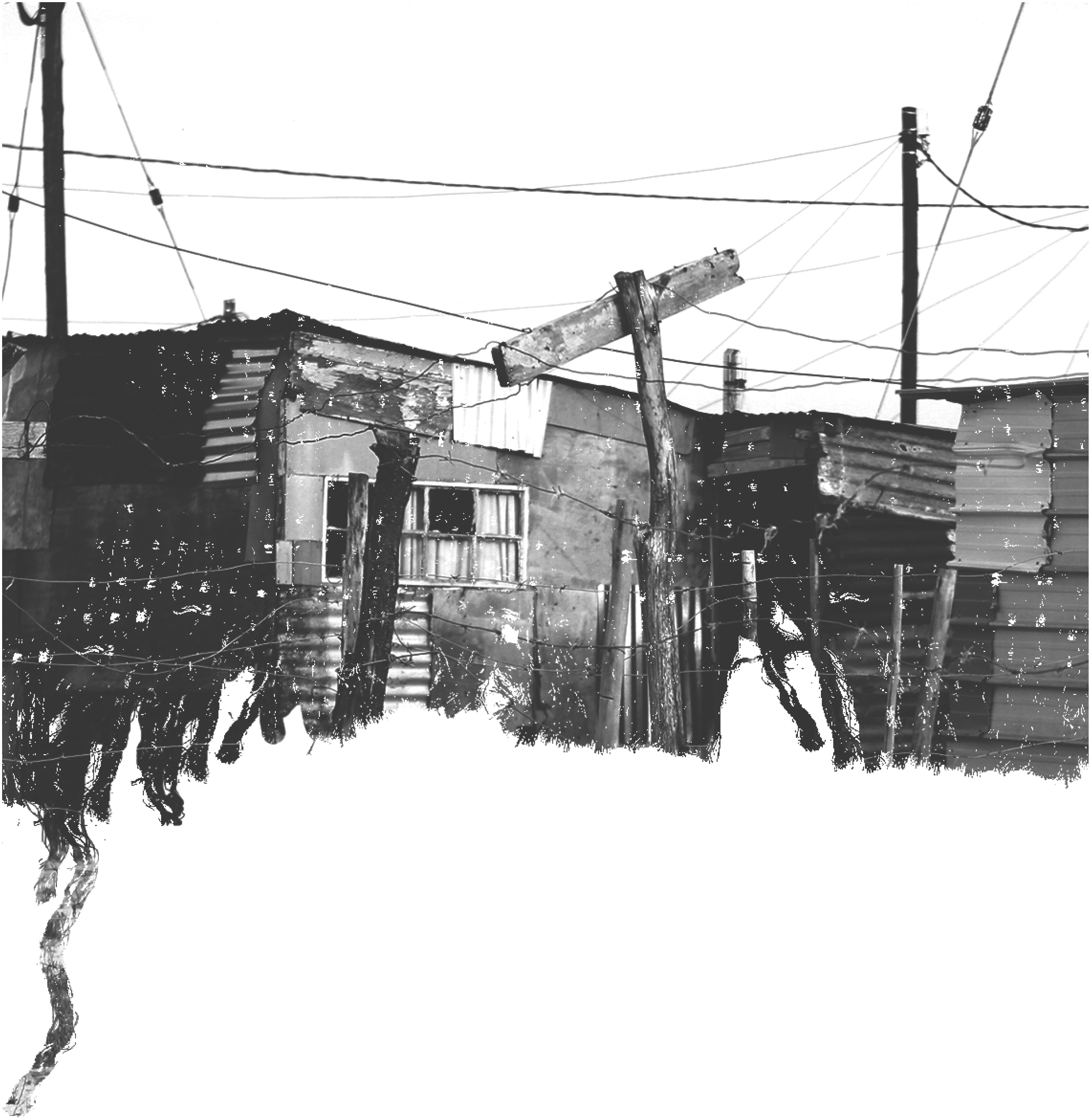
Makhaza township, 2012.
Meshugas, Flickr CC
This process is readily apparent in post-apartheid South Africa. In 1994, the newly installed democratic government devised a housing delivery program in which free, formal structures would be distributed to qualifying residents. A version of this program continues to this day, hypothetically serving any South African citizen whose monthly household income is below R3500 (US$240) and who has never previously owned any property.
The government’s data are hotly debated. According to its figures, more than 20% of the entire South African population has been housed under this program. Yet informal settlements have proliferated in municipalities across the country, and there are enormous municipal housing backlogs. Informal structures—shacks, really—constitute the standard form of housing for roughly a fifth of Capetonians and between 15 and 30% of residents in most South African cities today. “Informal settlement” is the government’s favored term for shacks deemed facts on the ground, homes for a deserving poor; land occupations—or “land invasions” in the government’s terminology—are represented as obnoxious, dangerous, and ultimately, housing for an undeserving poor.
The situation is particularly stark in Cape Town. Of South Africa’s major municipalities, only Durban and Port Elizabeth have higher levels of racial segregation, and, in the province in which Cape Town is located, the housing backlog nearly doubled over the first decade after the transition, remaining relatively constant since 2006. Still, the ruling party in Cape Town—the Democratic Alliance (DA)—continues to assert that its housing and service delivery record is exceptional, even as land occupations are regularly evicted.
What happens to those who slip through the cracks? Housing delivery is a process that can take decades. During my fieldwork, I regularly encountered people who had registered with the waiting list under the apartheid regime and were still awaiting homes. As interpreted by South Africa’s Constitutional Court, the post-apartheid Constitution requires municipalities to provide “alternative accommodation” in all cases of eviction, and this includes the clearance of illegal land occupations. One emergent solution is what the City of Cape Town has called temporary relocation areas (TRAs). TRAs were originally devised as transitional housing in cases of shack fires, environmental hazards, or construction-induced displacement, but now serve as a standard offer of “alternative accommodation” whenever the City seeks to evict land occupiers.
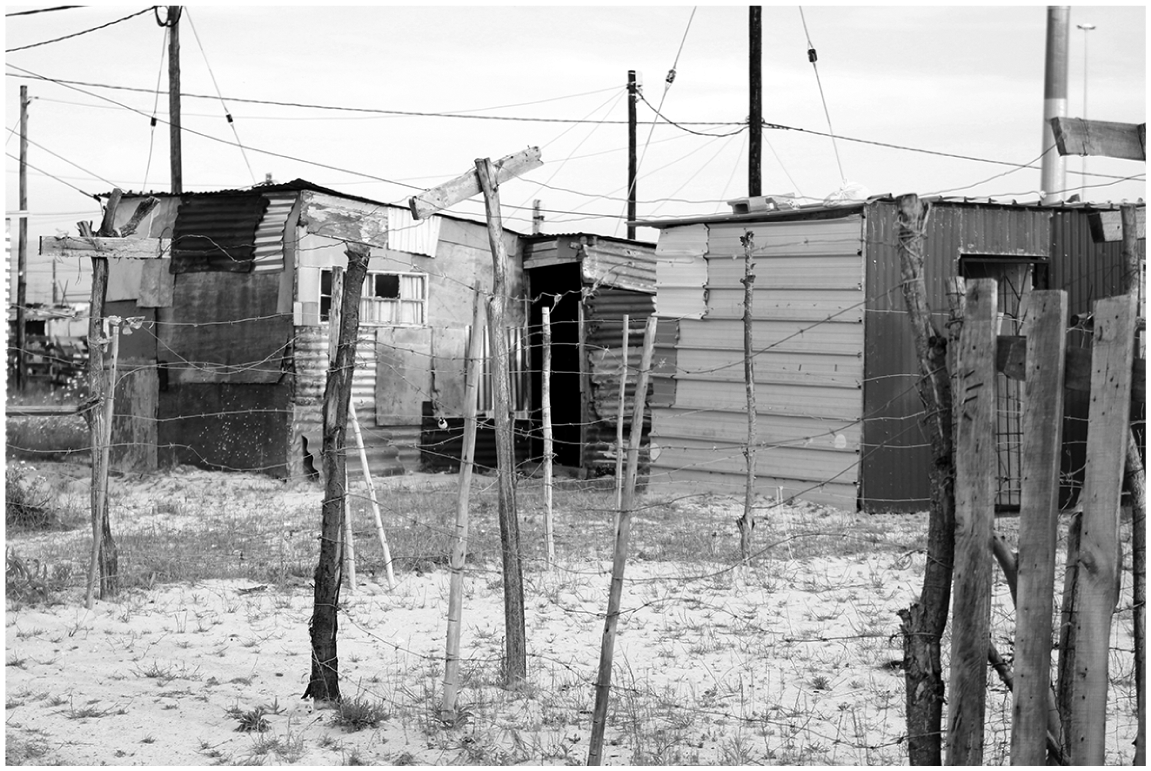
All of Cape Town’s TRAs are on the city’s outskirts, though at nearly 30 km from the city center by major roads, Blikkiesdorp—officially called Symphony Way TRA—is farther than most. In this large TRA, the City provides residents with free, one-room, 18m2 structures made of thin sheets of corrugated zinc. There are nearly 1,800 of these structures in Blikkiesdorp, an Afrikaans name meaning “tin can town.” In August 2013, I drove to a public library a half-mile or so down the road to meet with community organizers who had called a meeting to discuss the future of “temporary” housing in their TRA. Many residents had, by this time, been in Blikkiesdorp for six years. There did not seem to be anything “temporary” about this temporary relocation area.
“The City doesn’t have plans for relocation?” I asked. The meeting hadn’t begun, and three of us walked down Delft Main Road, turning down a small side street. My companions looked at me, looked at the rows of small structures enclosed by chain-link fencing, then looked back at me. If it were possible to beam with disdain, this is precisely what they were doing. They dealt with the surreality of the municipal government’s relocation plan in the only way they knew how: by laughing it off.
“These are the New Tech houses,” Eva told me. She was one of the key organizers in her section of Blikkiesdorp. She reached down and picked up a piece of Styrofoam, about the size of a softball. “See this? This is what those homes are made from!” The homes in front of us were only marginally bigger than the structures in Blikkiesdorp, and they looked quite similar—complete with corrugated zinc siding. I asked what distinguished these homes from blikkies. Eva explained that the Styrofoam was there for insulation. During the rainy season, it got particularly chilly on the Cape Flats, and this was supposed to keep inhabitants warm.
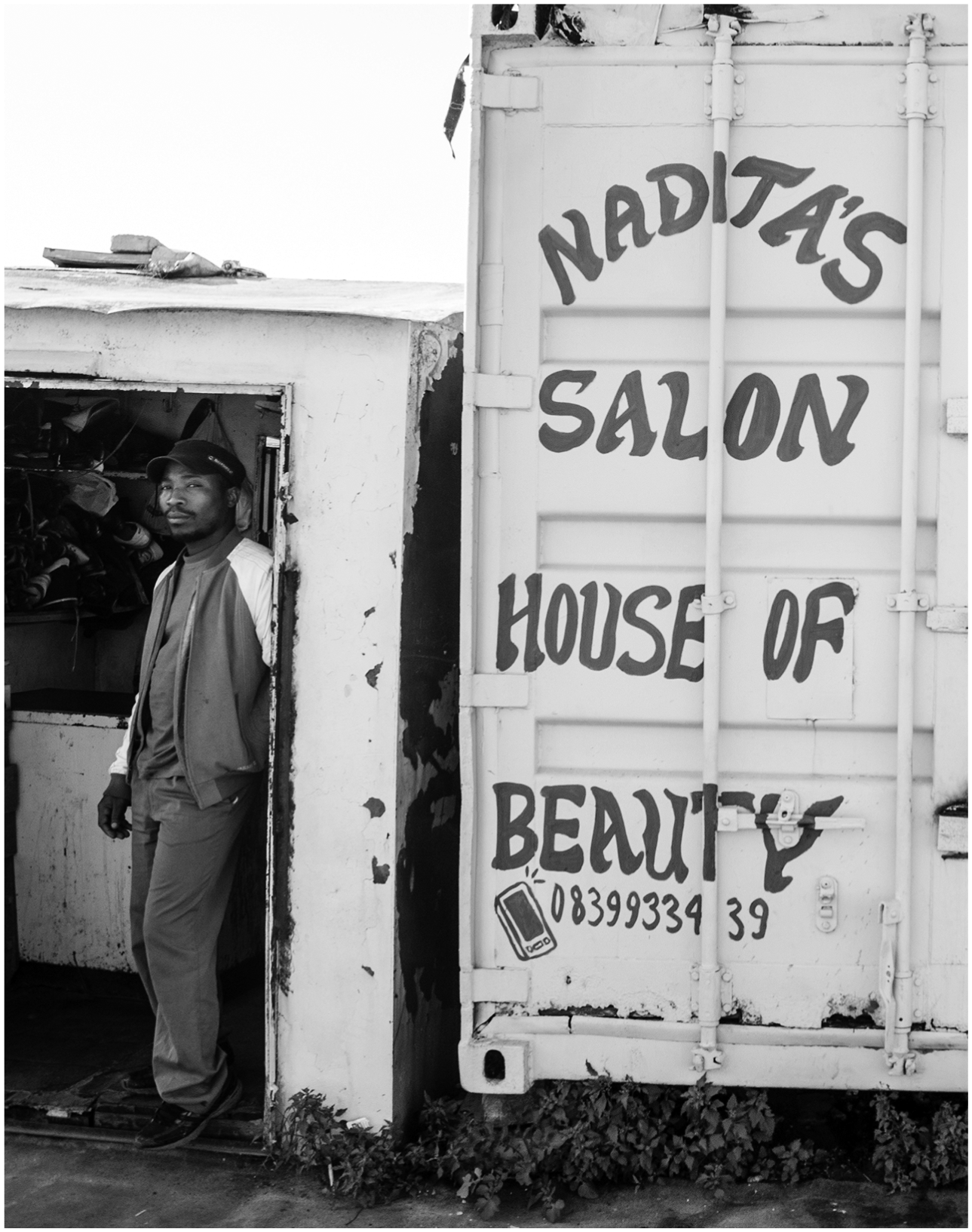
Small businesses operate in shipping containers in Bridgetown.
Isabel Sommerfeld, Flickr CC
Settlement regularization and housing delivery have reinforced Cape Town’s apartheid geography.
If mass land occupations are a form of self-preservation for homeless people, for the City, they are an emergent problem. By 2007, Cape Town’s Department of Human Settlements began “land banking,” buying up land in anticipation of having to relocate land occupation (or “invasion,” in the parlance of City officials) participants. This project was overseen by Marlize Odendal. “From my perspective,” Odendal told me, “I think a lot of what is happening in terms of land invasion—it’s need-driven, by all means. I mean, I understand that. …[U]rbanization alone is a reality that we need to cope with, but I think that a lot of [the occupation] is politically motivated and purely aimed at embarrassing and/or just jumping queue. This is really the issue.” Indeed, land occupations are sometimes orchestrated by political parties attempting to move their constituencies into rival parties’ territories, but it is a different thing to say that land occupiers are themselves politically motivated. In my fieldwork, even in the land occupations that did involve parties manipulating constituencies, none of the occupiers appeared aware of the party involvement, and most were openly hostile to the idea.
Land banking was caught in a paradox, Odendal said in our interview. If the City purchased affordable land on the urban periphery, it would have to install taps, toilets, and other basic services—a costly enterprise. But land closer to the city center, where these amenities were already available, was too expensive. Even if the City were to abandon all pretense of providing durable housing and instead simply deliver building materials to greenfield sites and install taps and toilets, land banking still could not reduce the housing backlog. From this perspective, TRAs are a cost-effective means of providing temporary housing as a sort of stopgap measure. But now, nearly a decade after the initial construction of Blikkiesdorp, its original residents remain, and new residents are being funneled in. Blikkiesdorp—and TRAs more generally—have become regularized as a legitimate form of state-provisioned housing, even in non-emergency situations.
Since the demise of apartheid, the functions of relocation have changed drastically. Under apartheid, state-initiated squatter removals had two major purposes, reconciling the needs of two factions in the apartheid government: white supremacists and agribusiness. Initial rounds of evictions were about ensuring racial separation through a modernist project of “tidying the map.” Subsequently, as agricultural capital gained power in the ruling bloc, dispossession was strategically deployed as a means of generating cheap Black labor sources for white farm owners—moving the destitute closer to sites in need of their labor.
After apartheid, the functions of relocation changed altogether. Municipal governments could no longer simply shift populations at will, as they had an image of democratic legitimacy to uphold. Under the post-apartheid government, forced eviction on the basis of race, let alone class, was not a viable option. Second, a prolonged economic crisis beginning in the early 1980s coupled with a process of deindustrialization to create a job shortage. Cities did not contain sufficient employment opportunities for the people building informal settlements. Relocated populations after apartheid typically remain unemployed, with official rates exceeding 40% in some of the neighborhoods where I conducted fieldwork. It therefore does not make sense to think of post-apartheid relocations as either the creation a free wage labor force or the spatial matching of labor sources to potential employers.
Aisha and her husband Muhammad, a Colored Muslim couple in their early 40s, lived in a shack in a distant relative’s backyard in Mitchell’s Plain, the largest Colored township in South Africa. I asked why they decided to join a coordinated land occupation a couple of miles down the road in 2011. “Desperation,” Aisha responded. “We were living in a backyard in a shack that’s probably one-by-two – one meter by two meters.” She laughed at the absurdity of the situation. “And we literally had nowhere to go and were living there, struggling to survive… .I mean, we both had families [and] we wanted to settle down with them… so that our children can… come and live with us.”
On the first morning of the 2011 occupation, Aisha recalled, police and members of a special Department of Human Settlements division called the Anti-Land Invasion Unit (ALIU) showed up to demolish the shacks erected overnight in a municipally owned field. For months, these forces would destroy residential structures and occupiers would rebuild. When their building materials were confiscated, they lived under shopping carts covered with tarps. When these were taken, they dug underground hovels. When police filled them in with dirt, covering their remaining belongings, they lived under a tarp.
When the post-apartheid project of housing distribution fixes racialized populations on the urban periphery, whether in TRAs or in formal houses, it reinforces the spatial mismatch between employment and residence.
Muhammad told me that the City eventually offered those living on the field housing in Blikkiesdorp. “We came to understand that the City’s going to make the offer of Blikkiesdorp,” he explained, “and if you say no, you know what I mean, then you must still leave the land. And the City’s argument in court will be, ‘But we gave alternative.’ But we said, ‘We will take the alternative, but not Blikkiesdorp.’ Because this is what happens: (a) rape, (b) murder, all these things. There’s no schools… And the only reason we went there was because the City wanted to prove to us that Blikkiesdorp is okay.” Muhammad understood the City’s offer as disingenuous: by offering homes in a dangerous encampment known to lack basic amenities, the City was legally allowed to force squatters off the land under the threat of jail time. The City had, after all, offered alternative (though unacceptable) housing.
Land occupations are represented by the City government as exceptional cases of opportunists scrambling to seize land. Stephen Hayward is the director of the City’s ALIU, the agency that combats squatting. Hayward told me, “The City was losing a lot of land because of people illegally invading, and the fact is that the City was losing the land and couldn’t plan and couldn’t continue the process of housing.” For Hayward, land occupations were unpredictable events that interfered with the comprehensive planning and systematic logic of state-provisioned housing. For residents who knew that housing delivery frequently took decades, occupations were attempts to secure livable housing, however precarious, rather than calculated attempts to upend the housing distribution program.
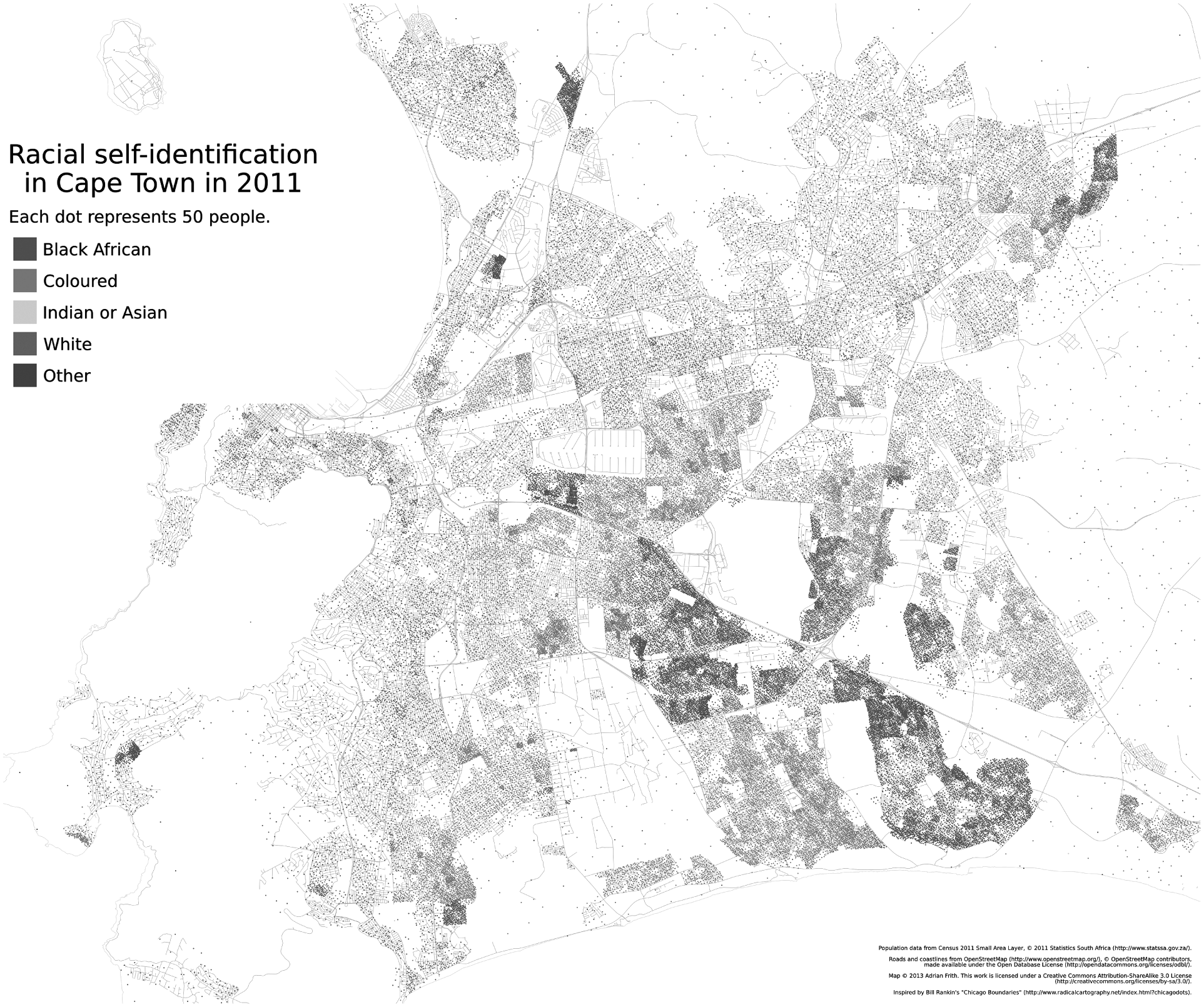
Based on data from the 2011 Census by Statistics South Africa, Adrian Frith’s map shows the relative concentration of people of color on Cape Town’s peripheries. For a more illuminating, full-color version, visit adrianfrith.com.
Nearly every statistic, from unemployment to crime to poverty, remains highest in Cape Town’s Black belt, slightly lower in Colored areas, and substantially better in predominantly White neighborhoods.
Sometimes, this language of “invasion” takes on a double meaning: not only do officials describe land as invaded, but they simultaneously describe cities as invaded by racialized populations presumed to be rural. I asked Alida Koetzee, a White Afrikaner who serves as the Department of Human Settlements’ head of public housing, whether land occupations interfered with housing distribution, and she, like Odendal, insisted, “[T]hey invading, and they get the opportunity first.” She was referring to Black land occupiers. “You must know the nuances in the Cape,” she continued. “The Coloreds are in the Cape; the Blacks are invading the Cape. That’s history. Look at what’s happening: they moving from the Eastern Cape for the opportunity here—whatever economic opportunity: economic, housing, whatever—‘cause there’s nothing happening in the Eastern Cape. You can look at all the national states. It’s just a declining region. So they move everywhere. But that is Xhosa people versus what we have in the Cape, majority still, Coloreds, neh?”
I pressed Koetzee, asking why this constituted a problem. “They abuse the system,” she said. “They will benefit from a house, they sell it or rent it out, and they go and sit in an informal settlement.” Koetzee believed that land occupations were deliberate schemes in which Black South Africans would come to Cape Town, receive free houses, and then illegally rent them out. They would squat on vacant land in the meantime, accruing profits from the rent and therefore not having to work. But land occupations are informal settlements in process—to describe settlements as legitimate but occupations as necessarily hazardous is a meaningless distinction, governmental strategy notwithstanding.
More generally, housing delivery, informal settlement regularization, and the provision of TRA housing shift around populations that city governments see as superfluous. Coupled with the dispersal of land occupations, these technologies function to fix surplus populations on the urban periphery, thwarting their persistent attempts to relocate closer to sites of potential employment. Settlement regularization and housing delivery have reinforced Cape Town’s apartheid geography. To this day, a Black belt extends southeast from the city center, stretching from Langa, the City’s first Black township, to Khayelitsha, among its last. Colored buffers flank both sides of this belt, stretching from Athlone to Mitchell’s Plain on one side and from Bonteheuwel to Blue Downs on the other. Nearly every statistic, from unemployment to crime to poverty remains highest in the Black belt, slightly lower in Colored areas, and substantially better in predominantly White neighborhoods.
The most recent census (2011) makes a few aspects of racial (im)mobility in Cape Town apparent. First, intra-township mobility is limited. In Mitchell’s Plain, where Aisha and Muhammad live, the population remains roughly 95% Colored. This is the second largest township in the city. Depending upon neighborhood, the official unemployment rate in Mitchell’s Plain ranges from 20 to nearly 40%, and between 93 and 99% of Colored residents make below R25,600 monthly (less than US$1900). Meanwhile, in predominantly White suburbs like Constantia, Rondebosch, Newlands, and Hout Bay, between 65 and 75% of the White population makes over R25,600. In wards where substantial Black and Colored populations reside alongside Whites, they are rarely equals. In the ward stretching from the wealthy suburb of Camps Bay south to Hout Bay, the White unemployment rate is barely above 3%; for both Black and Colored residents, it remains upward of 31%.
There are certainly historically Colored neighborhoods to which upwardly mobile Colored Capetonians have moved, among them Zonnebloem, Woodstock, Salt River, and Athlone, all of which are close to the city center, have higher average incomes, and have substantially lower unemployment rates than the more peripheral, informal settlements. But this upward mobility is typically a consequence of finding gainful employment rather than securing a home. Indeed, upward mobility for Black and Colored residents comes despite, not because of, housing provision, which actively isolates them in townships with a shocking lack of decent employment. When the post-apartheid project of housing distribution fixes racialized populations on the urban periphery, whether in TRAs or in formal houses, it reinforces the spatial mismatch between employment and residence.
Cities across postcolonial Africa, Asia, and Latin America are facing similar problems, entrenching rather than reversing colonial settlement patterns through well-intentioned urban policies.
Without a concerted effort to redistribute land proximal to the city center to those South Africans dispossessed by apartheid-era spatial planning, we should expect to find apartheid geographies rendered permanent in cities across the country. Indeed, given the extent to which rapid informal urbanization is a salient phenomenon in most postcolonial states, the unintended consequences of housing distribution require careful analysis. Cities across postcolonial Africa, Asia, and Latin America are facing similar problems, entrenching rather than reversing colonial settlement patterns through well-intentioned urban policies.