



Abstract
In the 2015/2016 season, the close link between big budgets and soccer dominance broke down in the English Premier League. Here, a look at what motivated the surprise and why American-style sport socialism still isn’t likely to emerge in European leagues.
Sports commentators are prone to hyperbole. But when ESPN’s Ian Darke described Leicester City Football Club (LCFC) winning the English Premier League (EPL) title during the 2015/16 season as “the biggest sporting upset in history,” it was hard to call it an exaggeration. These Hoosiers of English soccer started the season with 5,000:1 odds of winning the title due, in part, to the enormous inequality between rich and poor teams in the EPL. By comparison, Vegas gave the 1980 U.S. men’s “Miracle on Ice” hockey squad 1,000:1 odds to secure gold on home territory in Lake Placid. Meanwhile, Chelsea, the previous year’s title winners and a club that spends 4.5 times as much as LCFC on player salaries, spent much of their season lurking at the bottom of the league table.
As remarkable as LCFC and Chelsea’s individual stories are, 2015/16 ought to be remembered as the year when the correlation between spending and winning broke down.
The kind of inequality that exists in global soccer is hard to imagine for American sports fans, accustomed to the socialism of the NFL, NBA, and NHL. American leagues go to great lengths to preserve parity. By imposing salary caps, sharing profits among all the owners, and giving high draft picks to the worst teams of the previous season, the leagues maintain a relative meritocracy wherein teams win because of wise management (and some luck).
In the English Premier League, the correlation between spending and winning broke down.
Global soccer, by contrast, is Bernie Sanders’s worst nightmare. With virtually no limitations on spending and no drafts to allocate players, the one-percenter clubs can pay enormous transfer fees to buy players or tempt them to the club with the promise of high wages. The proletariat teams nurture talent in their youth programs and try to make smart, affordable signings. In the 2015/16 season, the top-spending team, Chelsea, paid £215.6 million in player wages, while lowly Bournemouth spent only £25 million. UEFA Financial Fair Play Regulations aimed to reducing excessive spending have done little to close the divide, despite some limited sanctions to rich clubs.
The consequences of the inequalities in club spending are obvious. In soccer, teams earn one point in the league table for a tie and three points for a win. As James P. Curley and Oliver Roeder wrote in Contexts in Winter 2016, during the 1990s, the bottom four teams in the EPL earned about 20% of the points amassed by the top four teams. In the 2010s, it’s only about 10%. Likewise, from the 1950s through the 1990s, in any given five-year period, about ten different clubs would appear in the top four at the end of the season. In the decade prior to the 2015/16 season, only six clubs appeared in the top four and the only teams to win the EPL title were Chelsea, Manchester United, and Manchester City.
Can’t Buy Me Wins (In 2015/16)
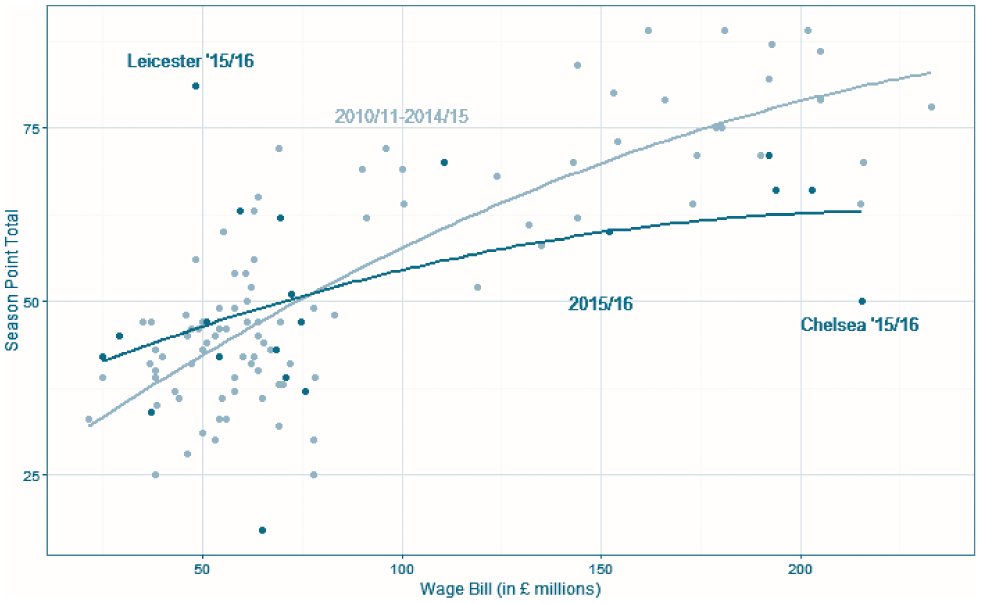
It is against this backdrop of growing inequality that valiant paupers, Leicester City, won the title, challenging the known laws of how to produce a winning team. As the left-hand figure at the top of page 71 shows, compared to the previous four years, in 2015/16, a club’s wage bill proved less predictive of performance in the Premier League. In previous seasons (represented by the gray dots and line), spending an additional 10 million in wages netted a squad 2.5 wins, whereas in the current season (the black dots and line) the same spending only returns just over a point.
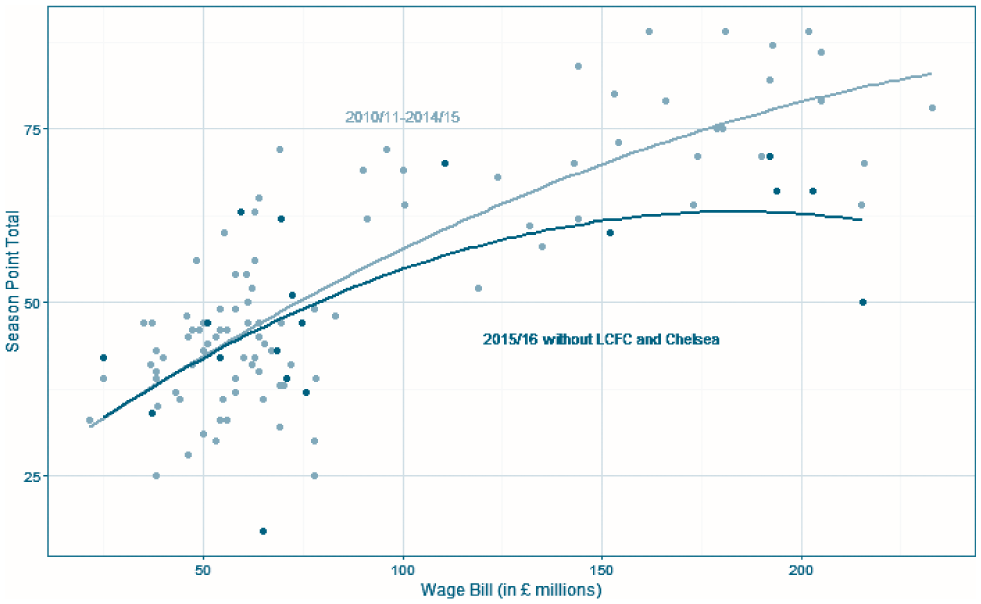
But what happened to the relationship between wages and points goes beyond just Leicester. Even accounting for the two teams that disproportionately impacted the wilting of this trend—the downturn of money-flush Chelsea and the success of hard-up Leicester City— this year’s line is still a lot less steep. As the right-hand figure on page 71 shows that the relationship between a club’s spending and its season point total are still markedly different (albeit a bit smaller) this current season, even after the removal of the two most extremely “out of trend” teams. In sum, clubs didn’t get quite the bang for their buck they’re used to this season.
The Luck Hypothesis
Why didn’t wage spending have such a big effect on winning last season? One possible explanation for the breakdown is that rich teams happened to have bad luck, running up the score in their wins, but losing heartbreakingly close matches. Likewise, maybe budget clubs like Leicester City, West Ham, and Southampton just barely snuck by in their wins. In this scenario, high spending teams just did a worse job of translating goals into wins.
EPL Points by Wage Bill including Leicester and Chelsea
EPL Points by Wage Bill excluding Leicester and Chelsea
To figure this out, we can compute a team’s “expected points” – the season total of points from wins and draws we would expect, given the number of goals scored and conceded in each of its individual matches. In general, expected points are highly predictive of actual points (for the EPL in the past five years, the correlation is .95). But, in a given season, a team can get very lucky or unlucky.
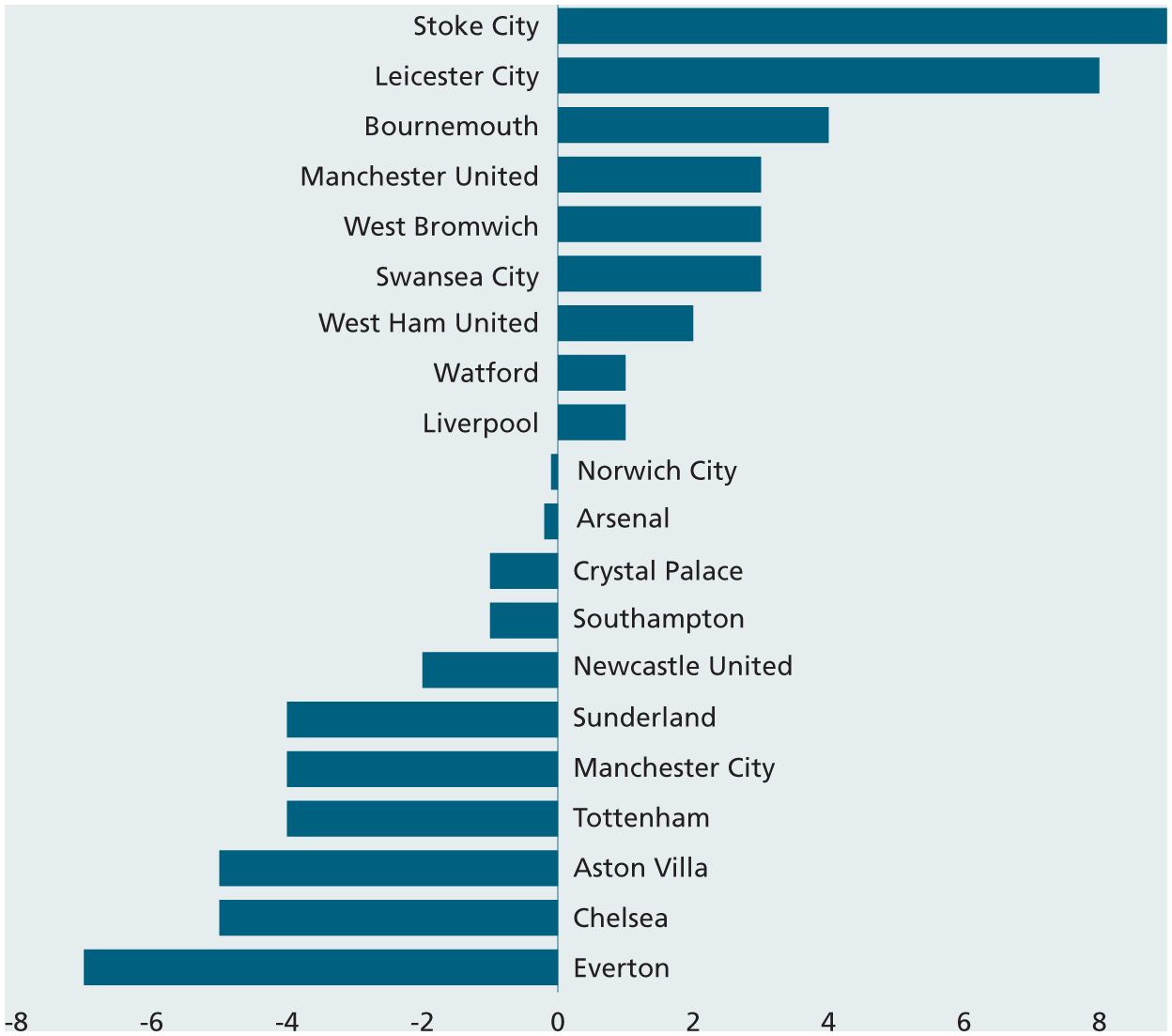
As we see in the graphic at right, which shows how much each team over-or under-performed their expected points, though, luck wasn’t a big factor. Sure, Leicester eked out eight more points than we would expect due to several narrow wins. And Tottenham would have come close to winning the title if they converted goals into points as expected. But most teams did about as we would expect; compared to other seasons, 2015/16 did not have many anomalous clubs. Leicester’s good fortune is nothing compared to 2013/14’s Tottenham squad, which won the equivalent of five more games than expected. Or poor sad Swansea that same season, underperforming expectations by nine points.
Simply put, this season, there was no correlation between wage spending and performance relative to expectations. It wasn’t just bad luck for the wealthy clubs.
No Goals for Sale
So, if not for bad luck, what does explain the breakdown between a team’s spending and their season performance in 2015/16? Compared to the past, teams with high-priced squads were less likely to score goals and more likely to concede goals. The trouble this season if you were the owner of a big money team is that player wages just don’t buy what they used to. In past seasons, each additional £10 million in wages (about the salary of a star striker like Harry Kane) bought you 2.2 more goals and prevented 1.5 goals from being conceded. In 2015-16, £10 million was worth less than one goal for the club and one fewer goal allowed.
In part, this is a story of three teams who broke the rules: Leicester City, Chelsea, and Manchester United. Manchester United couldn’t turn their affluence into offense, which some have chalked up to the team’s overreliance on their aging and underperforming striker Wayne Rooney. For its part, Chelsea struggled with defense. Having allowed star goalkeeper Petr Cech to move to Arsenal and with aging captain John Terry in decline, Chelsea conceded many more goals than their wage bill would indicate. Leicester City outperformed in both areas, scoring and defending at levels in discord with their wage bill. The emergence of Jamie Vardy as an elite-level striker was a boon for the Foxes’ historic season.
However, the breakdown of buying power extends to the rest of the league. As with our analysis of points, even accounting for these three disproportionately over/underperforming squads, club spending still has a less potent effect on goals scored and conceded than in previous seasons.
Regression to the Mean
Why did highly paid teams stop scoring goals and defending well in 2015/16? That is more difficult to say. Some expensive players suffered injuries. High-priced new signings turned out be busts. Previously unknown players made names for themselves. But these things happen every season.
One possibility is that the talent gaps between players are not as big as the salary gaps, leading to diminishing returns for each dollar spent. Wayne Rooney, who scored eight goals in 2015/16, earns 566% more in wages than Leicester star Jamie Vardy who found the back of the net 24 times. Is Rooney 566% better than Vardy? No. As salaries at the tippy-top have exploded, some of the wealthier clubs may have spent themselves into a place where on-field performance can never match player wages.
Given such irrational spending, we might have imagined that the wealthy clubs would learn a lesson and curb inefficient wage spending in 2016/17. If anything, the opposite happened: the wealthy teams doubled-down on the strategy of buying their way to wins. The summer of 2016 was the first year on record that EPL clubs spent over a billion dollars on player transfer fees. New Manchester United signing, Paul Pogba, became the highest paid player in league history, earning £290,000 a week. Meanwhile, Chelsea paid top dollar to sign one of Leicester’s star players, N’Golo Kante. Soccer pundits widely regarded poor, sweet champions Leicester as lucky in that they didn’t lose Vardy or midfielder Riyad Mahrez to a richer club.
And, as we approach midseason, the top of the table looks familiar: Chelsea (3rd in wage spending), Liverpool (5th in wages), Man City (1st in wages), Arsenal (4th in wages) are all jostling for the top spot. Leicester City, 11th in spending, sits in the 14th spot.
In both the wages of soccer stars and the fans, we live in an age of extreme inequality. Even if it turns out to have been short-lived, last year’s unusual moment of parity in the EPL made it one of the best seasons in recent memory.