



Abstract
Soft and hard landings in transatlantic crossings Mabel Berezin on Strangers No More.
Strangers No More: Immigration and the Challenges of Integration in North America and Western Europe Richard Alba and Nancy Foner Princeton University Press, 2015 325 pages
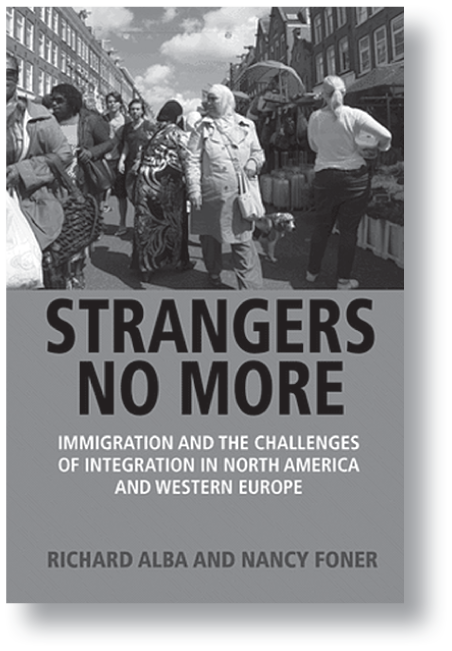
Migration has been a fact of life throughout human history. Today, more than 230 million people live outside the country where they were born. Some have moved legally, others illegally. Some were forced to move; others chose to do so. In almost all circumstances, migrants are vulnerable. However, the degree of their vulnerability depends greatly on how well they are received by their host country. Which country is most successful at welcoming and integrating immigrants? Richard Alba and Nancy Foner set out to answer these questions in their refreshingly cross-national comparative work, Strangers No More.
So who does it better? As you might expect, it’s complicated. The United States, for example, is exceptional in taking in more legal immigrants each year than any other country. But our ability to fully assimilate immigrants is far less remarkable. We fall behind other countries in terms of residential segregation (Germany’s immigrants are far less segregated), educational opportunities (France and the Netherlands are better at funding the immigrant children’s schooling), and political representation (immigrants in Canada fare better).
Immigrants’ reasons for and expectations about migration affect these outcomes, of course. Immigrants come to America with the idea of doing better and making more money than in their homelands. By contrast, when unskilled migrants enter Europe, they do so knowing that if they cannot find a job in the highly structured European labor markets, they can at least rely on European social protection policies for basic survival. That race is a more salient category in the U.S. than in Europe is not, surprising given that cultural similarity is highly valued in Europe, whereas skin color is somewhat secondary. Similarly, we would expect some form of residential segregation among immigrants—at least in the origin group. How segregation plays itself out in succeeding generation varies along multiple dimensions, not the least of which is whether housing is market-driven (as in the United States) or state subsidized (as in Europe).
Religion, citizenship, and identity also matter when it comes to successful integration. But where the authors mention institutions and law in their chapters on religion, politics, and identity, they somewhat underweight them in their discussion—in part, because these chapters are packed. For example, the chapter that discusses citizenship also takes up the issue of second-generation immigrants running for elected office. The identity chapter touches on inter-marriage—about which I would have wanted to learn more.
Identity is not simply a feeling; it is very much shaped by legal arrangements. I may own French cookbooks or read Le Monde every day, but until I change my passport, I am an American. Citizenship is important because it legally embeds individuals in national states. Along with citizenship comes an array of institutions buttressed by law that create social identification, as well as legal identification. Education is a universal institution of incorporation. One way that education operates is in teaching a common language (the one process the authors did not touch upon) as well as a common national history. But, depending on context, the military and religion also serve as powerful incorporation mechanisms and vehicles of solidarity.
The differences in how religion was institutionalized in the U.S. and in Europe is, I would argue, most predictive of the future of immigrant incorporation. Both regions are secular and regulate religion, but this regulation does not suggest that religion is without cultural valence. In the United States, the Establishment Clause in the First Amendment to the Constitution permanently guards against a state religion. Among other things the colonists who came to what would become the U.S. was a desire that their government would not interfere in religion. Indeed, one of the reasons why American Protestants viewed a Catholic President (Kennedy) as a threat was a general fear that a Catholic would take orders from the Vatican. Europe is quite different in this regard. Rather than keeping the state out of religion, European nation-builders wanted to make sure that religion stayed out of the state by incorporating it and by specifying its boundaries and limitations. The French did this most thoroughly with their 1905 law on laicite, but there are similar precedents in virtually every European nation with state churches and church taxes.
Completely secular Christian cultures—for example, the presence of crucifixes in Italian public schools—are a secondary product of European legal arrangements. National policies on religion, in fact, were not of particular import until the late-20th century influx of Muslim migrants who wanted to practice their religion in a public way. Because religion and its boundaries were institutionalized in a fairly rigid manner and tied to the European state, religion—which had hardly figured on the policy or academic radar—has come to dominate discussion of immigration and tolerance in millennial Europe. And in the United States, the First Amendment guarantees a free market in religious affiliation and practices. This does not mean, of course, that prejudice or exclusion based upon religion has been absent in the United States—simply that it is not built into the structure of the state. With the Charlie Hebdo terrorist attack in France, the acceleration of violent terrorism, the war in Syria, as well as the global financial crisis creating greater and greater forms of inequality, it is highly likely that in Europe, religion is going to become an even more salient barrier to immigrant integration and incorporation.
I write and research nationalist and illiberal politics in Europe—both the 1930s variety and contemporary iterations. In the course of this work, I often consider the issues that Alba and Foner raise with respect to Europe. Immigration and integration are the calling cards of the nationalist right. For many years, I have been looking for a book on immigration that provides a narrative of both history and policy and paints in broad and comparative strokes. Strangers No More is certainly that book. As I write, Europe is experiencing the most serious refugee crises since the end of the Second World War. Anyone on any continent who has any contact with any form of media (that is, virtually everyone) is witness to vast throngs of refugees making their way to Europe in fragile boats. There are daily reports of drownings, detainments, and policy changes. We cannot forget the lifeless little boy whose body washed ashore in Greece, but the United Kingdom, fearing waves of immigrants, has voted to leave the European Union in a moment of protectionist panic. Anyone paying attention to the U.S. election cycle can clearly see that there is no end to the capacity for prejudice here, either.
Strangers No More is a magisterial book and an ambitious enterprise, required reading for any scholar and policy professional who wants to grapple with the complex issues of global migration.
Last September, the European Council of Ministers met and ordered an allocation of refugees among European nations. Four former Eastern Bloc countries immediately refused; other countries are hedging as the Ministers announce penalties for those countries who refuse refugees. While there has always been movement of peoples, the burden of war and colonialism has governed post-war European migration policy. As an arena of morality and atonement, the potential for backlash has always been a fault line of European migration policy; for the U.S., economic opportunity and hope have been the primary drivers of immigration policy and immigrant experience. And on the same day the European Ministers met, the National Academy of Medicine, Engineering, and Science released a study, The Integration of Immigrants into American Society, demonstrating that today’s immigrants to the U.S. are assimilating at the same rates as past generations of immigrants. Alba and Foner, members of the study team, show that for all its problems, the U.S. remains a model toward which other regions undergoing influxes of immigrants might aspire. I wish they had been clearer on that point here.
Still, Strangers No More is a magisterial book and ambitious enterprise. It stimulates comparative thought on multiple dimensions. It should be required reading for any scholar and policy professional who wants to grapple with the complex issues that global migration raises. The answers are not in yet, but the movement of global populations will not pause.