



Abstract
Dubai’s Kafala system regulates the lives, labors, and mobility of migrant domestic workers who have seen no new rights with reforms. this is how they resist.
Keywords

On January 1, 2016, the United Arab Emirates implemented sweeping reforms to the kafala system, its migrant employee sponsorship system. Now, in contrast to the kafala system’s rules, most migrant workers are permitted to seek different employment when their contract ends; without penalty, workers and their employers can mutually agree to terminate their contract; and workers can unilaterally decide to end their contract as long as they comply with the legal requirements of early termination, including providing one month’s notice. The new system represents an improvement for most migrant workers, releasing laborers from some of the most draconian aspects of contemporary labor control in the UAE.
Prior to these reforms, the legal status of a migrant worker had been conditional on the continuous sponsorship of an employer-sponsor. The kafala system requires that employers control migrant workers’ entry into the country, departure, and job transfer. The employer is then required to report to immigration authorities if the migrant worker ever leaves their employ to ensure that the worker departs the country upon the termination of their contract. According to Human Rights Watch and Free the Slaves, the migrant worker, in this context, is arguably a victim of “modern-day slavery.”
The kafala reforms have been welcomed by migrant rights advocates. However, domestic workers have been excluded from the reforms, leaving them distinctly susceptible to multiple forms of abuse and exploitation, exacerbated by the continued application of the kafala system to their segment of the labor force. Whereas migrant workers in construction, retail, hospitality, and transportation can now claim some limited rights with respect to mobility in the labor market, the estimated 300,000 domestic workers in the UAE have gained no such ground. Domestics can be fired at will, at any time, and without explanation. They can also be denied release from their contracts, making them especially vulnerable to persistent overwork and forced labor. The ongoing application of the kafala system deepens the structural disadvantages that they face, locating them in positions of indentured servitude, bound labor, and permanent exclusion from citizenship rights abroad.
Indeed, physical, sexual, and psychological abuse, inadequate food and living conditions, limited freedom of mobility, underpayment or non-payment of wages, and overwork are widely understood as problems for low-wage migrant workers, especially domestic workers, throughout the Gulf Cooperation Council countries. (These include the UAE, Saudi Arabia, Kuwait, Bahrain, Qatar, and Oman.) In the UAE, domestic workers are excluded from various labor protections including the electronic salary monitoring system that requires employers to pay workers via bank deposits and protective laws against recruitment fees. Although, on June 1, 2014, the UAE did revise the standard domestic worker contract to mandate one rest day per week, employers still commonly refuse days off. Domestics are excluded from the overtime pay regulations that apply to other sectors, and they are not guaranteed the right to freedom of communication (e.g., access to a mobile phone or Internet) nor a standard minimum wage. Even the bilateral agreements between countries that are intended to protect domestic workers’ wage rates have Indonesia setting its monthly minimum at $331 and the Philippines at $400 (in U.S. dollars). Not only are these minimum rates low from a global perspective, but, in practice, they also commonly constitute a ceiling rather than the baseline.
Domestics can be fired at will, at any time, and without explanation. They can also be denied release from their contracts, making them especially vulnerable to persistent overwork and forced labor.
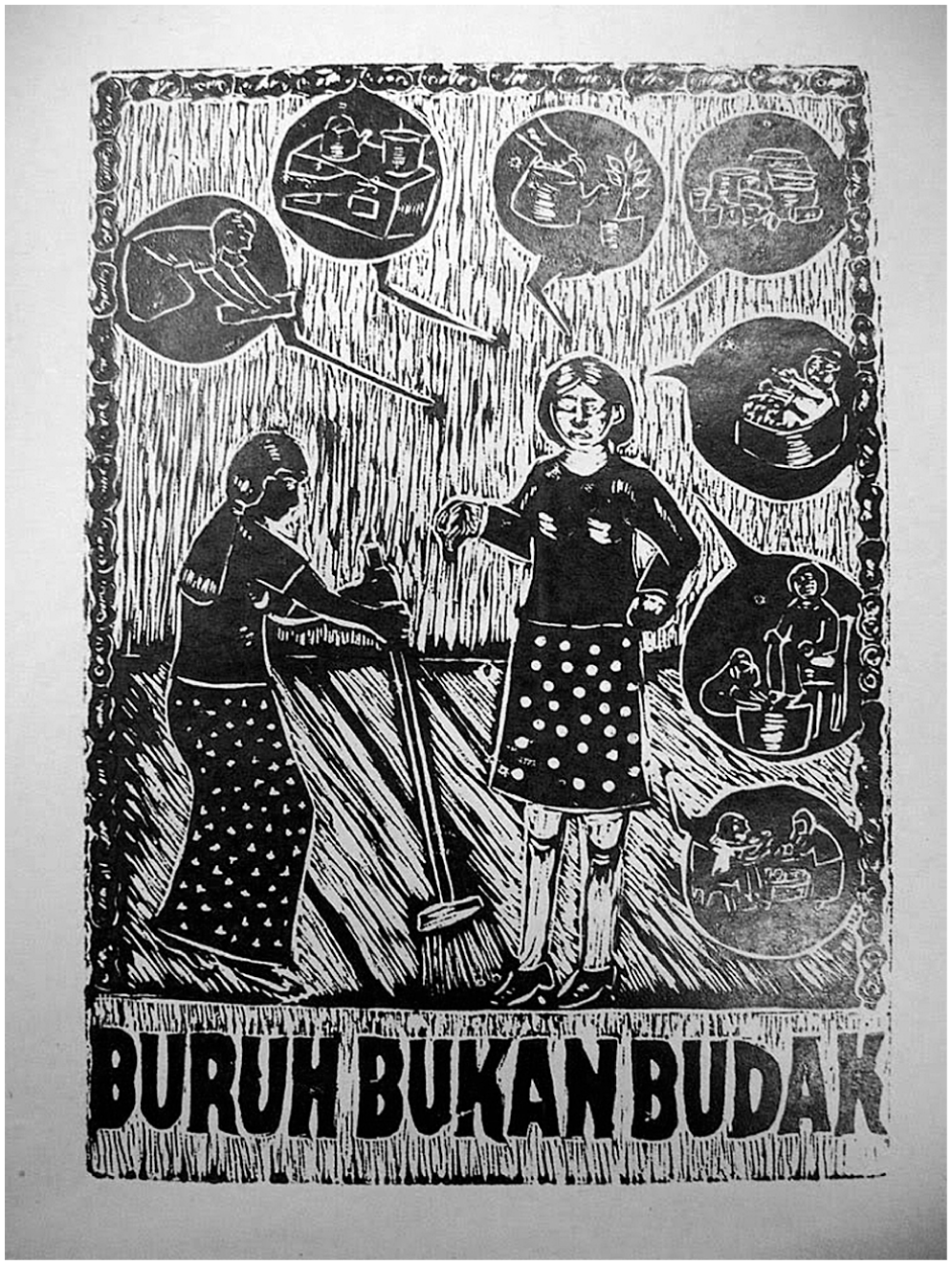
“Workers are not slaves.”
Taring Padi
Scholars, activists, and policymakers are paying increasing attention to the serious problems of domestic workers worldwide. Aiming to contribute to this growing conversation, we conducted 85 in-depth interviews with Filipino migrant domestic workers and 52 with Indonesians in the UAE between 2013 and 2015. Our research found that, whenever possible, domestics refuse to tolerate the “slave-like conditions” permitted by the regulatory regime. Sometimes their refusals take the form of running away from their employers; other times they perform more subtle oppositional tactics. Their limited rights as employees under the kafala system and their insecurity in the transnational labor circuit underpins their interest in running away from their employers. Rates of absconding are high: Consular officials report that 10% of Filipinos and 15% of Indonesian domestic workers flee their employers, and these figures only include those who report to government shelters, not those who escape without registering. The poor working conditions discourage most workers from renewing their contracts. Very few of those we interviewed had renewed their contracts after the end of two years, and less than 10% had stayed on to work in the UAE for more than a decade.
Running Away and Moving Up
Ruth was given a three-day notice by her employer. Three months after renewing her contract, her employer terminated her, denied her request to search for a new employer, and forced her deportation. The employer escorted her to the airport, checked her in for a flight bound to Manila, and walked her toward airport security. Ruth wanted to continue working in the UAE, though. After parting ways with her employer, she managed to discreetly exit the airport.
Stories like Ruth’s tend to be recounted under the heading of “forced deportation.” However, for Ruth and others in similar situations, the hours at the airport may offer the possibility of escape from a broader regime of extreme controls on their labor and mobility. Nada, from the Philippines, ran away from her employer when they decided not to renew her contract and refused to grant her permission to seek a new employer. Her employer’s refusal to “release” her meant that she would have to leave the country and find another sponsor to permit her to re-enter the Emirates and work legally. Yet, Nada was unwilling to leave the country. She, too, chose to run away and work informally.
Soraya had absconded more than ten years before our interview. The 45-year-old Indonesian woman from West Java worked as what she termed a “freelancer,” by which she and others meant without a sponsor (kafeel). She told us her story. After completing two contracts in Saudi Arabia for what she considered acceptable employment, Soraya had secured a contract in the UAE, but she felt the employer treated her inhumanely. She explained that she had escaped because she had experienced sexual harassment and debilitating depression as a result of overwork and loneliness. Her passport was confiscated by her employer when she had first arrived, and she’d had no way to retrieve it prior to her escape. Now, under the radar of the state’s immigration and labor ministries, she cleaned houses in the informal sector and sent money home to her sister for school fees and food for the son who had been just six years old when she last she saw him. Her marriage in Java had unraveled several years before her departure for the UAE, but she had met a new partner in Dubai, and they were in a serious relationship when we interviewed her. She explained that although she faced the daily threat of deportation, police raids, and detainment as a result of her undocumented status, she strongly preferred these conditions to the thought of returning to Indonesia.
Soraya’s reasoning paralleled the rationales that other long-term “freelancers” and serial migrants expressed. For example, Leah, was a 40 year-old woman who had grown up in a wooden hut in a remote region of the Philippines. Prior to migration, she had not known how to use a toaster or a stove. Contract labor migration was her only option for upward mobility. In her first job abroad, Leah received 600 dirham per month, rather than the salary of 736 dirham ($200) her contract had stipulated. Her work conditions with her first employers, an Emirati family, had not been ideal; she complained, “Mostly I was working 12 hours but sometimes 16 hours. But one time I was awake [and working] for 24 hours.” Yet, she tolerated her situation in order to stay in good legal standing. Leah completed her two-year contract, securing her release, and found a second employer before the end of her first contract. In fact, she said it was easy to find employers, as many posted online ads on dubizzle.com so as to bypass the $3,000 fee typically charged by agencies. In her experience, only rarely do employers refuse to “release” domestic workers at the end of their contract, because “they have no reason not to.”
Rather than expecting both a solid minimum wage and a humane working relationship with their employer, workers feel required to make deep compromises. Their notably low expectations are endemic among subjects of servitude.
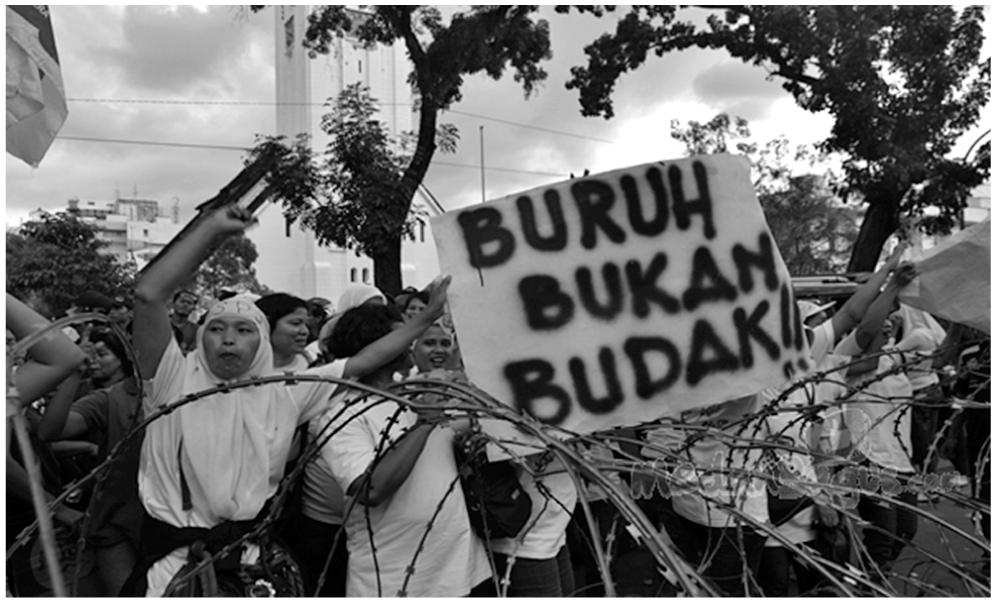
Domestic workers protest working conditions in the UAE.
Wahyu Fahmi
Next, Leah secured employment with a European family who paid her 1,500 dirham ($400) per month and limited the work they asked her to do to eight hours per day, allowing her time away from work in the evenings. She completed this contract, as well as the next, and has now worked for four different employers. Each job has brought higher pay than the last. A recurrent migrant to the UAE, Leah now earns 2400 dirham per month ($650) and considers herself “very lucky.” Her friends and acquaintances enjoy re-telling her “success story” and hope that they will have such good fortune in the future.
Most domestics we interviewed had wanted to escape the poverty, monotony, joblessness, and “futurelessness” of their rural origins. They accepted precarity and serial migration as a norm and a necessity.
Migration “Choices” and Multiple Sojourns
The kafala system does not universally leave migrant domestic workers in “slave-like” conditions. In a context of extreme spatial constraints and high levels of exploitation, domestic workers expressed and acted upon their own definitions of desirable and intolerable conditions. What mattered most to many of our interviewees was the quality of the interpersonal relations they had with their employers. These relationships are especially important for domestic workers because of the close proximity in which they work and live with their employers. Sometimes they mattered even more than might be expected. For example, one domestic worker who slept in a hallway preferred her situation to another who had her own bedroom. The one staying in the hallway was employed by a lower middle-class family residing in a one-bedroom apartment, while the one with the private bedroom worked for a wealthy family that provided her with all the basic amenities and a higher salary. Yet, the lower-income employers regularly invited the domestic worker to eat with them, called her by her name, and spoke with her in a regular conversational tone, rather than yelling or ordering her about.
Most workers we interviewed would strongly prefer the considerate, lower-income family to the one that paid more but yelled at or disparaged them. Few respondents expressed concern with meager resources or cramped living quarters, but all cared tremendously about the ways in which their employers spoke to them. Interviewees were very specific in their definitions of what consideration they entailed from employers: sensitivity to workers’ eating preferences; support for social interaction and refusal to isolate; acknowledgement of workers’ and their children’s birthdays, holidays, and family losses; accommodation of workers’ health status; and mindfulness of workloads. Caring for the migrant in these ways counted more toward being a “good employer” even than providing standard wage rates. Nhenski, a 37-year-old single Filipino mother who has been employed by an Iraqi family in Dubai for nearly five years, stated, “I am not looking for the salary. I am looking for how they treat me.” Rather than expecting both a solid minimum wage and a humane working relationship with their employer, workers felt required to make deep compromises. Their notably low expectations reflect a lack of entitlement that is pervasive among subjects of servitude.
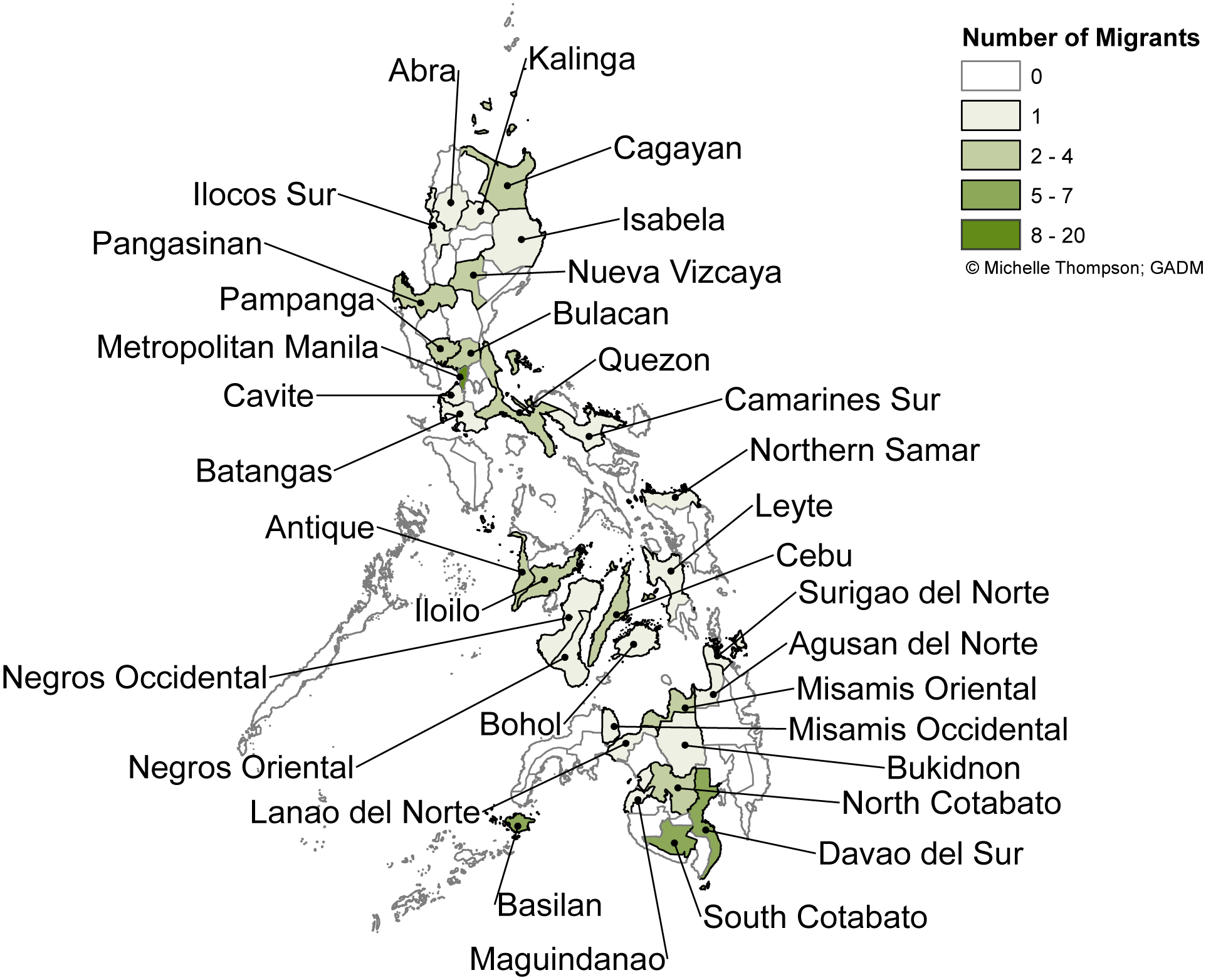
In the UAE, migrant domestic workers only rarely find what they consider good working conditions. For short periods, many will tolerate a less than ideal situation in the hope that, by waiting for some unspecified additional time or moving on to another job, they may eventually experience some socio-economic mobility. Or, at least, as many from Indonesia put it, they might “find some experience” during their travels. The domestics we interviewed generally came from poor, rural areas of the Philippines and Indonesia. Members of what one could describe as the “fourth world,” they tend to have a low level of educational attainment and limited work opportunities prior to migration. Most are indebted to local money-lenders or larger scale creditors, including recruitment agents, even before they leave home, and they are driven by their debts to continue to seek work wherever they can find it. A map of the origins of respondents from the Philippines illustrates that the majority in the UAE came from the poorer outer provinces rather than the higher income central urban areas (see p. 39).
Most had hoped to escape what they described as the poverty, monotony, joblessness, and “futurelessness” of their rural origin site lives. They did not view going home permanently as an option, except to visit and perhaps to retire. Instead, they accepted precarity and serial migration as a norm and a necessity, assuming that after they completed their first contract abroad, they might return briefly only to depart again on their next overseas contract. Many felt that they had “had no choice” other than to migrate for work, and, rather than compare their existing situation to an imagined ideal, they expressed pride in their capacity to persevere and tolerate difficult conditions. Sirani, a 45-year-old Indonesian woman from West Java, explained: “I can get by on very little, and my boss likes that about me. I don’t complain, and I know how to adapt.” Her acceptance and valorization of her subordinate social status was common among interviewees. However, we also documented breaking points, limits to what they were willing to tolerate. These migrants’ endure extreme vulnerability to abuse; they also relish the momentary ruptures and spaces for respect their actions can create.
Not Just Victims, Not All Slaves
Attention to the voices of migrant domestic workers reveals that in the UAE, as elsewhere, women have a tremendously wide range of labor experiences. Domestic work is shaped not only by the structures of employment but also the personal ties between employers and employees. Migrants even use creative tactics to affect their own situations. Whenever possible, for instance, domestics actively negotiate the terms of their employment; they enter each job with a particular set of expectations for wages, hours of work, job duties, and access to communication and rest. Using these standards, they evaluate the pros and cons of their jobs, always aiming to improve the terms of their employment and requesting a “release” to search for a new employer or running away when dissatisfied.
Migrant domestic workers in the UAE are at the mercy of a legal system that refuses them any rights. They face imprisonment or deportation if they get pregnant, abscond, or are accused of any wrongdoing by their employer. From a human rights standpoint they are living under conditions of “neo-slavery.”
Yet, this story of human rights abuse is incomplete. It erases the responses of domestic workers to their vulnerabilities. Every day, migrant workers enact far more complex responses to their marginalized positions than could ever be captured by the concept of “slavery.”
The evidence we have accumulated over the last three years underscores the complexity and diversity of migrant domestic workers’ preferences and decisions. Other than the very worst case scenarios, and whenever possible, migrant workers negotiate the conditions of their labor, whether it is by running away, switching employers, or refusing to stay back in their rural origin sites. They migrate repeatedly, risking the unknown abroad over and over rather than resign themselves to the constraints of the familiar. Indeed, as Indonesian domestic workers have put it in their protest slogans, “Workers are not slaves.”
Rather than compare their existing situation to an imagined ideal, the domestic workers expressed pride in their capacity to persevere and tolerate difficult conditions.