



Abstract
As their online efforts gather attention and become revenue sources, “mom bloggers” struggle to balance commercial affirmation with authenticity.

To celebrate its tenth anniversary, BlogHer, the premiere social media conference for women, asked over a dozen “community leaders” to participate in a series of talks reflecting on the last ten years of blogging. The conference hall was electrified with clapping, hoots, and tears as each blogger recounted the evolution of the blogosphere from 2004 to 2014 and testified to the transformative power of blogging. Shannon of Squidalicious told how it was through blogging about her son’s autism that she met “her people” who supported her through periods of self-pity and bitterness. Polly of Lesbian Dad discovered real community with other queer parents navigating the risks and demands of new family structures. Katherine Stone of Postpartum Progress found life in blogging about her debilitating experience of post-partum depression, hoping to prevent other women from suffering in silence.
These women had each started blogging in search of a cathartic space, and were surprised by how the blogosphere became a source of profound personal and professional significance. As Polly exclaimed, “This shit is real!” She put her finger on the sentiment of amazed gratitude they shared for how blogging had changed—and in some cases, saved—their lives. What is it about the mom blogosphere that so successfully serves a meaningful function in the lives of these women? What felt needs does blogging meet for today’s mothers?
“Mommy blogs” have become a significant source of support and community for contemporary mothers. They have also become an appealing means of making money, as major corporations seek to capitalize on bloggers’ influence to promote their brands through advertising and sponsored blog posts. Nevertheless, news coverage typically conveys a monochromatic portrait of mom bloggers as entitled, White, suburban moms chasing the latest fad–equivalent to digital scrapbooking. So we get news stories with headlines like “Honey, Don’t Bother Mommy, I’m Too Busy Building My Brand” or “Does Anyone Really Take Mommy Bloggers Seriously?”
“Mommy blogs” have become a significant source of support and community for contemporary mothers. They have also become an appealing means of making money, as major corporations seek to capitalize on bloggers’ influence.
It seems the news media’s construction of mom blogging as mercenary self-promotion or trivial “women’s talk” reveals less about the blogging, and more about the troubling degree to which public derision of mothers involved in non-domestic labor is culturally acceptable.
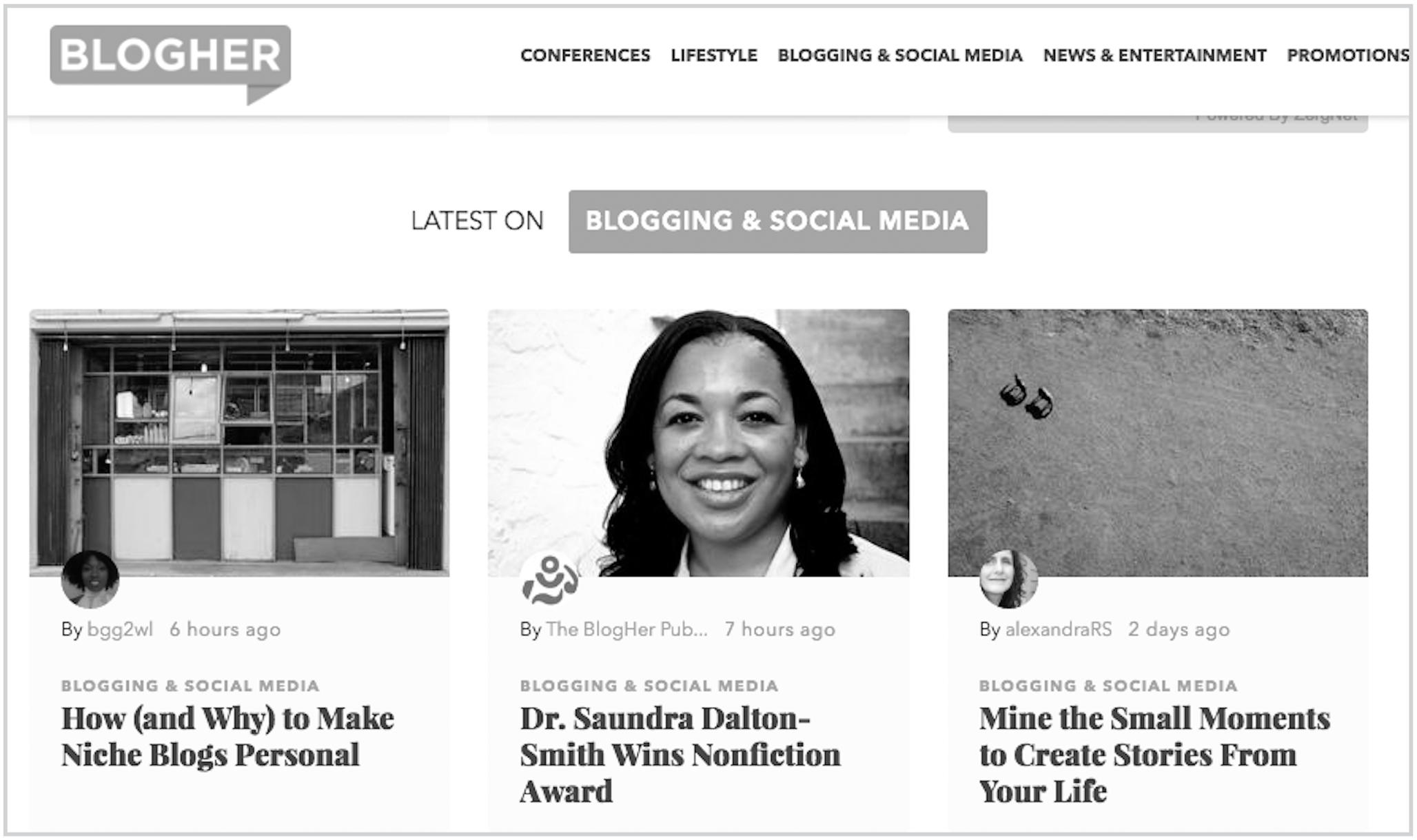
The website BlogHer and its eponymous conference are part of SheKnows Media, a “women’s lifestyle digital media company” meant to “empower women to discover, share, and create.”
From 2010 to 2014, I immersed myself in social media conferences tailored to mothers and women. Like standard tech conferences, events such as Blogalicious, Blissdom, and Type-A-Mom gather the blogging community and industry “thought leaders” through plenary sessions, workshops, and socials. After attending conference proceedings and interviewing bloggers and corporate sponsors, it became clear that active involvement in blogging and social media conferences brought cultural legitimacy, membership, and professional opportunities to women who otherwise found their labor—as bloggers and as mothers—undervalued, possibly even invisible. Whether social media was actually empowering these women, or merely creating a platform through which corporations and brands could commodify their authenticity and belonging was harder to determine. Whether mom blogging could actually shift conventional assumptions about mothers and create new legitimate public spaces for mothers remained to be seen.
The media’s construction of mom blogging as mercenary self-promotion or trivial “women’s talk” reveals less about the blogging and more about the troubling degree to which public derision of mothers involved in non-domestic labor is culturally acceptable.
The Evolution of the Mom Blogosphere
In the heyday of Web 2.0, buzzwords like “participatory web,” “collective intelligence,” and “user-generated content” marked the Internet’s shift from message boards and chat rooms to social media platforms like Facebook, Twitter, and Tumblr. Excitement over social media’s transformative potential generated much talk about the rise of the “citizen-journalist” poised with powerful digital megaphones to democratize information and empower the marginalized. Social media evangelists marveling over digital media’s role in the Arab Spring and Occupy Wall Street movements of 2010-2011 assured us that long-standing social hierarchies were going to be disrupted.
Blogs, in particular, were expected to destabilize traditional media and alter the balance of powers, outpacing print and TV news outlets with its real-time agility. The sheer number of blogs had increased exponentially—from a few million in 2004 to more than 70 million blogs hosted through popular platforms like Tumblr and Wordpress. As a tool for challenging the authority of public figures and major organizations, feminist scholars believed that the blogosphere could improve women’s status by amplifying their visibility and helping women collectively work towards social change. It was from these hopes that “mommy blogs” emerged.
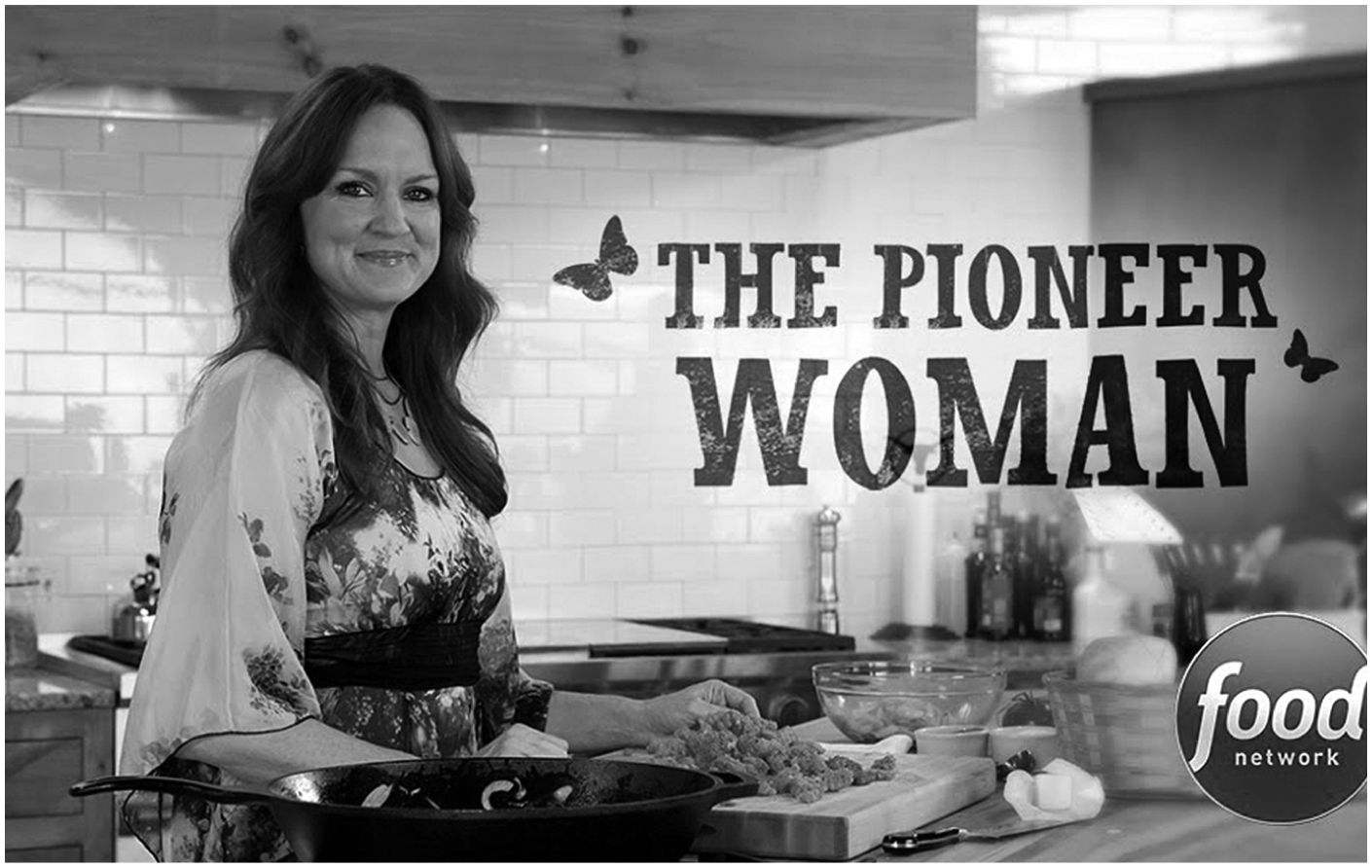
Ree Drummond, first known as blogger “The Pioneer Woman,” parlayed her online popularity into partnerships with the Food Network and Land O’ Lakes as well as a popular cookbook.
From the start, what had made “mommy blogs” so compelling was their ability to give voice to authentic and raw accounts of motherhood over and against the more sanitized and sentimental scripts that prevail in mainstream culture. Given the common expectation that “good mothers” invest inordinate amounts of time, energy, and resources in their children—what cultural sociologist Sharon Hays termed “the ideology of intensive mothering”—the mom blogosphere became an authentic space where mothers could talk about what is typically taboo, find support in their fears, and understanding in their failures. Mom bloggers cathartically narrated their struggles—sometimes with irreverent humor, often with honesty—and found hope in the spontaneous support they received through online comments and the viral sharing of their posts.
The powerful experience of journeying with these bloggers cultivated loyal readers, many of whom struggled with similar feelings of desperate isolation and relished the growing sense of community with other women whose lived experiences did not match the available scripts of contemporary American motherhood. This solidarity sometimes coalesced into collective action. Mom bloggers flexed their virtual muscles and found that together they could pressure corporations to remove insulting television commercials and crash Facebook servers to protest ill-informed policies. These successes inspired some mothers to blog beyond the gendered conventions of domestic labor—parenting, recipes, and shopping—and explore broader concerns such as disability, education, and social change.
Observing this unique combination of authenticity and influence, corporations and marketing firms awakened to the fact that mom bloggers were powerful opinion leaders. With mid-tier bloggers commanding a regular following of several thousands of readers, these women embodied companies’ vision of the future of word-of-mouth marketing. To Corporate America, mom bloggers offered “authenticity that can be used,” and were seen as an effective means to reaching and influencing a consumer market of mothers that was worth over $1.7 trillion dollars in annual spending. To this end, corporations began allocating resources towards blogger outreach using free giveaways and expense-paid trips to woo women to review their consumer products.
Observing their unique combination of authenticity and influence, corporations and marketing firms awakened to the fact that mom bloggers were powerful opinion leaders.
Well aware of how celebrity mom bloggers like Heather Armstrong of “Dooce” or Ree Drummond of “Pioneer Women” fame capably parlayed their monthly multi-million page views into personal media empires, many bloggers were interested in partnering with corporate entities. Ordinary mothers, like 32-year-old Jessica from “JessicaKnows,” jumped at the opportunity to “monetize her blog” with advertisements and sponsorships. Hired as a brand ambassador, she received a Ford crossover vehicle and gas card for a year, and was later chosen by the gaming company Electronic Arts to spend several weeks working out with Oprah’s personal trainer.
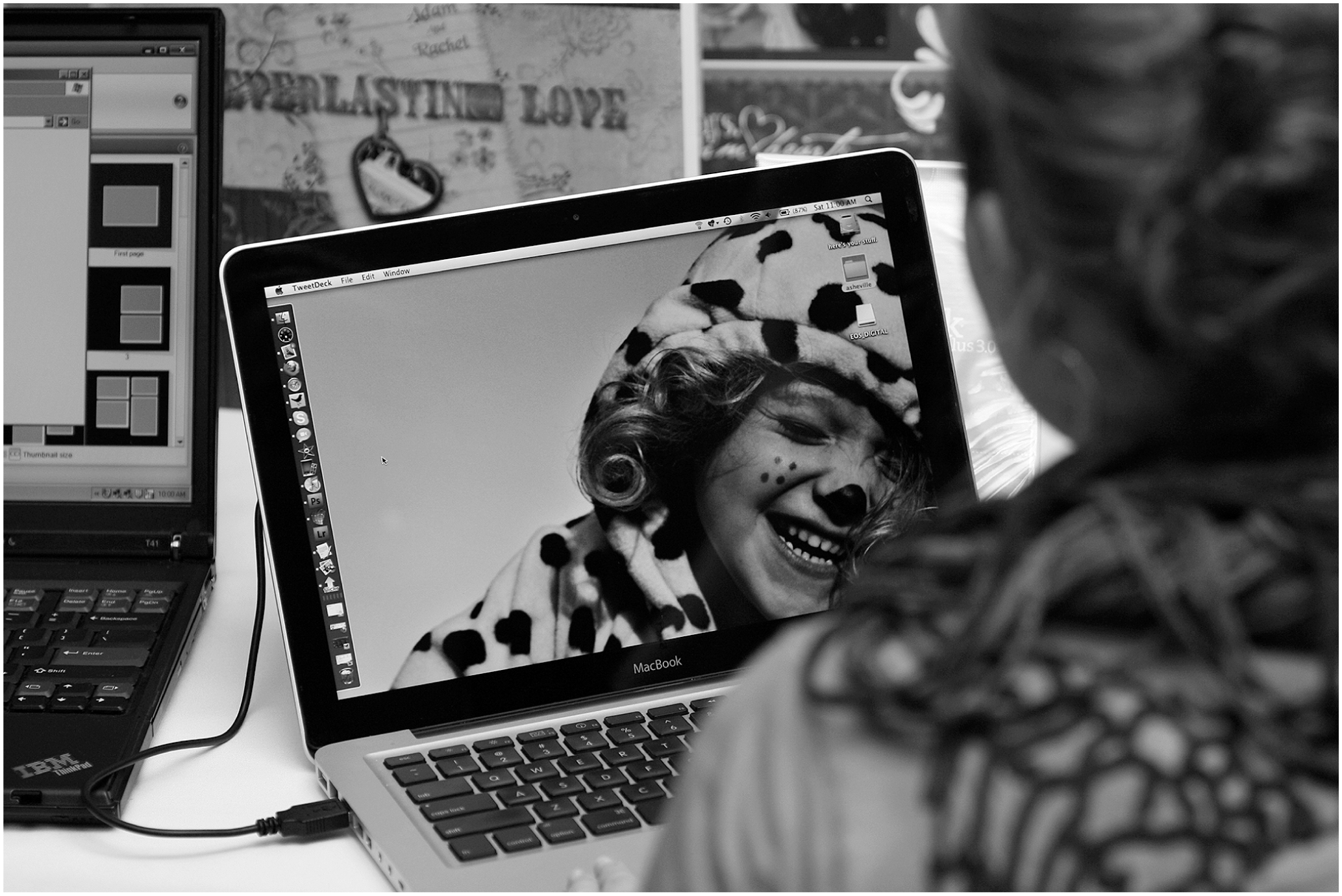
Women take notes at the 2009 Type-A-Mom conference.
Rick Bucich, Flickr CC
Ambivalent Consequences of Commercialization
Hiring mom bloggers to publish product reviews for household cleaning agents or a new line of orange juice demonstrates the limited scope of imagination many corporations have about mothers. In valuing mothers primarily as consumers, rather than producers, this commercial turn can be seen as the beginning of the end for the mom blogosphere. That is, it may mark a turning point when the promise of mom blogging’s potential to subvert ideological assumptions about motherhood submits to the market’s well-grooved paths of cultural commodification.
Tension between commercial affirmation and authenticity was omnipresent at every women’s social media conference I attended.
And yet, when one listens intently to bloggers’ own reflections about working with corporations, it becomes clear that this commercial turn brings with it a surprisingly complex combination of promise and danger. The promise, for some, is that commercial recognition makes the value of their motherhood visible and legitimate. Kim, a panelist from the Type-A-Mom conference in 2010, explained that prior to blogging, her experience of motherhood was primarily marked by a lack of legitimacy: “I was a stay-at-home mother, petite, Jewish. Walking down the street with a gaggle of children, I was invisible…[a] mom who was subservient….” Like so many other mom bloggers who are privileged in their race, education, and economic status, Kim opted out of a flourishing career to become a full-time mother, only to find the culturally circumscribed sphere of influence for mothers to be distressingly confining and undervalued.
As her blog gained attention from readers and corporations alike, Kim discovered that “blogs make us something.” While this recognition alleviated her former sense of insignificance, she confessed that her early excitement at the prospect of gaining cultural and economic power from working in corporate blogging led her to “compromise her integrity” in her writing, her relationships, and her own original goals. This was the danger. She had become, in her own words, “a blog whore” and she regretted it. Instead of relying on compelling content to build her readership, she employed standard industry tactics like product giveaways and link-up parties to increase her blog traffic. Commercial success had made her visible and relevant to the official culture of the market, but the battle to retain her authenticity was in earnest.
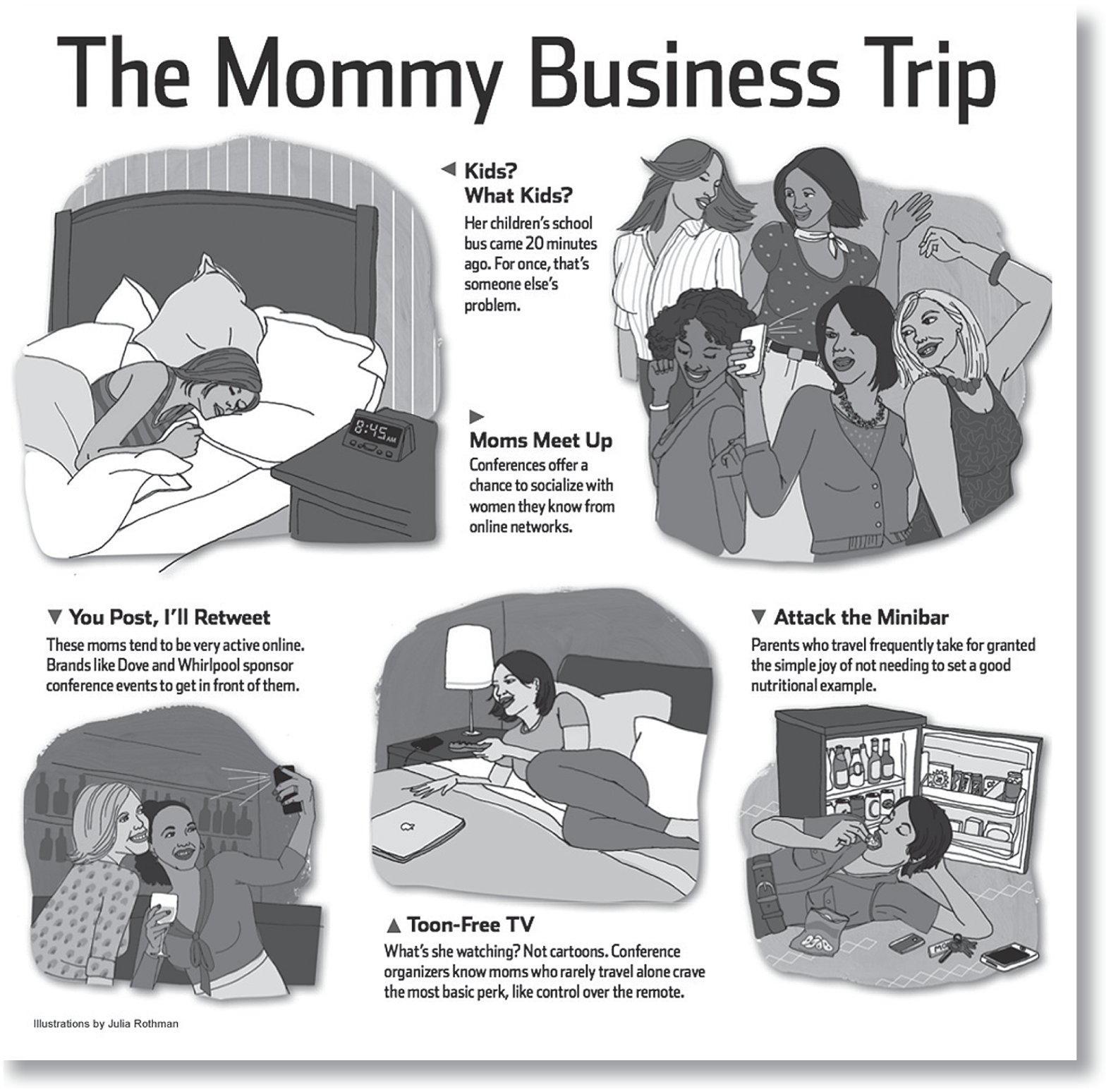
The Wall Street Journal illustrated a 2013 article on conferences like BlogHer with this image and the subhead, “Conferences Appeal to Women With a Guilt-Free, Child-Free Reason to Leave Home.”
Illustrations by Julia Rothman for the Wall Street Journal.
This tension between commercial affirmation and authenticity was omnipresent at every women’s social media conference I attended. Conference speakers attempted to unify these dueling motivations for blogging by using therapeutic language like “follow your bliss” or “pursue your passion” to establish the moral compass that ought to animate mom bloggers’ journeys out of private spaces and into public view. Similarly, the call to “know your worth” frequently addressed the need for mom bloggers to recognize both their personal and professional value.
Conference speakers openly complained about corporate representatives who assume mom bloggers are accustomed to unpaid domestic labor, offering them coupons or product samples in exchange for their blog work rather than discussing proper means of economic compensation. Explicitly linking women’s tendency to undervalue their contributions with the inability to actually believe that they are indeed professionals, one veteran panelist at Type-A-Mom exclaimed, “Mothers don’t think they’re good enough!” and urged newbie bloggers to refuse to work “for free” by charging for their skills and influence. Pointing out that a “Denny’s worker doesn’t settle for a meal,” she exhorted mom bloggers to recalibrate their sense of identity: “You are a social media marketer. You are a freelance writer. [Don’t say] ‘I just have a blog.’” While professional insecurities and temptations of “selling out” are hardly unique to the experiences of mom bloggers, their status as mothers enters into how their fears and actions are interpreted, often heightening the tensions between authenticity and commercial success.
Searching for Cultural Legitimacy
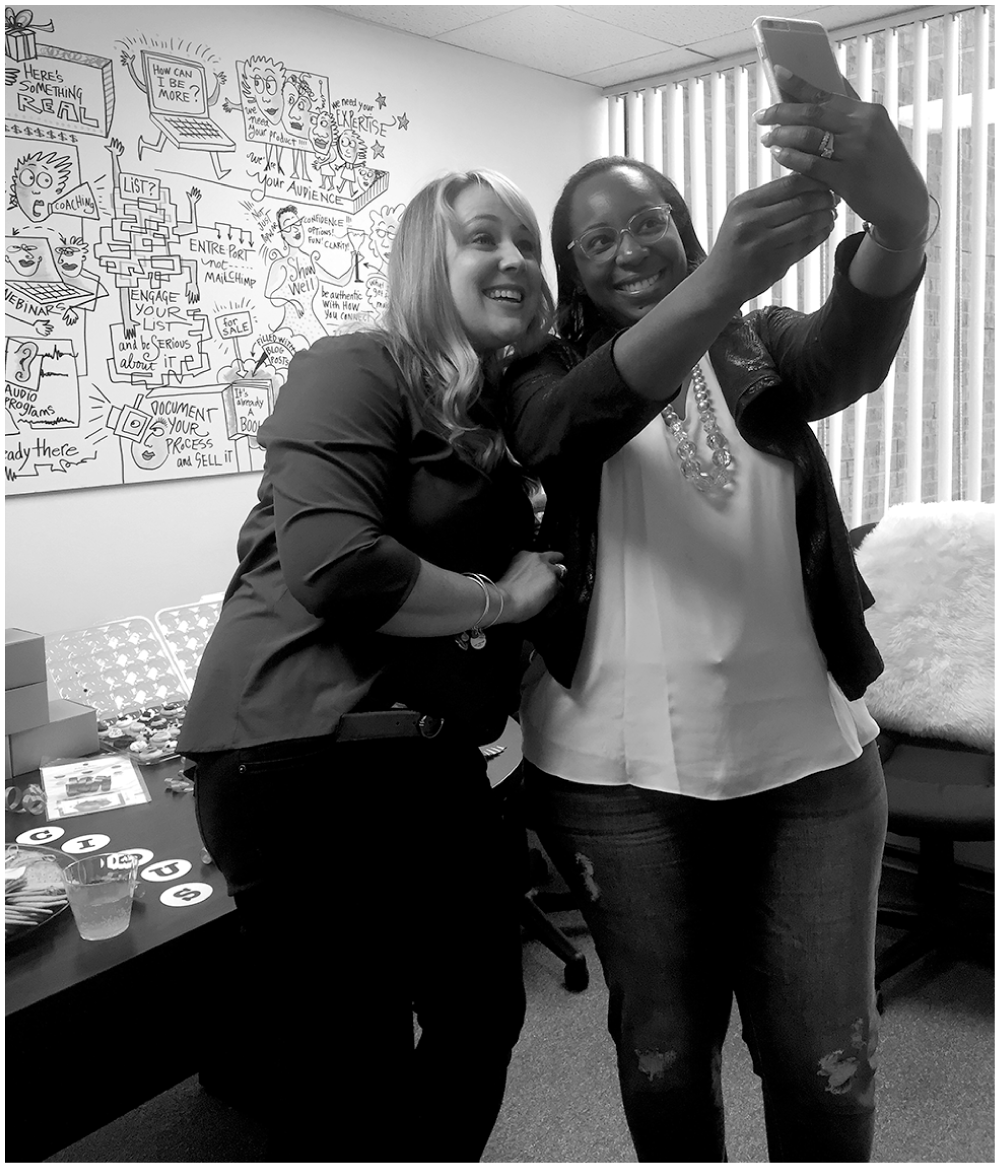
Though blogging itself proved personally empowering for women, becoming a professional mom blogger still involved negotiating the systems of power that worked against their status as women and as mothers. Entering into the business of blogging leads women into a corporate and media culture that undervalues women’s dominant modes of engagement and content. Consider how the Wall Street Journal dedicated an entire page in 2013 to a cartoon illustrating women’s social media conferences as “The Mommy Business Trip” portraying images of mothers taking selfies at a dance party, reclining on a hotel bed watching TV, and lying on the hotel floor, scarfing down a bag of chips.
Visitors—perhaps aspiring new media mavens—attend an open house at Blogalicious headquarters in 2016.
Be Blogalicious, Flickr CC.
Alice Marwick’s study of Silicon Valley culture reveals that such ridicule is not surprising given the shockingly low degree of racial and gender diversity in the digital media industry. Mom bloggers’ voices often remain segregated within a highly gendered blogosphere where longstanding cultural norms continue to separate and prioritize the masculinized “public” realm of industry and politics over the feminized “private” realm of home and hearth. In fact, despite equal numbers of men and women blogging today—and women actually exceeding men in social media usage—media and scholarly attention is paid almost exclusively to male-authored blogs in politics and sports. At the Blissdom conference in 2011, many heads nodded knowingly in the audience as a panelist bitterly commented that, even in her own home, her work is trivialized by her husband who views her blogging as merely time spent with her “little Internet friends.”
Undoubtedly, mom bloggers have earned real economic and cultural power through their entrepreneurial uses of blogs. As mothers, however, they continue to lack symbolic power.
Such belittling of mom bloggers, however, is not only voiced by men and male-dominated institutions. From the start, women themselves have questioned the relevance of mom blogs. As Jessie Daniels and Lisa Lopez’s earlier works on female bloggers documented, when the first BlogHer conference convened to address the unequal recognition women were facing in the blogosphere, ironically, mom bloggers were chided for “just” blogging about feelings, families, and parenting: “If you women stopped blogging about [your]selves, [you] could change the world.”
Given how little dignity is granted to mom bloggers and their work, social media conferences become essential to the identity work of mom bloggers by providing a whole range of cultural cues that signal professional legitimacy. First, attending blogging conferences at luxury hotels such as the Ritz-Carlton in major cities like Miami or San Francisco is a powerful sign of “making it,” especially for women coming from small towns and more modest households. Also, the shared experiences of wine tastings, dance parties, and poolside spa services immerse mom bloggers in the powerful symbols of high-status leisure activities that starkly contrast the mundane experiences of everyday motherhood. Then, conference producers exhort mom bloggers to recognize that they are “social media pioneers” or “trailblazers” on the “lead edge” of “something big.” These mom bloggers are not merely attending a conference; they are part of “a movement” that seeks to “make markets aware of us as a force.”
Further, from meals cooked by Food Network’s celebrity chefs to interviews with public figures like Arianna Huffington, these conferences also give mom bloggers access to high-status individuals. And as if having a five-star hotel or a block party deejayed by Rev. Run, the former frontman of Run-DMC, in the backdrop of one’s Instagram posts did not sufficiently convince readers, family, and friends that blogging actually meant serious business, the active presence of corporate sponsors often sealed the deal. Conference participants are surrounded with opportunities to meet corporate representatives from General Electric to General Motors, from McDonald’s to Microsoft, all seeking collaborations and partnerships with mom bloggers and confirming the market value of their realm.
And with real sponsors come real swag. Upon registration and throughout the conference, participants are typically privy to such name-brand swag such as Fossil watches, Build-A-Bears, and New Balance sneakers. While the role of swag at these conferences may appear superficial or avaricious, its materiality helps construct and validate mom bloggers in their new identities as social media professionals—particularly when mothers return home with extra luggage brimming with free products recognized and desired by her family and friends. In all, the presence of corporate sponsors, celebrities and brand name products at social media conferences confer a type of legitimacy that turns even the heads of those in mainstream culture.
The Cost of Personal Empowerment
For many mom bloggers, the blogosphere has been an extraordinarily empowering space. Women have spoken of how they have gained respect, confidence, and support that legitimize their maternal experiences. They have spoken of “finding their tribe” and discovering meaningful networks of other women who “share their passion.” Mom bloggers have also successfully turned their social networks and digital skills into a valuable economic asset and corporately recognized expertise. However, an unexpected consequence of such success is the increasing tendency to speak of blogs as just a stepping-stone toward achieving one’s “actual dreams.” Whether it is to become a published author, a lifestyle consultant, a radio or vee-jay personality, blogging is increasingly viewed as a first step in establishing an audience.
The truth is, few women ever self-identified as “mommy bloggers,” and most do not identify their blogging as being exclusively devoted to the experience of motherhood anymore. Rather, most prefer to claim alternative labels such as “parent blogger,” “lifestyle blogger,” or terms that position them more broadly as a “social media expert” or “social media influencer.” While the blogosphere continues to evolve, the question now is whether or not mom blogging can retain its roots as a cultural practice primarily about community and authenticity that coincidentally leads to economic and professional gains, or has the commodification of these blogs already robbed them of their authentic communal benefits.
Undoubtedly, mom bloggers—as individuals—have earned real economic and cultural power through their entrepreneurial uses of blogs. As mothers, however, they continue to lack symbolic power—that is, the ability to define what is legitimate, according to their vision and on their own terms as mothers. In fact, the power to define what is culturally legitimate has remained solidly located in the market, as evidenced in how mom bloggers seek out commercial opportunities and how social media conferences appeal to high-status experiences. At this point, the mom blogosphere appears not only to have been unable to change that dynamic, but may have become a perfect example of how powerful that reality really is.