



Abstract
A review of Joshua Gamson’s Modern Families.
Modern Families: Stories of Extraordinary Journeys to Kinship Joshua Gamson New York, NY: New York University Press, 2015 235 pages
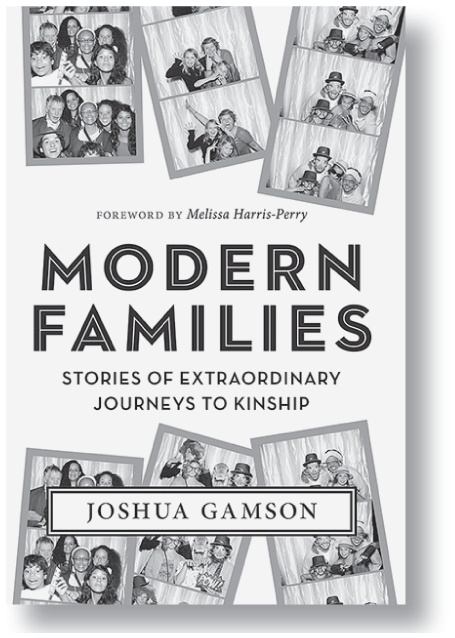
How to review a book that falls between genres? Sociological research monograph? Definitely not. Memoir? Partially, but not only. Critical analysis? For sure, but not primarily. Such a great read that you stay up too late at night even if you have to get up early the next morning? Absolutely! Is this that very rare book that you want to give to your recently married gay nephew, the parents of your neighbor whose single daughter just adopted a baby from Ethiopia, and assign for a course about families or relationships or sexualities? Yes, yes, and yes.
Is this that very rare book that you want to give to your recently married gay nephew, the parents of your neighbor whose single daughter just adopted a baby from Ethiopia, and assign for a course about families or relationships or sexualities? Yes, yes, and yes.
Modern Families is a book full of wonderful stories, narratives of people who really want to be parents. Through Gamson’s writing we meet would-be parents without the requisite sperm and egg who have to creatively chart what path to take, what journey to make, to fulfill their dream to become a family with children.
Gamson brings the reader close into the lives of families that required creativity, grit, and determination in their very formation. The intimacy we are offered is a zoom lens with detail enough to see behind the scene to the passion, desire, pain, failures, and success of these would-be parents becoming real, live loving parents. The reader is invited to experience intense moments with such empathy that you will sit on the edge of your seat, cry, hold your breath, and rejoice with these couples.
And yet, you will never forget the larger social and political context these families inhabit. Nor will you be able to ignore the inequalities, both local and global, that allow these people (and not others) to become parents. Gamson’s sociological eye is ever-present, reminding us about how the poverty in some countries produces children available for adoption, the corruption in adoption practices that just might have allowed these particular children to become available to well-off American would-be parents in the first place. Gamson is not shy, either, about the ethical issues involved with the commodification of women’s bodies. He describes the class distinctions made between desired egg donors and women who act as surrogates. Sometimes the would-be parents struggle ethically with these inequalities, but even when they’re not focusing on social inequality, Gamson never lets the reader forget. He consistently provides strong analysis, with repeated reminders about the class, racial, and gender politics that envelop the possibilities available to upper-middle class Americans, whether they are single mothers or queer couples.
These stories of extraordinary journeys to kinship should rightly and totally put to bed the myth of the one-size-all American family (if such a myth exists even in the Bible Belt any more). Still, they are about middle-class people with resources to pay $11,000 to start to the process, then fly around the country or the world, managing to come up with another $10k for this or that along the way. These are not stories about the 1%–these would-be parents have borrowed from their own parents, taken second mortgages, and gone into credit card debt. They’ve scrimped and saved, borrowed and begged. And yet, they have the class privilege, the graduate degrees, and the parents with bank accounts. They are privileged economically to be able to access reproductive technologies and/or international adoption. As the author makes clear, this is his own story, alongside those of his friends, colleagues, and others who travel in his social world. They are the lucky ones, financially able to benefit from both new reproductive technologies and changing social norms.
Even in today’s “post every moment of your life on Facebook” world, all of these families—beyond the authors’—have chosen to use pseudonyms. Just how open to be about novel creation stories is clearly still ambiguous, which makes the frankness from the author so powerful, so refreshing, sometimes raw, and always inspiring.
Reba’s creation story is almost mythical. Her parents, Joshua Gamson, the lefty Jewish professor and his husband Richard, the Black doctor, managed to circumvent all those thorny issues of the commodification of working-class American or poor international women whose bodies become surrogates; of purchasing eggs from women with genetic material of a presumably higher class; and of the commercial transactions involved in assisted reproduction. Instead, they found a close female friend to donate the egg, and another one (an ex-girlfriend at that) to carry the baby for them. Both of these women are open to remaining in some form a presence in the baby’s life. Reba and her dads had two sets of grandparents cheering them on, helping financially, buying baby clothes, and otherwise providing loving kinship support. The story is so heartwarming it could easily be a made-for-TV movie. But it is real, and the details are intimate and so touching that, the first time I personally met Reba (and her sister Maddie), I felt unusually shy, as if I knew them too well. It was as if, while they were simply adorable and talkative children a colleague had brought to lunch, I was somehow implicated in their lives through their father’s vivid telling of their creation story. How will they read this book when they are grown? Only time will tell.
And yet, you will never forget the larger social and political context these families inhabit. Nor will you be able to ignore the inequalities, both local and global, that allow these people (and not others) to become parents.
But this is not only a memoir. It is also the creation story of several other children and several other would-be parents. We meet Rahel, a friend of the author’s from Zionist summer camp, who meets a rabbi who tells her that her child is “waiting for her” in Ethiopia. The author reminds us of the horrific poverty and inequality that has led to such children patiently awaiting American parents to bring them home, and we readers know that some of those babies were actually taken or conned from families who expected them home one day. All of the possibility for a new family here is the result of global and political inequality. And yet, at the same time, we experience the joy and love and family that Rahel creates for herself and her child here in their privileged American life.
We also meet Maureen and Julia, a lesbian couple whose quest for a family is more complicated then it looks. One woman donates the eggs, the other the womb. Together, they make a family. Gamson, always the analyst and the storyteller, reminds us that queer couples live in the same cultural context as heterosexual ones, and that, for these women, biogenetic ties were seen as the ultimate arbitrator of parenthood—despite queer families being the vanguard in defining families by choice as well as by blood.
And then we meet the foursome, the two lesbians and two gay men who choose—at one of the women’s driving passion—to become parents together. Among them, they have the requisite biological equipment, but even so, pregnancy attempts fail. And so the four of them, co-mothers and weekend fathers, find their child in Nepal. (At least the first one.)
To meet the rest of these families, and to see just how the author and his husband conceive Maddie and bring her into the family, you will have to read the book yourself. Spoiler alert: This time they must struggle with the commodification of women’s bodies, forging a humane relationship between a paid egg donor and a “fetus babysitter,” the working-class woman who acts as a surrogate.
What Modern Families most powerfully succeeds in doing is moving us beyond either/or debates about reproductive technologies. As the author so aptly notes, past writing has been sharply divided between celebration and criticism. “Repro Lit” has mostly been about the joys of finally succeeding at parenthood after trying so hard and for so long. And then you have the sociological analysis of the heteropatriarchal global and class inequity that commodify women’s bodies, as wealthy usually (but not always) White Americans “buy babies” by using poor women of color’s reproductive labor. The author labels this genre “Repro Crit,” in that it focuses on institutional structures and global class and gender privilege. Gamson then goes on, through keen analysis, to dismantle the dichotomy between these two genres. The possibilities for single women and gay and trans couples to have children expand the concept of reproductive freedom far beyond abortion to the right to reproduce. Scholars have rightly celebrated the expansion of opportunities to make and examples to cherish new, very modern families. At the same time, reproductive technologies and international adoption are inextricably embedded in inequalities between women and men, across class boundaries, and between rich and poor countries. Both the joys and the inequalities are often present.
The memoir embedded in Modern Families shows that even the use of reproductive technologies including donor eggs and surrogate bodies can be approached humanely, honoring the intimacy and respecting the sacred aspect of even transactional contracts when the creation of human life is involved.