




Abstract
Exploring naturalization ceremonies as sites of Durkheimian ritual, creating social solidarity and shaping stories of the nation.
The U.S. Army
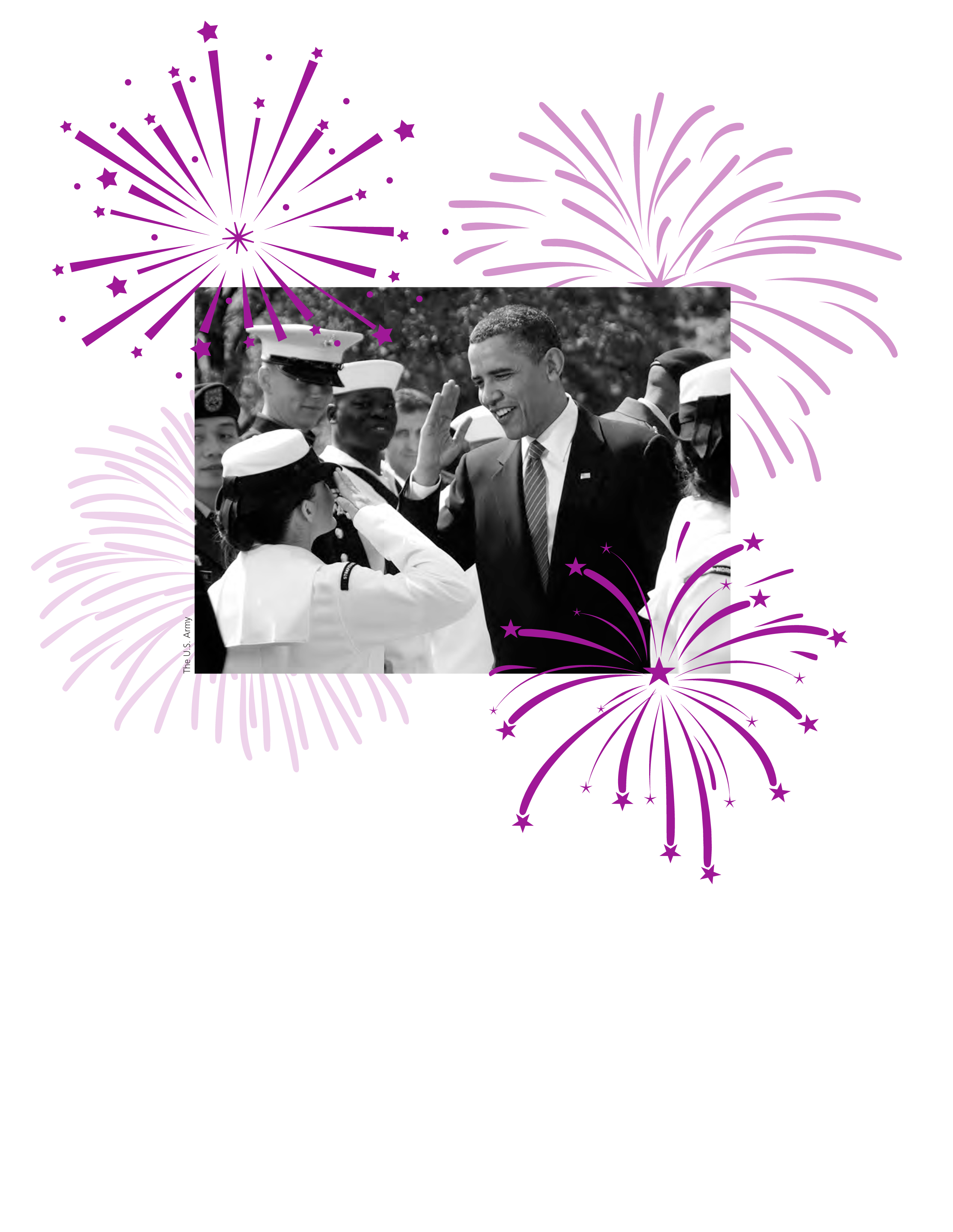
<< At a White House naturalization ceremony, 24 U.S. service members were saluted by the President after taking the Oath of Allegiance.
“Afghanistan, Albania, Algeria, American Samoa, Argentina, Australia…”. Almost 400 immigrants are rising from their seats in a San Francisco auditorium as their country of origin is called. To wild cheers and applause, an immigration official leads the group in repeating the Oath of Allegiance, line by thorny line, from renouncing all “allegiance and fidelity to any foreign prince, potentate, state or sovereign” all the way to “so help me God.” A few speeches later, the brand new U.S. citizens step out into the chilly fog bearing embossed certificates that prove their transition into formal national membership, joining a total of 19 million naturalized U.S citizens.
Perhaps you have seen footage of citizenship ceremonies on a slow news night, or photographs of rows of immigrants, their right hands raised, being sworn into citizenship. Perhaps, like me, you became a citizen in one of these ceremonies, or watched a friend or a family member get naturalized. What a contrast these ceremonies present with much else having to do with immigration in the U.S.! Images of smartly dressed and beaming immigrants celebrating and being celebrated clash with figures of emaciated mothers and kids in immigration detention, shots of high-tech drones and barbed wire on the southern border, and the skyrocketing tally of the deported. The naturalization of immigrants seems to fit more easily into narratives of the nation of immigrants, built by hard-working newcomers intent on joining a mainstream and achieving a shared American Dream.
The Road to Citizenship
In debates over U.S. immigration, proponents of deportation and other policies that crack down on immigrants who live in the U.S. without authorization juxtapose these immigrants to the “good” immigrants who “wait in line.” This makes it seem like there is a straightforward approach that takes one from the desire to immigrate to a legal, step-by-step process to eventual citizenship. It does work like that for some, not so much due to their exceptional respect for the law or hard work, but what is often a lucky confluence of country of origin, opportunity for education, and existing connections. For many others who want to migrate to the U.S. or who are already within its borders but without formal authorization, there is no line in which to wait. The labyrinthine immigration system works to limit the possibility of legal immigration for many interested in it, even if they are determined to do the right thing, even if their survival depends on it.
Naturalization ceremonyies do more than turn immigrants into citizens.
Immigrants who are eligible for U.S. citizenship are those who already have permanent legal residency, colloquially known as “having a green card.” Most immigrants get this status when close family members living as either citizens or permanent legal residents in the U.S. sponsor their immigration. This process can take a long time, depending on country of origin and closeness of relation: brothers or sisters of U.S. citizens from the Philippines currently have to wait 23 years for a visa, and married children of U.S. citizens from Mexico have to wait 21 years. A smaller number of those who have green cards are sponsored by employers, and an even smaller number (around 120,000 in 2013) are refugees. The fourth most common way to gain permanent legal residency is through a lottery. People from countries that are underrepresented among immigrants (for example, Ireland, Paraguay, and Cambodia) and who have a high school education and a clean record can apply to “win” one of 55,000 green cards every year.
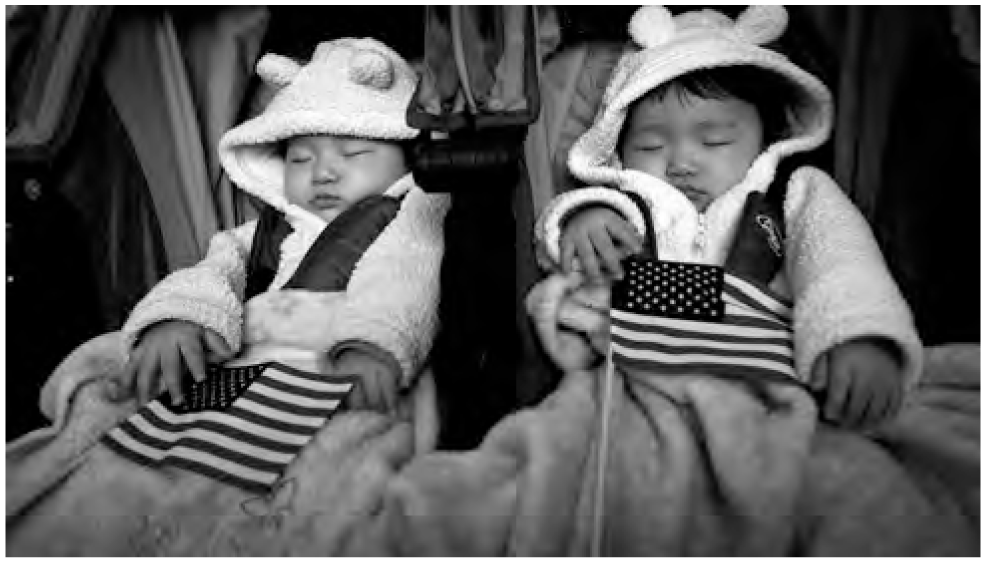
During a ceremony celebrating the 125th anniversary of the Statue of Liberty, a Marine’s children sleep as he becomes a citizen by virtue of his military service.
MarineCorps New York
According to estimates by the Office of Immigration Statistics at the Department of Homeland Security, of about 13 million legal permanent residents living in the U.S. in 2012, almost 9 million were estimated to be eligible for citizenship. The road to citizenship was largely closed, however, for the estimated 2 million immigrants on temporary student and worker visas, not to mention the estimated 11 million undocumented immigrants.
They generate social solidarity and shape stories of the nation.
When immigrants gain permanent legal residency they can apply for citizenship after living in the U.S. for five years. Those who are married to U.S. citizens can apply after only three years, and, since the beginning of the official period of hostilities after September 11, 2001, members of the military can apply after completing basic training. Before they can take the oath, applicants fill out a lengthy application that presents their lives in painstaking detail. They pay $680 in fees (more if they retain an immigration attorney). If the application is accepted, their fit for citizenship is evaluated in a face-to-face interview with an immigration official who decides whether the applicant possesses good moral character; can speak, write, and understand English; and has a good knowledge of U.S. history and civics.
Most recently, for every 100 new citizens, about 8 people are rejected, but the rejection rates fluctuate from year to year and district to district. New citizens get the right to vote, better access to jobs, convenient international travel, and are able to sponsor the migration of family members much faster. Naturalized immigrants are also eligible to receive federal means-tested benefits and are protected from deportation. These significant benefits are acquired when immigrants raise their hands and swear allegiance to the U.S. during naturalization ceremonies. But this explanation of the individual steps to citizenship and the benefits of naturalization for those who have access to it misses a much larger, sociological aspect of citizenship acquisition for the nation, best seen through the lens of the citizenship ceremony.
Durkheimian Rituals in Post-9/11 America
Naturalization ceremonies, now a standard milestone on the path to citizenship, are much younger than naturalization itself. Provisions for naturalization have been around since the birth of the nation, but the ceremonies did not become institutionalized until well into the 20th century. At the turn of that century, scandal surrounded naturalization. “Citizenship mills” turned masses of immigrants into citizens in time to vote for candidates representing corrupt political machines. Among nativist fear of the proverbial huddled masses, there were calls to make naturalization more solemn and uniform across the country. In 1906, a public ceremony for oath-taking became a requirement for naturalization, if one conducted without much fanfare or formality.
Naturalization ceremonies truly drew the spotlight during World War II and the subsequent Cold War. Reformers compared ideal ceremonies to university graduations, key religious occasions, or even weddings, meant to instill immigrants with proper sentiment of loyalty.
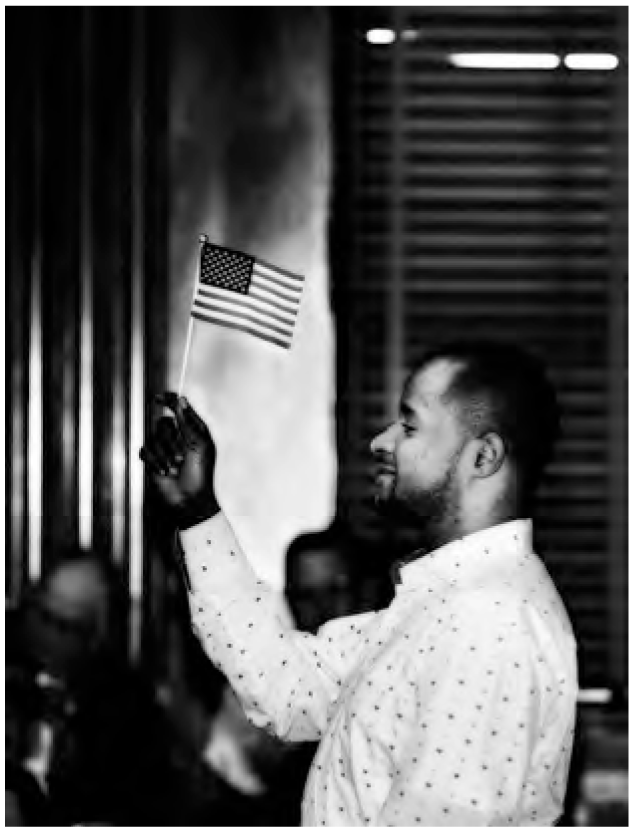
Today, many ceremonies are very much like graduations. In 2007, my research assistants and I attended 36 ceremonies across the U.S.. We saw immigrants sit in rows, rising and sitting for various parts of a ceremony that culminated in their transition to a new state of being: full membership in the nation. They listened to speeches about the greatness of their new nation and their place in it. They waved small American flags, sang the national anthem, and watched patriotic videos. When the number of people was manageable, they were called up one by one to receive their naturalization certificates, while family members snapped pictures. Some ceremonies were small, with only a few immigrants. Others inducted thousands into citizenship simultaneously in stadiums and convention centers. The mood ranged from almost routine to very formal to exuberantly celebratory. Clearly, naturalization ceremonies have become elaborate rituals to welcome new members into the American nation.
A naturalization ceremony in Fort Worth, Texas is a moment for celebration.
Greg Westfall, Flickr CC
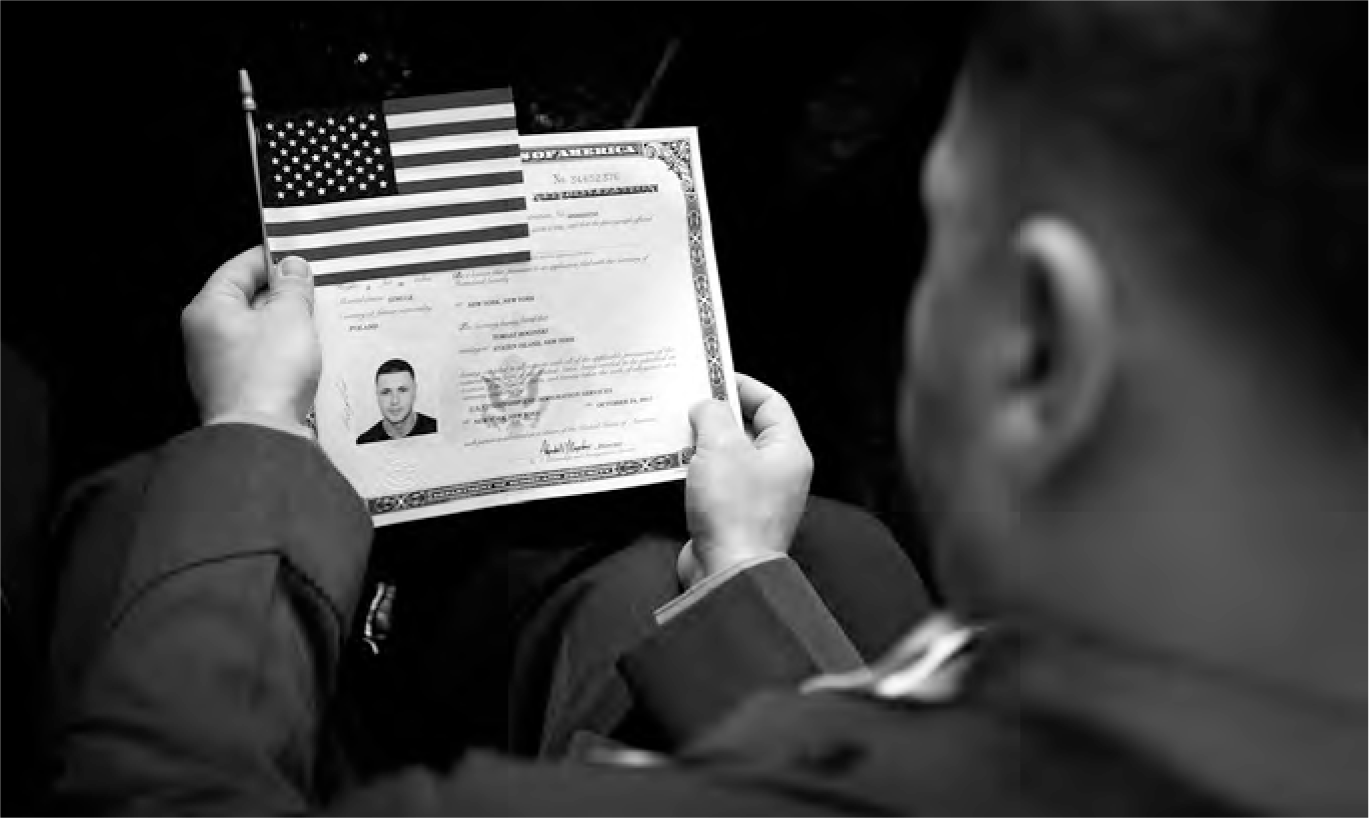
A new American citizen looks at his naturalization paperwork.
MarineCorps New York
But naturalization ceremonies do more than turn immigrants into citizens. In his classic 1912 work, The Elementary Forms of Religious Life, Emile Durkheim explained how rituals work to maintain social order and solidarity. Durkheim theorized that ceremonies give rise to a collective conscience; a sense of belonging that brings members of a community together. Sacred objects and images play a key role in eliciting a heightened and emotional sense of solidarity. In developing this theory, Durkheim relied on accounts of religious ritual in indigenous societies of Australia, but his insights bear weight in other contexts, even those that are not ostensibly religious. During participant observation of naturalization ceremonies, I noted a plethora of sacred objects and images: U.S. flags, national anthems, oaths and pledges of allegiance, uniformed members of the armed forces, the Statue of Liberty, and photographs of immigrants arriving at Ellis Island. These work together to elicit an emotional sense of belonging, pride, and patriotism.
Crucially, this does not just happen for the new citizens. True, I saw many immigrants who were moved by the naturalization ceremonies, but their effect is much wider. Their use in the media and political spectacle demonstrates that these ceremonies reaffirm the American nation as a whole, allowing native-born Americans to experience a meaningful sense of solidarity through the ritual, even if their experience of it is filtered through the media. Beyond turning immigrants into citizens, naturalization ceremonies provide an emotionally resonant experience of the American nation that draws new and old members together through what Durkheim described as “collective effervescence”. Not surprisingly, the heightened energy and excitement that these ceremonies can generate and the resulting sense of community lead to their frequent use in other events, such as Independence Day celebrations and September 11th commemorations.
An Exceptional and Diverse Nation
Naturalization ceremonies are a fascinating research site for those interested in nationalism and immigration, particularly because these ceremonies include speeches made to new citizens, expounding on the greatness of the American form of government and explaining the responsibilities of citizenship. These speeches provide a unique opportunity to study how immigration fits into the narrative of the U.S. I analyzed 79 such speeches given between 2003 and 2008. I collected 24 by attending ceremonies, analyzed recorded proceedings from 12 ceremonies attended by my research assistants, and studied 43 ceremonies with written, audio, and visual records stored in a variety of archives. Naturalization ceremonies are administered by local immigration offices and district courts, which made access to them complicated and uneven. For that reason, the sample I studied—while diverse in geography, size, venue, and background of speakers—is not random.
Significant benefits are acquired when immigrants raise their hands and swear allegiance to the U.S.
Many different types of people speak at naturalization ceremonies. Often, a federal judge or an immigration official gives a speech, but prominent individuals, such as politicians, community leaders, distinguished academics, or even clergy also take the stage. The speakers are given only vague guidelines with which to create their remarks, which reflect their interests, experience, as well as the context of the ceremony. My analysis of naturalization ceremony speeches revealed a common thread: diversity is the defining characteristic of the American nation. In many speeches, new citizens heard that the U.S. was the greatest country in the world because of its diversity. Speakers referred to diversity as the nation’s “greatest strength” and the “key to its success,” with emphasis on the idea that such diversity resulted from exceptional American openness to immigration.
The U.S. as a nation of immigrants is a familiar cultural trope, first popularized in reference to the mass European migration at the turn of the 20th century. In naturalization ceremonies, however, the idea of a nation of immigrants was expanded to encompass not only contemporary immigration, but also earlier European settlement of the continent and even the migration of Native Americans from Asia thousands of years ago. For instance, a U.S. District Court judge in Los Angeles, Patrick Walsh, said in his 2007 address to new citizens: “America is a country of immigrants. We all share in common the fact that at some point in our history, somebody left the land they loved and came to America to make it a new home. Even the Indians who inhabited the United States when the first European settlers came, they traveled to this country from Asia, across a land bridge that used to connect Alaska and Russia.”
Durkheim theorized that ceremonies give rise to a collective conscience; a sense of belonging that brings members of a community together. Sacred objects and images play a key role in eliciting a heightened and emotional sense of solidarity.
By combining wildly different experiences under the umbrella of the nation of immigrants, speakers extended the immigrant experience to everyone as a basis for national unity. But one group was notably left out of this story: African Americans. In all the speeches I collected from across the country, not one extended the immigrant experience to encompass the descendants of the enslaved. In story after story about the American nation, African Americans were simply omitted, as in this 2004 speech by Jeff Miller, a Congressman from Florida: “This country was built with the blood, sweat, and tears of Native Americans and immigrants. And successive waves of immigration have served to renew and enrich the American dream, and contribute to the cultural, spiritual, and intellectual wealth of our country.”
The only exception was then-mayor of Newark, NJ, Cory Booker, who told his audience that immigrants and slaves founded the American nation. Even in its expanded version, the nation of immigrants narrative omits paths to U.S. citizenship that have not been based on immigration, which include not only slavery, but also colonialism, expansion, and annexation.
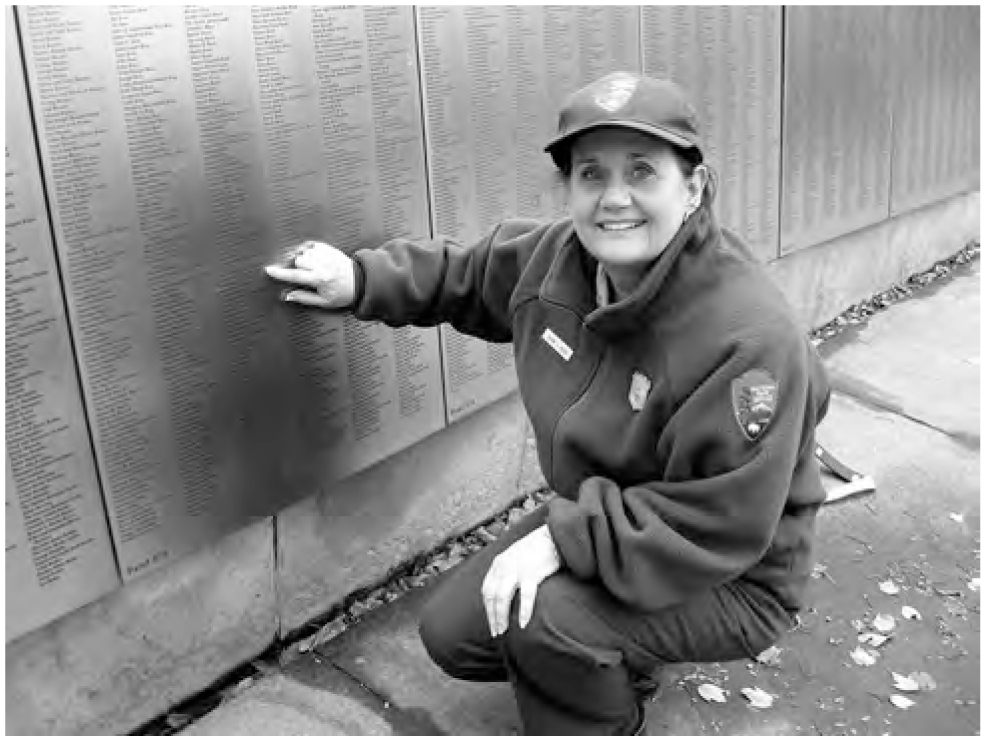
Susan Rossi points out an immigrant ancestor at Ellis Island’s Wall of Honor.
National Park Service/Northrup
Immigrants as Supercitizens
At a time of heated debates over immigration, conflicting and ambivalent characterizations of immigrants abound. Are they family-oriented hard workers or lawbreakers who burden the social system? Policy makers, commentators, and advocates attempt to parse the immigrant population into deserving and undeserving. Scholars have found that those who are formally authorized to live and work in the U.S. are often painted as deserving, compared to a mythologized image of earlier European immigrants. These are the immigrants who make the U.S. exceptional through diversity. The undocumented—or those suspected of being undocumented, as is the case for so many Latinos—are the undeserving immigrants, who should be deported and kept out by ever-higher border walls (literal and figurative).
However, at the naturalization ceremonies I studied, I did not actually hear this conflict and ambivalence. It would be equally as jarring for speakers welcoming immigrants to citizenship to bring up negative characterizations of immigrants as for college commencement speakers to talk about cheaters and perpetrators of sexual assault among the graduates arranged in front of them. Thus, unsurprisingly, today’s naturalization ceremonies are full of great praise of immigrants. Yet, as difficult as it is to imagine, this was not always the case.
Through archival research using papers of prominent individuals, historical records, court and other government libraries, I found 19 speeches made at naturalization ceremonies in the 1950s and 1960s. Even from this small sample, it was clear that immigrants used to hear far more negative things about themselves as they became citizens. There was suspicion about their loyalty, as in the speech that Judge Tom Clark delivered to new citizens in Miami in 1959: “Before commenting upon some of the provisions of our Constitution let me say that we have but one loyalty here: to the United States of America. We do not countenance divided allegiance. America is first, it is second, it is third, it is every choice. We have but one oath, one citizenship, one country. As Theodore Roosevelt declared, any citizen ‘who says that he is an American but something else also, is not an American at all.’” Similarly, ceremony speakers doubted new citizens’ tolerance, and self-sufficiency—and they openly admonished their audiences to stay the course and do the right thing.
Today, as anti-immigrant rhetoric rages in the public sphere, such doubt and suspicion are banished from the naturalization ritual. Not only are immigrants told they are good people, they are told that they are better than native-born Americans. For example, Joseph Torsella, CEO of a prominent Philadelphia cultural institution, said at a 2007 ceremony: “It’s always a moving experience for you, but even more importantly, I think, for us. I want all of you to understand that this landmark day for you is vitally important to the rest of us and we are incredibly privileged to be a part of it. Why is that? Because you remind us what a gift it is to be a citizen, because that’s too easily forgotten by those of us who’ve been born into citizenship. So when you become Americans by choice, you remind us what precious gift that citizenship is and you perform a service to each and every one of us and to the country as a whole by inspiring all of us to renew our civic commitments as you do the same for yours. So we thank you for that.”
The language around immigrants in these speeches is so superlative—redeemers of the nation, morally superior, bringing honor—that they are made to seem like supercitizens, understanding and demonstrating the true meaning of U.S. citizenship in a way native-born Americans do not.
If naturalization ceremonies in the past were not like this, why do they feature this laudatory language today? To understand this puzzle, we must return to the contrast drawn between good and bad, deserving and undeserving immigrants. The naturalization ceremony not only inducts immigrants into citizenship, but also highlights and legitimizes the line between those who can become citizens and those who cannot. The audiences at the ceremonies are seen as the deserving immigrants who have struggled to gain the ultimate prize of membership. Unseen and only implicitly referred to are those not eligible for citizenship, the undeserving who are left out of the nation of immigrants narrative. Thus, while the rituals of citizenship ceremonies generate symbolic solidarity, they also reveal a poignantly meaningful set of omissions in the constructions of collective identity and belonging in the U.S.. These ceremonies generate an incomplete and one-dimensional narrative of diversity that leaves out whole swaths of the American experience. They create a model of citizenship that inevitably suggests that some immigrants belong because others are not good enough.
These ceremonies do much more than mark immigrants’ transition to full national membership and its benefits, they serve as create recurrent rituals that generate social solidarity and shape stories of the nation.
The initial reaction may be to discount naturalization ceremonies as trite patriotic rituals. After all, naturalization rules have not changed in many decades, and the real policy action is seemingly elsewhere. Yet, hundreds of thousands become citizens at naturalization ceremonies every year. These ceremonies do much more than mark immigrants’ transition to full national membership and its benefits, they serve to create recurrent rituals that generate social solidarity and shape stories of the nation and the role of immigration in it. They also help justify the current immigration system that blocks the road to citizenship for so many.