



Abstract
Today’s gender dissidents find support, community, and practical advice by sharing information and creating intimacy through trans vlogs.

Kye dreams of having a masculine chest one day. “A big chest is extremely dysphoric for a lot of transguys,” he says, using the psychiatric term signifying estrangement from one’s sexed body. Though the 16-year-old has small breasts, wearing a bra “enhanced them and made them look bigger,” so he started binding them in order to minimize their appearance.

In a four-minute YouTube video, he displays his flattened chest and instructs others on how to achieve a similar effect; over 75,000 viewers have seen it. “I’m a real boy!” he proclaims in the video, which was shot on his computer in his bedroom, poised in front of a dinosaur crossing poster, a series of hand-drawn animal cartoons, and the cover of a Broadway playbill.
Kye is among a growing number of transgender men (female-assigned-at-birth who identify as male) who are coming out of the shadows, at younger ages—and online. In YouTube videos, transmen are documenting their decision to assume a male gender, disclose to family and friends, and undergo surgical and non-surgical body modifications. (In the following, I refer to individuals using male pronouns, in accordance with how they wish to see themselves.)
Over the course of three years, Kye posted 20 videos on subjects ranging from “How Do You Know You’re Trans?” to an interview with his girlfriend: “How to Date a Transman.” People have viewed his YouTube channel, which has over 1,000 subscribers, over 145,000 times. His is one of thousands of video blogs, or vlogs, produced by young female-to-male (FTM) individuals on the Internet.
While the very public gender transition of Caitlyn—formerly Bruce—Jenner dominates the television airwaves and tabloid pages, hundreds, perhaps thousands, of young people are utilizing YouTube, Instagram, and other social media sites to publicly narrate their gender transitions, creating videos which are buried in plain sight among clips of adorable cats, high school girls mugging to Miley Cyrus songs, and do-it-yourselfers instructing people on how to change a flat tire or fix a toilet.
Stumbling upon these videos while doing research on transgender men’s lives, I became intrigued by the ways these young people are using YouTube to connect with others. What do they talk about? Who are they talking to? And how do they negotiate questions of privacy in such a public forum? To find out, I first conducted a content analysis of 50 randomly chosen transmale vlogs on YouTube, and then narrowed my search, focusing upon videos which document a particular aspect of the transition process: chest binding.
What I found is that by producing and consuming YouTube vlogs, young transmen are producing a visual record of the transition process and creating what Internet researcher danah boyd calls “networked publics” – spaces that are structured by networked technologies for people to “gather, connect, and help construct society as we understand it.” If feminists in the 1970s formed small groups to speak the truth of their lives, blurring the boundaries of private and public, today’s gender dissidents are more likely to do so online.
Networked Publics
A young transman in rural south central Kentucky told media scholar Mary Gray, when she interviewed him nearly ten years ago, that he documents his own transition on YouTube in order to “‘think out loud’ to himself and mull through his own anxieties about gender reassignment surgery and what it would be to become the boy he felt he had always been.”

By narrating their life stories and sharing information, young transmen are building emotional bonds with one another.
For millennials—the vast demographic group born between 1980 and 2000 who are the first generation of so-called “digital natives”—growing up online is normal and natural. Queer millennials, transpeople among them, have been particularly enthusiastic users of social media. If not for the Internet, many of them, particularly those who live in rural areas, or who are particularly young, would have little or no access to others like themselves. Many utilize YouTube, the video-sharing website, to find other trans masculine individuals with which to share their stories.
“When it comes to real life stories, how we feel about our bodies and how we identify, documentaries are generally not made by trans people. They’re made about transpeople for nontransgender people,” says Warren, a transman in his early 20s. YouTube, he says, offers transmen a forum for discussing “everything from the initial coming out, to ten years post-transition what’s going on in their lives.”
Warren continues: “Seldom do we see the telling of a story the way that we would tell it ourselves, or tell another person who has gone through something similar. That’s what’s really interesting about YouTube. There are hundreds of transpeople on YouTube sharing their story.” The beauty of vlogs, says Warren, is that “you get invested, and you make friends, and you get to see where each other’s lives go and evolve over time.” The vlog format is particularly well suited to narrating processes over time.
In 2000, a cisgender (normative, or non-transgender) man by the name of Adam Kontras posted a video alongside a blog entry to inform his friends and family of his cross-country move to Los Angeles to try to break into show business, documenting his adventures. It is thought to be the first vlog. Many vlogs are, in effect, interactive diaries. Communication is asynchronous: someone posts a video, and others may view it days, weeks, and sometimes months or years later, posting comments, thanks, and sometimes questions.
Transgender males, who often speak of the process of changing gender as a “journey,” use vlogs to document aspects of the transition process: the decision to move away from their assigned gender, bind their breasts, change their pronouns, pass as male, and often, undergo chest surgery—along with the emotional challenges such choices pose.
Sharing Information, Creating Intimacy
Since breasts are such a central marker of femaleness, a key part of the FTM transition process involves refashioning one’s body to minimize or conceal the appearance of having them. Like Kye, many transmen hope someday to have “top” surgery, but typically they must wait at least until they are 18 to do so. In the meantime, many bind, or flatten, their chests.
“If a transman can walk down the street in a way that does not call any attention to the way he is self-consciously producing gender,” write anthropologists Ryan Pils and Evelyn Blackwood, “that gives him greater confidence.” Little wonder, then, that binding techniques are a popular topic of discussion on transmale vlogs. (Searching for the terms “transgender men” and “chest binding” on YouTube yielded over 4,000 videos.)
“Wearing sports bras are better than nothing,” says Kye in a video post, but “binders are what transmen need to start passing as men”—that is, to be seen by others as male. Kye, who lives in Illinois, can’t afford commercially made binders, such as undershirts which have two or three layers of spandex, so he affixes Ace elastic compression bandages tightly across his chest with a safety pin, cautioning viewers of his vlog: “when wrapped too tightly, they can do damage.” Many transmen bind their breasts for months, even years, often as a prelude to undergoing “top” surgery.

In his videos, Kye thinks out loud, figuring out ways of minimizing the social tension that occurs when gender presentation raises questions in public, and sharing what he’s learned with others facing similar challenges. He’s trying out a different body, helping others to do the same, and building an intimate community with other young transmen.
For young transmen, these opportunities for public self-reflection are particularly important as they contemplate gender transitions, frequently while they are still living in the liminal space of their family homes. Being out in public is difficult, if not dangerous. By narrating their life stories and sharing information they are creating a networked public comprised of young transmen, building emotional bonds with similar others.
In the first of over 40 videos documenting his transition, a young transman named Connor introduces himself: “The name is Connor and like many other people in the world I am transgender. I know there are a million videos that you can watch about trans stuff but now you have another one. I am here to help and to entertain. DUUHH! A’ight so love you my friends. Enjoy the page.”
If feminists in the 1970s formed small groups to speak the truth of their lives, blurring the boundaries of private and public, today’s gender dissidents are more likely to do so online
One video in his vlog “Journey to Connor” is entitled a “Moment of Major Dysphoria.” Here Connor grapples with his estrangement from his natal body, and others’ inability to recognize him as the gender he feels himself to be. His room is dark, illuminated only by the glow of the computer. He discusses his desire to physically transition: “I really need to get it done. It’s hard to wait. I want to get on t (testosterone). It gets better, I think. It just takes time.” He is crying.
In the vlog, he tells his viewers that when he went to work the other day, everyone called him by Connor, his chosen name, rather than his given female name, “which was really cool.” A few people even “called me sir,” he said, “but it doesn’t fool me.” He desperately wishes to be recognized by others for the gender he feels himself to be. “I want my parents to be ok with it, and I just want to get things done”—meaning he wants access to chest surgery and hormones. He addresses his viewers, other transmen, the “guys,” with familiarity and affection, and describes “meeting buddies online,” though they have never actually been in the physical presence of those they communicate with and probably never will be.
“Looks like some of you are watching,” Connor says. “I hope everyone else who has this problem is hanging in there. Don’t give up. Hopefully you guys are rooting for me, and I will root for you too. Peace and love, I’ll talk to you guys soon.” At one point, he appears on screen with his girlfriend, a gender studies minor, and tells viewers: “I’m going to be making some more videos soon.” He invites others to comment and ask questions, and signs off: “I love you, talk to you soon.”
To the outside observer, he and other young people seem extraordinarily willing to share the deepest aspects of their private lives—and even overshare, at times. When he first saw these videos on YouTube, sociologist Sal Johnston, who is a member of an earlier cohort of transgender men, admits that he initially feared that their publicness would invite voyeurism, disdain, and mockery. “Why would you do that?” he wondered.
But today’s young people are living their lives online. Millennials who openly narrate their experiences online, even experiences that are at odds with the vast majority of those around them, are downright normal.
Transitioning in the Age of Publicity
As a number of observers have suggested, young people’s online and offline lives often blur into one another. Many millennials assume that the sheer volume of information available online means that only like-minded people will view their videos, and that those who lack a direct investment in such concerns will have little interest in them. In other words, those who enthusiastically share their intimate lives with those online often believe that disattention, in effect, protects their privacy.

While few barriers to public gawking actually exist, norms of mutual respect generally seem to operate on transgender vlog sites. “In networked publics, interactions are often public by default, private through effort,” writes danah boyd. “What’s at stake is not whether someone can listen in but whether one should.” Even though transgender vlogs tend to be open for all to see, my content analysis of more than 50 videos revealed only a half dozen instances of negative feedback. In each of these cases, a member of the community, or an ally, came to the defense of those who were attacked.
The allure of fame may drive some transmen to produce and post videos; the vast majority, though, are content sharing their story with like-minded others.
So for example, when Ethan posted a vlog of his flattened chest, discussing the virtues of a particular type of chest binder, and was taunted: “If your [sic] a dude why can’t you show your chest?” another viewer responded in Ethan’s defense: “If you think it is wrong and/or nasty, then why would you search for it to begin with? Ethan is not a woman, he’s a man… you deal with it.”
Feedback is much more likely to be positive. Responding to one of Kye’s videos, a viewer writes: “Ok so, I’m not FTM or MTF but my boyfriend is FTM and watching your videos has helped me. Thank you so much, and keep up the great Vlog.” She adds: “PS. You’re great for starting these to help people. Not just to bitch or try to get famous. You’re an amazing guy, and I appreciate you!”
Another viewer writes: “You inspire me beyond belief. Maybe one day I can come out, too.”
In theory, individual vloggers can control their privacy settings, deciding which videos to share and which to keep private. But creating boundaries around online spaces is difficult— and clashes with the goal of reaching as many viewers as possible. The greater the number of viewers, the less isolated vloggers feel, and the more information they are able to share. For those who participate in these networked publics, coming out online can be personally powerful.
In their everyday lives, transgender people must be acutely aware of how they appear to others, particularly when they use bathrooms and travel through public places. “Moment to moment, day to day, you have to be careful,” Sal Johnston says. “It’s an exhausting way to live.” But by openly narrating their lives on YouTube, young transmen are throwing off their internalized shame and making a claim for attention in a world where attention-getting is key to self-making.
Growing up in an age of publicity, young people understand the search for attention as normal—and inseparable from our “brand culture,” according to communications scholar Sarah Banet-Weiser. Brand relationships, she argues, have become cultural contexts for everyday living, individual identity, and personal relationships.
Indeed, many FTM transition vlogs are a mash-up of coming out stories, Consumer Reports product reviews, and reality television self-revelations. Short, personal, and informational, they are embedded in the commercial culture in which they have sprouted, appearing next to videos instructing viewers on “How to get a flat stomach in a week,” or ads for Epson printers, exemplifying the freedoms as well as constraints of self-making with new media.
A vlogger called DemyDew reviews a chest binder that costs $34. “I’m a D38 and it gets me pretty damn flat,” he proclaims. He shows off his chest, pleased that with the binder he looks like “a dude with a belly.” “[The binder] pretty much flattens me out,” he says. “Some binders look like you’re wearing a bra, and that’s not cool,” he says. But this one doesn’t have straps. “It just looks like I have man boobs because I’m a big dude anyways. I’m almost 200 pounds.” Of the chest binder, he says, “Go get one, it’s worth it, and thanks for watching.”
In addition to consuming branded products, young people at times engage in the process of “self-branding,” marketing themselves, in effect, as brands. Adrian, who has nearly 9,000 viewers, posts videos that are barely distinguishable from the commercials that surround them. In one, he touts an Underworks chest binder: “This is like the best thing ever.” A Christmas tree sits in the background, and banners for Black Friday sales and the Home Shopping Network drift across the screen. “The good thing about this is that it is low-cut, if you want to show some skin,” he says. “My boobs are size C. They hold them back nicely.”
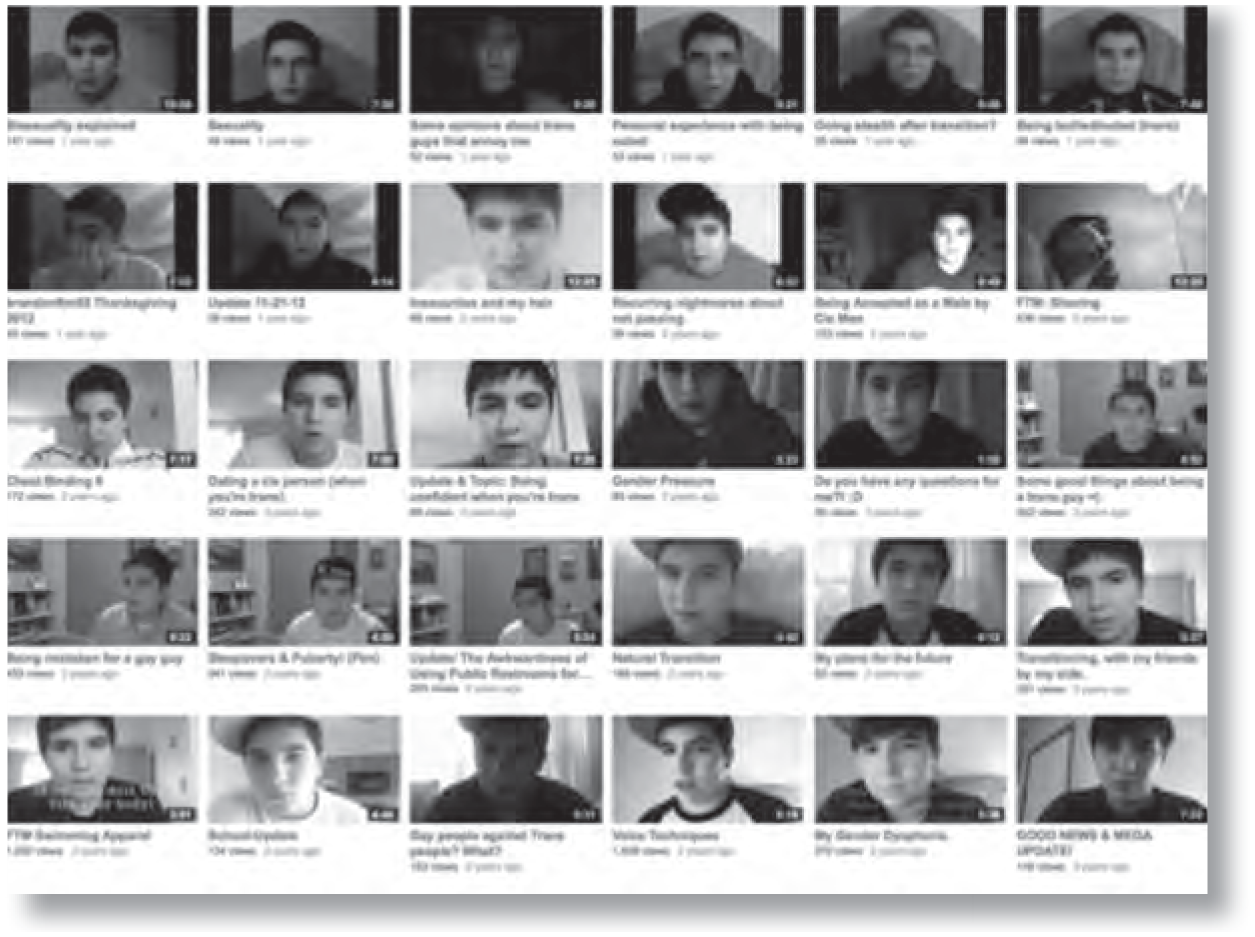
Those who master the art of attention-getting have some potential to earn money by directing traffic to ads and becoming “content management partners.” Brandon has posted 43 videos, and has 177 subscribers. He has started a YouTube channel of his own. “I have about four guys who are going to be doing videos,” he says, “I’m still going to be doing videos here, and also on our channel. A 13-year-old is our youngest.” He meets lots of his “buddies” online, he says, and plans “to get a couple more guys so that we can have a video every day.”
Some young people have parlayed sizeable fan bases on Facebook, Instagram, and Vine into book contracts for Young Adult novels, television roles, and “micro-celebrity” status. Aydian Dowling, a 28-year-old weight-training enthusiast, activist, and entrepreneur from Eugene, Oregon, who became known in the transmale community through his online videos, was recently named a finalist in Men’s Health magazine’s “Ultimate Guy” contest, crossing over into the mainstream, at least for a brief moment.
But while the allure of fame may drive some transmale vloggers to produce and post videos, the vast majority are content sharing their story with like-minded others. A year after he began posting videos on YouTube, Kye underwent top surgery; his final video documents the effects of testosterone on his changing body. Today, Kye, an art student studying illustration, lives fulltime as male, and no longer posts videos online. But only a few years ago, his vlog was a lifeline, enabling him to publicly document his transition and help others to do the same.