



Abstract
Tracy Luff, Kristi Hoffman, and Marit Berntson on a false divide.
Keywords
Dating, especially among college students, has been declared dead many times in the last half century. In 2014, student writer Chloe Finch lamented in The Galleon, “We’ve forgotten how to date; there are just no ‘rules’ for how it should work anymore.” Social science research tells a much different story.
Although college students often participate in hookups, they still go out on dates and frequently form committed relationships. According to our research with more than 600 students on two college campuses, 41% had a sexual intercourse hookup in the last semester and 73% reported going on a date (not including dates with boyfriends or girlfriends). Over half of the students (56%) were or had been in a committed relationship. Other researchers document similar findings. Psychologist Jessica Siebenbruner, for instance, found that 47% of the college students in her study had a sexual intercourse hookup and 71% had dated.
Hooking up privileges sexual intimacy, while dating privileges emotional intimacy.
Contemporary media emphasize concern about the promiscuity of college students, but sociologists Martin Monto and Anna Carey maintain that concerns about an increase in hooking up and casual sex on campus have been greatly exaggerated. Their research compared the sexual behavior and attitudes of 18- to 25-year-old adults who had completed at least one year of college during two time periods: 1988-1996 and 2002-2010. They found no significant differences between the two cohorts in the number of sex partners, frequency of sex, or the permissiveness of sexual attitudes. They did find that the young adults in the 21st century were more likely to engage in sexual behavior outside of a committed relationship, whether with a friend, casual date, or an acquaintance. Hookup culture, then, has not led to college students having more sex, but to a shift in the social conditions under which uncommitted sex takes place. Further, Monto and Carey argue that the function of dating may be changing. Students may not rely on dating to get to know a potential long-term partner, but dating has not disappeared. Today’s college students seem to simply experience less pressure to maintain the pretense of a committed relationship within which to enjoy a sexual partner.
Hookup or Date
Rather than two endpoints on a continuum, dating and hooking up may be better viewed as two sides of the same coin. Whether it’s a hookup or a date, our study revealed few differences in how students met their partners (see below). In addition, the majority of hookup and dating partners were not strangers. Most students described both dates and hookup partners as friends (42%) or someone they knew from school (20%). Hookups (17%) were more likely than dates (8%) to involve a partner the student had just met. Arielle Kuperberg and Joseph Padgett’s review of more than 25,000 dates and hookups among students from 22 colleges similarly revealed few differences in how they met their hookup and dating partners. Still, an examination of the range of sexual behaviors that take place in hookups and dates yields some interesting parallels.
How respondents knew their partner in the most recent hookup and the most recent date

The sensationalism associated with hooking up in popular culture is due, in part, to a lack of understanding about the ambiguous term “hookup.” A hookup might end in oral sex or sexual intercourse, but often it involves just kissing and making out. As a result, most social science researchers carefully distinguish between different types of hookups. In our study, 65% of students reported hookups in which they “just made out,” compared to those who had sexual intercourse (45%) or oral sex (44%) hookups.
Sexual intercourse is more likely to occur during a hookup (54%) than on a date (13%), where sexual behavior is more likely to be limited to kissing (38%) or fondling (14%) (see below left). About one-third of dates involve no sexual behavior at all. The large sample examined by Kuperberg and Padgett found that hookups were twice as likely as dates to include sexual intercourse. There is less sexual activity in hookups than commonly assumed, yet they generally still involve some intimacy. Both hooking up and dating provide opportunities for sexual experimentation, but hookups emphasize sexual activity.
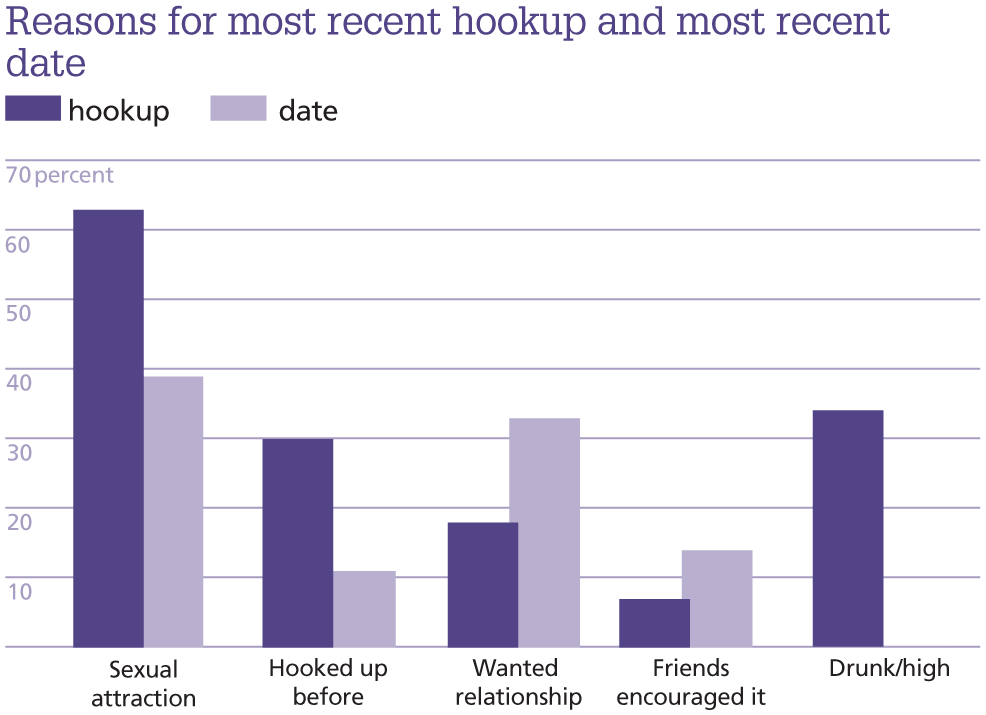
Not surprisingly, sexual attraction was reported most often as the reason for both hookups and dates, but it was far more common for hookups: 63% versus 39% (see below right). Students also sought emotional intimacy in both hookups and dates. However, they were more likely to report wanting a relationship as a motive for dates (33%) than for hookups (18%). Being intoxicated was the second most common reason given for hooking up (34%), but it did not apply to dates. This reflects the important role of alcohol and drugs in hookup culture. Students were also more likely to hook up with someone more than once (30%) than to date someone with whom they had previously hooked up (11%). Thus, hooking up and dating allow students to explore and engage in different forms of intimacy; hooking up privileges sexual intimacy while dating privileges emotional intimacy.
Why Both?
So, two patterns coexist on college campuses. Young adults may choose to hook up at some times and date at other times. In fact, Siebenbruner’s study of female undergraduates reveals that women who hooked up reported more dates and romantic relationships than women who had never hooked up. In our sample, this finding was stronger for males than females.
Sexual behaviors occurring on most recent hookup and most recent date

Reasons for most recent hookup and most recent date
One way to understand how the choice is made between hookups and dates, at least among women, is to consider the advantages and disadvantages of the two patterns. Sociologists Armstrong, Hamilton, and England pointed out in the Summer 2010 issue of Contexts that neither the hookup nor the date is ideal for college women. Hookups don’t require the time commitment and emotional investment of dates and romantic relationships. Relationships for women can, at times, be characterized by jealousy and emotional turmoil. A bad hookup is much easier to end than a bad relationship. On the other hand, they suggest sex in hookups may be less satisfying for women than sex in relationships, where sexual and emotional reciprocity are expected and more often received.
While media stories bemoan the hookup culture and lament the death of traditional dating, research clearly shows that dating continues to be common among young adults. Students today don’t have sex more frequently or have more partners than young adults 20 or 30 years ago. What has changed is that sexual activity is more likely to occur outside of committed relationships. The similarities and differences suggest that hooking up and dating are distinct, but clearly related. Rather than being opposite or competing patterns of intimate interaction, with hooking up eclipsing or eliminating collegiate dating, it is more accurate to view them as coexisting and even complementary patterns with their own advantages and disadvantages.