



Abstract

Marijuana prohibition can seem like a joke, especially to people like me—White, middle-class Americans living in politically progressive (and often cannabis infused) communities such as coastal California, where I grew up, or Southern Maine, where I now live. For many like us, “Reefer Madness” seems a ridiculous relic of a much less enlightened age. Stoners and dealers—from Cheech and Chong to Harold and Kumar and on to the Pineapple Express—are funny, not dangerous felons.
And then maybe someone we know gets arrested. For me, it was my friend Valerie, a member of that least-likely-to-be-arrested demographic: an economically secure White woman living in that most liberal of enclaves: Santa Cruz, California. Because she was growing five marijuana plants in her home garden, she was charged with felony cultivation. As I quickly learned, far from being a joke, marijuana prohibition is an ongoing horror show. It involves almost 700,000 arrests each year, 88% of them for possession. Huge numbers of Americans are being imprisoned, sometimes for decades, for marijuana offenses. In fact, according to the American Civil Liberties Union, at least 69 people are serving life sentences for non-violent pot crimes.
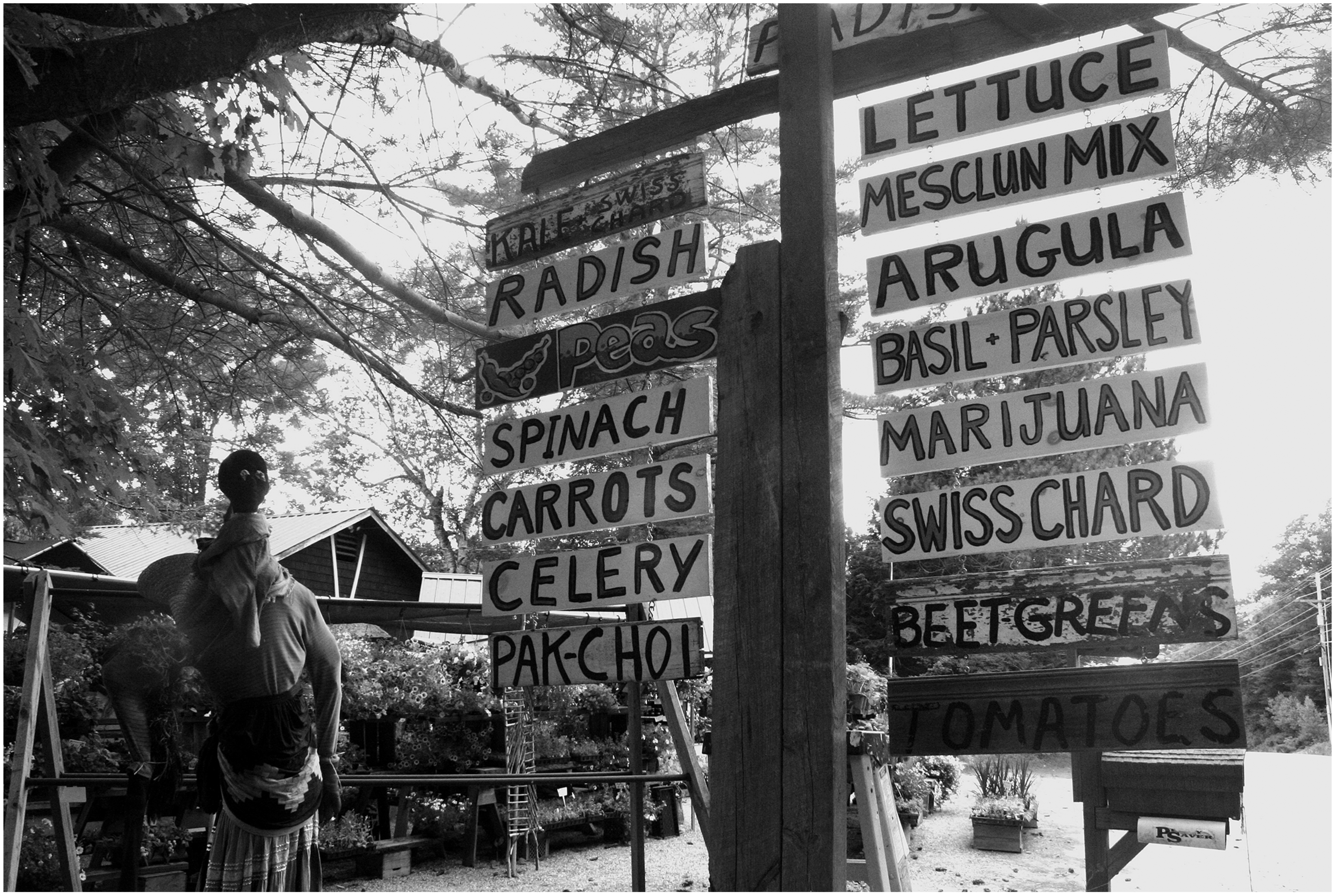
At the farmers’ market.
Abigail Batchelder, Flickr CC
Marijuana prohibition, moreover, has been absolutely central to the draconian War on Drugs. According to the Pew Research Center, almost half of all Americans have tried marijuana; in contrast, according to the National Institute on Drug Abuse, less than 2% have ever used heroin. Marijuana is the only illicit drug used by large enough numbers of Americans to justify a massively expensive federal anti-drug bureaucracy and a militarized police force.
Marijuana prohibition has made a significant contribution to mass incarceration, disproportionately of Black Americans, helping to make the U.S. “the world’s most highly incarcerated society in history.” Children have been removed from the custody of their marijuana-using parents; homes have been seized using asset forfeiture laws; students convicted of marijuana offenses have been denied federal scholarship aid; and patients have been punished for using a substance their physicians, research scientists, and now even CNN’s Chief Medical Correspondent Sanja Gupta believe would help.
But, finally, state by state, this prohibitionist approach to marijuana has begun to collapse. In 1996, California passed the nation’s first medical marijuana law; there are now 23 states where authorized patients are allowed to legally access and use cannabis. In 2012, marijuana prohibition took another major hit when voters in Colorado and Washington legalized adult recreational use of marijuana. Two years later, in 2014, Oregon, Alaska, and the District of Columbia also voted for full legalization. It is likely that in 2016 additional states will vote to regulate and tax adult recreational sales and use of cannabis.
For the first time, more than half of all Americans now say that marijuana should be legalized. It increasingly appears to be true, as long-time marijuana activist Michael Corral argues, “the war against marijuana is over; now we are just negotiating the terms of surrender.” But before we declare victory, it’s important to remember that the devil is always in the details.
“Legalization” can mean radically different things. In the Netherlands, marijuana is currently available for legal purchase in small, independently owned “coffee shops” scattered throughout the country. Canada, on the other hand, has been attempting to centralize all legal (currently medical) marijuana cultivation in the hands of only a dozen industrial growers and distributors for the entire country.
In the United States, legalization looks very different in the states of Washington and Colorado. In Washington, voters surrendered the right to cultivate cannabis at home in exchange for legalized sales and use. In that state, marijuana consumers must purchase their cannabis through a small number of licensed distributors. In Colorado, individuals growing a few plants for themselves exist alongside small commercial cultivators and large industrial operations.
In other words, policy differences produce very different outcomes. It can seem trivial to debate competing legalization proposals in the face of the very real and very serious problems of prohibition. But it is also useful to remember that it can be difficult to undo, or redo, bad legislation. Take, for example, the end of alcohol prohibition. As Jon Walker notes in his book After Legalization, the 21st Amendment ended federal prohibition, but states made very different decisions on how to regulate alcohol. Not only did a third of states continue to outlaw it entirely, even states that permitted the production and sale of alcohol generally didn’t allow producers to sell directly to consumers. The result was the consolidation of production in the hands of a few very large companies. This, Walker reminds us, “was not some natural end state created by the invisible hand of the market. It was a policy choice. The government adopted regulations that disadvantaged small producers and made new startups almost impossible.”
This is important to reflect on when we think of “regulating marijuana like alcohol.” Which version of alcohol regulation are we referencing and what outcome do we desire? It wasn’t until 1982, when California changed its liquor laws to allow small breweries to sell directly to consumers in “brew pubs” that the “micro-brewery revolution” began. In 1983, there were only 80 breweries in the entire U.S. By the late 1990s, hundreds of new breweries were founded every year.
So what terms of surrender should we demand in the failed war on cannabis? Should consumers be able to purchase pot directly from growers through a community supported agriculture (CSA) model of cultivation? Should local, small-scale growers be protected from competition with large corporate cultivators? Should we be allowed to grow for ourselves? And, even more importantly, how do we begin to undo the damage inflicted by the War on Drugs, including the problem of prisoners of war?
Without a robust policy for releasing drug war prisoners, there is a real risk that legalization of marijuana will mean that a few White men (in a still male-dominated industry) will make a lot of money on cannabis cultivation and sales, while many Black men (almost 4 times as likely as Whites to be arrested for marijuana possession despite similar rates of use) will remain behind bars or carry felony drug convictions forward. President Obama has recently begun a conversation about the need for the reduction or elimination of mandatory minimum sentences for non-violent drug crimes, for an end to the practice of asking job applicants about their criminal histories (“ban the box”), and for the restoration of voting rights for felons who have completed their sentences. In July 2015, he even commuted the sentences of 46 low-level drug offenders. These are all important first steps. But there are tens of thousands more incarcerated people who need their marijuana sentences commuted and hundreds of thousands who need their records expunged.
Certainly marijuana legalization in itself is better than policies of prohibition and criminalization. It may even represent a significant blow to the War on Drugs apparatus. But it is equally possible that marijuana legalization could be to the Drug War what marriage equality is to the queer liberation movement: a celebrated step toward social justice but not the only—or even, arguably, the most important—one.