




Abstract
A social movement against fracking is scoring victories in some states but not others. Why are some groups finding more success?
Keywords
Environmentalists in New York scored a major victory at the end of 2014 when Governor Andrew Cuomo banned fracking, the controversial method of extracting natural gas and oil from deposits embedded in shale rock deep underground. The governor’s ban was the result of a massive anti-fracking campaign by New York environmental activists. In the previous years, they collected tens of thousands of petition signatures, convinced over 200 local municipalities to pass resolutions opposing the practice, and held demonstrations across the state calling for a ban. In the end, they won, providing new protection for local watersheds and human health while putting the brakes on the development of another major greenhouse gas contributor.
But victory was declared in New York as the use of this new technology continued to spread in several other states, from Texas to Pennsylvania to North Dakota, places where opponents failed to slow the tide. Fracking poses environmental and health risks wherever it is practiced. Why did significant mobilization fail to materialize in other states and why were activists successful in New York? There is no simple formula, but social movement scholars have identified several factors that are important to movement success: resources, organization, a good message, and a little help from powerful people. Anti-frackers in New York had all of this going for them.
Getting Organized
One way New York differs from states like Texas and North Dakota is in the prevalence of environmental groups. Activist groups need resources like meeting space, funds, staff time, and expertise to mobilize successfully. Areas without such groups at the ready are vulnerable to the imposition of harmful environmental practices.
New York has many organizations capable of mobilizing against environmental threats. One on-line directory listed 159 environmental organizations in New York State. North Dakota had two. Even on a per capita basis, there are a third as many environmental groups in North Dakota as in New York. Under those circumstances, elected officials and policy makers primarily feel pressure from industry interests, which helps to explain why North Dakota has more than 8,000 fracking wells and New York has none.
Many environmental groups in New York State made opposition to fracking a priority, and at least one, Frack Action, was created specifically for this purpose. Several professional policy oriented groups like Environmental Advocates have a significant membership base linked by e-mail and newsletters. These groups gathered signatures on petitions and sent out “action alerts” asking members to call or write their representatives at crucial junctures in the struggle.
New York City store windows demonstrate the anti-fracking messages’ reach.
Eden, Janine, and Jim, Flickr CC
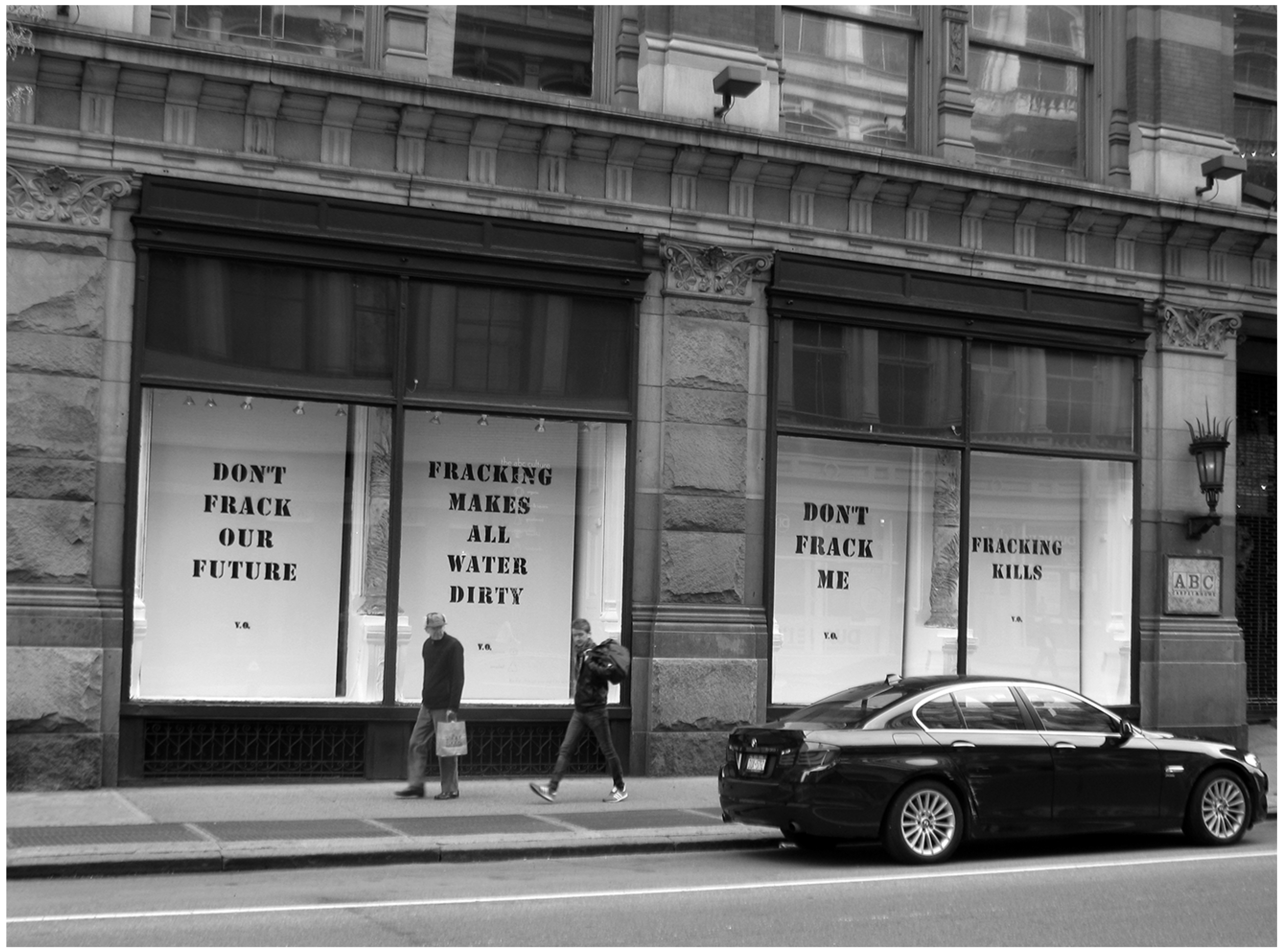
Other groups, such as the New York Public Interest Research Group and the Sierra Club, have well-organized local and regional chapters with grassroots volunteers. This means they can get people on the street for demonstrations or turn out citizens for grassroots lobbying. All of this activity kept fracking in the media spotlight in New York and put pressure on elected officials fearful of alienating this mobilized constituency.
In addition to these formal organizations, many small informal groups, like the Climate Action Coalition (CAC) in my town of New Paltz, played an important part in the anti-fracking campaign. They helped to raise awareness among the public by distributing literature at community events, writing letters to the editor of local papers, and sponsoring educational forums. Given their strong local ties, such groups are also able to turn out participants at protests and other actions, of which the CAC organized many. In one action, 100 activists gathered at a nearby state environmental office, then called the governor and chanted their opposition to fracking into the phone. In another they lined up along Main Street behind a homemade, 50-foot pipeline drawing cheers and honks of support from passing motorists.
The CAC also mobilized people to testify at town board meetings where they helped to persuade officials to pass resolutions against fracking and to enact ordinances that would have inhibited gas industry development locally. This particular group has a key resource in that its members are primarily retirees and students, two populations that have flexible schedules, skills, and access to social networks, all of which are valuable for mobilization. Together, all of these groups and the resources at their disposal make up an infrastructure of resistance, an apparatus put into action when the threat of fracking was presented.
Fracking poses environmental and health risks wherever it is practiced.
Framing the Issue
Aside from the organizational capacity and resources available to activists in New York, the messaging or “framing” of the issue was also crucial. Opponents needed to characterize the threat in a way that was attention-grabbing and persuasive. The use of the term “fracking” itself was part of that framing. Gas industry officials handed the ominous sounding term to activists by using it informally within the industry. Had they been more careful they would have stuck to the more formal terminology, “horizontal hydraulic fracturing”—much more difficult to fit on a picket sign. Inevitably, the more militant fracking protesters adopted slogans like “No Fracking Way!” and “Frack Off!”
But framing is about more than just slogans. It is a broad battle of words and images between activists and their targets. Gas industry officials describe fracking as a safe sophisticated means of extracting a clean burning domestic fuel source. The American Petroleum Institute frequently touts it as a means to free America from “foreign oil,” which they see as vital to national security. According to this logic, fracking is not only environmentally beneficial, it’s patriotic, a message that likely played well in more conservative parts of the country like Texas.
In New York, economic appeals were the foundation of the industry’s framing. Their core argument was that natural gas development would create thousands of jobs and bolster the economy in a struggling region of rural upstate New York. This appeal worked well in neighboring Pennsylvania, which was quick to permit fracking based on the lure of economic development.
The promise of jobs and economic growth is part of a commonly used frame, especially in fights over natural resource extraction in rural areas. Industry interests use this to dissuade working class people from environmental advocacy, at the same time framing their adversaries as rich, big city environmentalists who don’t understand or care about rural communities.
Anti-fracking activists eventually won the war of words by highlighting not only the ecological issues, but also by putting personal health front and center. Opponents cited cases of water contamination, epidemiological studies on illness and birth defects in the vicinity of fracking wells, and ecological ramifications not captured by the “clean energy” message presented by natural gas proponents.
North Dakota has more than 8,000 fracking wells and New York has none.
However persuasive scientific studies may be, they cannot compare to a powerful image. And the anti-fracking movement had the ideal picture to present their message: a kitchen faucet with flames pouring out along with the flow of water. This disturbing iconic image was captured and popularized by documentary filmmaker Josh Fox. Fox proved himself to be a master of framing in his film, Gasland, a moving and witty first-hand narrative of the effects of fracking in his native Pennsylvania. The film served as an important educational tool that was used by activists who drew audiences to free screenings.
Fox became something of a celebrity based on his award-winning film, and he would regularly speak at anti-fracking events across New York. But he was not the only famous figure to serve as a public voice for the movement. A number of celebrities, including actors Matt Damon and Mark Ruffalo, lent their star power to the cause by speaking at events and broadcasting recorded messages via the web. Several famous recording artists performed at a benefit concert that was filmed and distributed as a movie called “Dear Governor Cuomo,” another vehicle for instilling the anti-fracking frame and linking it with admired figures.
Powerful Friends
Perhaps more important than celebrity endorsements, New York’s anti-fracking movement also had the backing of some economic and political leaders whose interests diverged from the corporate powers vested in natural gas extraction. Division among elites can often prove decisive for movement outcomes. Research shows that the poor and especially people of color most often bear the health and environmental consequences of ecologically damaging practices, a phenomenon referred to as environmental injustice. But in this instance, the potential victims of fracking’s effects included a broad swath of people, including many economically and politically powerful actors.
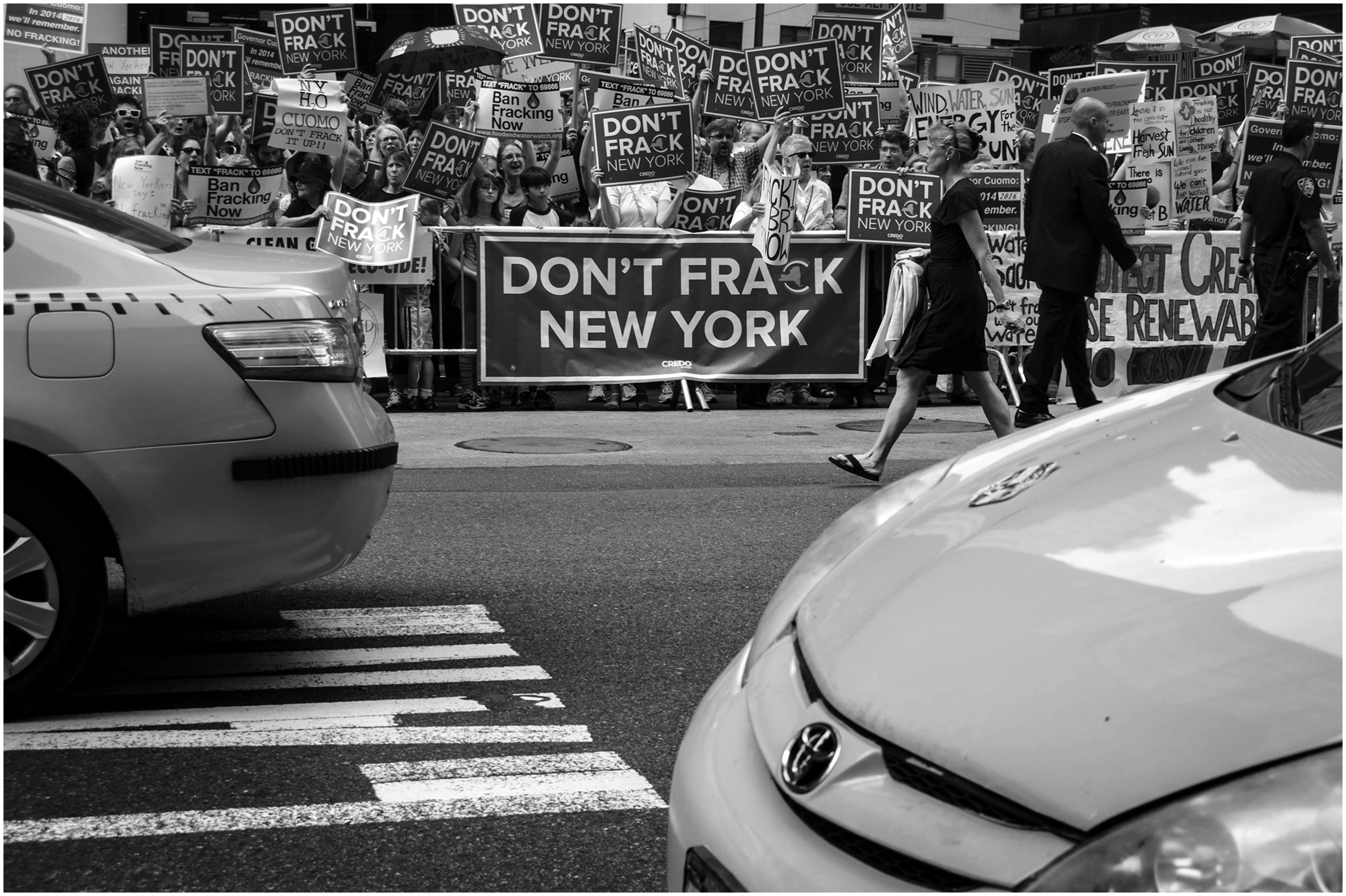
A joint protest by Credo Action and New Yorkers Against Fracking targeted then-Governor Cuomo’s 2012 policy summit.
Adam Welz for Credo Action, Flickr CC
Videos of “flammable tap water” in areas with fracking are controversial, but popular.
Screengrab, Gas Drilling Awareness Coalition, YouTube

The primary area suitable for natural gas development in the region is known as the Marcellus Shale, a natural rock formation that stretches from West Virginia up through Pennsylvania to the southern and western parts of New York State, an area that also happens to be part of the New York City watershed. The downstate region of New York includes much of the state’s population and New York City is home to some of the world’s biggest corporations and wealthiest citizens. Given the potential threat to the watershed, many elected officials in the New York City region, including New York City Mayor Bill de Blasio, voiced opposition to fracking. Over 1000 businesses from across the state also called for a ban. Thus, in addition to the grassroots mobilization against fracking, there were also powerful interests allied with the movement that improved the likelihood of success.
Understanding movement outcomes also requires examining the interests and vulnerabilities of targeted decision makers. In this case, it was up to the Governor to decide whether fracking would be allowed. Although the state is majority-Democratic, a primary challenge by a little-known candidate successfully mobilized anti-fracking support, which helped push Cuomo to take a stand against fracking. A little over a month after the bruising primary, and following the release of a report indicating that fracking posed potential health and environmental hazards, the governor imposed the ban, a major victory for the movement.
New York shows that, with good organization, access to resources, the right message, and support from at least some influential figures, movements can overcome even the most powerful adversaries.
Anti-fracking activists in New York State demonstrated how mobilized citizens can successfully challenge powerful actors. Despite a population that is more supportive of environmental protection than states such as Texas and North Dakota, New York activists still depended on good organization, access to resources, the right message, and support from at least some influential figures. With those resources, movements can overcome even the most powerful adversaries.