



Abstract
Heterosexuals’ new freedoms and anxieties.
Crossing the street, I eavesdropped on a conversation between two teenage boys. They were making fun of two other men we had just walked past. The boys thought these two men’s excitement over taking a bicycle “for a spin” was tinged with a homosexual overtone. One of the boys remarked, “That guy should have said, ‘Take it for a spin—No homo.’”
Phrases like “no homo” demonstrate the anxiety of being straight today.
Phrases like “no homo” demonstrate the anxiety of being straight today. Although the boy may not have intended it as a homophobic insult, he clearly wanted his straight/no homo status to be projected to others. Phrases like “that’s so gay” are signs of anxious straight identities as American society has increasingly become a “post-closeted culture.”
By a post-closeted culture, I don’t mean a society in which homophobia has been eradicated. Rather, it’s a society with visible and openly gay and lesbian people and an array of lesbian, gay, bisexual, transgender, and queer (LGBTQ) representations across a range of cultural institutions.
Many journalists and scholars have focused on how LGBTQ people are affected by this new cultural dynamic, but it’s worth considering how straight Americans react as well. Based on my research interviewing straight Americans in recent years, I found that many straight people are now more conscious, reflective, and defensive about establishing their sexual identity status in everyday life.
The Post-Closeted Culture
The normalization of homosexuality and Americans’ liberalization toward homosexuals are relatively recent social and historical developments. Two periods stand out in the rise of a post-closeted dynamic as a national formation. First, the Stonewall riots of 1969 signaled the rise of the politics of coming out of the closet and the development of large, visible gay and lesbian communities and institutions throughout the country. In chronicling gay and lesbian movements in the United States at this time, historians and social movement scholars have found a rapid proliferation of gay organizations, such as newspapers, crisis hotlines, and social clubs, which increased from just 50 in 1969 to more than a thousand in 1973. These developments, made possible by the growth of lesbian and gay subcultures, made coming out to straight society its political centerpiece.
The mid-1990s opened a second important period of coming out, marked by increased visibility in mass media. The unprecedented popularity of sitcoms like Will & Grace, which featured openly gay lead characters, came alongside the inclusion of same-sex commitment and wedding ceremonies in the New York Times’ Sunday Styles section. At the same time, gays and lesbians continued to achieve significant social and political gains, from the development and spread of domestic partner benefits and antidiscrimination laws to significant attitudinal shifts among Americans.
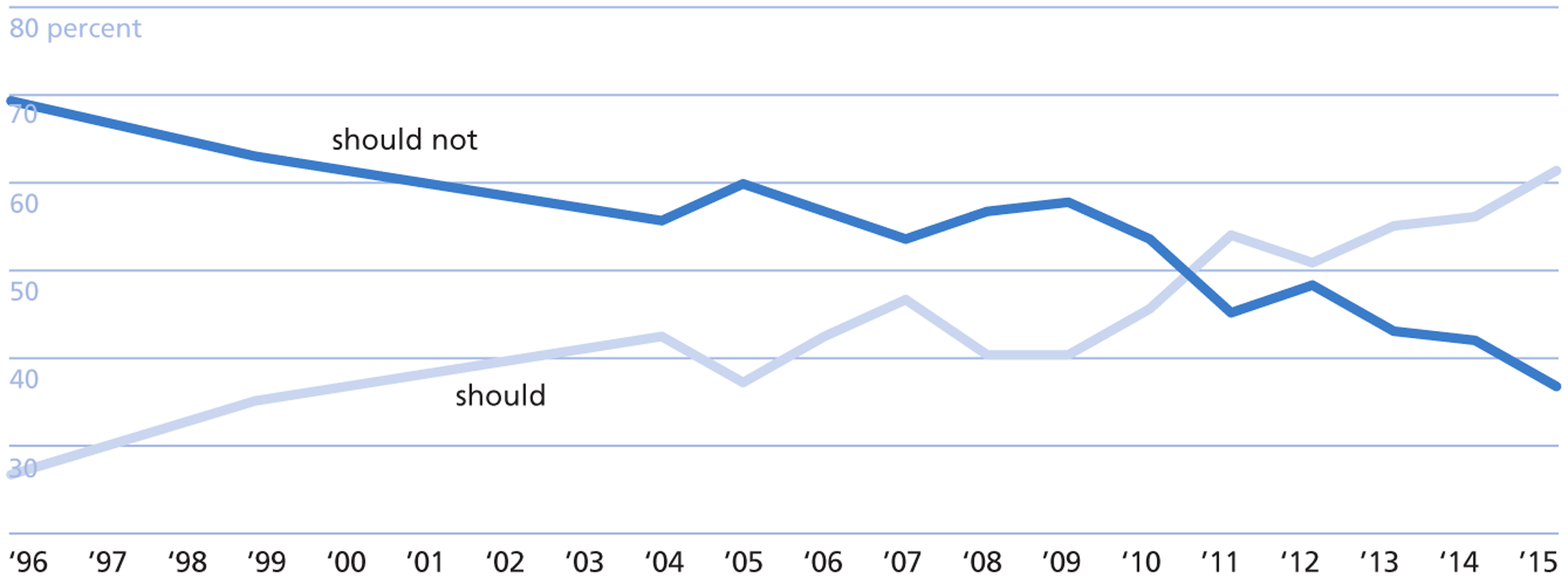
Polls over the last decades confirm the increase in liberal attitudes regarding gays and lesbians. For instance, as shown at right, when Americans were asked whether lesbians’ and gay men’s marriages “should or should not be recognized by the law as valid,” 27% of Americans supported same-sex marital rights in 1996. Today, 60% of Americans embrace the recognition of gay marital rights. This historic high in polling data along with the recent Supreme Court decision in Obergefell v. Hodges, which made same-sex marriage the law of the land, show the growing support behind same-sex marriages and relationships.
Still, many media depictions of gays and lesbians are often stereotypical, and many members of the LGBTQ community still face daily discrimination. A vocal minority of Americans opposes the extension of LGBTQ rights. Yet, with Americans increasingly supportive of lesbians’ and gays’ legal rights and more normalized media portrayals of same-sex couples, we have seen the emergence of a post-closeted culture.
Straight Identities
In my research, I interviewed a diverse group of straight men and women living in the northeastern U.S. about their heterosexuality and the kinds of interactions they had with lesbian and gay men. Not only has a post-closeted culture been liberating for gays and lesbians, it has also given straight men new freedom in expressing their masculinity in non-homophobic ways.
Marriages between same-sex couples should or should not be recognized by the law as valid, with the same rights as traditional marriages?
Note: Trend shown for polls in which same-sex marriage question followed questions on gay/lesbian rights and relations. 1996-2005 wording: “Do you think marriages between homosexuals…”
Source: Gallup
For many of the straight men I talked to, homophobia used to be the tried and true way to establish straightness. Now, many aim to avoid being seen as homophobic. Straight men who might have used words like “fag” or “queer” in the past now exclude the slurs from their everyday vocabulary.
Today, many straight people have developed an anti-homophobic stance. Being anti-homophobic ranges from countering prejudice and discrimination against gays and lesbians to renouncing one’s straight status and privilege. This development makes sense as a post-closeted culture has created a climate where homophobia is stigmatized as wrong and mean-spirited in many contexts, although this is uneven across different settings and groups.
In gay-friendly contexts, anti-homophobic straight men and women earn a kind of honor or prestige by being gay-friendly and supporting LGBTQ rights. For example, Nick, a single White male in his early 20s, expressed an anti-homophobic sentiment by noting that the line between who is and isn’t gay is often blurred today: “I have guys and girls come on to me. So I know for a fact that I don’t protrude a straight, exact heterosexual or homosexual identity. I realized that the lines are so blurred these days that you really can’t tell who’s gay and straight.”
For Nick, being viewed as potentially non-straight is not an affront to his masculinity and it doesn’t trigger a homophobic defensiveness that might prompt him to try to reclaim a clear straight status. Nick explained that many of his gay male friends are “conventionally masculine,” and so he doesn’t view his heterosexuality or his gay friends’ homosexuality as connected to being masculine. This decoupling of masculinity from heterosexuality in part explains Nick’s anti-homophobic stance that allows him to be comfortable in being viewed as possibly gay in some contexts.
These changes are even more salient among straight women. The straight women I interviewed expressed their solidarity with LGBTQ friends and communities in ways that their straight male counterparts didn’t. The most anti-homophobic straight women described their sexualities as socially constructed, malleable, and fluid.
In her book Sexual Fluidity, psychologist Lisa Diamond defines sexual fluidity as “situation-dependent flexibility in women’s sexual responsiveness” to both women and men as objects of desire, fantasy, and sexual partnership. But she applied the concept only to non-heterosexual or lesbian and bisexual women. The anti-homophobic straight women I talked to identified themselves as straight, but had strong political identifications with their LGBTQ friends. For them, same-sex feelings, fantasies, and experiences attested to their solidarity with LGBTQ people. That is, straight women shared their same-sex sexual encounters with me as proof of the lack of shame in homosexual sex acts and as a badge of being a strong political ally. Queer culture is now part of some straight women’s lives, not just expanding the boundaries of femininity, but also breaking down the sexual line that privileges straightness over gayness.
Of all the straight people I interviewed, the anti-homophobic straight women were the ones who augur the possibility of a truly post-closeted era in which the line between straightness and gayness isn’t a form of social hierarchy and denigration, the minority group doesn’t feel the need to come out to show their pride, and the majority group doesn’t take for granted their sexual status as normal, natural, or rightly ideal.
Commenting on a same-sex encounter, Erica, a single Black female in her early 20s, said, “I consider myself heterosexual. Just the same way, like I said before, politically, I consider myself Black. But I’m more than that in terms of my ethnic makeup. Just as in sexuality, I’m more than just a straight female. I’m attracted to different things. I don’t make myself any promises that I’ll never change. I believe that a lot of things are based on the individual person. Give me a woman who does everything right for me and we’ll see. This particular woman did not.”
While anti-homophobic attitudes seem to be on the rise among straight Americans and allies like Erica embrace experiences of sexual fluidity, American society is still divided by a sexual hierarchy that privileges heterosexuality over homosexuality. In other words, neither has the closet disappeared nor have all straight people become allies to LGBTQ communities. But with homophobia on the decline and post-closeted culture on the rise, straight Americans have started to rethink what it means to be straight and their place in America in the twenty-first century.