



Abstract
In an outlier city in California, whiteness has become the new code for academic mediocrity and laziness.
Angelica is a typical teenager in the Silicon Valley town of Cupertino. She is poised, well-spoken, involved in lots of extracurricular activities, and connected to her friends 24/7 through various social networking platforms. She works extremely hard in school, and it’s mostly paying off. She earns nearly straight As, and has even been admitted to a program at a local community college that allows her to take classes for college credit.
In spite of all of her academic success, Angelica feels like she has something to prove. As Angelica tells it, she frequently has to fend off assumptions by classmates and teachers that she is probably academically mediocre because of her race: Angelica is White.
Such assumptions about the inferior academic performance associated with Whiteness reflects what we heard over and over again when we interviewed residents of Cupertino as part of a research project aimed at understanding how the “third-plus generation” (those who were born in the United States to also U.S.-born parents) make sense of immigration-driven change. Angelica and her peers do not live in the northern California suburbs her parents knew as kids. Back then, Whiteness was synonymous with doing well in school; the overwhelming success of Whites relative to a handful of minority students affirmed Whiteness was the model of achievement. That picture largely represents what many think of as the norm throughout the United States. Angelica’s Silicon Valley is different, having undergone massive immigration-driven change. It is characterized by upheaval in how people think about the connection between race and academic success. Compared to her parents’ experience, what it means to be White has been turned on its head. Whiteness, to Cupertino residents of Angelica’s generation, represents academic mediocrity and laziness.
That notion is the product of how people in the city associate Asianness with academic excellence and hard work. It is not that Angelica and other White teens in Cupertino, as a whole, are doing—or have ever done—badly. Quite the opposite. Cupertino has bred academic success for a long time. In the late 1960s and early ‘70s, a burgeoning technology industry transformed Santa Clara Valley into “Silicon Valley,” and White engineers and other professionals began buying homes in Cupertino. The children of these highly educated Cupertino residents were as driven as their parents, and Cupertino’s public schools quickly earned a reputation for excellence. When Silicon Valley was in full bloom, it was that very reputation that made Cupertino an attractive landing spot for high-skilled Chinese and Indian tech workers, who began arriving in the region in large numbers in the 1990s. Cupertino’s changing demographics, then, tell part of the story: between 1990 and 2010, the immigrant population grew from 22% of residents to 49%. Most were from Asia, with Chinese and Indian immigrants driving an increase in the overall proportion of Asian residents from 23% in 1990 to 64% today. Whites have become a numerical minority, shrinking from 74% of the population in 1990 to 29% two decades later.
In spite of all of her academic success, Angelica feels like she has something to prove. Angelica is White.
If Cupertino is a major immigrant destination, it is hardly home of the “poor, huddled masses” commonly associated with American immigration lore. The largely Chinese- and Indian-immigrant populations that have settled there are highly educated, and their settlement has only bolstered the city’s upper-middle-class status profile. Three-quarters of the adult population holds a college degree or more, and an equal proportion works in managerial or professional careers, many in the technology sector. The median household income is around $125,000 a year, and purchasing a typical home in the city will set a buyer back more than $1 million.
Cupertino is just the kind of place designed for kids to do well in school and beyond. And, by most standards, White and Asian kids alike generally succeed. But most standards don’t apply here. In Cupertino, status is tied to performance on the SAT, sleeping less to study more is the basis of informal competition among high school students, and football and cheerleading don’t make anyone terribly relevant. The settlement of the high-skilled Asian immigrant population, according to residents, has elevated the meaning of academic success. In the process, Asianness has replaced Whiteness as the racial emblem of academic achievement, and third-plus-generation parents and kids are undergoing a challenging adjustment.
Whiteness, to Cupertino residents of Angelica’s generation, represents academic mediocrity and laziness.
Shifting Terrain of Race and Achievement
Most observers would agree that there is a crisis in education defined by race. Regular reports of the “achievement gap” highlight how Whites continue to outpace Blacks and Latinos on just about every measure of academic attainment. The larger concern is that the achievement gap produces racially defined income and wealth disparities later in life. If the most glaring and problematic gaps are those between Whites on one end and Latinos and/or Blacks on the other, there is a less noted gap at the “top:” the one between Asians and everyone else, including Whites. Asian students outpace Whites on just about every standardized test, a fact that has led the State Boards of Education in Virginia and Florida to set group-specific academic achievement standards that are higher for Asians than for Whites, and well above those set for Blacks and Latinos.
This depiction is hardly abstract to the people we studied. Achievement gaps reflect in their experience of racial identity, especially when it comes to academic success. Third-plus-generation kids in Cupertino are pushed by their parents in many of the same ways that upper-middle-class kids are pushed to succeed anywhere else. But as the people we interviewed see it, high-skilled Asian immigration has introduced a new set of achievement standards that requires more than typical upper-middle-class striving. People working closely with students for a long period, like teachers and coaches, were quick to note the changes resulting from the settlement of large numbers of Asian immigrants: less emphasis among students on athletics and more emphasis on all things academic. Everyday residents reported much the same. What is clear is that this influx also introduced an atypical racial inflection of academic achievement.
Social scientists have observed that students and teachers typically connect notions of race to academic ability, seeing Whiteness as emblematic of scholastic aptitude and success. Survey researchers implicitly share that view, regularly treating Whites as the reference group against which to judge the progress of racial minorities. But that ordering of the academic racial hierarchy is almost unrecognizable to Cupertino residents. Marcus, a White, 22-year-old recent college graduate, echoed what other respondents told us about the stereotypes that existed at his Cupertino high school: “The Asian kids and the Indian kids were really smart and they were really good at math and they were always going to do really well in the AP classes, whereas the White kids were less academically oriented. And they did okay, but they didn’t put in as much effort.”
It is not necessarily surprising that Asians are stereotyped as smart. Popular culture, the news media, and teachers have touted Asians as a “model minority” that stands apart because the group’s high levels of success comes in spite of minority status. Yet the very idea that the minority group is a “model” implies a comparison between Asian success and the supposed failure of other minorities—Blacks and Latinos, in particular. But Blacks and Latinos make up an incredibly small share of Cupertino residents, and so the city’s demographics do not provide for multi-group comparison. Instead of Asian achievement highlighting Blacks’ or Latinos’ underperformance, then, it places Whites at the bottom of the academic heap. To be sure, the bottom of that heap finds third-plus-generation Whites well above the achievement levels that most other American teens will ever know. The people we interviewed are likely on their way to replicating their parents’ class standing. Still, that likelihood is rendered almost irrelevant to the daily lives of our third-plus-generation respondents who are very much regarded as academically inferior in the context they navigate daily.
Seemingly everyone we interviewed—everyday residents, teachers, and students—acknowledged that hierarchy without our prompting. One high school teacher’s acknowledgment of the unconventional position of Whites in Cupertino’s academic hierarchy only seemed to make their inferior place clearer: “As the teacher, I try not to stereotype, of course, but after a while, I guess I just assume… the White kids probably aren’t going to be my very, very best students…. If I were to go back and look at the grades I’ve given… I’m sure that the GPA for the White kids I’ve had would be lower than the GPA for the Asian kids I’ve had. I’m sure of it.”
Students hunker down to take an AP Psychology test.
Eric E. Castro, Flickr Creative Commons
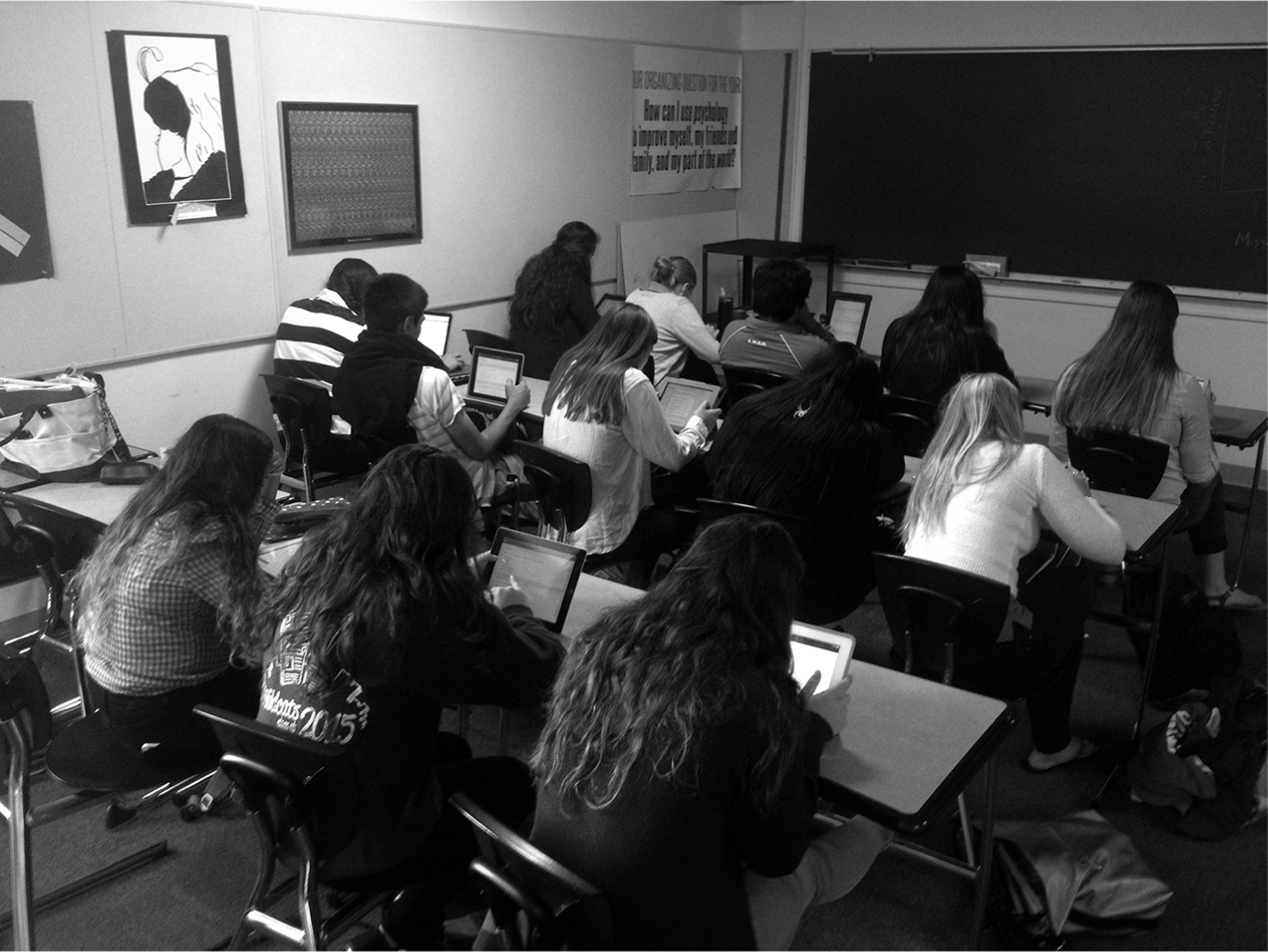
As we interviewed more individuals, we were surprised by how uniformly people talked about the academic hierarchy in explicitly racial terms. Students, in particular, repeatedly used “White” and “Asian” as shorthand for how students approach school, with the former indicating a lax approach and the latter suggesting a more intense approach. One teacher reported an instance in which two students discussed their course schedule, with one asking, “Well, are you taking AP?” According to the teacher, the other student replied: “Oh no, I’m White.”
The view of Asians as smart and driven might be a more positive stereotype, but it is an unwelcome one to Asian-American interviewees.
These stereotypes can have a biting edge. Social psychological experiments by Joshua Aronson and his colleagues show that Whites fare worse on standardized tests when they are primed to think about Asians’ intellectual ability. The perceptions of the people we interviewed support those findings. Whites—especially the more academically oriented among them—have a sense that they need to constantly fight against stereotypes that tag them as dumb. Teens like Angelica and their parents often explained the situation with a tone of exhaustion. Angelica told us, “I’ve gotten a lot of feeling like I’m not taken seriously because I’m a preppy White girl.” An instance capturing that feeling took place after she got a test back in a chemistry class: “We were all comparing answers that we got on the test afterwards…. I said, ‘Oh. I know how to do that one.’ And they were like, ‘Oh, okay,’ and then asked their other friend, anyway. It was two Indian guys, and I was like, ‘Do you not think that I know the answer?’ …. And I was like, ‘Is it because I’m White that you don’t think that I know?’ And he’s like, ‘Well, I don’t know if you know or not.’ ‘Could I just give it a shot?’ I guess I constantly feel like I have to prove people wrong.”
Students like Angelica generally push through, even when confronted with these stereotypes. But less academically inclined Whites said that they more or less give up on trying to excel in school, opting out of what they characterize as an achievement rat-race that places them as slow runners because of their Whiteness. These students coasted in school, and either made it to a four-year college via community college or wound up at one of the California State University campuses (which lack prestige in Cupertino as compared to the University of California heavyweights). These are hardly disastrous outcomes. Perhaps that’s why the parents of these students condoned their child’s opting out, seeing what it would take to swim against a tide of stereotypes as too big a price to pay for the chance to compete.
The Stereotype Promise Bind
If “acting Asian” means taking school very seriously, the Asian category is bound up with being an immigrant or the child of an immigrant. These categories involve a nuance that becomes clear from our interviews with young, third-plus-generation Asian Americans, whose families have been in the United States for multiple generations. They frequently described themselves as “whitewashed”—a reference not only to a weak connection to a Japanese or Chinese ancestry and culture, but also to a less intense approach to academic pursuits (one that’s one more akin to Whites’). Melanie, a high-school junior we spoke to, said that her household is more similar to White households and less like the stereotypical Asian ones because, as she put it, “We want to have fun. But when it does come down to academics, we can do our work, but still have fun at the same time. And sometimes the academics get put on the back burner and the fun takes control first. My household is definitely not focused on studying at all.”
Cupertino’s changing demographics have created a new achievement landscape for kids.
Travis Wise, Flickr Creative Commons

Regular reports of the “achievement gap” highlight how Whites continue to outpace Blacks and Latinos on just about every measure of academic attainment. The larger concern is that the achievement gap produces racially defined income and wealth disparities later in life.
These respondents are also subject to the consequences of stereotypes, albeit with some differences from their White, third-plus-generation peers. While high-achieving Whites feel like they have to counter prevailing stereotypes, third-plus-generation Asian American respondents said that they feel a stress-inducing pressure to live up to them. Tiffany, an Asian-American high-school sophomore whose great-great-grandparents came to the United States from China and Japan, does fairly well in school. But her Asian ancestry, combined with a more relaxed approach to school, put her at odds with prevailing stereotypes. Tiffany described the result: “All the teachers expect all the Asians to do really well. When one Asian doesn’t do well, they’re looked down upon in a way, because they’re Asian and they’re smart, automatically. I think it’s tough…. If I didn’t do that well, I’d be a little bit ashamed because [the other Asian students] probably did really well and I’m kind of lagging on that one test or something.”
Sociologists Jennifer Lee and Min Zhou argue that these “positive” stereotypes can give a boost to Asian Americans who are not doing so well in school, a phenomenon that they call “stereotype promise.” Yet as psychologists John Siy and Sapna Cheryan conclude from their research, even positive stereotypes “fail to flatter” precisely because they take away the ability to be seen as an individual. Thus, the view of Asians as smart and driven might be a more positive stereotype, but it is an unwelcome one to Asian American interviewees.
Even if the Asian Americans whose families “have been here forever” (i.e., for multiple generations) have a much more dialed back approach to school, they continue to face heightened expectations that indicate a conflation of racial origin and immigrant generation driven by Cupertino’s racially encoded notions of achievement.
A Bizarro World of Race and Achievement?
Is Cupertino to race and education what Bizarro World is to Earth in the Superman comics—a place where things work in opposition to widely regarded norms? Yes and no. Cupertino’s large, concentrated, relatively wealthy, and highly educated Asian-origin immigrant population gives Asians a certain power to set the standards for academic success. And there are other U.S. towns with traits similar to those found in Cupertino: large, highly-educated White and Asian populations and a near absence of other racial groups. These include San Marino, CA, Skokie, IL, and Princeton, NJ. Anecdotal evidence further suggests that similar achievement processes occur in high schools in places like Sugar Land, TX, Irvine, CA, and Oakland County, MI, though it would certainly require more systematic research to be certain.
The fact that Cupertino is a White/Asian city with no substantial representation of other racial groups means that Whites—not Blacks or Latinos—are the only comparison group against which stereotypes about Asians make “sense.” Interviews we did in another Silicon Valley neighborhood with a different history of immigration and demographic composition—a middle-class subsection of San José called Berryessa—affirms that the presence of Latinos and Blacks prevents the fall of Whites to the bottom of the academic hierarchy. Just as the people we interviewed in Cupertino easily articulated a racially inflected academic hierarchy, so too did interviewees in Berryessa. The difference is that, in Berryessa, interviewees repeatedly told us that Asians were at the top, Whites were below Asians, and Mexicans and Blacks were at the bottom. Whites don’t necessarily excel according to Berryessa residents, but they don’t perform as badly as Blacks and Latinos. Still, the large presence of high-achieving Asians (mostly of Vietnamese descent) in Berryessa means that Whites do not wind up on top either. Among the highest achieving students, the experience of Whites in Berryessa and Cupertino are more similar than different.
It’s important to note that what might seem like benefits for those with Asian ancestry in high school may not necessarily pay off in equal proportion in college and beyond. As sociologist Thomas Espenshade and his colleagues have shown, there may even be an Asian-American penalty in college admissions, where colleges require more of students with Asian ancestry in order to gain admission.
Nonetheless, the situation in Cupertino is illustrative of a larger—though little recognized—phenomenon unfolding in the United States: native-born populations are adjusting to new linguistic, religious, culinary, political, and job-market related changes resulting from immigration. Our work suggests that the very strategies that immigrants use to find their way in places that are new and strange to them can make those very places new and strange to the people who have been living there for a long time. That is, it is not just immigrants and their children who are adjusting to the new contexts in which they settle. The people with family roots extending back generations are also adjusting to contexts that immigrants and their children are changing.
Racial dynamics are central to that change. The intersection of immigration, race, and achievement in Cupertino show that immigrants and their children are not “becoming” White, Asian, Latino, or Black. Instead, immigration is changing what is becoming of Whiteness, Asianness, Latinoness, and Blackness. In Cupertino, that means the third-plus-generation is adjusting to a new notion of what it means to be “White” in schools. But more generally, in places across the United States where immigrants have settled in large numbers, everyone is undergoing a new and sometimes bumpy adjustment.