



Abstract
Sangyoub Park on quiet but quick changes to Korean family structures.
One of the most significant changes in American family structure is a growing number of cohabiting couples. By contrast, the structure and composition of the Korean family is undergoing dramatic changes due to a rising number of singles, remarried couples, and the elderly widowed. Without much fanfare, demographic, social, cultural, and economic shifts have radically transformed the structure and composition of the Korean family in just the past decade. What caused this silent revolution and what does it mean to Korean society?
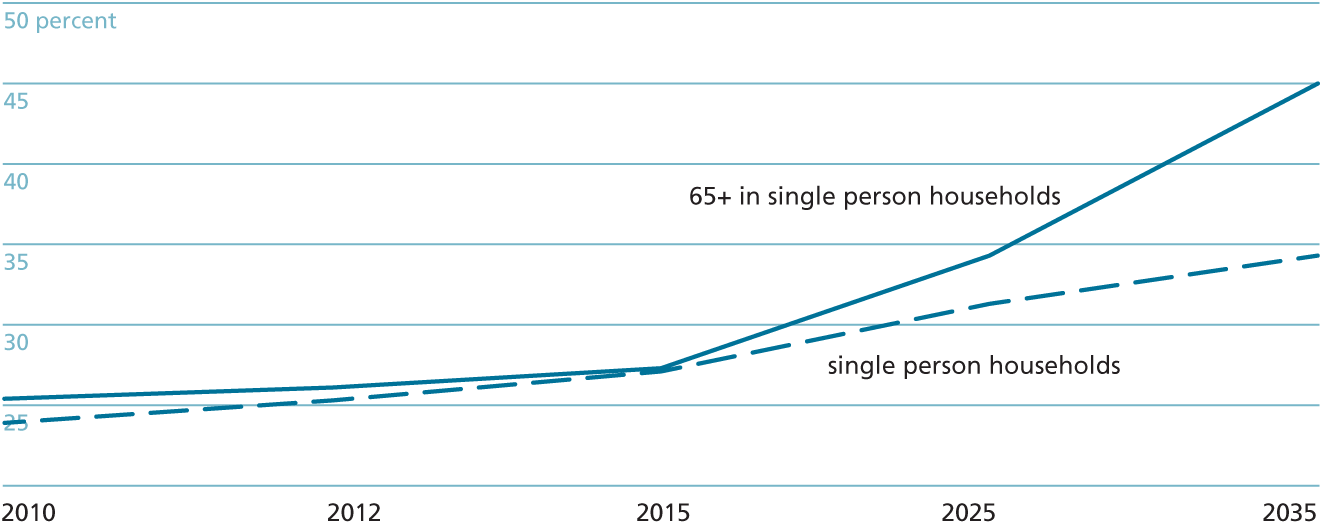
A driving force behind the silent revolution is the growing share of single-person households. While one-person households represented only 9% of total households in 1990, they accounted for nearly 26% in 2013, according to Statistics Korea. In other words, one in every four households consists of only one person, and these households are projected to steadily increase to 34.3% in 2035. Two different demographic trends help explain the surge: the growing gray population and the rising never-married population.
About 26% of one-person households were Koreans ages 65 and over in 2012. The fast-aging population in Korea stems from prolonged life spans. In 2013, life expectancy for Koreans was 81.9 years (85.1 for women and 78.5 for men). This means that the number of elderly Koreans living alone is projected to increase by 45% in 2035, according to Statistics Korea (see right).
The other trend contributing to the rise in one-person households is the uptick in young single Korean adults, a trend that is strongly associated with a retreat from marriage. Traditionally, Korea has a pro-marriage culture; marriage is viewed as a social obligation. According to Confucian values, marriage signals young people’s transition to adulthood, which leads to having their own children and caring for their elderly parents.
While Korean lives have traditionally centered on the family, the growing influence of individualistic attitudes and Western values have meant young Koreans today delay marriage or abandon marriage for their careers. The average age of first marriage was 29.6 for women and 32.2 for men in 2013, compared to 24.8 for women and 27.8 for men in 1990, according to Statistics Korea. Financial uncertainty among young Koreans is also likely exacerbating negative attitudes toward marriage. Statistics Korea found that four out of 10 Koreans in their 20s and 30s seemed to quit dating in 2014, mainly due to financial hardship.
Without much fanfare, demographic, social, cultural, and economic shifts have radically transformed the Korean family in just a decade.
These Koreans, in fact, are called the sam-po generation, combining the word for three (sam) and the word for giving up (po). The sam-po generation refers to young Korean adults who abandon dating, marriage, and having children because of growing economic uncertainty. In the United States, many members of the so-called “boomerang generation” have moved back into their parents’ homes. Young Korean adults may continue to stay at the parental homes and becoming a long-term “kangaroo generation” (as opposed to a boomerang generation), and many have moved away from the strong sense of responsibility to support their parents financially that was held by earlier generations. To them, marriage is simply one option. It is a personal choice rather than an obligation to others.
Remarriage
The other driving force of this quiet revolution in family structure is an increasing number of remarriages. Divorce was strongly discouraged in traditional Korea, especially for women. In a Confucian patriarchal family, a wife belonged to her husband’s family. As a consequence, the remarriage of women was deeply frowned upon. As a practical matter, few women were financially independent and they lacked the means to divorce. As marriage has become a more individual choice and divorce rises, attitudes toward remarriage have relaxed. Marriage is becoming more individualized: the satisfaction of individual needs, personal fulfillment and growth, and emotional intimacy are all cited as important in a good marriage. In particular, more tolerant attitudes toward remarriage may reflect this new meaning of marriage.
Households that have just one person, and those in which the person is 65 or older, 2010–2035
Blended families with older female matriarchs are challenging long-standing hierarchies.
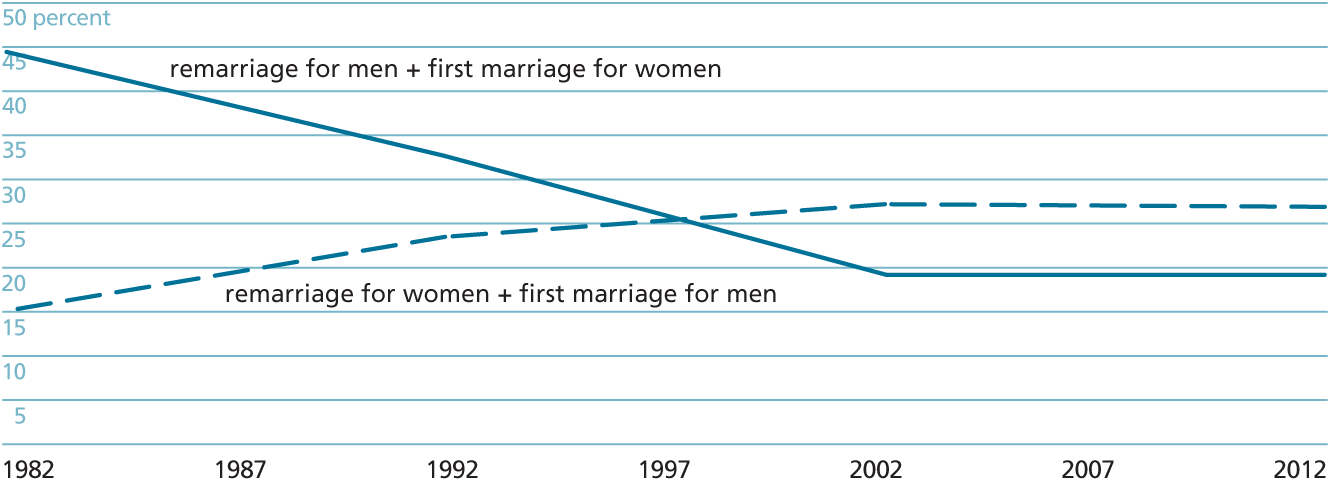
In 2013, 25% of new marriages included at least one partner who had been married before, compared to only 10% in 1990. Remarriage has increased particularly rapidly among women due to their improving economic status and autonomy within Korean society. Statistics Korea reports that women’s remarriages now outnumber men’s by 10%. The number of women’s remarriages jumped by 228% between 1982 and 2012, compared with an increase of 94% for men.
Remarriages including only one previously-married spouse: 1982–2012
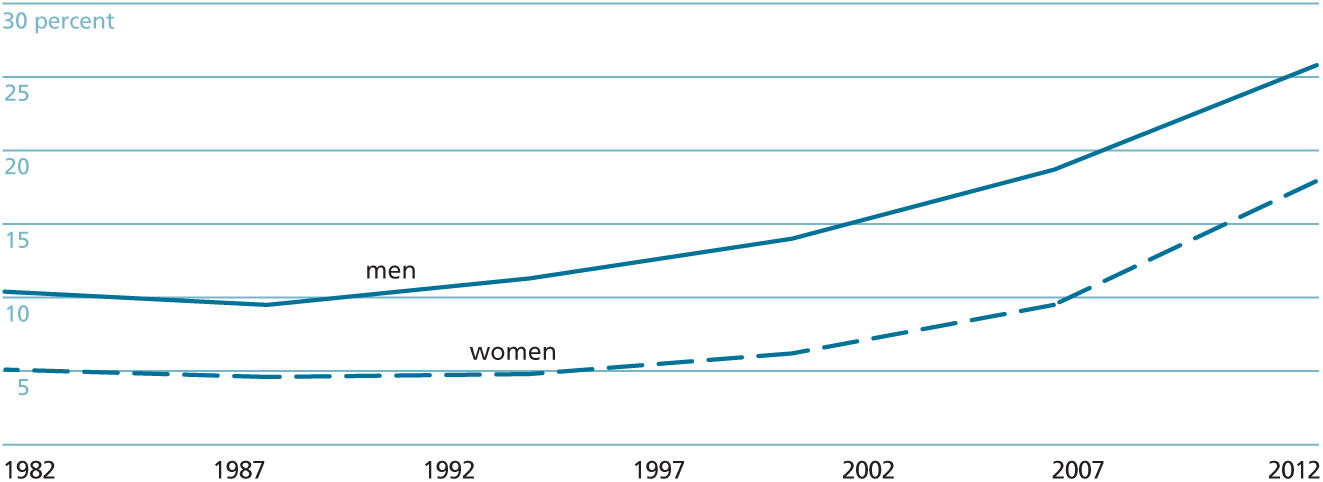
Remarriages occurring in ages 50-59, by sex: 1982–2012
More interestingly, much of the growth in remarriages is not from recent divorcees finding each other or from older men finding younger wives. Remarriages between divorced women and never-married men nearly doubled to 26.9% of total remarriages in 2012 from 15.1% in 1982, compared to a striking drop in remarriages between formerly-married men and never-married women (from 44.6% in 1982 to 13.5% in 2012). These previously-married women are called dol-sing-nyu, literally meaning returned-single-women (or, second-timer-women). Dol-sing-nyu who are well educated and financially stable seek out mates to pursue happiness and self-fulfillment. In remarriages between second-timer women and first marrying men, the wife tends to be older. While such couples were once uncommon and even considered deviant, the older-woman-younger-man relationship (yun-sang-yun-ha in Korean) has become the new norm.
Along with improvements in women’s economic status, the gender imbalance in the marriage market helps account for these couples. There is a surplus of marriageable males as a consequence of Korea’s history of skewed sex ratios at birth. Additionally, lopsided numbers of marriageable males and females are exacerbated by men’s propensity to marry younger women. These “maritally squeezed” men must now seek out mates among older Korean women. At the same time, the mass media, especially television dramas such as Witch’s Romance and Cunning Dol-sing-nyu, and celebrities in older woman-younger man relationships have helped people rethink age differences. They’ve created an image of age-mismatched couples as “cute husbands and responsible/mature wives.” By contrast, as Korean men’s economic prospects dim, dol-sing-nam (second-timer-men) are less desirable on the marriage market.
With delayed marriage, an aging population, and greater acceptance of divorce, it is no surprise that remarriage among Koreans ages 50 and over has been on the rise for decades. Men in their 50s represented about 10% of the total men’s remarriages in 1982, and their share increased to about 26% in 2012. Women in their 50s accounted for 18% of total women’s remarriages in 2012, a dramatic increase from 5% 30 years earlier. These gray remarrying folks seem to believe that they have a second chance to make more fulfilling marriages and enjoy them throughout their long life expectancies. The rising rate of divorce and ever-longer life expectancies will continue to expand the pool of Koreans who are eligible to tie the knot again.
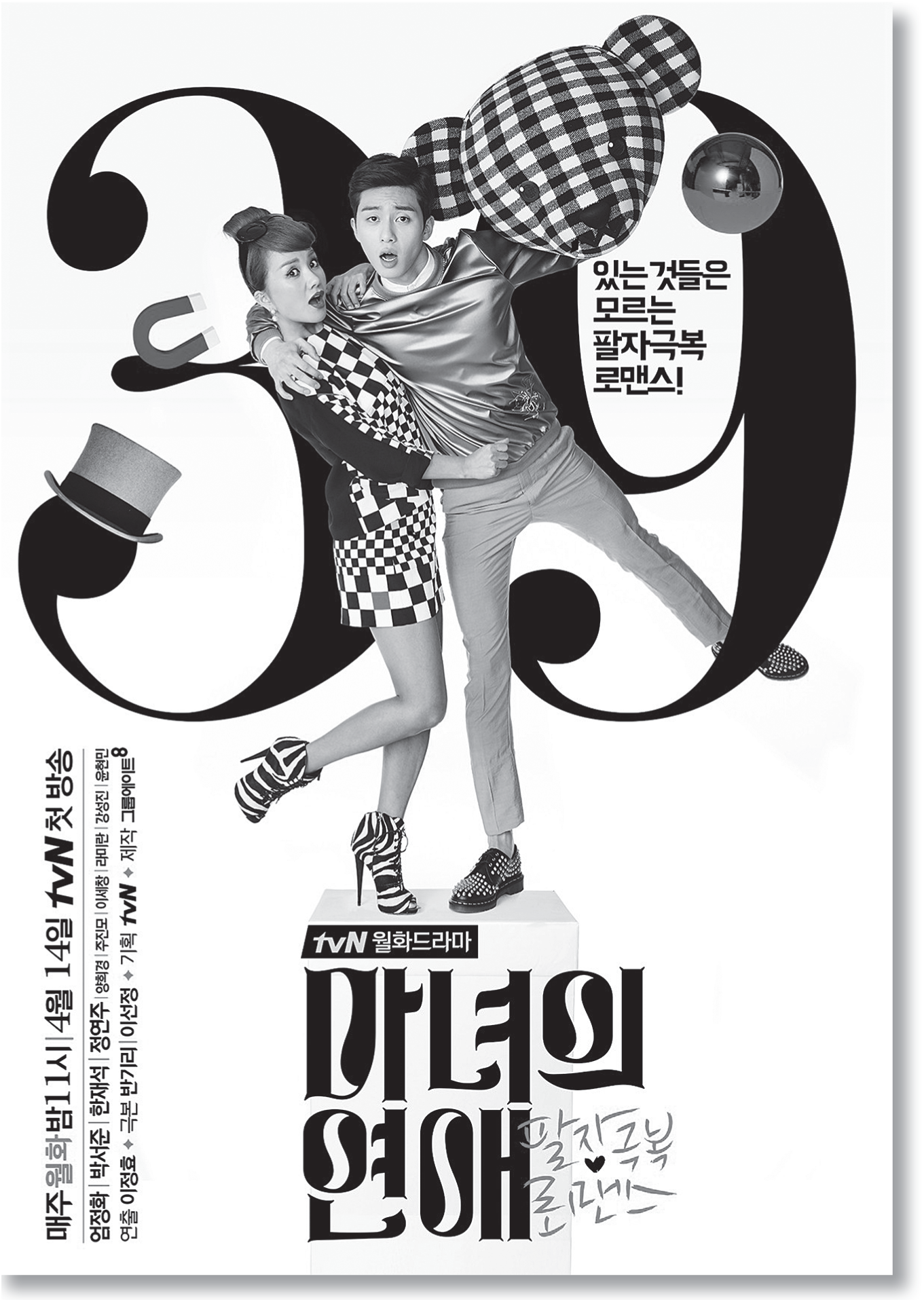
“Witch’s Romance” is a South Korean television show that’s helped normalize images of age-mismatched couples.
Promotional image
The silent revolution in the Korean family has many implications for Korean society. Eric Klinenberg’s Going Solo: The Extraordinary Rise and Surprising Appeal of Living Alone explored how the growing number of Americans who live alone are redesigning single life; the same holds true in Korea. The Korean government, for example, has promised to construct more small houses for the growing singles demographic. Television networks are producing popular shows about singles (e.g., Roommates, What Are You Eating Today?) and remarriage (e.g., With You Together) in Korea. Dating websites like Sunwoo or Only You treat second-timers as their main customers, not just clients for a niche market. These businesses are all a part of what Klinenberg dubs the “solo economy.” Singles, especially young singles, have gained new cultural and economic clout.
With so many remarriages, there are also an increasing number of blended families or stepfamilies. Traditionally, Korea has been a patriarchal society. But blended families with older female matriarchs are challenging longstanding hierarchies and creating new social scripts within and surrounding families. While the growing individualism surrounding marriage and the higher degree of gender equity in divorce and remarriage resemble patterns in the U.S., the relative lack of cohabitation and the status of dol-sing-nyu as compared to divorced men are quite different. Sparked by shifting values, especially in the status of women, this silent revolution has already brought about significant new developments in Korean culture and social structure.