



Abstract
Labor unions have been on the decline for sixty years in the U.S., though they raise wages, decrease inequality, and give voice to workers. Can they rise again?
© Ricardo Levins Morales, rlmartstudio.com
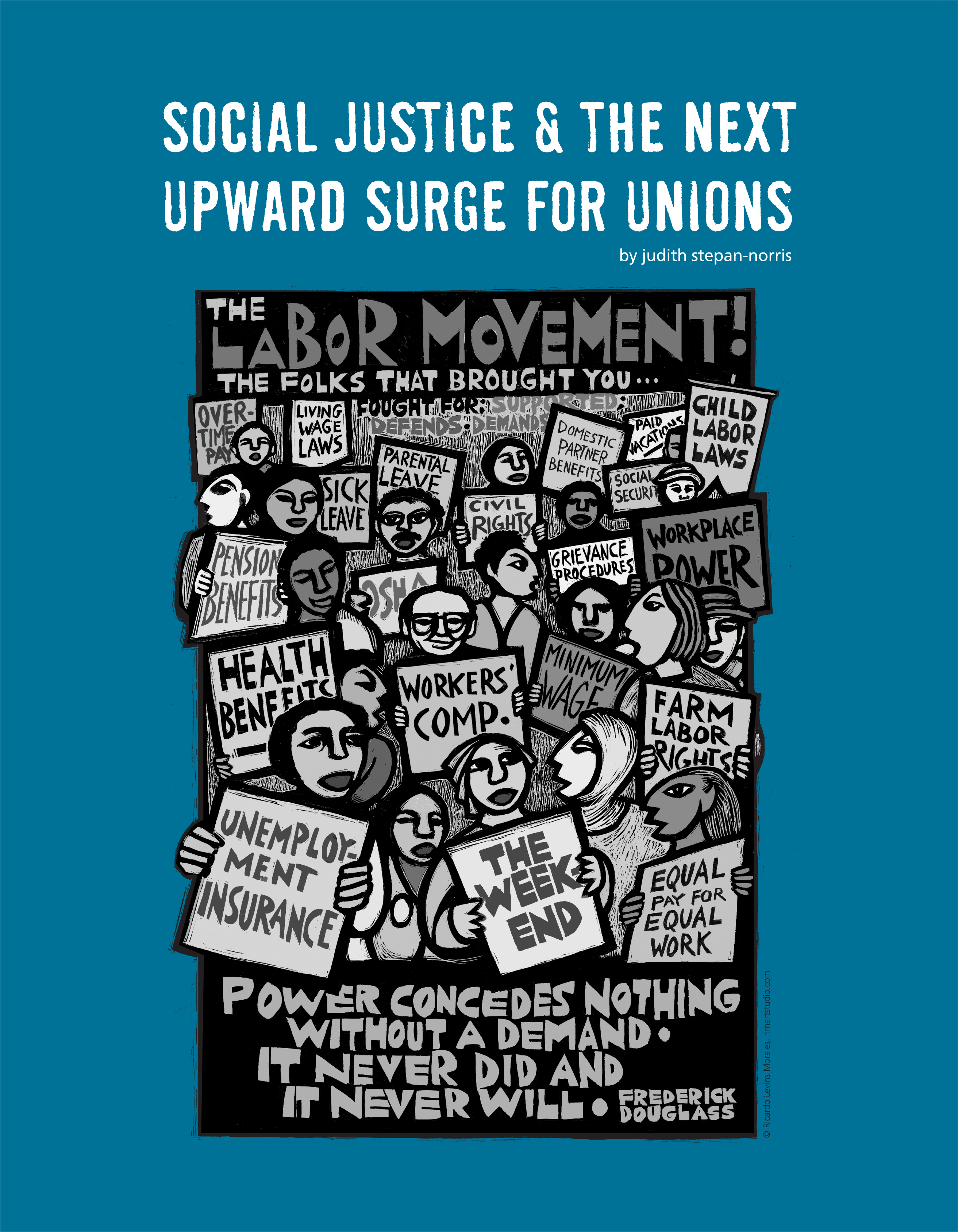
Coming out of the economic recession, millions of workers have found themselves in new jobs or looking for new jobs. If they end up working for Wal-Mart or many of the other “low-road” non-union employers, here’s what they can expect: Low wages: most hourly employees earn just above the legal minimum and are restricted to 34 hours a week. High turnover: two-thirds of entry-level hourly employees quit within three months. No or inadequate benefits: even those eligible for health benefits often don’t take advantage of them due to the high cost of required worker contributions.
Conditions among Wal-Mart’s subcontractors are equally bad: warehouse workers complain of working in high temperatures with harmful pollutants on dangerous equipment without regular breaks. Wal-Mart counters that it’s “offering real solutions to the challenges facing America’s working families,” and blames criticism on union organizers. “At Wal-Mart, we respect the individual rights of our associates and encourage them to express their ideas, comments and concerns,” the company said, as reported in the 2014 PBS documentary Store Wars. “Because we believe in maintaining an environment of open communications, we do not believe there is a need for third-party representation.” In other words, unions are not welcome at Wal-Mart.
In the battle between the U.S.’s largest private employer and the union movement, so far, Wal-Mart is winning. The union movement’s strength has ebbed and flowed over the last century, and the proportion of workers that unions represent has been on the decline for 60 years. Today, only 7.5% of private-sector workers, and 11.2% of all workers, are union members. What do these patterns mean for low- and medium-wage workers—do unions make a difference? If unions benefit workers and their families, why are they declining? What are the prospects for a union resurgence?
Before and After Unionization
The U.S. union movement, and its main umbrella organization, the American Federation of Labor–Congress of Industrial Organizations (AFL-CIO), consists of individual unions that vary on many dimensions, including the size of their membership and staff, whether they organize a kind of worker (craft unions) or a kind of workplace (industrial unions) or both, the extent to which they are democratic and involve members in their governance, their effectiveness in bargaining, and their attention to and satisfaction of workers’ concerns. Some are democratic and effective while others may be ineffective, autocratic, or even corrupt.
Unions decrease inequality when they improve workers’ economic and social status, giving them a voice at work, increasing wages, improving working conditions, and representing their interests in the political realm. In his 2014 book, What Unions No Longer Do, Jake Rosenfeld reported an average union wage advantage of 26% for men and 13% for women. The decline of unions, he shows, has had a “direct impact on private-sector wage and inequality levels.” Common objections to unions emphasize high dues, bloated bureaucracies, corruption, a tendency to raise employers’ labor and retirement costs to uncompetitive levels, and reductions in efficiency.
The proportion of U.S. workers that unions represent has been on the decline for 60 years.
To put this debate in context, let’s consider some examples, starting with the United Auto Workers’ (UAW) 1941 union victory at Ford’s River Rouge plant outside Detroit. During the 1930s and ‘40s, River Rouge was the largest car factory in the world. People came from all over to work in the modern facility and earn Ford’s highly publicized $5 wage. In our book, Talking Union, Maurice Zeitlin and I reported on oral history interviews with surviving union activists from the Rouge plant. They described the pre-union workplace environment as extremely harsh, with spies, “service men,” job selling, and company unions. One activist remembered:
“It’s almost unbelievable the way Ford was run. It was a real Gestapo set-up…. This guy Harry Bennett used to have his service men. Most of the service men were guys that he got out of jail, and he controlled with an iron fist…. They put the scare, the fear of God into people, that ‘you join a union, you’re going to get fired.’”
When the UAW began organizing in earnest, Ford’s anti-union efforts amplified. One organizer reported, “We went to one hell of an organizing drive at Ford. I was fired. I was caught with UAW literature inside my shirt. I got the hell beat out of me.… They said, “Nigger, if you ever be caught around the Ford Motor Company again, we’ll kill you.’” Another remembered: “I worked at Briggs Local 212, so I had one of the 212 hats. So the afternoon shift I was going out of the gate… these four goons they pummeled the hell out of me. They said ‘get that hat off there.’ They took the hat off and stepped on it and pounded me down in the cinders.” To keep workers out of the UAW, Ford organized and ran its own unions, the “Ford Brotherhood” and the “Ford Liberty Legion,” neither of which attracted much worker interest.
Unions have helped decrease inequality across gender, race, and class divides.
Kheel Center for Labor-Management Documentation and Archives, Cornell University
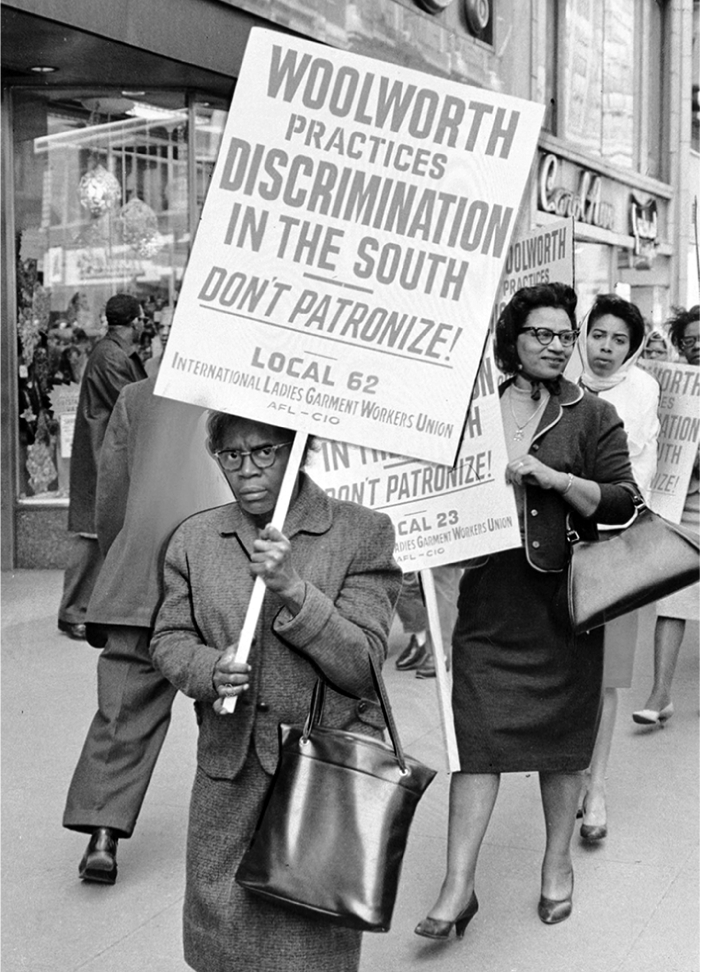
Ford also dominated workers’ activities outside of the workplace, in the surrounding communities. The company’s “Sociology Department” inspectors made visits to workers’ homes to ensure that they were tidy and that workers and their families conformed to Ford’s code of conduct. Michigan State Senator Stanley Nowak said:
“We would call a meeting, and if it was in a public hall, people wouldn’t come. And for a very good reason, because somebody would report who was there at the meeting, and he would lose his job, and very likely be put on the blacklist….The Ford Motor Company…. had all kinds of municipal acts against distributing leaflets, against organizing meetings…. [It was] like a military camp…. Like a fortress.”
Unions decrease inequality when they improve workers’ economic and social status, giving them a voice at work, increasing wages, improving working conditions, and representing their interests in the political realm.
Another activist commented:
“[W]orkers were playing safe because there were spies all around. So, if you saw the picture of Henry Ford hanging where the Madonna and Child might be otherwise, that worker was a thinking individual who was merely trying to protect his job security because he knew how dangerous it was to do otherwise.”
At the national level, pressure from social movements and radical political parties helped to usher in New Deal-era changes that helped unions’ organize, mainly the Wagner Act of 1935. At Ford, when the UAW won union recognition and began negotiating collective bargaining agreements, workers experienced a very different workplace. One worker remembered, “We started getting security, and we started living like human beings…. If we thought something was wrong, we’d have something to say about it—before you could never say it.” The change was dramatic: “Our people are going to have dignity and pride on the job. They are going to be respected by [the] foremen and supervisors. We got a contract.”
As the union movement achieved better conditions for organizing, and as they became integrated into labor relations within many mass production industries, many employers continued to push against unionization. Their efforts to reverse unions’ legal and political gains—through, for example, the Taft-Hartley Act of 1947, the Landrum-Griffin Act of 1959, and state right-to-work laws—have paid off. The new legal and political terrain has made it extremely difficult for unions to organize. While many employers’ traditional anti-union tactics are now illegal—including company spies, strong-arm tactics, company unions, and firing union activists—enforcement and penalties for existing laws are weak. Employers have also adopted newer tactics, including enlisting the help of union-avoidance consulting firms, delaying union elections, requiring workers to attend mandatory meetings, threatening to move production abroad, and refusing to bargain even after workers vote for union representation.
On top of these obstacles, some workers resist unionization because of their own negative perceptions. Steve Lopez, in Reorganizing the Rust Belt, shows that even when nursing-home workers had numerous grievances—from insufficient staffing levels, low quality of care, and unsafe conditions, to arbitrary employer discipline and unpredictable shifts—anti-union attitudes could prevent them from voting the union in.
For workers, the cost of declining unionization has been high. Ruth Milkman’s study of Los Angeles unionism among janitors, truck drivers, drywallers, and garment workers found that de-unionization of the 1970s and ‘80s led to “dramatic deterioration in working-class living standards,” the return of exploitative labor practices, and sweatshop-like conditions. In addition to changing working conditions and labor practices, the decline of union representation has contributed to the rise of wage inequality in the last several decades.
For and Against Unions
The contest between union organizers and employers for the hearts and minds of workers is also played out in the larger society. During unions’ heyday in the early 1950s, over 70% of respondents to the Gallup poll indicated approval of unions. That high level of approval declined through 1995, but then began increasing again. In fact, the Hart survey showed nonunion workers increasingly likely to say they would vote for union representation, from 30% in 1984 to 52% by 2004. This may be attributed to the increasing visibility of unrestrained corporate power, in contrast to the ability of unions to help protect workers’ living standards.
Although public opinion has swung back toward unions to some degree, persistent objections and negative perceptions remain. Chief among these is that unions are corrupt, self-serving, and undemocratic. This image was popularized in the 1950s, when U.S. Senate hearings focused on the International Brotherhood of Teamsters and its president, James “Jimmy” Hoffa. Corruption has occurred in all walks of American life, including in the business community (remember Enron and the more recent Wall Street examples) and in non-profits, and unions have not been exempt. But management and the media often amplify this image of unions during labor battles, and unions must continuously work to counter this narrative. While these complaints may ring true for some workers, most union staff (especially organizers) work long hours for little pay, and, even among top union brass, salaries pale in comparison to the soaring compensation of corporate leaders.
In recent years, unions have faced additional criticism for their role in the collapse of the U.S. auto industry, because of the perception that union benefits hurt the companies, especially General Motors (GM). Employee and retiree health care did impose a growing burden to GM, due to the aging of its workforce. In earlier years, however, management had agreed to take on responsibility for these health benefits in return for short-term UAW wage restraint and labor peace. The firms enjoyed immediate wage reprieves (and better-looking bottom lines) but didn’t adequately account for the accruing long-term health care costs. When solvency became an issue, the UAW agreed to concessions. In addition to the benefits burden, GM was hurt by sales problems, trouble with their financing operations, and the Delphi parts-maker bankruptcy. It is much too simplistic to blame the UAW for GM’s bankruptcy.
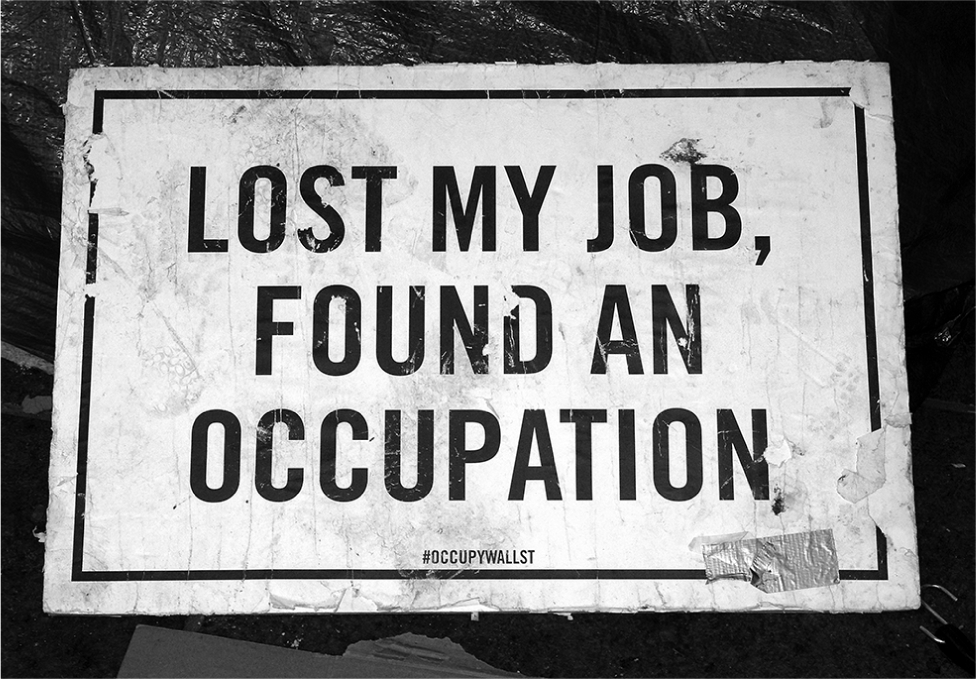
Occupy Wall Street helped spotlight inequality; the labor movement could use leaders from social movements such as this.
David Shankbone, Flickr Creative Commons
Historical evidence of the benefits of unions counters these negative views. In addition to the economic benefits to their workers, most U.S. unions make workplaces more democratic. Because management has authority, unions are the only real chance for workers to have a guaranteed collective voice at work. Unions are also important actors in national, regional, and local politics, where they amplify the political interests of the workers they represent.
Union efforts have shaped the work culture we know today, directly affecting workers through union contracts and indirectly affecting society generally through legal and economic changes. They were important in establishing the 8-hour day and the 5-day week, paid vacation time and sick leave, child labor laws, workplace safety, retirement and healthcare, and many other union and non-union worker benefits. Yet these positive union contributions to lower-to-middle income workers’ lives (and to society as a whole) are often forgotten—and deliberately obscured by their opponents.
What Explains the Decline of U.S. Labor Unions?
Union representation peaked at 32% of the workforce in 1954 before starting on the slide that continues today. What accounts for these changes? Jobs have shifted from unionized to non- or less-unionized industries, there has been faster growth in employment in non-union than in unionized industries, and there has been outsourcing to non-union U.S. regions and other countries. And as U.S. worker demographics changed, groups of workers (like women and new immigrants) who are less familiar with unions and with whom unions have traditionally been less experienced have entered the workforce in large numbers. However, when unions seriously address their concerns, these groups have been amenable to joining. And public attitudes have improved toward unions. But employer resistance has become more sophisticated. Companies facing union campaigns employ anti-union consultants in about two-thirds of all campaigns, and they’ve spent billions of dollars on such services in the last few decades.
The legal climate has changed considerably, too. Before the New Deal, employers used injunctions, labor spies, armed guards, and company unions to defeat unions. New Deal pro-union legislation prohibited company practices considered unfair to labor unions, including interfering with or discriminating against workers who engage in union activity, creating company unions, and refusing to bargain with a union that’s won bargaining rights. It also established the machinery for fair and secret ballot union elections. On the other hand, The Taft-Hartley Act of 1947 allowed for employer complaints against unions, outlawed certain types of union security and automatic check-off of union dues, required all union leaders to sign non-communist affidavits (thereby greatly reducing the presence and influence of class conscious leaders in the mainstream labor movement), and restricted successful labor actions such as sit-down strikes, sympathy strikes, and secondary boycotts. It eliminated some of the most effective worker actions and limited workers’ ability to build broad labor solidarity. The Taft-Hartley Act also enabled the passage of Right-to-Work laws, which now place further limits on unions in 24 states.
During the 1960s, federal workers gained the right to collectively bargain, as did many state and municipal workers (though most don’t have the right to strike), and they organized in large numbers. This development shifted the composition of the labor movement toward public workers, who now make up the slight majority of all unionized workers.
Union strategy has also affected the ebb and flow of union support. Scholars have criticized unions for devoting insufficient attention and money toward organizing activities and for being slow to adopt new organizing tactics. Some unions have responded with more militant and social-movement oriented tactics, which have been shown to be more effective. Aligning (or even fusing) with other movements has shown benefits, as unions are able to demonstrate that they support other workers and their families on a wider range of issues.
Union efforts have shaped the work culture we know today—the 8-hour day and the 5-day week, paid vacation time and sick leave…
What Will Determine Labor’s Fate?
While these factors are no doubt important in understanding the rise and fall of U.S. union density, and suggest ways that unions might increase at the margins, none explains what the U.S. labor movement needs to really get moving again.
First, it is important to note that the high level of inequality that accompanied the last upsurge is again salient. Poverty rates are relatively high: 15% of adults and 20% of U.S. children are below the official poverty line. More young adults are dependent on their parents, as job opportunities and wages are inadequate for establishing independent households. And the Occupy Movement has highlighted the injustice of extreme wealth concentration in the top 1%.
During the last 15 years, the AFL-CIO has initiated some drastic changes in response to its continued decline. These include initiating new organizing programs, funneling much more money into new organizing, and encouraging unions to use a revitalized repertoire of tactics in organizing campaigns. While necessary, these efforts have barely averted further decline. In response, a rival labor federation, Change to Win, broke away from the AFL-CIO in 2005, hoping they could independently reinvigorate the labor movement.
The history of union organizing can help here. Let’s consider two interrelated factors crucial for union growth in the 1930s: competition within and among unions, and participation by committed progressive organizers and leaders with experience in allied organizations. Together, these factors energized the labor movement; could they do it again?
For most of U.S. labor movement history, one federation has dominated. That federation is the AFL, formed in 1886 as a rival to the Knights of Labor. During the last century, the AFL (then AFL-CIO) has had anywhere from 50 to 120 member unions, each with an exclusive jurisdiction in which it was authorized to organize. This means that within the AFL, competition among unions to organize workers was prohibited. Another distinguishing characteristic of the AFL is that it was a craft-based union federation, meaning that for workers to join member unions (like the Plumbers or Carpenters’ union), he or she (mostly “he”) must have been trained in a craft. Workers in skilled crafts are more highly paid, and one main goal of the AFL was to preserve that wage advantage.
The AFL’s more progressive precursor and early rival, the Knights of Labor, collapsed by the end of the 19th century, and thereafter the AFL faced a series of other rivals, all of which were politically more left-wing and all of which sought to organize workers along industrial lines (this means that instead of organizing, say steamfitters or machinists separately, they sought to organize all of the workers within certain workplaces and industries, like the rubber or electrical industry). The AFL had three early rivals. Since the AFL and CIO merger in 1955, however, there has been only one: Change to Win.
In a 2010 study, Caleb Southworth and I examined the rate of change in union representation throughout the last century and found that, net of other factors, the number of rival unions and the number of members in rival unions both positively increased the growth of unions. We surmised that rivals spur union growth by encouraging learning, innovation, efficiency, adaptation to the environment, and enhanced energy. In addition, historically, rival unions have injected progressive ideas and practices into the mainstream labor movement and shaken up the status quo, resulting in enhanced worker representation and worker power (as a class) by increasing union power.
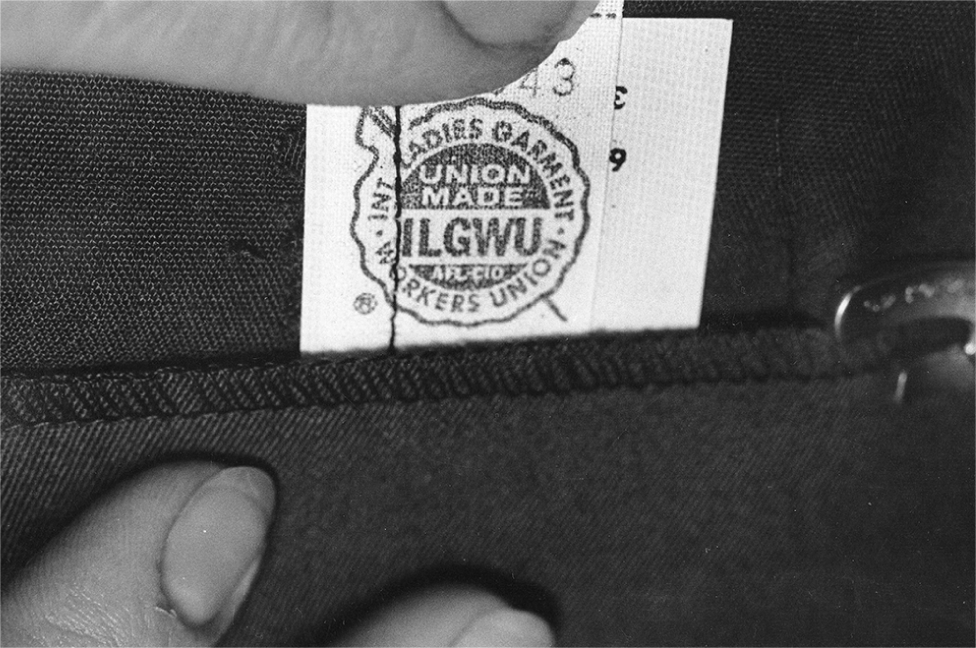
Kheel Center for Labor-Management Documentation and Archives, Cornell University
The Role of Participation by Left-Wing Organizers and Leaders
The AFL’s most successful rival, the CIO, was unique in that it also saw internal competition. In Left Out: Reds and America’s Industrial Unions, Maurice Zeitlin and I demonstrated the important role of CIO leftwing leaders in making advances in collective bargaining, union democracy, and gender and race equity. Unions in the left-wing camp were more successful at negotiating collective bargaining agreements that enhanced workers’ power on the shop floor: their agreements were less likely to cede management prerogatives or the right to strike and more likely to include efficient and empowering grievance procedures. That means that, when the CIO expelled the so-called “Communist-dominated” unions from its ranks during the McCarthy era, the labor movement lost some if its most dynamic, visionary, and effective leaders and unions. In the absence of left-wing rivalry, collective bargaining agreements became more conciliatory and workers’ rights on the shop floor weakened.
Although some of the contemporary unionization efforts have infused more competition into the mix, this competition lacks a coherent alternate ideological vision that gives workers clear choices. Without the combination of rivalry and a real alternative orientation, the new competition doesn’t have the same dynamism seen in the former left-wing rival federations that were so effective in boosting union growth.
The 60-year absence of competition by energetic and visionary left-wing union leaders explains much of the stagnation in today’s labor movement. Unfortunately, the Change to Win federation is not distinctly more progressive than the AFL-CIO. It has already lost several of its original member unions, and it does not explicitly seek to enhance union rivalry. Whether it will play a positive role as a progressive rival is yet to be seen, but its early history does not suggest that it will.
If we value lower social inequality, more social justice, dignity at work, and fair compensation, we should be concerned about union decline. Some approaches and reforms would help get the labor movement moving again. The Employee Free Choice Act, first brought to the House of Representatives in 2007, would have helped to limit employers’ abuse of existing labor laws, turning the tide against right-to-work and other restrictive labor laws. In its absence, unions should build more public support and alliances, with a deeper consideration of the labor force’s changing nature, including which new industries and occupations are in need of organizing. In addition to new allies, unions need continued and deeper involvement with left-of-center political activists, including student activists and those who gained experience in the Occupy Movement. Building alternatives that foster progressive union competition and rivalry will enhance the energy existing unions are willing to devote to new organizing campaigns. While change will require the right social and organizational conditions, enhanced competition between unions—and a cadre of progressive organizers and leaders willing to work hard for little compensation—will enable labor resurgence.