




Abstract
Deana A. Rohlinger contrasts the war on women with the war for women–or at least their votes.
In 2013, Texas senator Wendy Davis slipped on a pair of pink sneakers and filibustered a bill regulating abortion clinics for 11 hours straight. The bill, which passed amid protests after Davis was removed from the Senate floor, prohibits abortions after 20 weeks, requires abortion providers to have admitting privileges at a local hospital, and regulates abortion clinics as ambulatory surgical centers.
Davis’s efforts drew praise and criticism across the country. Supporters of safe and legal abortion cheered her stand and continue to use the Twitter hashtags #SupportWendyDavis and #StandWithWendy to discuss the “war on women” in Texas and elsewhere. Davis’s opponents have called her an extremist and, playing on Davis’s good looks and blonde hair, labeled her “Abortion Barbie.”
In a surprising move, Davis distanced herself from the abortion issue in her recent gubernatorial run. Her website listed education—not battling the “war on women”—as the top issue. And she wasn’t the only Democrat who avoided the once-galvanizing phrase in the midterm election cycle. Why? Did the “war on women” end? Not exactly.
2012 was a bad year for the Republican Party in terms of its relationship with women voters. Several Republican candidates made politically unfortunate comments about rape and abortion. Todd Akin (R-MO) infamously explained that women rarely become pregnant from rape because “The female body has ways to try and shut that whole thing down.” Richard Mourdock, a Republican U.S. Senate candidate, opined, “I think even if life begins in that horrible situation of rape, that it is something God intended to happen.”
These comments put abortion on the political map. The table on p. 71 summarizes voters’ responses to the survey question, “Do you think the issue of abortion is a critical issue facing the country, one among many important issues, or not that important compared to other issues?” Voter concern over legal abortion spiked during the 2012 election cycle.
Republicans’ poor relationship with women voters was evident in the 2012 election outcomes as well. The “gender gap,” which refers to the differences in how men and women vote, reached a new high. According to Gallup, President Obama won women’s votes by 12 percentage points while Mitt Romney won men’s votes by eight. This 20-point gender gap is the largest Gallup has measured since it began tracking presidential voting behavior by subgroup in 1952.
Not surprisingly, the Republican Party made attracting women voters a 2014 priority. Republican strategists recognized that winning women was unlikely, but believed they could narrow the gender gap. The efforts to woo women changed quickly. Republicans launched a campaign to refute the existence of a “war on women” in the developed world. This effort to show women that the GOP cared was combined with a campaign to highlight instances in which the actions of Democrats did not match their “pro-women” rhetoric.
Soon, however, the Republican Party realized there was a popular issue they could use to combat the “war on women” rhetoric directly: birth control. Page 71 summarizes voters’ responses to the survey question, “Do you support or oppose a recent federal requirement that private health insurance plans cover the full cost of birth control for their female patients?”
Unlike abortion, birth control is consistently a winning political issue—and one that voters typically associate with the Democratic Party. Republicans aim to change this association. Since July 2014, Republican candidates from Colorado, North Carolina, Minnesota, and Louisiana have all rolled out plans to make oral contraception available over-the-counter.
Beating the drum for over-the-counter birth control has another political purpose, of course. Republicans needed to attract women without alienating their socially conservative base, which opposes abortion and some kinds of birth control, such as intrauterine devices (IUDs). Easy access to the pill, Republicans maintain, balances religious freedom and women’s rights because it makes the pill available to women whose employers who do not want to offer contraceptives on religious grounds.
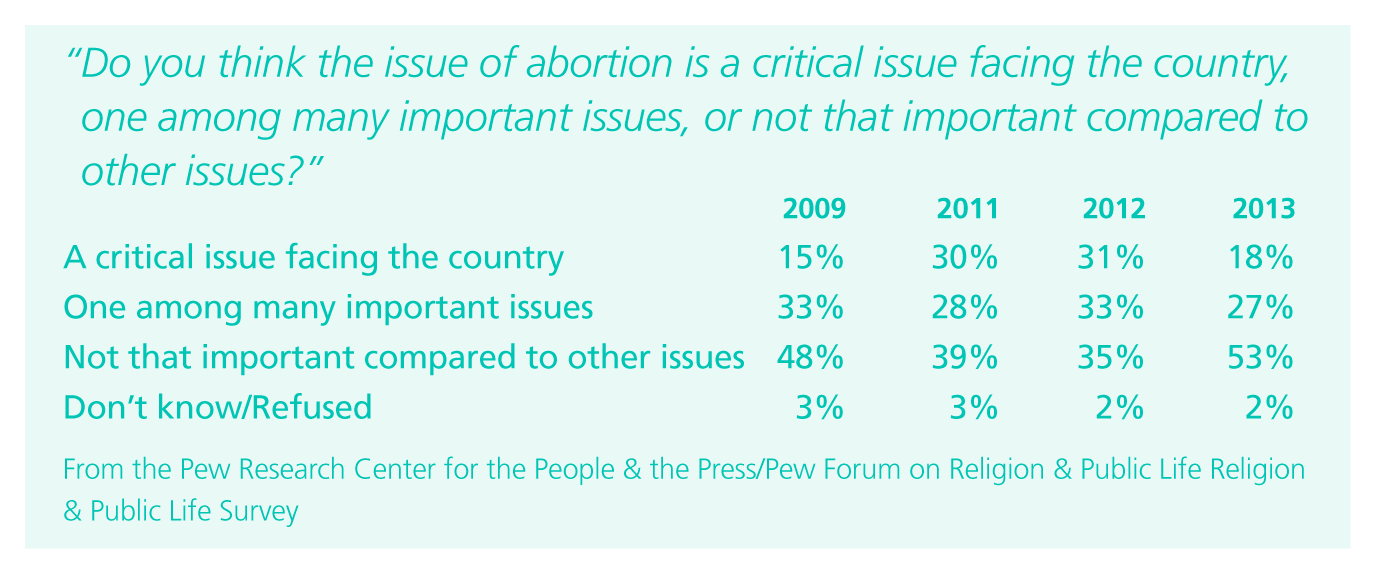
From the Pew Research Center for the People & the Press/Pew Forum on Religion & Public Life Religion & Public Life Survey
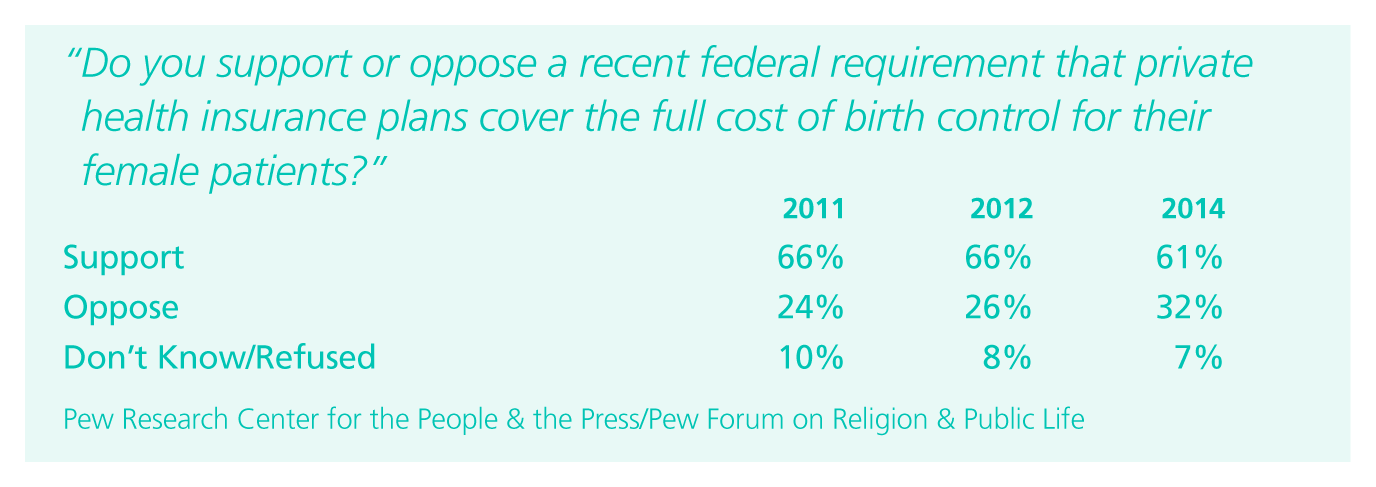
Pew Research Center for the People & the Press/Pew Forum on Religion & Public Life
This political rationale satisfied Republican candidates. Even staunch anti-abortion supporters advocated publicly for the pill’s availability. In his advertisement, Colorado Senate candidate Cory Gardner, an uncompromising opponent of legal abortion, said he believed, “The pill ought to be available over the counter, round the clock, without a prescription.” Gardner ousted the Democratic incumbent, Mark Udell in November.
Democrats and women’s organizations were furious with the Republican Party’s rhetorical turn, calling it a cynical ploy to get votes. Cecile Richards, president of Planned Parenthood Federation of America, told NPR, “It really is quite ironic that suddenly now the Republican Party and candidates, after voting repeatedly to take away birth control access for women, are trying to kind of do this before the November elections.”
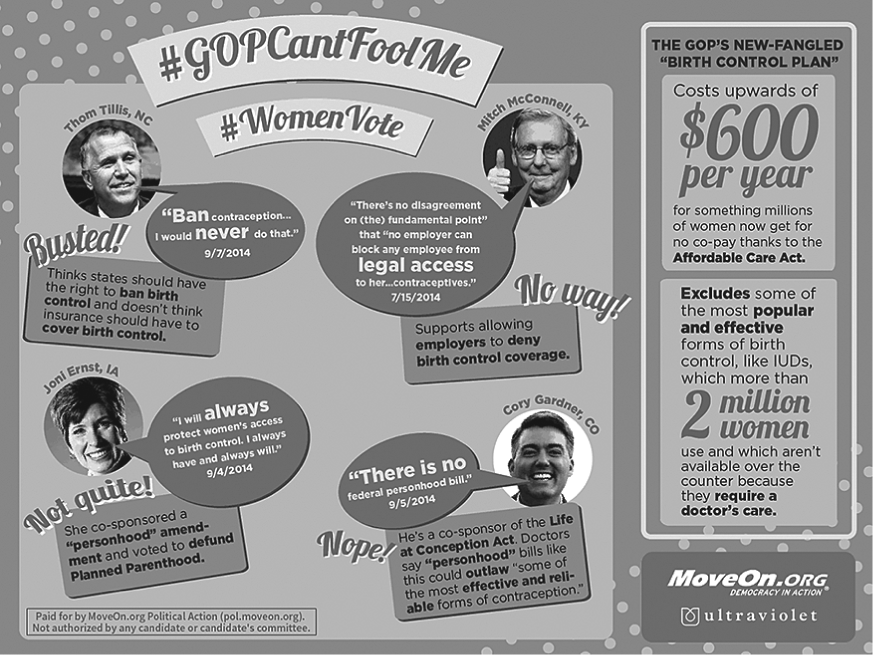
Proponents of women’s rights, including advocacy groups like MoveOn.org, have pointed out that making the pill available over-the-counter does not actually resolve the tension between women’s rights and religious freedom. IUDs, for instance, are eligible for coverage under the Affordable Care Act. Since some religious denominations argue that life begins at fertilization, they believe that IUDs, which prevent egg implantation, end innocent lives—an argument with which users of IUDs disagree. Progressives also note that making the pill available over-the-counter may actually cost women: most birth control is available with no co-pay under the Affordable Care Act, but would cost an individual upwards of $600 a year if purchased outside the insurance system.
Republicans dismiss these claims. They argue Democrats are just angry because they were caught off guard by successful efforts to “defang” the “war on women” rhetoric that had kept female voters leaning Democrat. Kelly Anne Conway, a Republican pollster, told NPR Democrats “think that they’ve got a monopoly on talking to women from the waist down. Anything that has to do with reproduction and birth control and abortion—they call it, quote, ‘women’s health’ and they call it women’s issues.”
Thus, the “war on women” became the “war for women voters.” A war that Republicans looked poised to win in the November election.
Why? Because Conway’s assessment of the Democratic Party is correct. Democrats have depended on “women’s issues,” and the abortion issue in particular, to mobilize women on election day. Republican candidates made that job a lot easier in 2012. Absent Republican candidates making outlandish claims opposing legal abortion or the existence of rape, the “war on women” rhetoric lost its luster and mobilization potential.
Arguably, the “war on women” line became a political liability for another reason. The mantra, which assumes that women have the right to control their reproductive decisions, was pitted against the ability of individuals (as corporate owners) to exercise their religious freedom by refusing to allow their employer-paid insurance to cover birth control in the Supreme Court’s decision Burwell v. Hobby Lobby. Choosing what or whose rights take precedence meant that the Democratic Party might alienate some subset of voters and corporate contributors—a losing prospect, electorally speaking.
This new political terrain explains why Democratic candidates like Wendy Davis quietly distanced themselves from the “war on women” rhetoric in the mid-term election cycle. Now that the dust from the election has settled, it is clear that Republican Party faces an uphill battle to woo women. Though they lost many seats, Democrats held onto the majority of women voters in 2014. The Pew Research Center reported that the gender gap remained wide in November.
The new Republican strategy could be a winning one in the end. If nothing else, progressives found themselves battling Republicans for the hearts and minds of women voters on what they once considered strictly left-leaning political terrain. The war for women’s votes has just begun.