



Abstract
Christopher M. Rea on conservation banks that price the priceless and change how we protect natural resources.
Bill’s Chevy pickup bounces and hiccups as we roll over the uneven terrain at Stegner Reserve. He takes a left turn onto one of the levies, and we stop to look at the wetlands below us. Mallards and pintails scoot along the marsh waterways, wary of the truck but not alarmed enough to fly off. “Pretty, isn’t it?” Bill asks. I nod. “It’s beautiful.”
The ducks Bill (a pseudonym; I’ve changed all person and place names) and I are watching are only the most obvious of the flora and fauna that inhabit the hundreds of acres at Stegner Reserve. The marsh and grassland we tour also provide habitat to the endangered valley elderberry longhorn beetle (VLEB), and the preserve is speckled with seasonal vernal pools, home to vernal pool fairy shrimp and vernal pool tadpole shrimp, both listed under the Endangered Species Act since 1994. “They form a hard cyst that can survive through the dry season when the pools are empty, years if necessary,” explains Bill, who is an ecologist. “The shrimp hatch and reproduce once the pools are refilled again. They’re incredible creatures. The average person doesn’t really understand, but you start explaining it to them, and they often say, ‘Wow, that’s pretty amazing.’ Most people get it once you start explaining the biology.”
Markets are ever more integrated into policies and institutions designed to protect the environment. How is it changing the ways we protect natural resources?
Biology, however, is only the beginning of the novelty here. The conserved land Bill is showing me is also the result of a remarkable political and economic development: Stegner Reserve is a for-profit conservation bank.
Such “banks” work like this: state and federal laws, most notably the Endangered Species Act mentioned above, do not allow the destruction of officially listed endangered species. Some “impacts” to endangered species invariably occur during routine construction projects, however. Since the mid-1990s, places like Stegner Reserve have begun to provide offset credits, or “off-site mitigation,” to developers or government agencies who are required to “make up” for the environmental harm they cause by building a highway or a tract of condominiums. This means that every allowed acre of land and variety of endangered species at Stegner Reserve is parsed into credits, and those credits are offered for sale. Fairy shrimp habitat credits usually sell for between $200,000 and $300,000 per acre. VELB habitat credits are cheaper, typically ranging in the mid-tens-of-thousands of dollars per acre. Stegner Reserve is, in some senses, an ecological warehouse, ready to sell conserved biodiversity to whoever needs it.
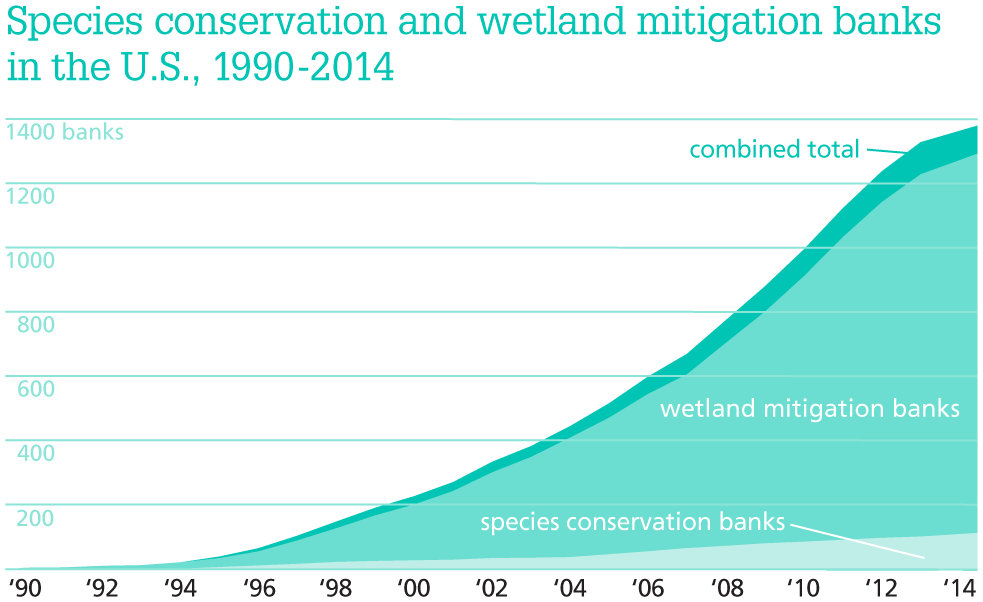
As it turns out, plenty of people seem to need species credits. Conservation banks like Stegner Reserve now protect at least 85,000 acres that provide habitat for dozens of endangered species. Their sibling wetland mitigation banks cover almost ten times that area, or at least 800,000 acres. Together, this amounts to nearly 1,400 square miles of conserved land—more acreage than the state of Rhode Island or Yosemite National Park. The combined number of species and wetland banks in the United States now tops 1,300 (p. 73, left).
Pricing the Priceless
For many observers, the spread of conservation banks in the last couple of decades can be linked directly to the broader expansion of markets into all areas environmental protection—or perhaps social life more generally. Markets in endangered species offset credits, after all, are not the only example of exchanges in what sociologist Marion Fourcade calls “peculiar goods.” Trades in water quality credits, ethanol credits, and sulfur dioxide (a key component of acid rain) are all becoming commonplace. So-called payments for ecosystem services, payments made to landowners to preserve ecological resources like forests or wetlands, are increasingly mainstream. And cap-and-trade systems, especially for carbon dioxide credits, are now well known. In these systems, the government “caps” the carbon emissions allowed, firms buy credits in proportion with their projected emissions, and can then sell (or “trade”) surplus credits to other firms who emit more than expected.
Species conservation banking works a lot like cap-and-trade, by forcing land developers to pay to preserve land in order to offset the destruction or harm to habitat incurred by building a new roadway or shopping center.
But explaining the proliferation of systems like species conservation banking or even carbon trading requires going beyond the observation that markets are profitable and politically popular. Attaching a price to nature is not easy or without controversy. Buying and selling species credits involves putting a price on what had previously been priceless (how much is an endangered bird or shrimp worth, anyway?). It sometimes requires assigning economic value to things that had long existed outside the world of economic exchange. Since the beginning of the Industrial Age, for instance, the release of carbon dioxide into the atmosphere or the development of privately owned land was taken for granted as the right of any industrialist. Now environmentalists, politicians, bureaucrats, and even some business people argue that carbon emissions and habitat destruction should not be free.
Species conservation and wetland mitigation banks in the U.S., 1990-2014
Source: U.S. Army Corps of Engineers, Christopher M. Rea
Relative shares of Endangered Species Act-related litigation for selected states
Source: Lexis Nexis Academic, Christopher M. Rea

Advocates of these new market-based systems like environmental economists, large environmental groups, and arms of governmental organizations argue that putting a price on nature incentivizes ecological stewardship and generates funds for further conservation efforts.
Others adopt what sociologist Viviana Zelizer calls a hostile worlds approach, arguing as biologist Douglas McCauley did in a 2006 issue of Nature that ecosystems are intrinsically priceless, that putting a dollar value on nature is impossible, and that markets have no place in the realm of environmental protection.
Market proponents counter that in practice, nature’s hypothetical pricelessness results in its actual treatment as worthless: effectively, there is no cost associated with its destruction. Many critical scholars skirt these explicitly moral debates, instead pointing out that capitalists and governments are remaking environmental regulations in ways less focused on conservation and more focused on creating new ways to profit from the natural world.
Politics of Nature’s Markets
My research draws upon elements of all these arguments, but focuses on the politics of building these new markets in nature. Both critics and advocates of putting dollar prices on ecological resources often take for granted that, once nature is turned into a tradable good, markets are sure to develop. But in my own research, drawing on archival data, interviews with folks like Bill, and ethnographic work with environmental regulators, I have discovered that markets in unusual commodities like endangered species or wetland credits are actually the product of intense political struggle.
Take species conservation banking, which, despite drawing legal support in the national Endangered Species Act, has remained heavily concentrated in one state: California, where there are approximately 100 species conservation banks. Some of the strongest advocates of these new institutions were not green capitalists or even pro-market academics and policy-makers, but environmental regulators who didn’t stand to make a dime from the creation of conservation banks. These bureaucrats played a key role in promoting conservation banking by reinterpreting environmental statues like the Endangered Species Act in ways that made it harder for land developers to impact sensitive species habitat without also conserving land.
So, why California? The state’s green legacy and supportive state laws played some role. But shifts in ESA enforcement relate most closely to federal policy, and it is unlikely that regulators based in California were intrinsically more concerned with conservation or more willing to stand up to powerful land developers than their counterparts in other states. As it turns out, environmental regulators in California are much more likely to have their feet held to the fire by environmental organizations who sue the government over lax enforcement of environmental regulations. Nearly one-third of all such suits originate in the Golden State (above right)—almost six times the number filed in Florida, where land development projects are actually more likely to impact endangered species habitat. With more stringent ecological requirements in place, green entrepreneurs in California have built alliances with regulators to set aside parcels of conserved land that can be used as “mitigation” for damage to habitats in other locations. These are the lands that become species conservation banks.
The contested creation of new markets in species credits highlights how exchange is always political. Indeed, the contingent and contentious processes that created the fairy shrimp and VELB species credits for sale at Stegner Reserve remind us that markets do not emerge “naturally” or even from simple profit motives. Exchanges in species credits were born of political-legal struggles that only later paved the way for new markets and new chances to make money. The markets we build are the products of our politics, not the inevitable results of a dollars and cents tally.
So as exchanges in ecological goods continue to spread, it is worth asking not just whether they should exist, but how we should build them. Conservation is a public good, and so the public has a stake in who controls, regulates, and profits from emerging markets in nature.