




Abstract
Sociologist Stacy J. Williams examines cookbooks and articles about cooking written by second-wave feminists. She explains how these activists brought their political ideas to the kitchen and suggested cooking in ways that could work toward greater gender equality.
Is an apron-clad feminist cook an oxymoron? Feminists in the 1960s, ‘70s, and ‘80s (“second-wave feminists”) have been accused of abandoning the kitchen and blamed for the rise of fast food. According to popular stereotypes of the time, feminists never set foot in a kitchen. This notion has remained pervasive in contemporary media; in her 2010 Daily Mail article “Has Feminism Killed the Art of Home Cooking?” food writer Rose Prince continues to hold feminists responsible for the scarcity of home cooks and the popularity of unhealthy convenience foods. Even Michael Pollan, an author and advocate of the local food movement, suggested in his 2009 New York Times article “Out of the Kitchen, Onto the Couch” that job-pursuing feminists are part of the reason why there are so few cooks in twenty-first-century kitchens.
But a glance at the history of the food industry suggests that feminists can’t be blamed for these food trends. Fast food and convenience products actually emerged decades earlier and can be linked to technological innovations in the early twentieth century. When second-wave feminism arose, the food industry capitalized on the stereotype that feminists didn’t cook and tried to sell convenience foods as pro-feminist. Pollan likes to cite the example of a 1970s ad campaign featuring a bucket of Kentucky Fried Chicken and the slogan, “women’s liberation.” Ads like these only reinforced the stereotype that feminists didn’t cook.
How accurate is this stereotype? Some second-wave feminists did publicly denounce cooking as a protest against the gendered division of private and public spheres that left women few opportunities beyond the housewife role. In 1968, a group of feminists dumped a pile of aprons in front of the White House, symbolically rejecting the traditional notion that cooking is women’s work. The anti-cooking demonstrations continued in 1970 when New York City feminists marched with signs reading, “Don’t Cook Dinner, Starve a Rat Tonight,” spoofing a citywide anti-littering campaign. Later, “Don’t Assume I Cook” became a popular feminist slogan.
© 1983 Judith Masur and Dinah, Yale Robert B. Hass Family Arts Library
The public protests were intended to show that women were more than just kitchen accessories, but many feminists still liked to cook. In a 1980 Ms. magazine article, Robin Morgan admits, “a conspirational air does sometimes pervade those conversations in which feminists actually (shhh) trade recipes… some women have felt we must be ‘closet cooks’ or ‘secret gourmets.’” Feminists were aware of the cooking-averse feminist stereotype and the need to symbolically disconnect women from cooking. Despite this tension, some feminists persisted in advocating for gender equality within the kitchen. Long before pundits such as Pollan began chanting, “we all need to go back to the kitchen,” feminists were advocating new approaches to cooking.
Long before pundits such as Pollan began chanting, “we all need to go back to the kitchen,” feminists were advocating new approaches to cooking.
Feminist Cookbooks
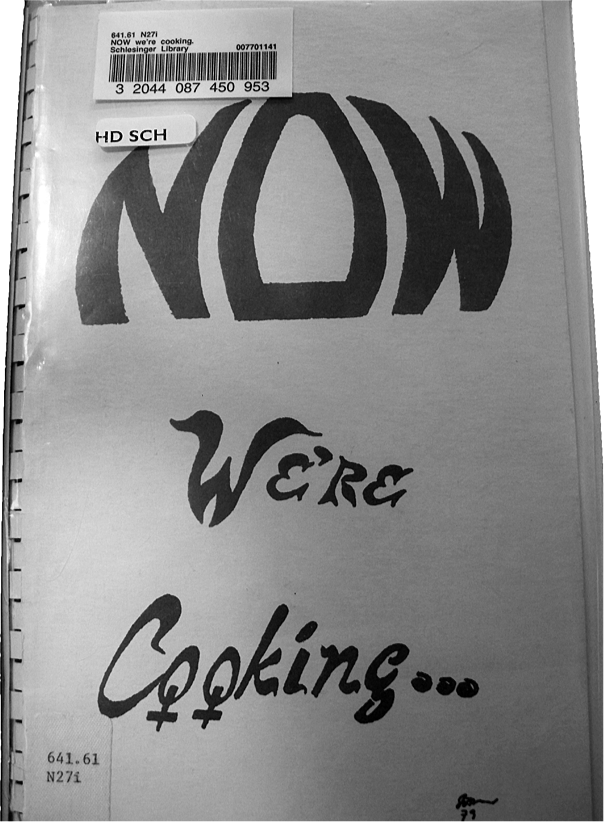
Paradoxically, publishing cookbooks was one way for feminist groups to raise funds. Cookbooks were published by chapters of the National Organization for Women (NOW) to support their efforts to improve women’s employment, political representation, and legal protection. For instance, the Lynchburg, Virginia NOW chapter published members’ recipes in their 1983 First Virginia Feminist Cookbook, and the Champaign, Illinois NOW chapter published NOW We’re Cooking in 1979.
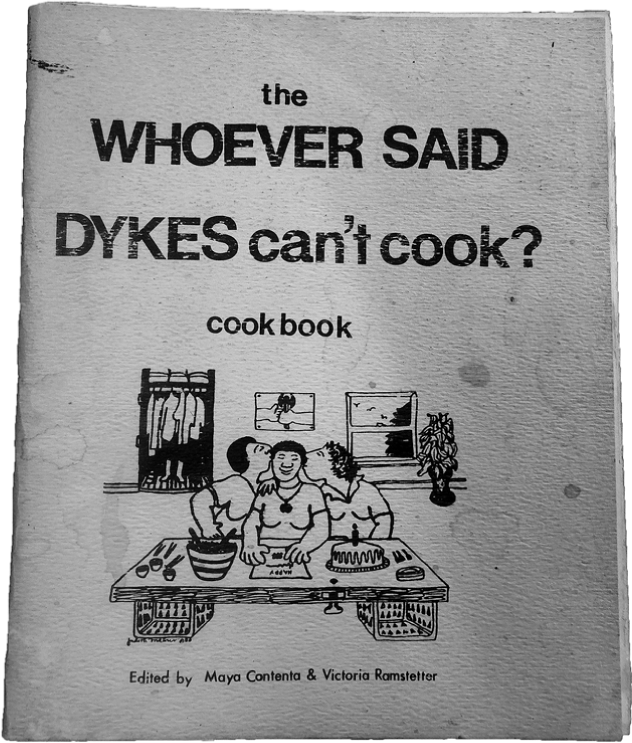
In 1983 a lesbian feminist group, the Cincinnati Lesbian Activist Bureau, published a cookbook called Whoever Said Dykes Can’t Cook? This cookbook raised money for the group, but it also aimed to prove that lesbian feminists cooked—and enjoyed it. As the editors explained in the introduction, a friend of theirs had once quipped, “What? Everyone knows lesbians can’t cook. What’s a lesbian’s recipe for dessert? Six gallons of ice cream—serves six.” The editors compiled a cookbook to prove this friend wrong.
Second-wave feminists continued to cook, but they also wrote about reforming the act of cooking to align with their feminist beliefs. Recommendations for cooking reform can be found in magazines, archival material, and cookbooks written by second-wave feminists. They suggested that cooking in new ways could bring about gender equality and social change. Feminists brought their political ideas to the kitchen by encouraging men to cook, endorsing vegetarianism, starting food co-operatives, cooking collectively, and supporting women chefs.
Who should Cook?
In 1965, women spent over nine hours per week cooking, compared to men’s one hour in the kitchen, according to Suzanne Bianchi and her colleagues in their 2000 article “Is Anyone Doing the Housework?” Feminists encouraged men to cook as a way to address the gendered division of housework. In a 1970s letter to activist Irene Peslikis, a fellow feminist explained that she wanted to write a cookbook: “I’m writing a Women’s Liberation Cook Book. It’s for men. About a dozen easy dinners with directions that assume nothing in the way of experience or knowledge… The point is that men won’t be able to plead ignorance. A no-excuse ultimatum.” According to this woman, a cookbook that encouraged men to take on more household labor would advance gender equality.
Feminists hoped that if men cooked more in the home, it would become a gender-neutral activity. For example, in Pots and Politics, a 1976 reprint of a 1909 suffrage cookbook, second-wave feminists explained that cooking should not be considered a feminine task. “People of both sexes eat; people of both sexes cook. Although the assumption of the 1909 cookbook was that only women cooked while only men and children ate, in 1976 we prefer not to make such categorical distinctions… The recipes in this book may be recreated by members of either sex.”
Feminists brought their political ideas to the kitchen by encouraging men to cook, endorsing vegetarianism, starting food co-operatives, cooking collectively, and supporting women chefs.
© 1979 National Organization for Women Greater Champaign Area Chapter, Schlesinger Library
Many second-wave feminists believed that women could cook their way to gender equality.
© 1981 Sanguinaria Pub.
Similarly, the introduction to First Virginia Feminist Cookbook explained that “feminists of both sexes are lively, active, creatively intelligent, and individualistic people,” which made them equally suited to cook. Feminists also encouraged young boys to cook so that they would grow up without assuming that women should always cook for them. For example, in 1975 Ms. magazine included an excerpt from Many Hands Cooking: An International Cookbook for Girls and Boys. Alongside recipes for Nigerian Groundnut Soup and Hungarian Liptoi Cheese were illustrations of both girls and boys preparing food. These cookbooks and magazines demonstrate that feminists considered cooking as both men’s and women’s responsibility.
What Food should We Cook?
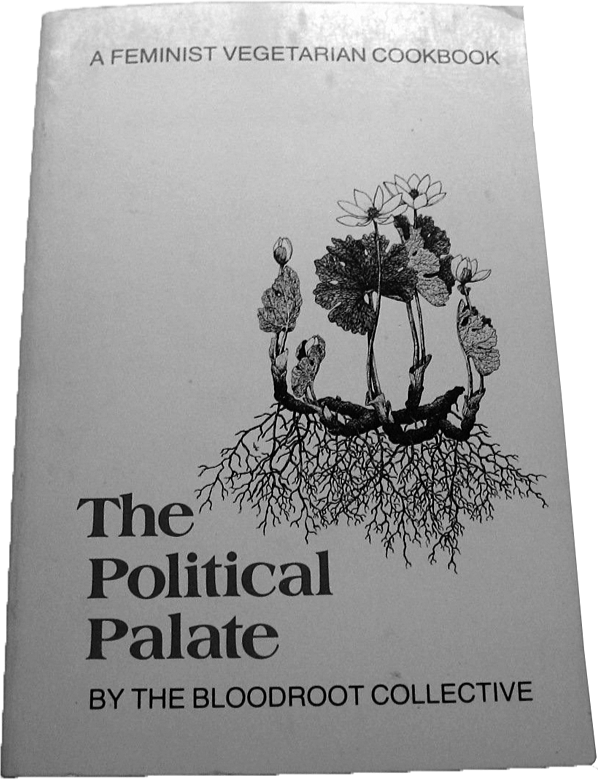
Some feminists advocated cooking vegetarian food because they saw similarities between a patriarchal society that oppressed women and a food system that oppressed animals. In their 1980 cookbook, The Political Palate, members of the feminist Bloodroot Collective compared men’s control over women to raising and killing animals. They explained, “Our food is vegetarian because we are feminists… We oppose the keeping and killing of animals for the pleasure of the palate just as we oppose men controlling abortion or sterilization.”
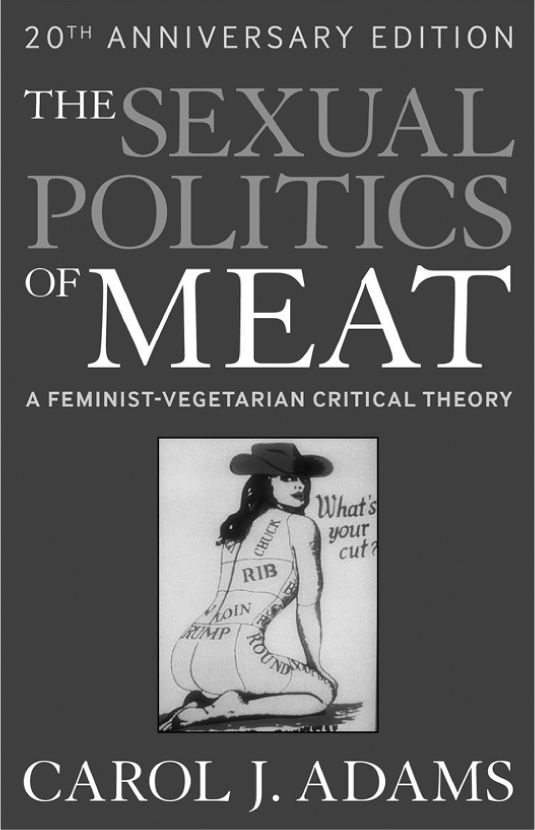
The critique of meat eating went one step further when feminists compared it to the sexual objectification of women. Carol Adams delves into this line of thought in The Sexual Politics of Meat. Feminists argued that men often viewed women as objects that existed solely for men’s sexual pleasure. When women are seen in this way, as only having one purpose, they are stripped of their humanity. Similarly, animals raised for meat are seen as objects that exist for one reason—to satisfy human appetites.
Some feminists drew parallels between the objectification of women and animals, admitting that they often “felt like pieces of meat.” A similar sentiment was expressed in a 1975 Real Paper article, “You Are Where You Eat,” about a feminist restaurant named Bread & Roses in Cambridge, Massachusetts. The restaurant’s owner, Pat Hynes, explained why she served vegetarian food at Bread & Roses: “I feel that vegetarian eating and cooking is a lot closer to feminism than meat-eating… Meat eating is like cannibalism. That’s the way men see women, in the terms that apply to meat.” In Hynes’s view, cooking vegetarian food was a way to challenge the broader system of objectification that devalued both women’s and animals’ lives.
Different ideas about what food we should cook came from feminists with a socialist viewpoint. These feminists believed that women’s progress would only come in combination with a broader revolution that erased class, race, as well as gender inequality. These feminists highlighted how conventional agriculture exploited farm workers, consumers, and the environment. To work toward equality, socialist feminists advocated collectives that provided organic, local food to consumers.
When feminists took over an abandoned New York City building to form a women’s center, they wrote an essay explaining that they wanted to create a women’s food co-op “to illustrate to women how they are tied into profit-making institutions for basic life needs. Women can and will free themselves from dependency on the A&P by making contacts with farms and buying and selling their own food together.” The desire to eliminate large, profit-hungry corporations was also reflected in Maria McGarrity’s 1976 Country Women article, “Making a Farmer’s Market.” She explained that the farmer’s market she helped form grew out of “a desire for more local self-sufficiency, and a revulsion toward the wasteful, exploitative, corporate food industry.” These socialist feminists believed that farmers’ markets and food collectives would make for a less exploitative food system and align with greater gender, race, and class equality.
Feminists compared the sexual objectification of women to the consumption of meat.
© 2010 Bloomsbury Academic
How should We Cook?
Many second-wave feminists recommended preparing food collectively. The Bloodroot Collective wrote in their introduction to The Political Palate, “Feminist food, in our case, is produced by a collective. That means each of us does what she can do best and that we learn from and teach each other… That means we are very particular, that continuity is important to us, that we all taste and discuss the final seasoning of a soup.” While feminists believed women did not have much power in the broader society, their collectives attempted to become models of equality by allowing each woman a voice in all activities, including cooking.
Feminists hoped that if men cooked more in the home, it would become a gender-neutral activity.
Other feminists suggested that women could cook their way to gender equality by making money from cooking. The 1977 Ms. magazine article, “How to Start Your Own Business: A Restaurant” gave instructions for finding a location, assessing the amount of money needed to start, and managing a restaurant budget. Feminists also encouraged women to become professional chefs. In the 1979 Ms. article “Their Place is in the Kitchen,” Carol Eisen Rinzler portrayed female professional chefs as courageous warriors in a field where women were underrepresented. By urging women to enter these professions, feminists presented cooking as a way to make money and reduce women’s economic disadvantages.
Many of feminists’ suggestions for cooking have partially come to fruition. More men are taking an interest in cooking, though women still provide the majority of household labor. Vegetarianism has become more mainstream. Locally grown food and farmers’ markets have become a form of social movement. There are more women chefs today than in the 1960s, but women are still only a small minority of head chefs. Of course, feminists did not single-handedly cause these shifts; many social forces have led to these changes. Yet, this does not discount the fact that second-wave feminists suggested how to cook toward a more equal society. Far from avoiding cooking altogether, these women considered how to achieve social change through the kitchen. If we continue to believe the stereotype that feminists don’t cook, we might miss second-wave feminists’ recipes for equality.