



Abstract
Sociologist Priscilla Ferguson considers competitive eating as an expression of identifiably American connections between abundance and country. Overeating both honors country and transgresses social norms.

Competitors chow down in the first-ever peanut butter and jelly eating competition, held in 2007 at Knott’s Berry Farm in California.
Associated Press/Reed Saxon

Picture the Fourth of July in small-town America: a parade, firecrackers, sparklers, a picnic. But for some 40,000 fans on Coney Island and millions watching ESPN, Independence Day means Nathan’s Famous Hot Dog Contest. Every year since 1916, on the birthday of the nation (with the exception of two contests that were skipped during World War II), the question of the day is who will down the greatest number of hot dogs in 12, and now 10, minutes—bun included.
Competitive eating, or speed eating as it is also called, has come a long way from the days four immigrants demonstrated their patriotism by consuming quantities of that quintessentially American food, the hotdog. Those men would probably be flummoxed by all of the hype surrounding competitive eating today: televised performances, intense promotion, rankings, wildly enthusiastic fans, and star performers.
Since the founding of the International Federation of Competitive Eating (IFOCE) in 1997 and especially since 2005, when the sports channel ESPN signed on with Major League Eating (MLE), speed eating has developed all of the trappings of a full-fledged sport.
For competitors, neither appetite nor hunger are motivators. Nor is taste for a particular food. From hot dogs and hamburgers to mayonnaise, prairie oysters, cow brains and sushi—the specifics of this apparently endless list make little difference to most of them. Since she already held oyster records, IFOCE high-ranking 46-year-old Sonya “The Black Widow” Thomas was eager to compete in a Rocky Mountain Oyster contest held a few years ago—until she found out that these oysters aren’t the familiar seafood but bulls’ testicles. She withdrew immediately, “exotic” foods not being to her liking. Among competitive eaters, however, such choosiness remains exceptional.
What drives competitive consumption is the determination to consume. For those who compete, food is neither a means of sustenance nor a source of pleasure, but an obstacle that must be overcome. As the current number one competitive eater, 30-year-old Californian Joey “The Jaws” Chestnut pointed out in a recent interview, extreme eating is not really about eating at all. It is all about “drive and dedication.” Much like other sports that push the body to its limits, competitive eating is extreme.
Overeating is fundamentally transgressive. Refashioned as a sport, competitive eating makes a spectacle of American values but limits (or at the very least obscures) its transgressive nature. Abundance and consumerism, the two central aspects of competitive eating, are after all, also hallmarks of American culture writ large.
Pete “Pretty Boy” Davekos (left) eats a fist full of poutine. The legendary Takeru Kobayashi celebrates his 337-chicken wing win at the Philadelphia Wing Bowl (right).
Associated Press/Darren Calabrese
Associated Press/Alex Brandon


Food as Spectacle
The modern practice of competitive eating originated in Japan in the 1990s, along with the competitive cooking show Iron Chef, introduced in Japan in 1993 and to the United States in 1999. Competitive eating continues to flourish in Japan today, particularly on television, but unlike the contests in the United States competitive eating in Japan is not organized as a sport.
Not until the 1990s did Nathan’s Famous hot-dog eating competition become more than a local contest. Nathan’s hired publicists George and Richard Shea to raise its profile, hoping to support and extend their franchises as they looked beyond Coney Island.
Abundance and consumerism are hallmarks of American culture writ large.
The big leap forward for competitive eating generally and for Nathan’s contest in particular was the 2001 arrival of Takeru Kobayashi from Japan. His 50 hot dogs almost doubled the previous record. (The current record is 69 hot dogs set in 2013 by Joey Chestnut; Sonya Thomas holds the women’s record with 45 in 2012).
It is obvious that food as spectacle is hardly new. Across history and civilizations, the high and the mighty have long made food a splendid vehicle for parading prodigality. Whether Roman orgy, medieval banquet, or today’s multi-tiered wedding cake, food is often involved in performing an aesthetic of excess and extravagance, which may or may not entail actually eating. Guests feast on the spectacle more than the food itself. Like the courtiers watching Louis XIV at his table, looking may be the only feast that they get.
In competitive eating, attention shifts from the food consumed to the act of consumption. In our media-saturated culture, the competitive eater is a Celebrity Consumer. As with the Celebrity Chef and the Celebrity Cook, celebrity is a function of the extraordinary things done with food. But while the Celebrity Chef and Cook offers us models of excellence to aspire to, the extraordinary achievements of the competitive eater are decidedly ambiguous. Feats of overconsumption draw on and undermine familiar food practices.
Competitive eating appears to be a perfect illustration of gluttony—our inability to control our desires, our appetite. And indeed gluttony is frequently invoked, as in the 2002 Glutton Bowl on the Fox Network and sponsored by the IFOCE. But even as these contests make a show of wretched excess, they’re about much more than simply gluttony on parade.
Meet the Gurgitators
Who are these “gurgitators,” to use the term coined by Major League Eating? Big men seem to have dominated the early years of televised competition, and male competitors at Coney Island are what we might call burly. But at six feet tall and 225 pounds, Joey Chestnut, currently ranked number one, is not outsized. Chestnut graduated from San Jose State in 2012, with a degree in civil engineering, though for the moment he seems to be focusing on competitive eating. (With career earnings upwards of $200,000, he is in a position to do so.)
The more they see themselves as professional, the more likely competitors are to train or prepare in some fashion. The Japanese contender Takeru Kobayashi is known for his intensive weight lifting and bodybuilding regime. Weighing in at 105 pounds, the Japanese outsider gave a distinctly professional push to competitive eating. Korean-born Sonya Thomas, 5’5” and 100 pounds, who ranked third in the world until recently, confirms the diminutive advantage. Although her earnings top $100,000, Thomas has a day job managing a Burger King in Washington. Her dream, post-competitive eating, is to have a BK franchise of her own.
Competitive eating is fundamentally about the individual exploit. Like extreme sports, it offers a means of impressing oneself on a fundamentally alien society. In sociologist Georg Simmel’s classic essay of 1904, “The Metropolis and Mental Life,” the most pressing problem in modern society is the preservation of “the autonomy and individuality” of our existence in the face of overwhelming social forces. To stand out in a society where quantity determines quality, where the blasé attitude creates a culture of indifference, the individual resorts to more and more extreme, and specialized, behavior.
For Simmel the extravagances of modern life came down to “the only means of saving…some modicum of self-esteem and the sense of filling a position…through the awareness of others.” Competitive eating makes sense as just such behavior aimed at singularity in a world that can so easily overwhelm the individual. Although much the same can be said about competitive sports generally, competitive eating has the advantage of not requiring extensive training. It’s not the Olympics—although its promoters hope that one day it will be.
Promoting the Sport
Like all major sports, competitive eating is heavily regulated, in this case by MLE and its parent organization, the IFOCE. Heavily promoted on television networks, notably the sports channel ESPN, competitive eating has catapulted into the entertainment “big time.”
The IFOCE manages the world rankings of competitors both overall and for particular foods, insuring that competitors in major contests, such as Nathan’s, reach the finals in carefully structured elimination trials. The organization of competition mirrors the control exercised in professional sports, where no non-affiliated competitors are eligible to compete. When Takeru ”The Tsunami” Kobayashi, multiple winner of the Mustard Belt, refused to sign with the MLE, the organization barred him from their competitions. The field was cleared for Joey “The Jaws” Chestnut. (The ever-present nickname is another sign of sport celebrity-hood.)
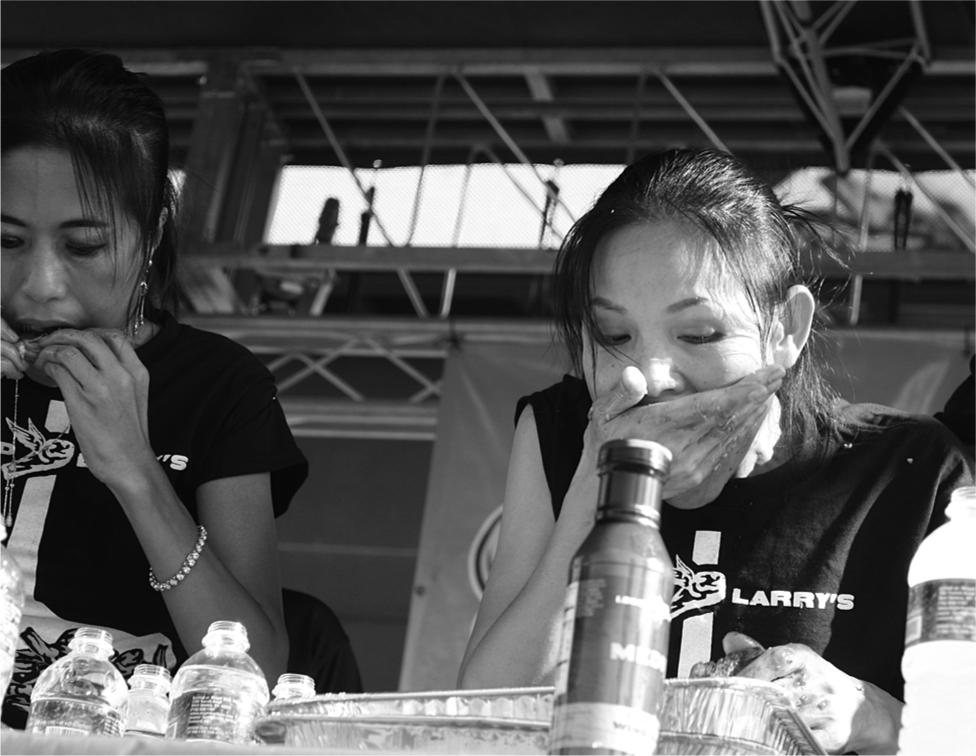
Sonya “The Black Widow” Thomas participates in a wing eating contest.
LegendLarrys
An active presence on the Internet and food circuits in Japan and abroad, Kobayashi holds several Guinness World Records (hot dogs, pasta, meatballs, Twinkies, hamburgers). Yet, because records outside the MLE do not count in the rankings of the IFOCE, he cannot compete for the Mustard Belt and has no world ranking. Guinness records are set by individuals who may compete in public, but they aim to better a record rather than compete directly against others. Guinness promotes the individual exploit, competitive eating an organized contest. Guinness hopes for a record holder; competitive eating contests want a winner.
The modern practice of competitive eating originated in Japan in the 1990s, along with the cooking show Iron Chef.
Accepting competitive eating as a sport is easier now that the competitions have acquired many of the features that Americans have come to expect of mega sports events. A look at the ESPN broadcast of the 2013 Nathan’s Hot Dog contest (readily available on YouTube) should convince the most skeptical that the sports model is the key to the enthusiasm generated by competitive eating in America today. A sportscaster follows every bite with commentary meant to keep the audience on the edge of their seats. The rewards are both symbolic and monetary. Nathan’s awards the Mustard Belt for the male champion of hot dog consumption, the Pink Belt for the female champion chomper, and a purse of $10,000 for each of the winners.
Every sport has its trainers, its promoters, and its fans. Cheerleaders cheer, media mavens interview the winners, and experts comment on the performance. The intermission at the 2013 Nathan’s contest featured a doctor who demonstrated just how, physically, mega-consumption is possible. Like races that come down to the wire, consumption victory can hinge on a fraction of a hot dog. The 2013 winner of the Pink Belt, Sonya Thomas, edged out her closest competitor by three-quarters of a hot dog.
Blurring Class Distinctions
One might see overeating, that is, the ingestion of food beyond need or even satiety, as a logical, and perfectly rational, reaction to pervasive food insecurity. Pie-eating contests have long been a perennial favorite at American county fairs, and sociologists may recall the photograph in Pierre Bourdieu’s Distinction that shows a hefty consumer, cheeks bulging, digging into an enormous plate of beans. For Bourdieu the “taste” for such excessive consumption signals lower class status, marked by the prominence given to the body.
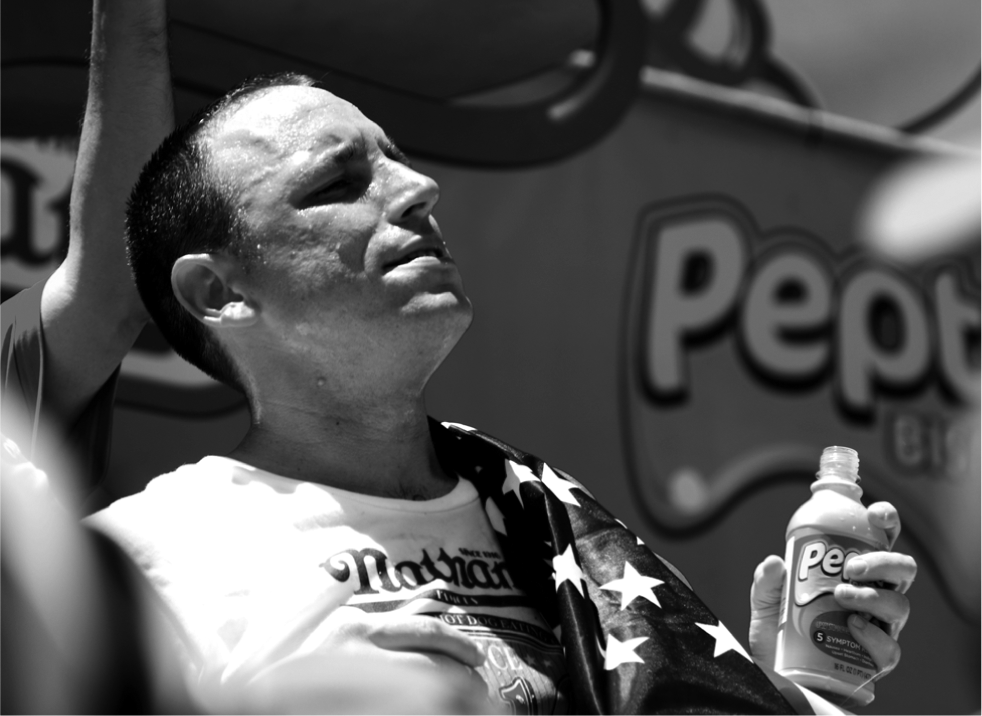
Joey Chestnut, the world’s top-ranked competitive eater, celebrating victories at a wing bowl (right) and Nathan’s hot dog challenge.
Michael | Hello Turkey Toes
LegendLarrys

Or one might imagine that competitive eating is akin to the conspicuous consumption that economist Thorstein Veblen, in The Theory of the Leisure Class, attributed to elites in America at the end of the nineteenth century.
But modern competitive eating muddles the social class distinctions marked by blatantly excessive eating. Today, and especially in America, widespread informalization of eating behavior blurs the class distinctions which Veblen’s elites used to set themselves apart. In contrast to the crinolines, bustles and walking sticks that Veblen fixes on to illustrate conspicuous consumption, competitive eating in twenty-first century America fits in a culinary landscape where informality mutes the class connotations of consumption behavior.
Modern competitive eating muddles the social class distinctions marked by blatantly excessive eating.
Today, dress codes are mostly a distant memory, and when eating pizza, sushi and burritos, or hamburgers and hotdogs, hands are the tool of choice, not cutlery. Informality is the default option. Bill DeBlasio, the newly elected mayor of New York City, was recently taken to task for using utensils to eat pizza instead of his hands. Pizza may be consumed with a knife and fork in Naples, but not, apparently, in New York City.
With the absence of these class distinctions, the body comes to the fore. The act of eating rivets attention on the mouth that chews, the teeth that crunch, the throat that swallows, the stomach that digests. Extreme eating makes the body prominent, intrusive, inescapable. Food is no longer displayed as a striking artifact on splendid tables, but is seen in various stages of decomposition. Nothing camouflages ingestion. No discourse, no image diverts attention from the primitive encounter of individual and food. Eating places the body front and center, showing humans driven by their appetites and their desires.
Land of Plenty—and Excess
It’s no surprise that competitive eating has taken hold in the United States. Chestnut and Thomas and their fellow competitors come from a culture of abundance. In the New World, food was everywhere, and it was prized—as it still is. Remember “the amber waves of grain above the fruited plain” in the song, “America the Beautiful,” that so many had to memorize in school. Consumption honors that abundance.
Excessive consumption raises the stakes still further. Consider the holiday of Thanksgiving. Even though Thanksgiving dinner is not an occasion for competitive eating, it certainly celebrates ritualistic overeating. What do you do when faced with your mother’s sweet potato casserole and your mother-in-law’s mashed potatoes? How do you choose between pumpkin pie and mince pie? You don’t choose—you take both. On such occasions, taste and judgment, which require choice, yield to indiscrimination. The second helpings invariably urged on diners further honor national abundance. The patriotism paraded in the hot dog eating contest on Coney Island on the Fourth of July is echoed at the holiday table.
American culture has long prized abundance, and Americans take the practice of that abundance seriously—and not only at Thanksgiving. Europeans never fail to note the size of servings in American restaurants. Think of the advertisements that entice customers with “All you can eat.” A roadside restaurant in upstate New York went so far as to identify its offer as a “Belly Buster.” Should we be surprised to learn that, as they tell us in the foreword, Julia Child and her co-authors of Mastering the Art of French Cooking had to double the quantities in their recipes over a standard French serving? To reach an American audience any translation of French cooking had to speak a language that Americans understood—the language of plenty.
Jason “Crazy Legs” Conti competes in a French fry eating contest in Austin, Texas in 2007.
Dustin Ground

Eating a lot is a way of being American. It was entirely appropriate that one of the competitors at the 2013 Nathan’s contest was granted leave from his unit in Afghanistan to compete. As it was for the original immigrant competitors in 1916, excessive consumption remains a patriotic duty.
Eating to Transgress
However patriotic it may seem at times, such extreme consumption is also fundamentally transgressive. And that transgressiveness has a good deal to do with its appeal to contestants and fans alike. Extreme eating flies in the face of virtually everything we’re taught about food and eating and our relationship to both. Competitors are rewarded for behavior that “civilized society” reproves, while spectators have all the pleasures of misbehavior without any of the consequences.
At its most elemental, competitive eating is a food fight. It is transgressive. As sociologist Norbert Elias taught us in The History of Manners, the civilizing process puts ever-greater distance between food and the consumer. Competitive eating destroys that distance so carefully built up over centuries by bringing the body front and center. Like belching, farting, tummy rumblings, drooling, hiccups and sundry manifestations of bodies at work, chomping, crunching, slurping, hands grabbing the food, food all over the person and the place, preclude euphemization or aestheticization. Extreme eating shows the body at work without restraint and without interference—no knives, no forks, no napkins, no plates, and no manners.
As Elias argued, the rise of elaborate cutlery signaled a new relationship between the individual to the food consumed, and to the other consumers at table. Knives, forks, spoons, glassware and the manners that told diners how to use them mediate the primal workings of the body. The formalization of consumption turned eating into dining.
Informalization takes us in the other direction, away from communal control. No control is needed because no one else needs be taken into account. Extreme eating is culinary individualism pushed to the extreme. There is no meal to socialize the individual’s encounter with food, no directives to order consumption. Spectators regress into a prelapsarian state of innocence, before eaters became diners.
Competitive eating certainly goes against so much of what we have been taught about how we should deal with what we eat. It is eating unrelated to appetite, food that takes no account of taste, consumption that disregards expense as well as health, a meal that flouts convention and community, excess for its own sake. The extreme sport of competitive eating speaks to the transgressor in each of us who, safely installed in front of the television set or the computer, transgresses by proxy.