




Abstract
Anthropologist John Hartigan considers the tricks and travails of writing about cities, via a review of Detroit: An American Autopsy and Unfathomable City: A New Orleans Atlas.
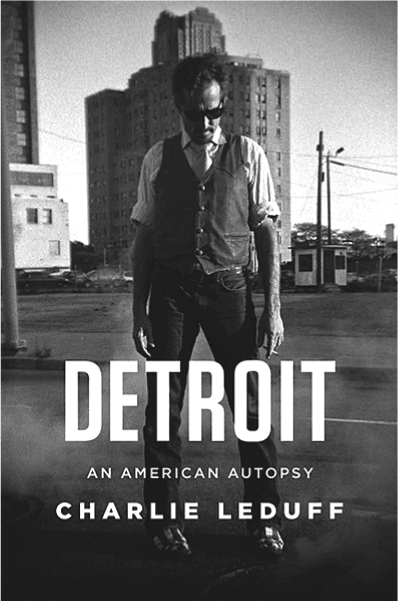
Detroit: An American Autopsy by Charlie LeDuff Penguin Press, 2013 304 pages
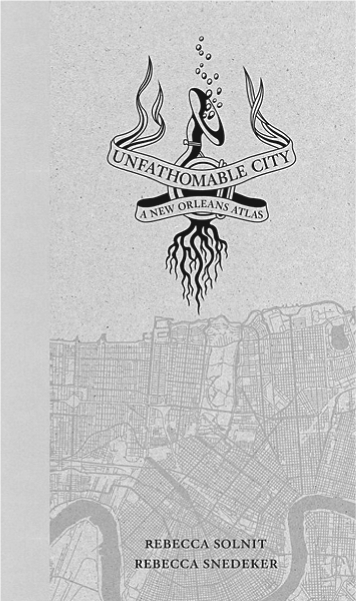
Unfathomable City: A New Orleans Atlas by Rebecca Solnit and Rebecca Snedeker University of California Press, 2013 176 pages
A quick quiz: what do Detroit and New Orleans have in common? Yes, they were both founded by the French—Detroit in 1701, New Orleans in 1718. But more significantly, these two “chocolate cities” were occupied by the U.S. Army in response to racial conflicts: Detroit —in 1863, 1943, and again in 1967— matched by New Orleans where, in 1866, a vicious race riot resulted in 11 years of occupation by federal forces.
But more importantly, both cities suffered from profound, man-made disasters in recent years. It was human design and engineering that placed millions of people squarely in the path of Hurricane Katrina, which devastated New Orleans in 2005. In Detroit, massive federal subsidies funneled whites from the central city out to the suburbs, generating devastation that resulted in miles of abandoned streets and lots. The subsequent bankruptcy of Detroit, a civic disaster of Katrina-like proportions, has received little of the assistance that poured into post-Katrina New Orleans.
How can we understand the commonalities and contrasts between these two cities, and what does this comparison tell us about our nation? Writing about cities is inherently challenging. As urbanists lean toward the generic, theorists search for the city that best models broader urban dynamics. (Witness the debates over the “L.A. School” versus the “Chicago School” in the United States and, internationally, over which metropolis should serve as emblematic of the global city.) Yet some of the most intriguing cities are atypical. Model cities may be interesting analytically, but places like New Orleans and Detroit are interesting because of their singularity—their uniqueness.
These and other issues are raised by Detroit: An American Autopsy, by Charlie LeDuff, and Unfathomable City: A New Orleans Atlas, by Rebecca Solnit and Rebecca Snedeker, books that reflect distinctly different genres in urban writing—LeDuff’s journalistic style, in contrast to Solnit and Snedeker’s essayistic, scholarly approach—and differing understandings of how particular cities relate to the nation as a whole.
Riding a wave of voyeuristic interest in the physical deterioration of Detroit (locals call it “ruin porn”), LeDuff warns us that this is our national future. First, the car-based consumer culture that arose in Detroit is our common condition. “America’s way of life was built here,” LeDuff writes, and (acknowledging the transformative power of unionization) “the American middle class was born here.” Second, what went wrong in Detroit, from the evaporation of high-wage jobs to the material and economic failure of basic urban infrastructure, is coming soon to a neighborhood near you. LeDuff explains, “what happened here is happening out there. Neighborhoods from Phoenix to Los Angeles to Miami are blighted with empty houses and people with idle hands.” To the voyeurs, he snorts, “Go ahead and laugh at Detroit. Because you are laughing at yourself.”
In contrast, Solnit and Snedeker assert, “New Orleans is an anomaly”; further, “it is an anti-America in which America invents itself, a place whose eccentric and libertine behavior and innovation have been deplored but also desired and often emulated.” In their rendering, New Orleans is an utterly unique locale, distinguished by its heady mixture of people and creatures drawn there from so many distant places. This is where America comes for sex and seafood, debauching, and then disavowing a self it prefers to express and identify via the relatively more restrained indulgences of proper consumerism. But they also make a broader claim about cities: “Every place is unfathomable, infinite, impossible to describe, because it exists in innumerable versions, because no two people live in the same city but live side by side in parallel universes that may or may not intersect.”
What went wrong in Detroit—the evaporation of high-wage jobs and the failure of basic infrastructure—is coming soon to a neighborhood near you.
LeDuff, in contrast, gives us a biography of Detroit as a singular persona, now spread out on a slab and ready for postmortem: “how did Detroit—the most iconic of American cities—become a cadaver?” Solnit and Snedeker suggest that this is absolutely the wrong approach: every city has multiple dimensions, and any one representation of it risks obscuring antithetical aspects of a metropolis. “Much of what you can say about this place you can also contradict. New Orleans is a city of firm racial divides and enthusiastic racial mixing, a city that contains both a poverty that can be measured by statistics and an extraordinary wealth of festivity and memory that cannot be quantified.” The list goes on, but the point is simple: cities are complex subjects, and overly broad renderings fail to do them justice.
Against their assertion of the impossibility of representing cities faithfully, Solnit and Snedeker settle on a brilliant approach. They assemble a collection of sharp-eyed authors, “a mix of natives, newcomers, and people who live outside the city,” who are willing to serve as deeply informed and impassioned tour guides. This is a cartographic project: the authors map the appearance and disappearance of musical forms, the expansion and contraction of extractive economies, and the movements of bodies, alive or dead, across an urban landscape. Each chapter combines an essay and map, with topics ranging from “Of Levees and Prisons” or “Sugar Heaven and Sugar Hell,” to “Oil and Water,” and “Lead and Lies.” These feature “sites of contemplation and delight” along with reflections on the “pleasures and brutalities of a commodity,” tracing carnival parade routes and the disappearance of one quantity that is in short supply in New Orleans: solid land. The essays eschew the dilettantish prancing so typical of tour books and instead train readers to see the landscape deeply and critically. This is superbly achieved in Shirley Thompson’s chapter on sugar and by Lydia Pelot-Hobbs, who reveals similar “logics of confinement and containment” in the Mississippi’s levees and Louisiana’s prisons, which repurposed the former slave plantation of Angola to warehouse the city’s black men.
Yet for all this attention to the particulars of New Orleans, Unfathomable City acknowledges that “even what is local came from afar.” Perched on the southern tip of a vast river system draining much of the North American interior, the city takes in nitrate runoff from farms and toxins from the industrial Midwest and the South, and is, as the authors suggest, “the northern most city of the Caribbean.” People and money flock there, as do migratory birds, such as egrets, gulls, and terns, who fleetingly perch amidst resident species such as possums, armadillos, and snakes galore, along with oysters, crawfish, crabs, and shrimp. This confluence of different natural and social influences makes the city possible, and raises the question of where it begins and ends. In grappling with this complexity, Solnit and Snedeker give urbanists more than a detailed rendering of one city; they demonstrate how we might depict multiple versions of a city, especially by attending to the diversity of nonhumans that permeate urban spaces. Their account is also a thoughtful reminder that, amidst keen attention to how transnational flows impact cities, their distinctiveness lies embedded in their often precarious connection to a particular geographic location.
Academics too often render race and class as abstractions; for LeDuff, they are vivid and inexorable forces, taking a legible toll on everyone.
In contrast, LeDuff’s Detroit showcases the strengths and weaknesses of the journalistic approach to cities, the longest running genre of urban writing. Here LeDuff does double duty, reporting on the sensational and corrupt but also giving us glimpses of the life and labor of a big-city reporter. Detroit is “a Candy Land from a reporter’s perspective,” he tells us. “Decay. Mile after mile of rotten buildings, murder, leftover people. One fucking depressing, dysfunctional big glowing ball of color. One unbelievable story after another.”
LeDuff is often the crusading journalist, inviting us along on adrenaline-fueled rides to scenes of violence or macabre encounters with death and despair. I was glad to go along with him and happy that he cares enough to pursue these kinds of stories. But his stories of lives and crimes fall too easily into one cynical narrative arc about the city’s condition. There is nothing here about music or food or style, or of any of the vital changes slowly emanating out from the city’s downtown; we are left only with a cadaver. It is a mistake to think that this is all there is to Detroit.
Strikingly, though, what makes LeDuff’s book more than just another morbid, sensationalistic romp through the ruins is the deeply personal form of his narrative. This is not just reporting; the author traces his intriguing family history. A grandmother who died at age 36 alone in an apartment “after an evening of spirited partying”; a grandfather who “was born black and died a white man.” These are stories that stun LeDuff as he learns of them in newly revealed family lore, and by digging through municipal archives. His brothers, we learn, toil in low-wage jobs, and a sister and a niece died young. Along with LeDuff’s own struggles with alcohol and grief, this account breaches journalistic detachment and yet manages to paint a keen portrait of the lives and losses of Detroiters. It is a virtuoso rendition of a city at once personal and lively, but also dead and dissected, a personal tangle of family and self faced with the hard economic determinism of a one-industry town.
LeDuff offers us an intimate understanding of the two principal forces shaping Detroit, and all of urban America: race and class. Academics too often render these forces as abstractions; here they are vivid and inexorable, taking a legible toll on everyone. Class is there in the precarious straights of people contending with the “end of work.” With race, it is there as a weird mixture of the trivial and the volatile. “In Detroit, we all talked the race game,” LeDuff explains. “It is a way of life.” This is a manner, cavalier and often cynical, of referring to the politics of whiteness and blackness. Where class circumstances are too often obscured by Americans’ powerful investment in individualism, race is where collective conditions matter. Confusions over race and class set up a contradictory terrain where personal trajectories complicate the collective view, by which LeDuff describes himself as “the palest black man in Michigan,” while also cringing as interview subjects persist in calling him “Mister Charlie.”
This book will remind urbanists of one of the most important rules for writing about cities: make it vivid. LeDuff’s account of Detroit is not just poignant and indignant: it is visceral. He captures the smells of race and class: in the odor of a workplace locker room “like a rope of frozen urine stabbing you up your nostrils,” of “puke and cigarettes” lingering around his own mouth, of “oils and fluids in the shot-and-beer joints that lined the industrial boulevards” in a house that reeks of “the choking, musty smell of fear so common in Detroit,” and in the aroma of gin and olives on the breath of a shell-shocked GM executive.
Many of the stories told in these books are so bizarre that they could only happen in places like Detroit or New Orleans. But rather than compilations of peculiarities, these accounts convey that cities—for all their seemingly uniform infrastructures and economics—remain full of surprises. They tell us that in order to understand how a city is lived, one must know the particulars. This is something any urbanist would do well to keep in mind.