




Abstract
Urban sociologist, Virág Molnár, reviews the books No Billionaire Left Behind and Thank You, Anarchy. The books examine satirical activism and Occupy Wall Street’s mix of direct democracy and anarchism as examples of unconventional political protest in the contemporary United States.
Keywords
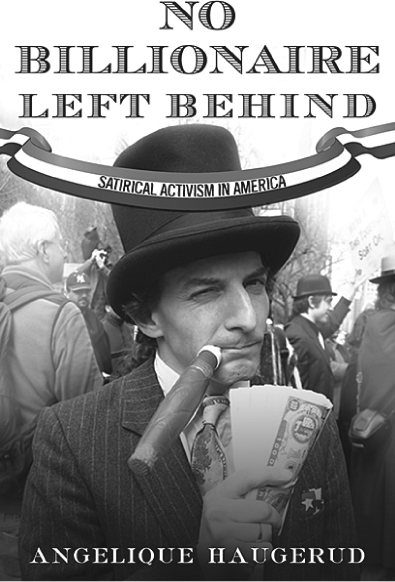
No Billionaire Left Behind: Satirical Activism in America by Angelique Haugerud Stanford University Press, 2013 288 pages
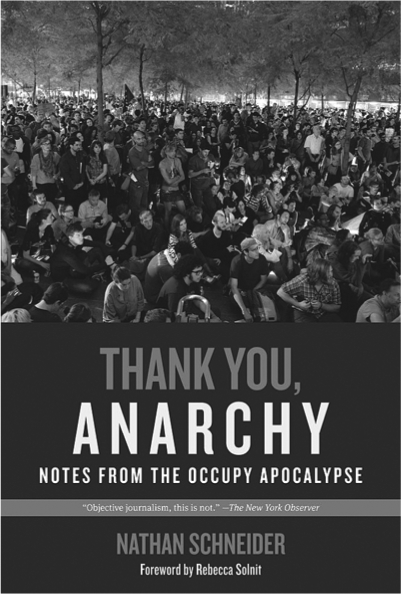
Thank You, Anarchy: Notes From the Occupy Apocalypse by Nathan Schneider University of California Press, 2013 216 pages
One fine Sunday in August 2004, Angelique Haugerud, an anthropology professor at Rutgers University, encountered an odd scene on Central Park’s Great Lawn in New York City. Costumed activists, dressed up as Gilded Age billionaires, paraded in tuxedos and top hats, elegant gowns, tiaras, and satin gloves, or Great Gatsbyian lawn-tennis whites. If their looks were not bewildering enough, the signs they carried certainly raised eyebrows, as they sported slogans like “Privatize the Park: Keep Off the Grass,” “Widen the Income Gap,” or “Taxes Are Not For Everyone.” Members of the entourage also went by strangely familiar names such as Phil T. Rich, Meg A. Bucks, and Tex Shelter.
The faux Billionaires satirical activism helped bring the fragility of American democracy into focus.
Haugerud had stumbled upon “The Billionaires,” a network of satirical activists staging theatrical protests on the eve of the Republican National Convention. Intrigued, she embarked on an in-depth study of the group whose history can be traced back to the early 2000s, although it is also firmly anchored in a longer history of satirical activism both in the United States and beyond. Her resulting book is based on several years of participant observation, oral history interviews, and archival research.
The faux Billionaires take on two extremely contentious issues in contemporary American political culture: the ever widening wealth gap and the role of big money in electoral politics. But rather than waging a traditional campaign for explicit political goals, the Billionaires engage in practices of “culture jamming” by subverting mainstream media messages or disrupting political events. In Haugerud’s words, they deploy ironic humor and street theater “to nudge questions about wealth and democracy into public view.” Their carefully planned interventions display the spirit of popular TV programs like Jon Stewart’s The Daily Show, The Colbert Report, and publications like The Onion. However, in the hands of Billionaires, satire combined with a sophisticated knowledge of economic and public affairs moves beyond light-hearted entertainment to become a resource for political action.
Haugerud wants to shed light on the boundaries of public discourse in times that are characterized by tremendous ambivalence toward politics itself. She explores how the Billionaires help bring into focus the fragility of American democracy, assessing popular activism that relies on informal networks, performance parody, decentralized consensus-based decision-making rather than hierarchy, formal institutions, and old-fashioned community organizing. In addition to reviewing theories of humor as a political weapon and surveying recent innovations in protest as spectacle (such as The Yes Men, Reverend Billy, and Reclaim the Streets), Haugerud offers close-ups of how people on the street perceive the Billionaires. The book concludes by comparing the Billionaires with Occupy Wall Street (OWS), suggesting that, in a myriad of small ways, the former were instrumental in setting the stage for the more serious and extended protests that ensued.
Those more sustained protests are the subject of Nathan Schneider’s Thank You Anarchy. Schneider is a writer and editor of several blogs, including Waging Nonviolence and Killing the Buddha. I suppose a few years ago he might have simply been described as a journalist, but the fact that he seems to eschew this label is indicative of the profound impact that digital media has had upon journalism. Schneider had been reporting about resistance and social justice struggles around the world, when he happened to witness the birth of the Occupy movement. His book provides the most comprehensive and fine-grained chronicle of Occupy Wall Street to date, from the earliest planning meetings preceding the call by Kalle Lasn (founder of the anti-consumerist Adbusters magazine) to occupy Wall Street on September 17, 2011, to the aftermath following the eviction from Zuccotti Park, all the way up to the one-year anniversary of the movement.
To readers who may wonder about the dramatic subtitle of the book (Notes from the Occupy Apocalypse), Schneider explains that he uses the original Greek meaning of the term, as referring to the lifting of a veil, a revelation, after which one cannot go back unchanged. To many participants, Schneider claims, OWS came to exemplify exactly such a watershed experience.
Schneider tells the story of the movement in chronological order using the changing seasons to provide structure to the events and signal the different phases of OWS. His account is most powerful in providing vivid and detailed portrayals of the everyday life of OWS in Zuccotti Park and beyond. He manages to make palpable Occupy’s “particular mix of overeducated, underemployed, postindustrial technoprimitivism.” He captures the spirit that catalyzed the participants by painstakingly cataloguing the competing voices, diverse beliefs, animated discussions, colorful characters, and their wide-ranging cultural experiences that made up the often somewhat elusive movement. He also remarks that “with artists mainly in charge, Occupy Wall Street was art before it was anything properly organized, before it was even politics.” And indeed, besides stirring up American politics and reframing political discourse, OWS also produced some great art. The Museum of Modern Art in New York has recently acquired the Occuprint portfolio, a collection of 31 Occupy posters curated by the Brooklyn Artists Alliance, underscoring the long-term cultural significance of the movement.
Schneider also gives a fascinating inside view of the emerging organizational infrastructure of OWS from the working of the General Assembly, the use of the people’s mic, the mushrooming of countless internal working and thematic groups, to the handling of donations and communication with mainstream media. OWS inspired copycat occupations that rapidly spread across the United States and the globe, but Schneider is also quick to point out that Occupy itself was strongly influenced by other global social justice movements, especially the Spanish Indignados protests, which began on May 15, 2011. Contrary to the many critics who faulted OWS for not having a well-defined political agenda or clear leadership, Schneider argues that the true strength of OWS lay precisely in its radical anarchistic qualities. The emphasis on horizontal power structures and decision making, bottom-up direct democracy, and a committed effort to get the process right and keep the tactics loose, allowed occupiers to adapt to new and unexpected situations during the long encampment, which lasted from September 17, 2011 to November 15, 2011. In Schneider’s view, these strengths helped to prolong OWS’ impact.
Competing voices, diverse beliefs, animated discussions, colorful characters, and wide-ranging cultural experiences made up the Occupy movement.
Some of the most interesting parts of Thank You, Anarchy deal with the aftermath of the physical occupation. Schneider follows the traces of various activist groups that try to keep the movement alive by seeking to occupy other spaces, experimenting with untried tactics and plotting new interventions, countering the widely held view that OWS no longer existed after the media’s gaze turned away from it. Although Schneider’s voice wavers throughout the book—at one moment, engaged participant, in the next moment, detached observer—he does strive to craft a balanced account of the ups and downs of the movement, including the doubts, frustrations, and increasing internal divisions over “diversity of tactics” (namely, the possible use of violence) in the face of mounting challenges.
He also implies that OWS lost momentum in large part because it was worn down by constant police vexation, unwarranted arrests, and repeated incidents of police brutality—most notoriously, the pepper-spraying of peaceful women participants—culminating in the forceful eviction of the protesters from Zuccotti Park. In fact, the role of the police in the events is a bitter reminder that the American state continues to be strong and ruthless when it comes to deploying physically coercive force against citizens who voice deep dissent, even as it remains weak and callous when it comes to ensuring the welfare and wellbeing of its more vulnerable citizens.
Together, Haugerud’s ethnographic portrait of the Billionaires and Nathan Schneider’s insider report on Occupy Wall Street offer engaging, enlightening and at times, surprising accounts of unconventional forms of political activism in the contemporary United States. They highlight the decisive role of creativity in expanding the political imagination and the repertoire of political protest, while also showing the limits of such unorthodox strategies in affecting lasting social change. The two books invite comparisons along important dimensions, including the articulation and dissemination of political objectives, operational tactics, attitudes about electoral politics, modes of organizing, the place of social inequality in the political agenda, and even the perspective of the reporter who chronicles their story.
The Billionaires do not renounce formal political processes and institutions, but they display a healthy dose of skepticism in the country’s economic elite that, compared to many other liberal democracies, is surprisingly muted in the United States. Their strategies of culture jamming and ironic humor are likely to endure as important staples of broader political protest movements. Wall Street Occupiers, in contrast, categorically distanced themselves from electoral politics. Calling for direct action as well as a direct participatory democracy, they wanted to devise everyday practices that embodied new political forms and social solidarity in spaces beyond state control, hoping that these would eventually undermine prevailing power structures.
OWS’s revamped anarchism may not have translated into the large-scale political change, but the protests certainly struck a chord at an important historical moment. Its definition of “we” as the 99 percent was also much more inclusive than the rallying cry of almost any other social movement that had gone before. In this way, the Occupy movement has opened up new political possibilities and shifted the focus of political rhetoric, thrusting the issue of social inequality into the very center. The impact of the new vocabulary was already evident in the 2012 election campaign, and most recently, in the landslide victory of Bill de Blasio, the new mayor of New York City, who campaigned extensively on a platform that promised to combat growing inequalities in the city. However, it remains to be seen whether mainstream politicians are simply adopting the language of Occupy as a form of cheap populism or whether we are witnessing a more profound shift in political priorities. Whatever the answer, both the Billionaires and Occupy Wall Street demonstrate that in an age of deeply flawed party politics and weakened social movements, political discontent and new ideas often emerge from the margins rather than from the political center.