




Abstract
Scholar Micere Keels explores the rise of college-educated women of color having children outside of marriage.
In 2010, approximately 4 million babies were born in the United States, 41 percent of them to single mothers. Among first-time mothers, about 47 percent were unmarried. Sixty-eight percent of first births to high school-educated women were nonmarital, compared to only 13 percent among college-educated women. This leads to the conclusion that highly educated single women avoid bearing children. But when it comes to college-educated black women—and to some extent college-educated Latinas, that’s not necessarily the case: they’re increasingly having their first child outside of marriage.
Recent decades have brought a remarkable growth in nonmarital fertility among college-educated women.
In 2010, 41 percent of all first births to college-educated black women were nonmarital; among college-educated Latinas it was 22 percent. In comparison, among college-educated white women, only 9 percent of first births occurred outside of marriage.
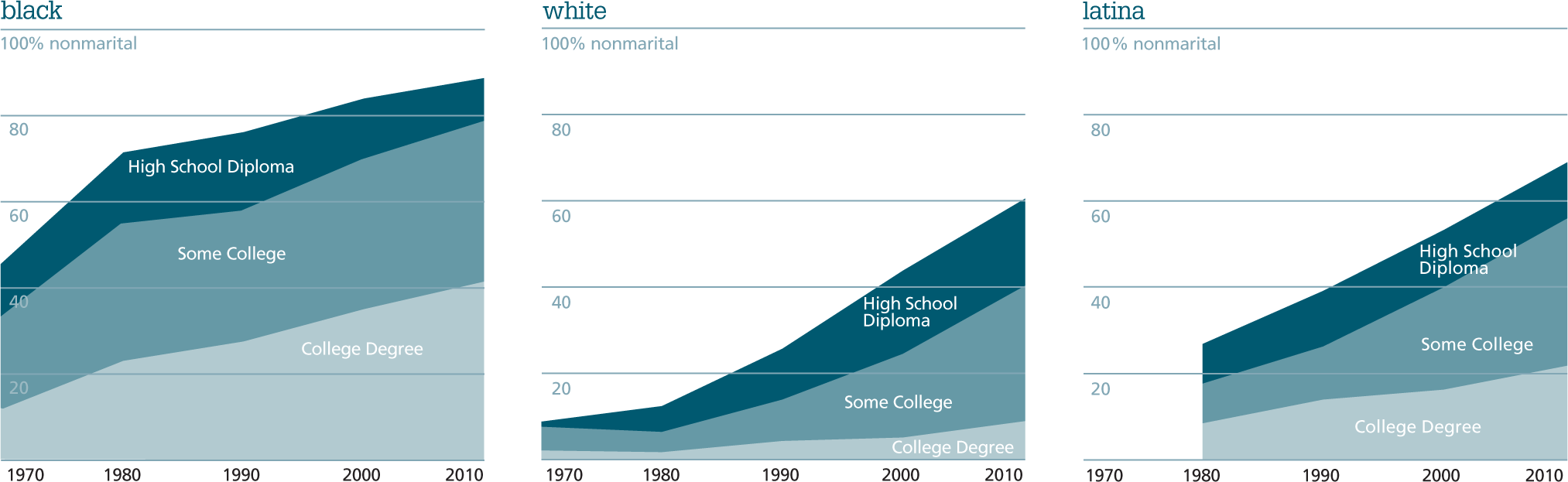
Recent decades have brought a remarkable growth in nonmarital fertility among college-educated women (see chart below). Between 1970 and 2010, the fraction of nonmarital births to college-educated black women increased by 350 percent, while nonmarital births to similarly educated white women increased by 430 percent. Among Latinas, since the 1980s, there has been a more than 250 percent increase in college-educated nonmarital births.
According to sociologist Harriet Presser, well-educated unmarried mothers are irrational economic actors, for taking on the burden of motherhood in the absence of a husband. But did women really ever make a “rational” decision to not have children before marrying? Is it simply that the overwhelming majority married early in life, and did not have to choose between nonmarital fertility and childlessness?
By continuing to think of nonmarital fertility as an irrational choice, we fail to see it for what it is: a rational adaptation to an age of diminished marital possibilities.
According to the 2010 American Community Survey, 32 percent of college-educated black women aged 35 to 42, at the waning end of fertility, had never married, compared to 16 percent and 14 percent of similar Latina and white women. Furthermore, slightly less than a half of those college-educated black women were currently married, compared to 69 percent and 75 percent of similarly educated Latina and white women. Perhaps the rational decision for many college-educated black women is not to wait for marriage; there is a high likelihood that that day will never come, or that it will come too late, or end in divorce too soon, for them to bear children. The biological clock forces them to make choices.
Trajectory of College-Educated Nonmarital Fertility, by Maternal Education, Race and Ethnicity, 1970-2010
Source: National Vital Statistics

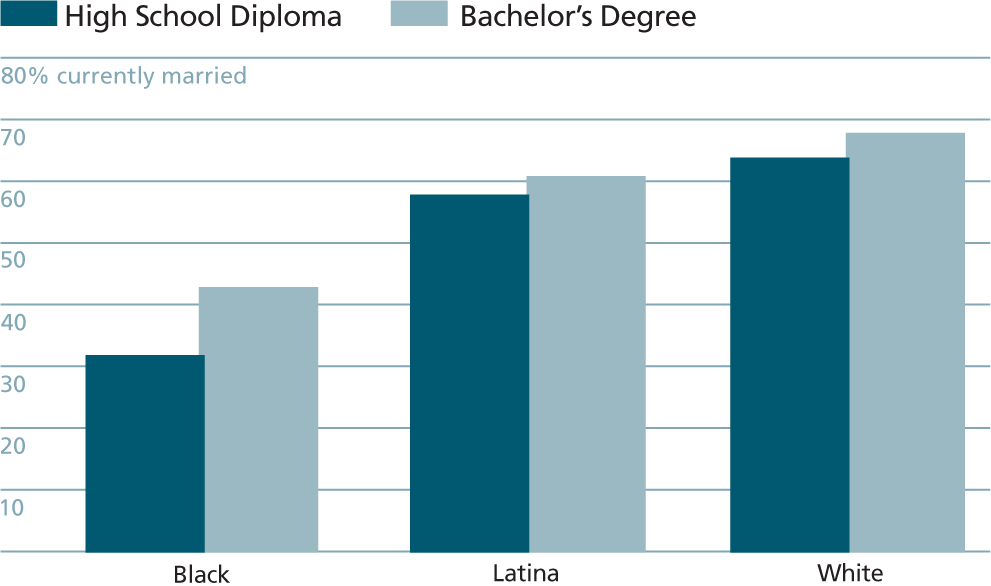
Black women are out-educating black men; they have been doing so for several decades. Among black Americans, women now earn 66 percent of all college degrees. However, this doesn’t mean that college-educated black women are educating themselves out of marriage. In these economic times, when a dual household income is a middle-class requirement, getting a bachelor’s degree is more and more necessary. In fact, education is more strongly related to black women’s chances of marriage than it is among Latinas or white women. Only 32 percent of black women with a high school diploma are married, versus 43 percent of black women with a college degree (see chart below, left).
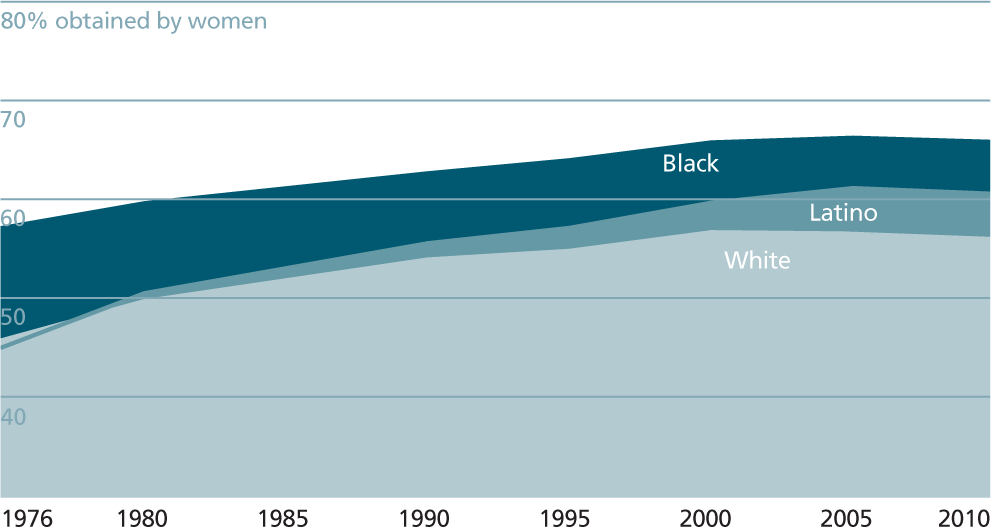
Contrary to recent arguments, the solution to college-educated black women’s marriage woes is not as simple as encouraging them to marry across racial lines. Women are now out-educating men in general (see chart below, right). Among whites, women now earn 56 percent of all college degrees.
Nor is the solution to college-educated black women’s marital woes to encourage them to marry less educated men. Research shows that marriages in which the wife is the higher earner have an increased risk for dissolution. Besides, they are already “marrying down.” Fifty-two percent of married, college-educated, black women are married to non-college-educated men. Instead, we should ensure that increasing numbers of black and brown men become marriageable, that is, make it through the educational pipeline to access the occupational opportunities that allow them to contribute adequately to a family’s income.
The decline in marriage among college-educated black Americans has serious ramifications for the potential downward mobility of the next generation. Balanced numbers of college-educated men and women allow those who are better educated to marry each other, consolidate their gains, and then pass them on to their children. A 2004 examination of the black middle class by sociologist Paul Attewell and colleagues highlights the importance of household income over individual income. Household income is what matters for the resource inequality between black and white children born to college-educated mothers.
The lack of a resident partner, either married or cohabiting, negatively affects the household incomes of black children relative to their white counterparts. For example, in 2010 the average earnings of college-educated black women was marginally higher than that of similar white women ($42,023 versus $40,118). However, because college-educated black women are much more likely to be living alone, their average household income was significantly less than similarly educated white women ($92,249 versus $130,773), which has negative implications for their ability to pass their educational advantages on to their children.
Marriage Rates of High School and College Educated Women
Source: 2010 American Community Survey, five-year estimate
Percentage of Bachelor’s Degrees Obtained by Women
Source: Digest of Education Statistics, Table 328
Currently, we can only speculate about the generational effects of college-educated nonmarital fertility. What we know comes from researching the children of less educated mothers. We do know that in comparison to less educated unmarried mothers, college-educated unmarried mothers are significantly older, and have significantly higher earnings. Furthermore, as scholar Linda Nielsen’s recent review of the literature shows, shared parenting is becoming culturally and legally normative in the United States. If she bears a child out of wedlock later in life, if she is able to keep her household out of poverty, and if nonmarital fertility does not equate to father absence, little of what we know about nonmarital fertility’s effects may apply to the children of college-educated unmarried mothers.
Even if they never marry, most women want children. Increases in college-educated nonmarital childbearing may lead nonmarital childbearing to become normalized. College-educated black women and Latinas are on the vanguard of these changes. Forty years ago nonmarital fertility was rare among college-educated women. Given the current pace of change, it is likely that 40 years from now, both marital and nonmarital childbearing will be normative pathways for college-educated women’s routes to motherhood.