




Abstract
Sociologist Paul Draus and Economist Juliette Roddy discuss tensions in Detroit as the nation’s largest municipal bankruptcy unfolds. The competing interests of art and pensions and the stamina of social contracts in times of financial insecurity are examined.
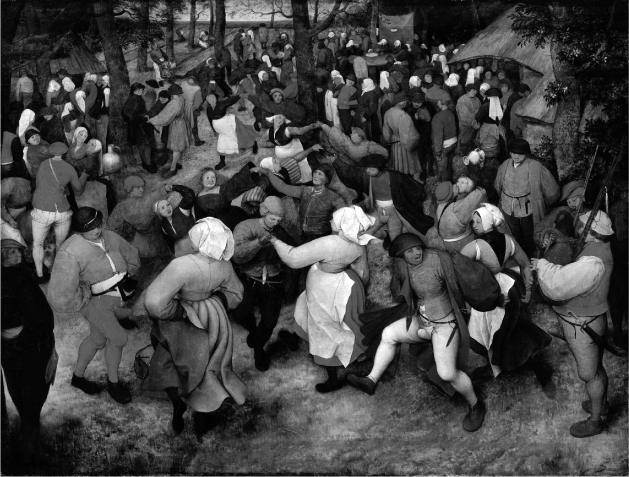
The Wedding Dance, a painting by Pieter Breugel the Elder, is not only a great work of art, but also a brilliant bit of sociology. Standing before this image, which has been preserved on a piece of oak since 1566, is like looking through a window to way of life long since past but still recognizably and universally human. The whirling dancers, the flowing spirits, the lovers stealing away under the trees—one almost wants to jump in and join them. What price can be put on this experience?
So which do you sell in a crisis: paintings or pensions? Which sacred promise does the city honor and which does it break?
The city of Detroit, currently undergoing the largest municipal bankruptcy in U.S. history, may soon find out. Kevyn Orr, Detroit’s Emergency Financial Manager (EFM), has said that, to satisfy the city’s creditors, he may need to put the treasured collection at the Detroit Institute of Arts (DIA) up for auction. The possible selling of the city’s art and the potential slashing of public workers’ pensions have generated major media attention. The stories are intertwined, and not only because both pensions and the DIA’s art are on the proverbial table in the bankruptcy proceedings. According to Huel Perkins of Fox 2 News in Detroit, “The pensions, the treasures of the DIA, nothing is sacred now that Detroit is bankrupt.” Both publically owned art and public sector pensions are considered sacrosanct. So which do you sell in a crisis: paintings or pensions? Which sacred promise does the city honor and which does it break?
Pieter Breugel the Elder’s “The Wedding Dance” is one of the artworks that Detroit may soon sell in order to raise cash.
Artist: Pieter Bruegel the Elder
Zero Sum Games and Tricky Trade-Offs
Affluent classes tend to care a lot about great art, at the very least as a form of durable investment. In fact, this is where most museums get their art collections in the first place. One of the arguments made for why the DIA’s art should never be sold is that donors were promised this would never happen; their donations are predicated on the belief that the art will be held in public trust. The current debate over the selling of art is a direct result of the DIA’S anomalous status as a city-owned museum. Significant portions of its collection are not the gifts of wealthy donors, but were purchased with taxpayer dollars in the mid-twentieth century—including not only The Wedding Dance, but a Van Gogh self portrait, a Rembrandt and a Matisse.
Voters in three counties supported a 2012 referendum for additional property tax (approximately $20 annually for an owner of a $200,000 home) to support the DIA so it could remain open and stable in spite of Detroit’s failing finances. The referendum also guaranteed free access to the museum for residents of all three surrounding counties, cementing its identity as a public-oriented institution. This broad support is the basis of an unusual bargaining maneuver that may not only ensure that the art is saved from auction, but also shield pensions. A group of philanthropic foundations, including Ford and Kresge, are negotiating with Orr and U.S. bankruptcy judge Steven Rhodes. They have pledged more than $300 million in funds that could be used to fill the shortage in pensions, in exchange for taking the art off the table.
In the current state of negotiation Rhodes has stated that the DIA will need to come up with an additional $100 million over 20 years for such a deal to work. Coincidently, this is also the estimated dollar value of The Wedding Dance, according to The New York Times. This offering of cash may protect the DIA and reduce the cuts to current pensioners, but it still doesn’t address the fundamental problem going forward. As economist Robert J. Samuelson wrote in the Washington Post, “The math is unforgiving. Detroit now has two retirees for every active worker.” The city cannot currently provide many of the services that define a government’s core functions, much less invest for the future.
Though not as sexy a topic as the ransom of Rembrandts, Detroit’s public worker pensions are also being watched closely. While some have framed the issue as “paintings versus pensions,” polls taken in December showed that two-thirds of Detroiters opposed both selling art and cutting pensions. Like donations of art, pensions were negotiated in good faith and people rely on them to make ends meet. However, pensions benefit older, retired individuals. Art museums benefit more educated and economically advantaged groups. If the bankruptcy is seen as a zero sum game, then pensions are pitted against art and creditors are pitted against taxpayers who need and expect essential services such as public safety. The spillover costs of either decision affect multiple parties over multiple time periods. Some are going to be hurt. How does the city allocate harm equitably? This is the very decision that the bankruptcy judge is charged with making.
What happens in Detroit is important, and social scientists have much to learn from it.
Is Dilution a solution?
As Detroit moved toward declaring bankruptcy, a variety of proposals focused on the future of Belle Isle, a 982-acre park located in middle of the Detroit River, halfway between the United States and Canada, with landscaping by Frederick Law Olmstead. Should there be an admission charge, should the park be opened up for private development, or could it simply be sold outright and converted into an independent, tax-free island nation, similar to, say, Singapore? Eventually, the Detroit City Council voted to lease Belle Isle to the Michigan Department of Recreation, which will run it as a state park, assume the costs of its maintenance, and charge admission to entering vehicles. A yearly pass for Michigan state parks costs $11; but those who walk or bike onto the island will be continue to be admitted free.
While some in Detroit saw this deal as a form of land grab, another selling-off of the city’s crown jewels, the promise of improved facilities, continued public access, and the shifting of costs to the state made it an easier deal for many to accept. Compared to the zero-sum squaring off of pensions versus art versus services, the Belle Isle deal seemed like a relative win-win. Environmental economists are fond of saying that “dilution is the solution to pollution.” In this case, the burden is spread across a bigger pool, making it seem less onerous to all.
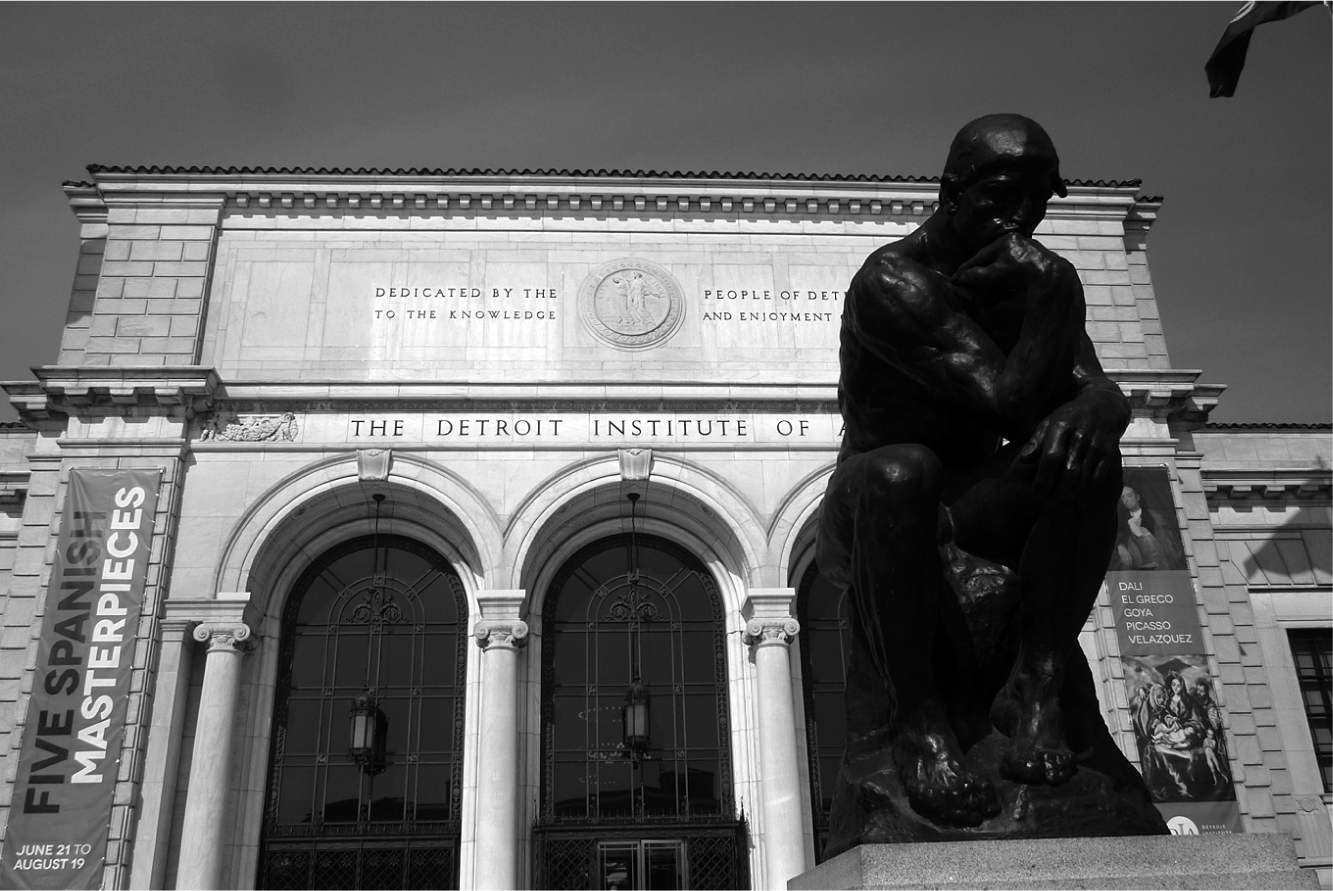
Can the Detroit Institute of Art hold onto its priceless works of art in the face of mounting pressures?
Quick Fix
Likewise, Governor Rick Snyder, who appointed Orr to the position of EFM in 2013, has said that the state may step in to help protect the DIA. Why couldn’t the state, which is now projecting a budget surplus, also absorb some of the costs of pensions, which were pledged to public employees and constitutionally protected? So far the governor has dodged this question. Judge Rhodes, on the other hand, recently dealt a blow to some of the city’s biggest creditors. The $230 million that Orr had negotiated as a payoff to Bank of America and UBS, he said, was “higher than the highest reasonable number. It’s just too much money.” Union leaders and representatives of retirees claimed victory, insisting that predatory banks, not retired workers, should pay the price for the city’s bad debts.
If the bankruptcy is seen as a zero sum game, then pensions are pitted against art and creditors are pitted against taxpayers who need and expect essential services such as public safety.
Thinking Big and Bearing the Brunt
Outside the purview of the courts, there is no shortage of big ideas for saving Detroit. The Detroit Future City Strategic Framework, released in 2013, contains concepts for repurposing the city’s land and infrastructure and revitalizing neighborhoods, including the expansion of urban agriculture. An accomplished metal craftsman on the East Side shares his own vision with us: “How to solve the financial debacle of Detroit? Not by taking the heart or the gut out of the city but by reducing the footprint from 8 Mile to 6 Mile all the way around, take our people and bring them back inside, then sell the rest to Grosse Pointe, Dearborn, let them build mansions there.” An MIT-trained engineer, who now trains young people on how to fabricate their own products, furniture, and houses, emphasizes the importance of systems thinking in a place like Detroit, stating “It’s hard to understand systems in general if you don’t have a functioning system to abstract from.” He plans the development of an urban eco-village that will manifest principles of permaculture at a scale that is practicable across the city. His goal is to teach young people to “be functional within a system that’s crumbling around us.”
This brings us back to pensions, and the fundamental unsustainability of the current arrangement. The city can’t support its pension obligations for a variety of reasons—deindustrialization and capital flight, a history of corrupt or inept leadership, short-sighted and ill-advised financial decisions, cuts to federal and state tax outlays to cities, divisive racial and regional politics—but fundamentally the problem is that the population and tax base is steadily shrinking. Whether this can be solved by bankruptcy, or if more radical strategies are required, a couple things are certain: what happens in Detroit is important, and social scientists have much to learn from it. In the meantime, Motown may need to specialize in the artful allocation of pain.