



Abstract

Little Free Libraries
“Little free libraries” are popping up in front of houses, apartments, parks and other public spaces across the country. Since 2009, these handcrafted book boxes, which hold between 20 and 100 books, have multiplied, amounting to as many as 4,000 libraries across the world. And they’re helping neighborhoods bolster community spirit and cohesion.
In his 2013 book, Small-Town America: Finding Community, Shaping the Future, sociologist Robert Wuthnow finds that social spaces such as football games, festivals, and public events cultivate “community spirit” and help bring small-town residents together. Exchanging and discussing literature can be a particularly helpful element of building community identity, according to Wendy Griswold and Nathan Wright in a 2004 American Journal of Sociology article, “Cowbirds, Locals, and Dynamic Endurance of Regionalism.”
Little free libraries also offer an interesting snapshot of local interests, permitting visitors a glimpse into their neighbors’ worlds. This is because the meanings of cultural artifacts, such as books, are influenced by the social spaces where they reside, according to sociologists Clayton Childress and Noah Friedkin, writing in 2012 in the American Sociological Review.
So, before you get rid of your unused books, think about donating them to the little free library near you. You may receive new treasures—and new friends—in return.
RJL20

Mouse Click Plagiarism
Imitation may be the sincerest form of flattery—unless you’re a college student writing a course paper. Many colleges are trying to crack down on plagiarism through honor codes and new technologies (like “Turnitin”) that systematically check papers. But in today’s culture of memes and mass collaboration, is the definition of plagiarism shifting?
Yes, says legal scholar Deborah Gerhardt. One reason so many students submit plagiarized work, she claims, is that academia often valorizes rote memorization and copying—in exam-taking, for example. In her 2006 article, “Plagiarism in Cyberspace,” Gerhardt notes that copying and recycling is pervasive in popular culture today.
But Nicole Auer and Ellen Krupar (Library Trends, 2001) disagree, arguing that “mouse click plagiarism” (the tendency for people to simply copy and paste material from the Internet and pass it off as their own) is certainly stealing. While imitation may have once been flattering, it is now widely considered criminal—or at the very least, disrespectful.
Broadcaster Rachel Maddow exposed Kentucky Senator Rand Paul’s “borrowing” practices: in one of his speeches, he repeated verbatim a synopsis of Gattaca found in Wikipedia. Since then journalists have scrambled to find additional evidence of such appropriations. However, few agree on the severity of the infraction. For example, there is little consensus on whether it is it worse to quote someone else’s work in a speech, without attribution—or in a book.
What we do know is that growing popularity of referencing recycled or mass-collaborated material raises the question of “who copied whom” and where are we getting our information from—questions that will become increasingly difficult to answer.
Tipping Woes
Americans like to tip, offering extra cash to everyone from service station attendants to home health care aides. But for some workers, like restaurant wait staff, tips are essential because the job itself fails to pay a living wage.
As scholar Saru Jayaraman reports in Behind the Kitchen Door (2013), despite strong job growth in the restaurant industry, poverty levels among waiters and waitresses remain higher than in most other occupations. Eighty percent of all food service workers do not earn enough to pay for the basics—rent, transportation, child care, and health care. And food stamp reliance among servers is almost double that of the workforce in general.
Beginning in the 1960s, the restaurant industry successfully lobbied for a lower hourly wage for wait staff. Unchanged since 1991, the federal minimum wage for tipped restaurant workers is $2.13. As a result, the restaurant industry contains 7 out of the 10 lowest-paying occupations in the United States, according to Jayaraman.
Women, who make up at least 72 percent of servers, and are more likely to work in casual dining establishments where earnings are lower, are disproportionately affected. But customers’ health is also affected. In a survey of more than 4,000 restaurant workers conducted by worker advocacy group Restaurant Opportunities Centers, two-thirds of those surveyed reported preparing, cooking, and serving meals while sick because they could not afford to miss a day of work.
Reducing workers’ reliance on tips, and offering tipped and non-tipped employees the same wage guarantees, would help to ameliorate poverty—and contribute to our collective public health.
Hunger Games as Role Model
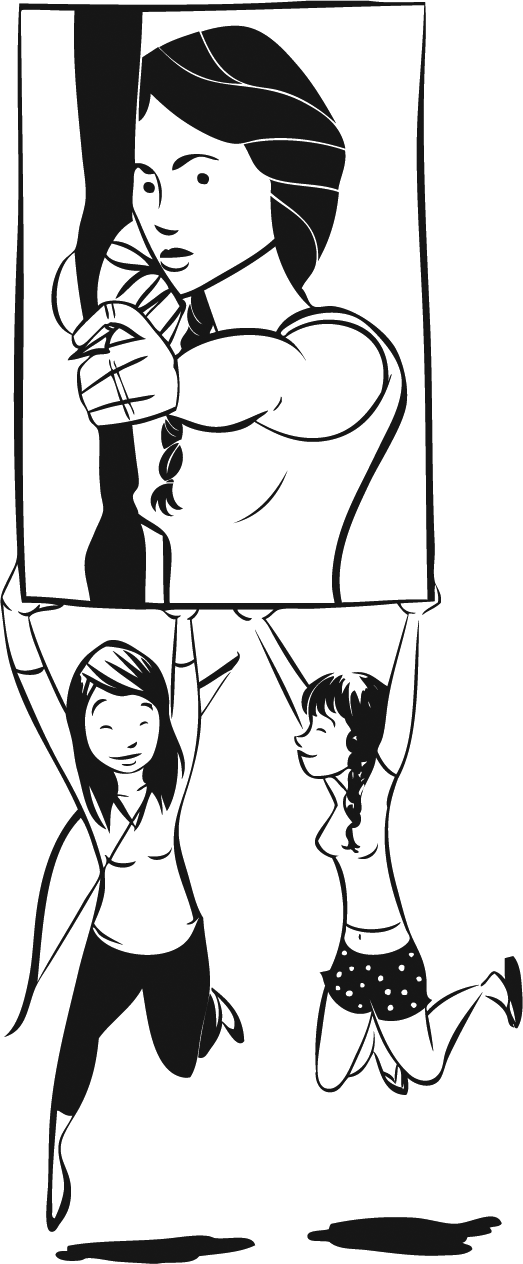
The current popularity of the trilogy Hunger Games may offer teens a model of female leadership, according to sociologists. Katniss Everdeen, the central character in the books (and movie adaptation), is proficient with a bow and arrow. While her use of violence, weaponry, and stoicism may at times be shocking, self-reliant characters like Katniss can inspire young girls, according to sociologist Janice McCabe and her colleagues (Gender and Society, 2011). Katniss’s character displays strength in the face of adversity, whether facing starvation due to oppressive government policies—or threat of death. She’s self-reliant, and uses her wits and skills to solve her problems, rather than waiting for the men in her life to swoop in and take care of things.
Female central characters are significant for young girls and women, McCabe and her co-authors argue, because they counteract the “widespread pattern of underrepresentation of females” in children’s literature. Such underrepresentation, according to McCabe, “may contribute to a sense of unimportance among girls and privilege among boys.” Perhaps characters like Katniss, who would rather take care of business herself than rely on boys, can change the way girls understand themselves—at least a little bit.
Corey Fields
The Terrorist Next Door
Last August, when the cover of Rolling Stone pictured Dzhokhar Tsarnaev, one of the suspected Boston Marathon bombers, with light skin, a goatee, and shaggy brown hair, it immediately sparked controversy. Some white Americans, it seemed, were uncomfortable with the idea that terrorists can look very much like them.
Sean Murphy, a Massachusetts state police sergeant, claimed that it “glamorized the face of terror.” Eric Randall, blogging at BostonMagazine.com, suggested that a “cartoonish illustration”—such as the May 3, 2013 cover of The Week, which featured caricatures of Dzhokhar and Tamerlan Tsarnaev with darkened skin and large noses—would have been more appropriate. These illustrations evoke renderings of Osama bin Laden, creating a distance between the Tsarnaevs and other white Americans.
Media depictions of terrorists exaggerate the distance between “us” and “them.”
©2013 Rolling Stone
©2013 THE WEEK Publications, Inc.


In their 2000 book The Black Image in the White Mind, communications scholars Robert Entman and Andrew Rojecki found that images of black suspects were four times more likely than images of white suspects to appear in local news reports. As historian Khalil Muhammad demonstrated in his 2010 book The Condemnation of Blackness, such depictions, combined with a lack of interaction between whites and blacks, contribute to white Americans’ tendency to see black men as criminals.
When the media attribute criminal behavior to racialized others, nonwhites are more likely to be be targeted for “stop-and-frisk” police tactics or such events as the shooting of Trayvon Martin by George Zimmerman and the shooting of Jordan Davis by Michael Dunn. These attributions also mask the crimes of whites, preventing us from seeing that the danger one poses to others is not determined by clothing or skin tone.
Boys will Stay Boys
“Picture this: your 7-year-old daughter comes home from school in tears. You ask her what’s wrong and she says she’s afraid to go to the bathroom at school because a boy comes in while she’s there. You’re told that your daughter is telling the truth, but because the boy says he wants to be a girl, [the school’s] hands are tied.”
The Pacific Justice Institute, a non-profit legal foundation, spread misleading information like this in order to challenge the California School Success and Opportunity Act, which became law in August 2013, and was designed to reduce discrimination against transgender students in California public schools.
Sam Grinberg

The opposition argues that boys will declare that they are girls for the sole purpose of gaining access to girls’ spaces, like locker rooms and bathrooms. The way this campaign framed “boys” as a threat to the sanctity of female spaces is not unique, however. In a 2013 Gender & Society article, sociologists Kristen Schilt and Laurel Westbrook argue that women’s spaces are at the center of a debate about transgender rights. This derives from the belief that women are inherently vulnerable and men are dangerous. These differences, which are seen as rooted in biology and therefore immutable, are used to keep transgender individuals out of women’s spaces.
In this narrative, transgender girls are always and forever boys, and a boy who says he wants to be a girl is a dangerous “wolf in sheep’s clothing” who is simply seeking to get physically closer to helpless girls. This myth is just the latest way to paint transgender individuals as liars, females as weak, and ignore the real threats—which are to, not from, transgender girls.
No Laughing Matter
In her 2013 book, Lean In: Women, Work, and the Will to Lead, Facebook’s Sheryl Sandberg encouraged women to scale the corporate ladder. Yet women still make only 77 cents for every dollar that men earn. Some researchers say sexist humor in the workplace is partly to blame.
Derogatory jokes are pervasive and persistent—despite the fact that men and women are more likely to find them offensive in workplace settings, according to scholars Jared Gray and Thomas Ford’s 2013 article (Humor: International Journal of Humor Research). In addition to being offensive, these jokes restrict and devalue female upward mobility, according to researchers Thomas Ford, Julie Woodzicka, Shane Triplett, and Annie Kochersberger, by amplifying sexist attitudes and values that already circulate in workplaces (September 2013 Current Research in Social Psychology).
Since the long-term effect of sexist jokes is no laughing matter, eliminating such water-cooler talk should be part of the struggle for workplace gender quality.
The Marriage Diet
Getting married may lead to weight gain—and not just because of that extra piece of wedding cake.
Newlyweds’ body mass index (BMI) increases after marriage, according to economists Susan Averett, Asia Sikora, and Laura Argys (Economics and Human Biology, 2008). Married men have a higher BMI than unmarried men, and married women are more likely to be overweight or obese.
Perhaps this is due to the fact that marriage offers new social occasions involving food and eating, compelling couples to eat more—and more often—than they otherwise would. But another possible explanation is the marriage market hypothesis: maintaining a healthy weight becomes less important after one has found a marital partner.
Corey Fields

In a study published in Appetite in 2011, sociologists Caron Bove and Jeffery Sobal found that while weight was a salient issue when couples were dating, it became less relevant once they settled into romantic relationships.
And scholars Debra Umberson, Hui Liu, and Daniel Powers, writing in the Journal of Health and Social Behavior in 2009, found the transition out of marriage, either through divorce or widowhood, is an even more important determinant of weight trajectories than getting married.
Perhaps the solution is to just live together: cohabiting men and women have lower BMIs than their married counterparts, according to sociologists Jeffrey Sobal and Karla Hanson, in a study published in the Marriage and Family Review in 2009.
What this suggests is that declining marriage rates may lead to slimmer national waistlines in the coming years.