




Abstract
Sociologist Margaret K. Nelson explores how Hollywood has portrayed the use of assisted reproductive technologies. She argues that these new technologies have the potential to transform the nuclear family as we know it; however, popular films glorify romantic love and traditional family structures.
Keywords
Assisted reproductive technologies (ARTs) are transforming the nuclear family as we know it. How has Hollywood, that famous maker of family image, responded?
The two-parents-and-their-children family model glorified by the movie industry has never adequately represented the range of actual families in real life. With the increase of ARTs this range is becoming even more complex. Consider a heterosexual couple that relies on donor eggs, donor sperm, and a surrogate. The resulting child will have three kinds of mothers (one genetic, one gestational, and one social), two kinds of fathers (one genetic and one social), and, quite possibly, a host of genetic half (or full) siblings living with their own social parents. A similar range of permutations is possible for same-sex couples. Social relationships and family life have become similarly complex under these conditions: known donors and known surrogates sometimes keep in touch with “intended parents” and offspring for years; some even become deeply involved in the children’s lives. New online registries enable children themselves to become acquainted with, and to develop relationships with, “donor siblings.”
The family image in popular culture is far more limited. Movies with broad box-office appeal represent donor insemination (the only ART widely shown) as a mechanism for recreating the nuclear family rather than as a mechanism for refashioning it. For the most part, mainstream movies proclaim the virtues of an “intact” nuclear family composed of two parents and the child or children who live with them
While new technologies busily reinvent family life, Hollywood films portray the sperm donor as daddy, reproducing nuclear family ideals.
© 2010 CBS Films
© 2010 Focus Features
© 1993 Warner Bros.
© 2011 Caramel Film
© 2010 Miramax Films
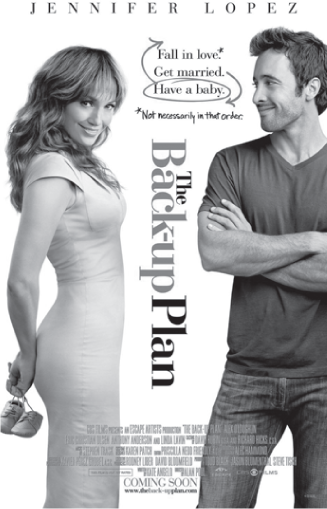

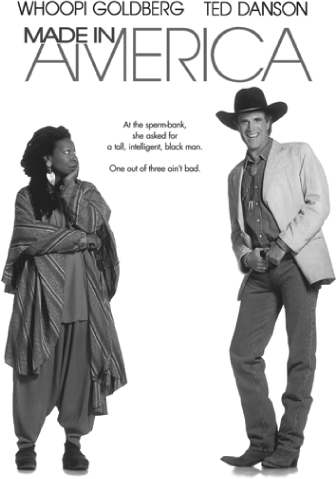
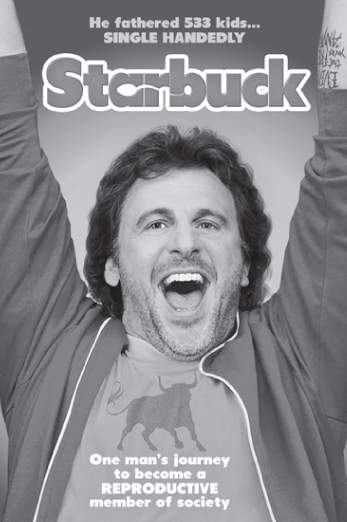
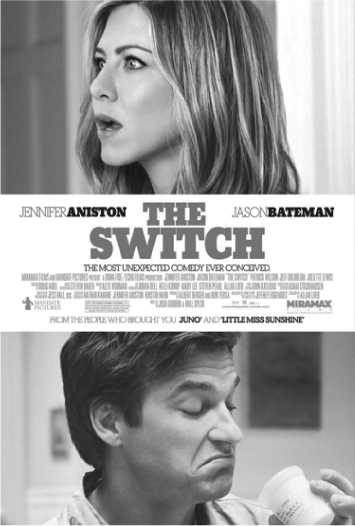
Movies that feature families created through sperm donation include The Switch, The Backup Plan, and The Kids Are All Right (all released in 2010), one 2011 Canadian movie (Starbuck) and a fifth movie (Made in America) released almost two full decades earlier. Despite the sperm donation theme, they substitute fiction for fact when they imply that the usual practice of sexual intercourse (mostly as part of romantic love)—and not the less usual one of sperm donation—creates the family. They also offer fables of redemptive fatherhood and tout the lure of genetic connection.
Redemptive Fatherhood
Hal Jackson (Made in America) could not be more inappropriate as a father to the young Zora Matthews. He is a white (Zora is African-American), sleazy car salesman (Zora’s mother runs a bookstore and rides a bike), and totally inept (Zora is a merit scholar). When Zora confronts him with the news that he is her biological father, he abruptly and cruelly brushes her off. But of course, as the plot demands, in time he is won over by her charm and vulnerability; through his relationship with Zora, he is able to demonstrate the deep sensitivity hidden beneath his brash exterior. It just took fatherhood to bring it out. Ironically, a plot twist in which Hal and Zora donate blood following a bad accident involving Zora’s mother, results in Hal’s learning that he could not possibly be Zora’s biological father. But his believing that he is a father is the path to his salvation.
Fatherhood is also redemptive (albeit temporarily) for the sperm donor in The Kids Are All Right. After receiving the news that teenagers and siblings Joni and Laser are the product of his sperm donation (used by lesbian parents), Paul attempts to embrace the role of fatherhood. During this period he throws over his promiscuous life and tries to be more responsible. In Starbuck, David may be no more reliable as a “delivery man” (which is what the 2013 U.S. version of this film is called) for his family’s business after learning about the 533 progeny that have resulted from his multiple occasions of donating sperm. But he improves the lives of several of these children: he fills in at a job for one when that young man is called in for an audition for an important role; he makes frequent visits to an institutionalized boy with major disabilities; and he leaves money for a third, a subway busker, each time he passes by.
Despite the sperm donation theme, many films continue to portray fables of redemptive fatherhood and tout the lure of genetic connection as the true basis for parent-child bonding.
Genes Create Connection
In spite of their differences, many of Starbuck’s offspring had already learned to love one another during a weekend they spent together celebrating their roles as co-claimants in a class action lawsuit to force the fertility clinic to reveal the identity of their donor. Once David acknowledged that he was the progenitor of them all, they learn to love him too. To sharpen the notion of a vital genetic tie, throughout the movie the youth appear isolated from other familial relationships: they have no mothers, no (social) fathers, and no “other” siblings. They are “pure” offspring of sperm donation, connected only to their donor siblings and to David. In the penultimate scene, David emerges from the hospital delivery room where his fiancé has just given birth and announces to the many of his offspring gathered in anticipation that a new “brother” has joined this imaginary family.
The mere idea of a genetic tie is also powerful enough to create an intimate bond between Hal and Zora (Made In America), but The Switch treats image and reality differently. The title refers to a drunken—and not consciously remembered—substitution by Wally of his sperm for that of the donor his friend (Kassie) has chosen. Five years later, when they first meet, the bond between Wally and the child, Sebastian, is instantly deep and satisfying to both. Love blooms between them well before fatherhood is revealed. By way of contrast, the putative sperm donor (Roland) wants to like Sebastian, but doesn’t, and the savvy Sebastian actively dislikes him. In this movie the message is that believing in a genetic tie is insufficient grounds for connection between donor and child whereas real genetic fatherhood will triumph in the end.
Assisted reproductive technologies (ARTs) are transforming the nuclear family but not Hollywood’s imagination.
Sperm Donors are Sexy and Reproduction Requires Sex
In a surprising plotline that has drawn the ire of many feminist viewers, both lesbian mothers of Joni and Laser (The Kids Are All Right) have moments of attraction to the donor, Paul. One of them (Jules) actually hops into bed with him; the other (Nic) merely croons at (and with) him. Zora’s mother, Sarah, and Hal (Made in America) astonish the viewers—and themselves—with their uncontrollable sexual attraction to each other; the mere belief that Hal provided the sperm for Sarah’s conception of Zora requires a filmic substitution of sex for insemination.
The sexy donors in the other movies are more predictable. When he is perceived to be the actual donor, Roland (The Switch) is the attractive hunk, especially in contrast with the neurotic Wally. But over time Roland is portrayed as domineering and crude. Ultimately, as we knew would happen all along, Sebastian’s mother Kassie reveals that she is truly in love with—and wildly attracted to—her long-time friend, Wally. Once they act on that love and attraction, history is revised: intercourse, and not “artificial” insemination, created the child.
The Backup Plan foregoes a sexy sperm donor but engages in the same revisionist history that repudiates donor insemination. Immediately after she is inseminated in a doctor’s office, Zoe meets Stan as they compete for the same taxi. Predictably, they too fall in love and after their first sexual encounter, she tells him that she is pregnant. Although the plot takes some obvious twists and turns (he is angry that she hadn’t told him about the “backup plan” before; she thinks his anger means the relationship is over) eventually, Stan promises to be the father of her babies (it turns out that she is expecting two). The twins are barely out of the womb when Zoe is pregnant again, this time, of course, with Stan’s seed. No further mention is ever made of the sperm donor. The resulting family is (at least partially) created through true love and “normal” practices.
Recreating the Nuclear Family
Because the parents are lesbians, The Kids Are All Right offers a contemporary take on the family. Even so, it reinscribes family as a tightly-bounded unit from which Paul (who was initially sought out by Joni and Laser and who has joined in boisterous sex with one of the mothers) is eventually expelled when he fails to live up to “fatherly” expectations: Joni expresses her total disappointment in him; Laser turns his back on him; and the other mother snarls that this is her family, not his. Made in America also celebrates a non-traditional nuclear family when, as the crowning moment of her high school graduation, Zora brings about a reconciliation between Sarah (African-American) and Hal (white) and claims them both as her parents.
The other three movies offer up more conventional families. David (Starbuck) has joined in a group hug with his many offspring, but it is quite clear that his heart (and daily life) will be shared primarily with his fiancé and their new son. Stan proposes to Zoe (The Backup Plan) just in time to celebrate their joint parenthood of their (soon to be) three children. And Kassie and Wally (The Switch), as a newly married couple, rejoice together at their son’s birthday party.
Egg donation and in vitro fertilization as supplements to donor insemination have altered ARTs over the last 20 years. In addition, the population relying on these practices has shifted radically as it has come to include single mothers and lesbian and gay partners. Meanwhile celebrity revelations of fertility difficulties produce broader understanding of these issues. However, our cultural imagination barely budges: the same themes are present in the earliest of the “sperm donor” movies as well as in the most recent ones. All are comedies that tell us that, sure, sperm donation sometimes takes place, but that ultimately it really takes sex—ideally sex accompanied by romantic love—to make a family.