




Abstract
Borrowing from Herbert Spencer’s phrase “survival of the fittest,” the documentary film Survival of the Fastest aired just before the 2012 Olympic Games. It recycles the outmoded notion that race is an extant biological category that determines physical and intellectual outcomes. Sociologist Matthew W. Hughey discusses how such archaic racist assumptions are repackaged in the media spectacle of contemporary sporting and the glossy veneer of documentary film.
I’m Michael Johnson. I’ve won four Olympic golds in sprinting. At this level of my sport, nearly all the athletes are black. But there is another connection, a hidden and more disturbing bond. Almost every one of us is descended from slaves. Is that coincidence?
This narration, along with footage of Michael Johnson’s world record-breaking 400 meter sprint, opens the film Survival of the Fastest (2012). This controversial documentary ushered in British media coverage of the London 2012 Olympics. With an audience fixated on the Olympics and its marquee event of men’s sprinting, there are few other times when such a large and demographically varied audience would all watch a documentary about race, genetics, history, and sports.
Media narratives seize upon the notion that black dominance in sport is a biologically determined trait intensified by Darwinian winnowing during slavery’s harsh conditions.
Borrowing from Herbert Spencer’s phrase “survival of the fittest,” Survival of the Fastest turns on the question of whether the brutality of the trans-Atlantic slave era (during the early 1500s to mid-1800s) accelerated the process of natural selection: the weakest died off leaving a black super-population predisposed to superior athletic performance today. The film’s message relies on a series of well-documented spurious relationships such as: racial groups are biologically distinct; and different groups are naturally predisposed to certain characteristics like possessing high IQ or running fast. But despite the flawed reasoning, Johnson’s deft narration renders this media spectacle of black athleticism and biological determinism believable.
Media Constructions of the Black Super-Body
Throughout the eighteenth and nineteenth centuries in Western cultures, it was commonly believed that blacks were physically, emotionally, and mentally inferior to whites. But by the turn of the twentieth century—due in part to a series of well-publicized black wins in boxing and other popular sports—commentators began to emphasize white cognitive superiority in contrast to the supposedly savage and unbridled physical superiority of blacks.
A media narrative of “black brawn” vs. “white brains” slowly emerged and became the “common sense” explanation for a perceived black athletic exceptionalism. As a few black athletes began to gain notoriety (such as the African American boxer Jack Johnson and white authorities’ attempts to ban his filmed victories over a string of opponents dubbed “Great White Hopes”), they came to epitomize blackness as an endangered super-species. Jim Crow laws shut African Americans out as writers, producers, owners, and main protagonists of film and television, leaving media representations of black athletic and talented bodies as the primary image for male blackness. Media narratives seized upon the notion that African Americans were a physically-gifted race, and that black dominance in sport was a biologically determined trait intensified by Darwinian winnowing during slavery’s harsh conditions.
For example, a 1971 issue of Sports Illustrated published “An Assessment of ‘Black is Best,’” in which Yale graduate and NFL star Calvin Hill stated that blacks were “the offspring of those who [were] physically and mentally tough enough to survive … We were simply bred for physical qualities.” In 1977 O. J. Simpson argued in Time Magazine that blacks, “were built a little differently … built for speed—skinny calves, long legs, high asses are all characteristics of blacks.” During a 1987 ABC Nightline with Ted Koppel episode, Koppel asked Al Campanis, the general manager of the Los Angeles Dodgers baseball franchise, to explain the paucity of black managers and owners in major league baseball. Campanis replied that blacks “… are gifted with great musculature and various other things, they’re fleet of foot, and this is why there are a lot of black major league ballplayers. Now, as far as having the background to become club presidents, or presidents of a bank, I don’t know.”
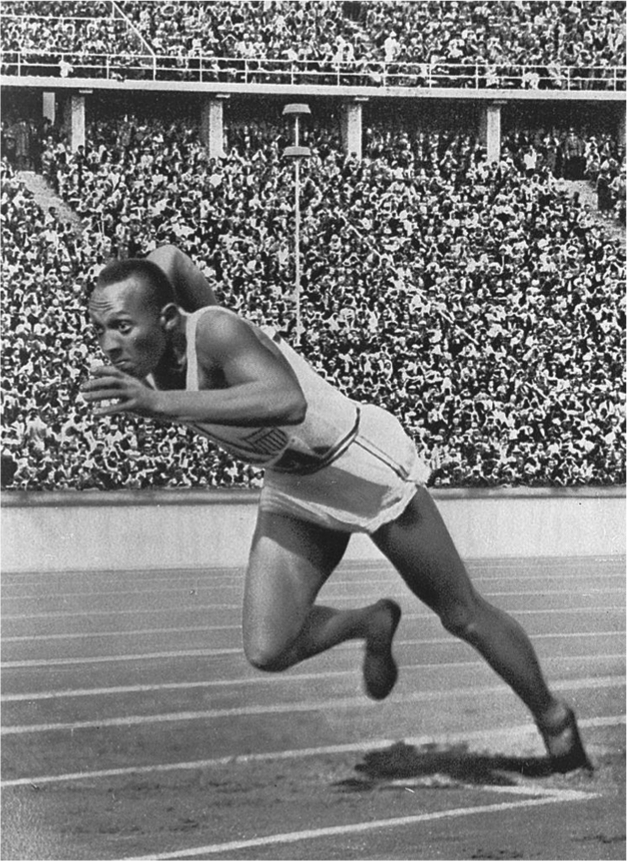
Biological explanations have long been used to account for the success of black athletes, such as Jesse Owens, pictured here in 1936.
Die Olympischen Spiele, 1936
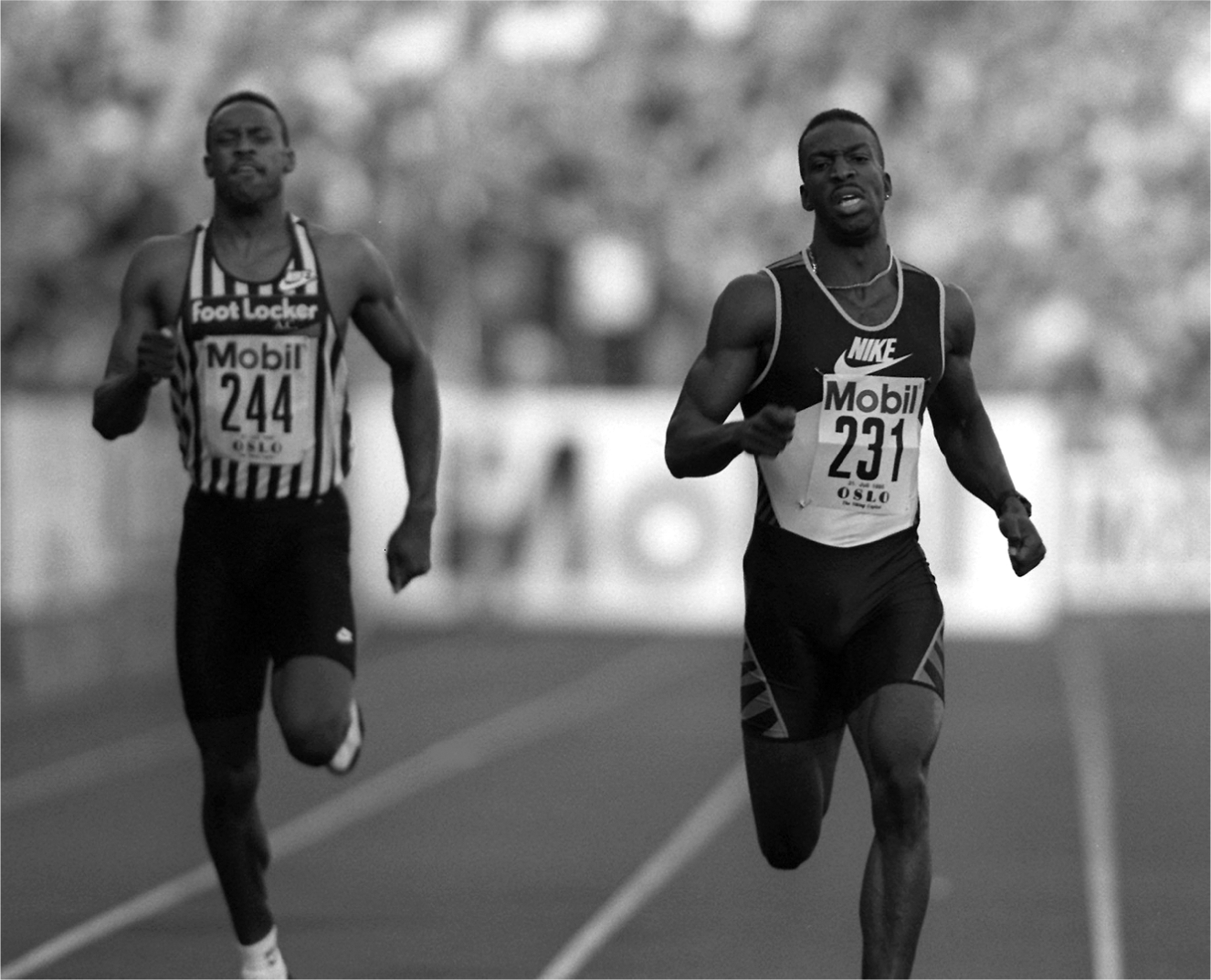
Sprinter Michael Johnson (pictured on right) made the documentary, Survival of the Fastest.
Mike Hewitt/Allsport
In 1988, CBS broadcaster Jimmy “The Greek” Snyder claimed in a conversation with a reporter (later re-broadcast on national television): “The black is a better athlete to begin with because he’s bred to be that way, because of his high thighs and big thighs that goes up into his back, and they can jump higher and run faster because of their bigger thighs and he’s bred to be the better athlete because—this goes all the way to the Civil War when during the slave trading—the […] slave owner would breed his big black to his big woman so that he would have a big black kid.” Outcry over Snyder’s words prompted NBC News anchor Tom Brokaw to produce a 1989 documentary entitled, Black Athletes: Fact and Fiction. But that documentary contained the same erroneous presupposition: black sporting success is the product of genetics and little more.
The notion of “black brawn” vs. “white brains” slowly emerged and became the “common sense” explanation for a perceived black athletic exceptionalism.
The Tenacity of the Myth
Much of the general public continues to agree with this mythology: in 2001, a Zogby International survey found that 54 percent of Americans believed that athletic ability was linked to genetics, and 43 percent believed that some races have a natural athletic advantage over others. Among those aged 18 to 49, 59 percent believed that East Africans possessed the so-called “fast twitch muscles” or the “speed gene.”
A few days after Survival of the Fastest was broadcast in 2012, just before the Olympic men’s 200 meter final, the BBC aired a five-minute documentary that reinforced the thesis that blacks dominate sprinting due to natural selection and the legacy of slavery. Narrated by veteran BBC and ITV broadcaster John Inverdale, the segment was immediately followed by a panel discussion featuring three Olympic sprinters, Colin Jackson, Denise Lewis, and Michael Johnson who debated the “nature” of biology versus the “nurture” of social factors. While some on the panel suggested that resources, work ethic, and personal circumstances could play a role in any particular athlete’s success, the supposed causality of slavery’s most unnatural selection and racialized genes figured prominently in this discussion.
Commentators around the globe have accepted the claims in Survival of the Fastest uncritically. Sally Beck of the UK-based Mail Online wrote, “African slaves underwent a rigorous selection process and only the fittest were transported on ships.” On Fox Sports Australia, Mike Hurst wrote, “… history supports the notion that there was an inadvertent culling process whereby only the strongest survived the crude and cruel kidnapping and transportation process out of Africa to Spanish, Dutch and British colonies from 1501 to the 1800s.” And in the United States, The Huffington Post’s Caroline Frost stated, “… it seemed that those who survived these hardships were stronger, more testerone-filled [sic], more ready for an Olympic games generally. All of this seems a bit obvious …”
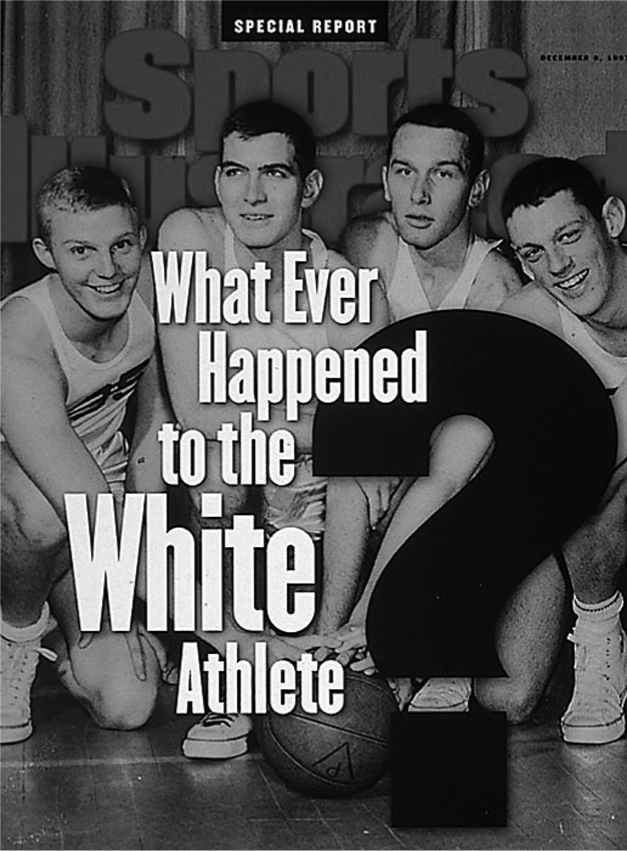
The link between race and athleticism is still a hot topic for media outlets like Sports Illustrated, which featured it on its 1997 cover.
©1997 Time Inc.
But what makes these claims so “obvious”? The thesis of Survival of the Fastest is seductive because it rests upon common beliefs about race, biology, and athleticism. Although these ideas don’t hold up under sociological or even biological scrutiny, they predominate in popular culture where they are rarely questioned or rebutted.
Why do we deny that access to resources, discrimination, and social expectations related to race and sport persist? First, athletic competition is interpreted as an “equal playing field” that offers clarity about racial debates. Many see sport as the perfect laboratory where social and economic issues are physically and metaphorically out of bounds. Many thus assume that any racialized patterns—such as black dominance in sprinting—must be the result of genetics. Second, Western media has revived the antebellum notion of essential race differences that correspond with the rising tide of conservative political thought. This ideology helps to legitimate and rationalize racialized sporting patterns as the handiwork of biology rather than the outcome of modern laws, policies, or habitual expectations that funnel varied racial groups into different sports. Third, after mapping the human genome in 2000, headlines about race and genetics captured audiences, particularly with the spread of information via the Internet. And fourth, in a time of “post-racial” and “color-blind” politics in which discussions of race are now framed as little more than “race baiting” and inherently divisive, the remaining space to discuss race became the body—especially the black body. What better place to reproduce notions of “black brawn” than sports where differently raced bodies collide and unequal performances must be interpreted and explained to an audience transfixed by the spectacle of competition—especially within the hyper-mediated marvel of the modern Olympics? It is within this context that Johnson’s Survival of the Fastest was produced, broadcast, and its claims widely accepted.
Survival of the Fastest ignores the major contributions of sociological thought: “race” is a social, not biological, category. Race is a “social construction” that governs our lives because it is a meaningful identity, a powerful ideology, an interactive framework, and a notion institutionalized in the mundane activities of everyday life—from hospitals to prisons and from our neighborhoods to our schools. But despite a settled science that strongly demonstrates otherwise, media misappropriations of genetic research masquerade as scientific authority in support of the cultural myth that black super-bodies were formed in the crucible of slavery’s natural selection. Films like Survival of the Fastest perpetuate the myth of a natural racial inequality, and eclipse the socially constructed order of inequality in which we all participate.