




Abstract
Public contention over recent changes in New York City’s streetscape, allocating more space and priority to pedestrians and cyclists, illuminates an underlying conflict between a belief system regarding motor vehicles as central to American life—the windshield-perspective assumptions here termed Motorism—and dissenting beliefs questioning the rationality of automotive monoculture. New York-based writer Bill Millard argues that during the twentieth century, Motorism attained a level of dominance thorough enough to be unrecognized and unquestioned in most locales; though it encounters enough opposition to be visible as an ideology only in a few places (particularly New York), its ill effects on the environment, the economy, health, and other values are increasingly apparent, suggesting that the New York “streetfight” has social ramifications extending well beyond New York.
Keywords
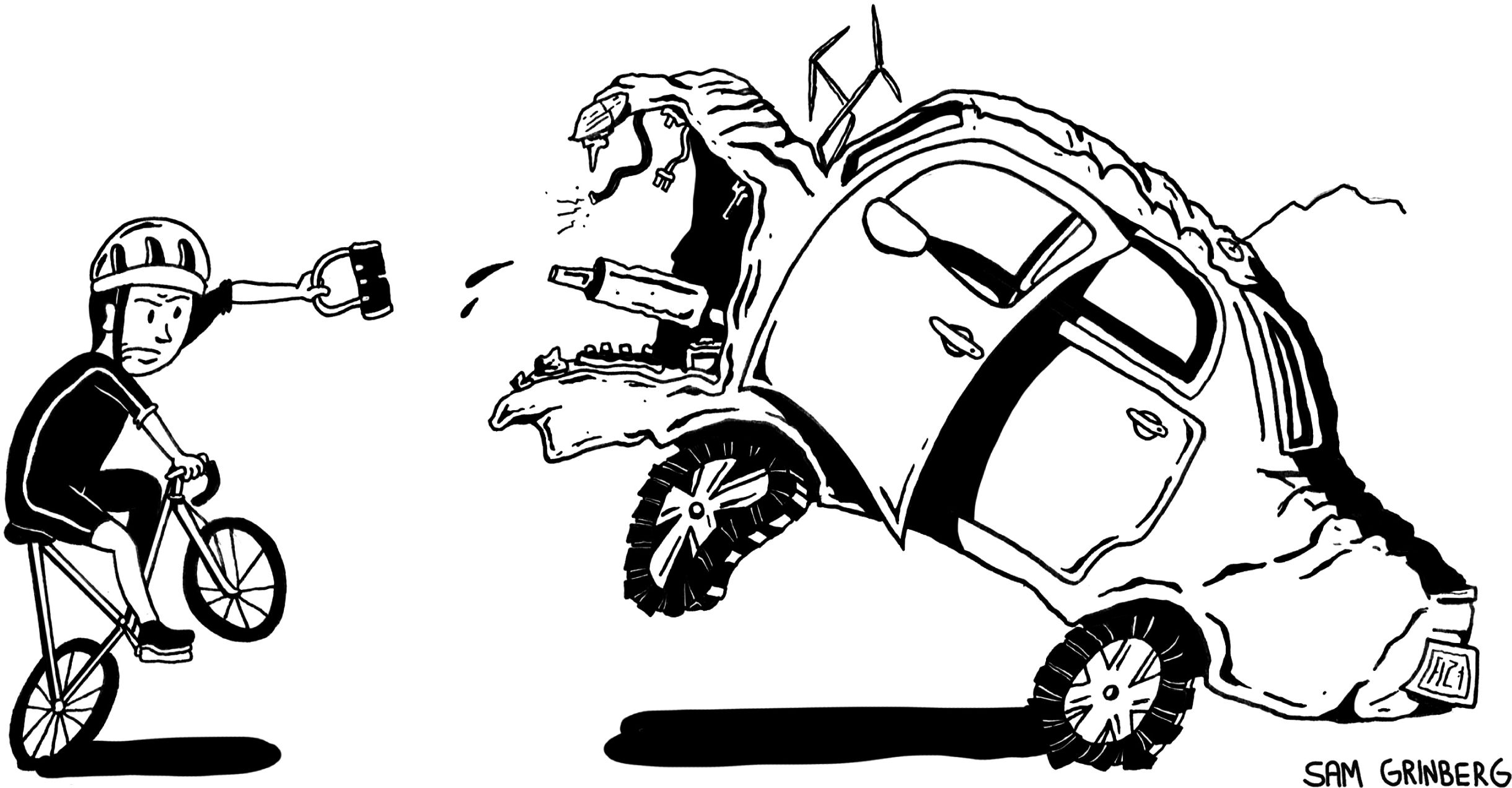
In most of the United States, the assumption that driving is a precondition for full citizenship is so pervasive it’s essentially invisible. In a trend that scholar Richard Florida calls “the Great Car Reset,” more Americans are choosing transit, telecommuting, car sharing, and dense, walkable mixed-use neighborhoods over the package deal they inherited: mandatory auto ownership, commuting by car, and the centrifugal pattern of exurban residence that hollowed out twentieth century cities. Demographic trends and activism are converging to make alternatives to transportation monoculture viable.
But even in New York City, where pedestrians come first, those who try to institute alternatives to the car still face considerable odds, as current resistance to biking suggests. New York City never accepted the autos-first paradigm and has gone through public-space revisions that counteract it. These changes have improved street safety, cut congestion, and boosted the city’s bicycling culture. But even in the city with the nation’s broadest transportation options and lowest rates of auto ownership, the car is still privileged.
Janette Sadik-Khan, recent commissioner of New York City’s Department of Transportation (DOT), became a heroine to many New Yorkers by directing the creation of pedestrian plazas, cycling infrastructure (250 miles’ worth and counting), bus rapid transit lanes, and other measures allocating more street space to pedestrians, bicycles, and transit. As part of PlaNYC 2030, former Mayor Michael Bloomberg’s environmental blueprint, DOT’s adjustments of infrastructure and policy have promoted “complete streets” or “livable streets,” where cars cede space to other modes.
The Citi Bike bicycle-share network launched last May, achieving high enrollment (2 million trips in its first 76 days) and extremely low injury rates (8 during the same period). Green urbanists and pedestrian/cyclist/transit-rider representatives like Transportation Alternatives (TA) hail these changes as long overdue. In these circles, “JSK” or simply “Janette” has become nearly as iconic as FDR or JFK.
But her innovations have also elicited a backlash. Some regard Sadik-Khan as the devil incarnate. She has endured aggressive media attacks and a well-funded lawsuit to remove a bike lane on Brooklyn’s Prospect Park West (now dismissed). Her opponents’ vehemence implies that she has hit the most sensitive of nerves. “It’s a rich debate,” says architect/scholar Lance Jay Brown, FAIA, of City College, who co-edited Beyond Zuccotti Park: Freedom of Assembly and the Occupation of Public Space. “I have friends who hate Janette Sadik-Khan. They hate her. … I say, ‘Even if you’re not sympathetic to what’s happening, why do you have such a level of visceral dislike?’”
Get Your Motor Running
Hostility to bicycles is just one part of a wider syndrome. The physical structures that make driving easy in most of the United States are accompanied by a culture-wide presumption that driving is normal and normative. The implicit equation of motorist with citizen remains the default setting.
You are a motorist, this assumption holds; essentially everyone is. (Or, as the late Jane Holtz Kay pointed out in Asphalt Nation, everyone is who matters politically.) The streets in nearly every American city are built for cars. This is a nation whose landscape and mindscape have been colonized by what economic historian Emma Rothschild calls “the auto-industrial complex.” Our streets are the physical expression of a pervasive belief system: depart from the autocentric norm at your peril.
This is more complex than a widespread love of cars. It amounts to a cultural formation, even an ideology. It rests on beliefs that are pervasive enough to be invisible, which are often seen as common sense. When dissenters identify those assumptions or even cite their history—the zoning laws, engineering decisions, business transactions, and advertising campaigns that established their dominance—adherents find this dissent fundamentally disturbing. Perhaps this is why New York’s “streetfight” is so loud: it’s practically the only place in the United States where there’s still a real contest.
The physical structures that make driving easy in most of the United States are accompanied by a culture-wide presumption that driving is normal and normative.
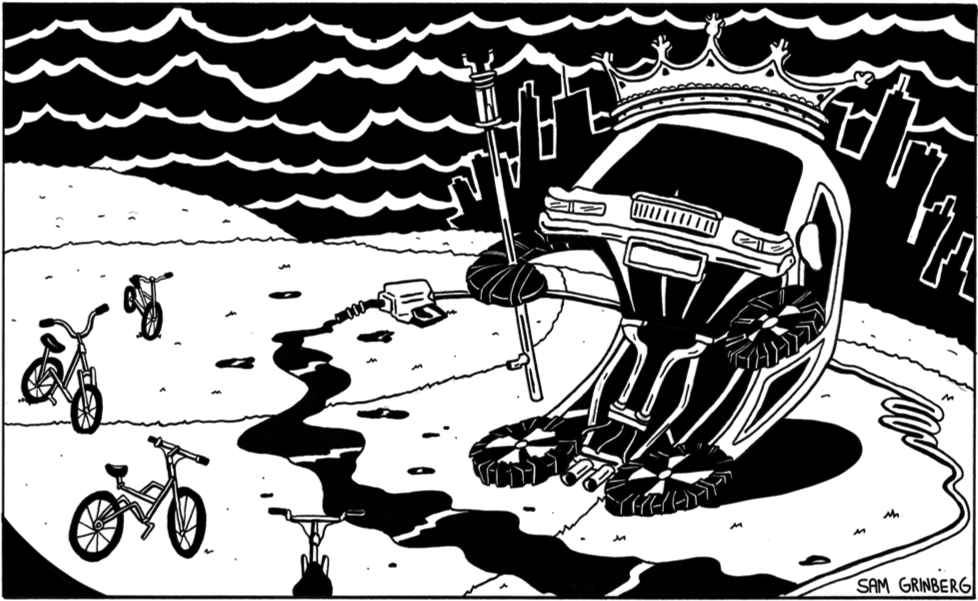
If every mainstream citizen is a motorist, the ideas and cultural norms the make the car king can be seen as “Motorism.” While not yet in general use, the concept has a deep history. Motorism is a windshield perspective that underestimates driving’s downsides so drastically that benefit/cost calculations, whether economists’ rigorous studies or every citizen’s daily mode choice, practically amount to dividing by zero. It takes little heed of carless people, regards car-free places as anachronisms, and exercises enormous cultural power (accrued over decades, chroniclers like Peter Norton have shown, through marketing and memetics, reframing cars not as invaders of civic space but as instruments of freedom).
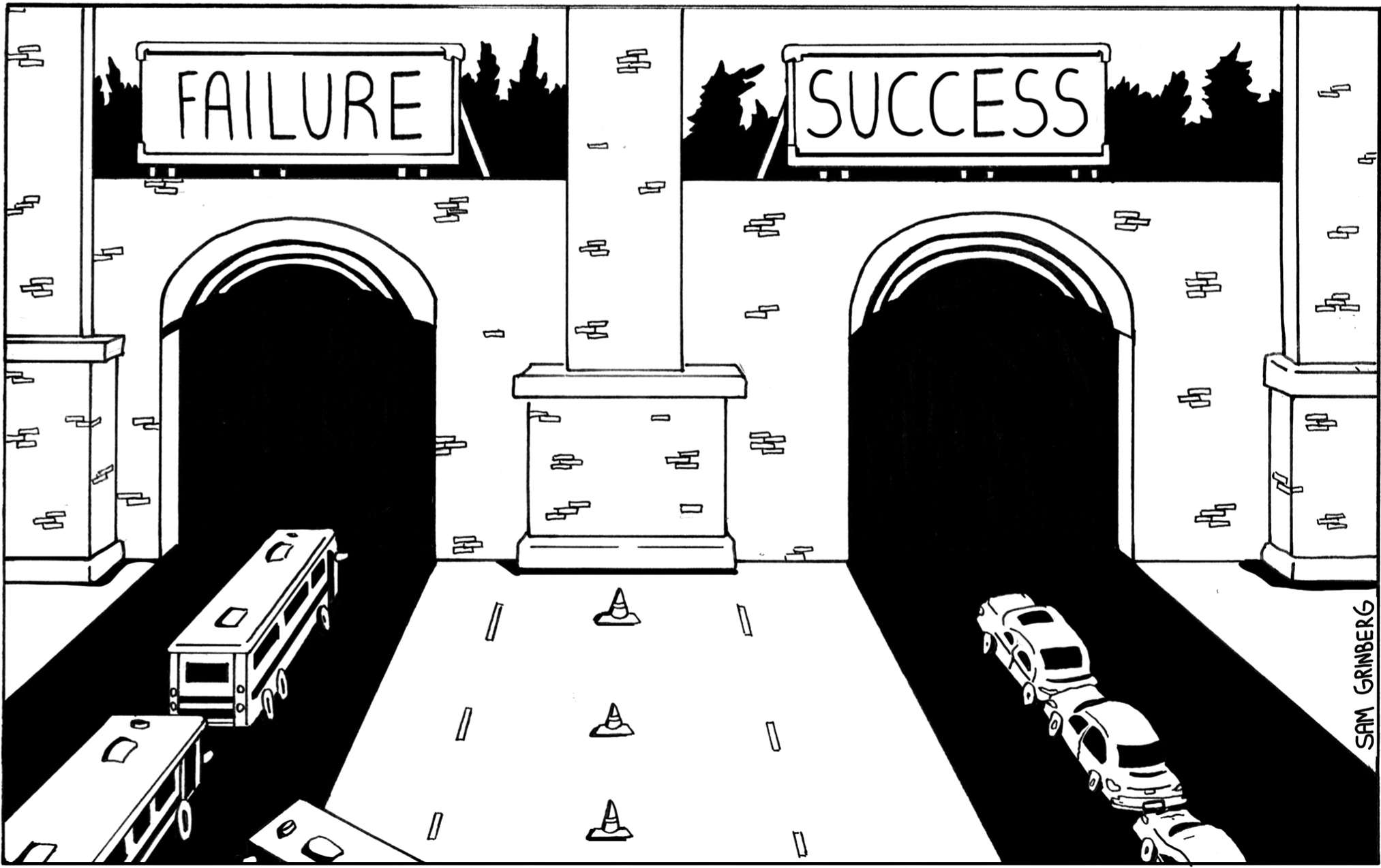
Motorism underlies the refusal to fund modern transit infrastructure; the implicit belief that free parking is a self-evident human right; and the recurrent political complaints that cycling and pedestrian facilities are recreational amenities rather than legitimate transport options, or that Amtrak depends on federal subsidies while autos do not (every transportation mode is subsidized, most economists agree, and auto subsidies dwarf those for rail). It is the sentiment expressed in a quote attributed to Margaret Thatcher: “If a man finds himself a passenger on a bus, having attained the age of 26, he can count himself a failure in life.”
NYC as Exception, Battleground
Even though New York, like other cities largely built before the auto age, took steps to accommodate cars, it retained non-automotive features. High density and widely available transit—the city has nearly as many subway stations as the rest of the United States combined—ensure that pedestrianism remains the norm. Many New Yorkers rarely or never drive; two prominent ones, authors Norman Mailer and Jimmy Breslin, ran for mayor and council president in 1969 on a platform that included banning cars from Manhattan and providing free buses and bicycles (anticipating Citi Bike, minus the business model).
If every citizen is a motorist, the ideas and cultural norms the make the car king can be seen as “Motorism.”
Greenwich Village’s “intricate sidewalk ballet” inspired Jane Jacobs to write the urbanist ur-text, The Death and Life of Great American Cities. To many New Yorkers, King Car can’t dance peacefully with others: it’s more like an armed lunatic that’s invaded the stage. Yet New York is also the city where the schemes of planner Robert Moses, who nearly bisected the Village with a superhighway, made Jacobs’s work necessary. The tension between his top-down approach and her allegiance to bottom-up spontaneity remains the animating dialectic of New York’s built environment, particularly when the car’s appetite for space encounters competitors.
Moses tipped the balance toward cars for decades (especially in the outer boroughs and Long Island), provoking preservationist opposition. However, he never fully understood the technology for which he reshaped the city. It wasn’t just that he never comprehended induced demand: traffic increasing to fill available space, making it impossible to decongest roads through more roadbuilding (first observed in this region, Brown recalls, on Moses’s Long Island Expressway). His blind spot was experiential: chauffeured throughout his career, Moses never learned to drive.
Proponents of walkable neighborhoods point to Manhattan and northwest Brooklyn as a national model for environmentally resilient design and a high quality of life. But different districts offered different degrees of resistance to the car invasion, with the Cross-Bronx Expressway dividing and dispersing neighborhoods. Greenwich Village and what is now SoHo organized to block the Lower Manhattan Expressway, and midtown escaped bisection by Moses’s proposed Mid-Manhattan Expressway. Meanwhile, Staten Island, Queens, South Brooklyn, and other areas oriented themselves to autos, much like less dense areas of the United States.
It would therefore be an oversimplification to attribute Jacobs-style neighborhood cohesion to all of New York. Indeed, outer-borough opposition helped doom Bloomberg’s 2008 congestion-pricing plan in the State Assembly. Opponents played up the “Manhattan elitist” aspect of charging drivers for a previously unpriced privilege, despite Tri-State Transportation Campaign studies pointing out that drivers have up to twice the income of non-drivers.
Safer Streets, but Not From Policing
The chief disincentive to cycling in New York, and the chief menace for pedestrians, remains the risk posed by motor vehicles. Rates of death and injury have dropped in correlation with the livable-streets program. As cyclists’ numbers have quadrupled, the city has seen the safety-in-numbers effect of lower injury rates for all street users. Still, though vehicles pose the greater hazard, cyclist-pedestrian crashes draw disproportionate attention. (Sometimes, cycling proponents recognize, the “Lycra lout” stereotype is accurate. Brown’s own partner was injured on a New York avenue by a wrong-way cyclist, who proceeded to criticize her as if the crash were her fault.) Yet despite hundreds of deaths and injuries by auto, fewer than half of 1 percent of the estimated 78,000 annual collisions receive any investigation at all (limited until recently to fatal or near-fatal cases).
Illustrations by Sam Grinberg

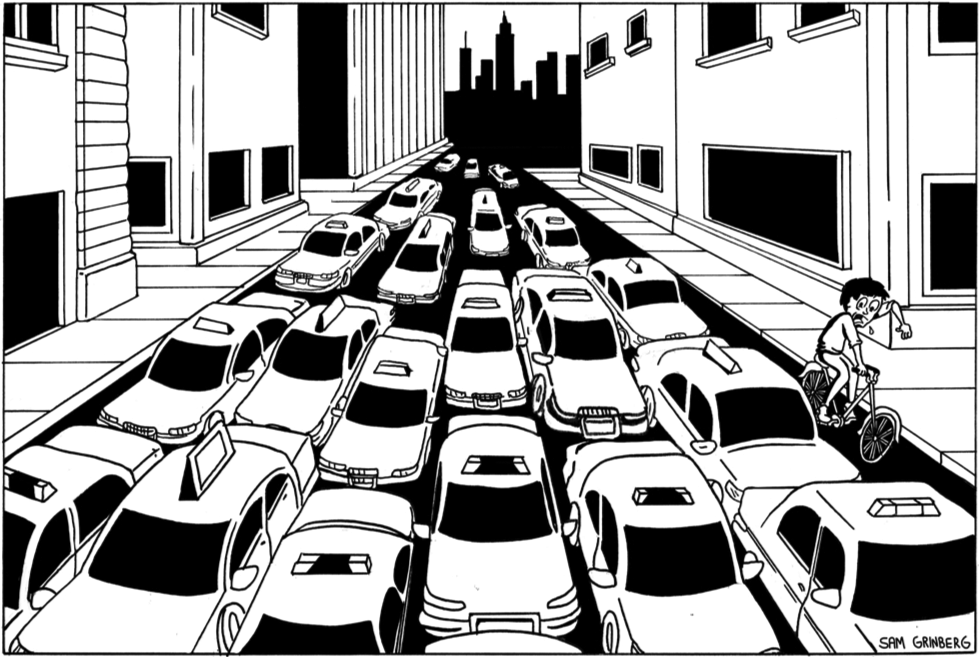
Driving continues to be the norm, despite attempts to encourage American commuters to rely on mass transit.
In 2012, fatal car crashes rose 23 percent, yet the New York Police Department issued 7 percent fewer speeding tickets than in 2011—and fewer than a quarter the tickets for speeding on neighborhood streets as for tinted-window offenses—and the fewest overall moving-violation tickets since 2002. Careless-driving tickets are negligible: just 84 citywide in 2011. Meanwhile, though the last fatal crash caused by a cyclist occurred in 2009, the Department issued a peak of 48,556 summonses to cyclists in 2011 and drew fire for ticket-trapping cyclists whose actions were actually legal.
Steve Vaccaro, a Manhattan attorney and cycling advocate, has encountered the NYPD’s priorities both professionally and personally. Riding in Brooklyn, Vaccaro encountered a driver who stopped and appeared to yield, then lurched into his path; Vaccaro went over his handlebars and landed hard, injuring his wrist and knee. After hospital treatment, he visited the precinct repeatedly but was denied a report. Obtaining case information from fire and ambulance personnel eventually satisfied the insurer’s procedures, and he was fortunate enough to be struck by a driver with a cooperative insurer, but he has seen less resourceful cyclists end up with no help for their costs.
Cyclists are barely present on the NYPD’s radar screen, he observes, except negatively—“almost nowhere mentioned in the training materials used at the Police Academy,” except for “a brief discussion of how people on bicycles, often minors, are used as lookouts for gangs and drug dealers.” Monitoring (often harassing) Critical Mass bicycle protesters, he notes, is many officers’ main contact with cyclists.
Rutgers University professor of planning John Pucher, author (with Ralph Buehler) of City Cycling, minces no words when describing the NYPD. “I think they are the number one roadblock to improving cycling conditions in New York City…. DOT has been trying to do all it can possibly to do encourage more and safer cycling, and they have been frustrated at every single point by the Police Department, which hates cyclists. [Police] are all themselves motorists; they’re all getting in by car.” By refusing to hold drivers accountable or investigate collisions, he charges, the police are exacerbating hazards. Pucher calls for a simple, tradition-based change of policy and perspective: officers would do their job better if they mounted bicycles and returned to foot patrol among the people they are sworn to protect. “Get ‘em out of those patrol cars, and get ‘em on their feet and onto bikes!”
Growing Smarter Cities
Jeff Speck, the planner who collaborated with Andrés Duany and Elizabeth Plater-Zyberk on Suburban Nation (2001), suggests a 10-point program to help cities overcome the autocentric legacy. In Walkable City (2012), Speck does not advise others to directly emulate New York; different scales, demographics, and leadership call for diverse approaches. New York’s ample transit and numerous intersections per square mile, consequences of preautomotive expansion, strike him as decisive factors in “New York exceptionalism.”
While King Car still reigns supreme, grassroots activists throughout the nation are trying to make bicycling a viable alternative.
Cities whose growth came later, particularly the post-World War II era when planners promulgated “a complete fresh start, an embrace of suburban living,” present different problems. Yet elements of Speck’s recommendations, already in place in New York—reclaiming space, calibrating parking pricing, welcoming bicycles, planting shade trees, designing spaces to foster pedestrians’ safety and interest—can succeed at lower densities.
Economically, one could argue that Motorism takes everybody for a ride, hitting non-drivers far harder than drivers.
In Oklahoma City, Cedar Rapids (Iowa), Brownsville (Texas), and elsewhere, Speck has helped officials convert excess road capacity into more purposeful space—not by excluding auto traffic but by calming it. Inexpensive restriping can turn four-lane roads into three-laners, with center turning lanes to smooth traffic flow and extra space freed up for bikes or for broadened sidewalks. Measures that enliven a 25- or 50-block district can improve an entire city’s livability, attracting talent and investment.
Economist and activist Charles Komanoff, who led TA from 1986 to 1992, views DOT’s reforms as the continuation of groundwork by the two Janes (the “seminal theorist” Jacobs and the “validator” Holtz Kay) and others, including Danish planner Jan Gehl, Bogotá’s ex-mayor Enrique Peñalosa, and parking economist Donald Shoup. “The whole end of the 1980s and quite a lot of the 1990s was a really difficult time,” Komanoff recalls, “when it just seemed that we livable-streets advocates—we didn’t have that term—were just losing ground almost everywhere. And in fact, an exception was New York City: if you will, the only really bright spot in the universe.”
Most of the United States, says Komanoff, saw interconnected environmental disasters: accelerating sprawl; the oil-driven First Gulf War; the subsidization and marketing of the SUV. In contrast, “I think New York’s impact on the bike movement throughout the country and North America was profound.” Critical Mass took root around the same time. Transit grew more appealing, and street crime receded. Public space became a place one could explore on foot, not armored inside a vehicle.
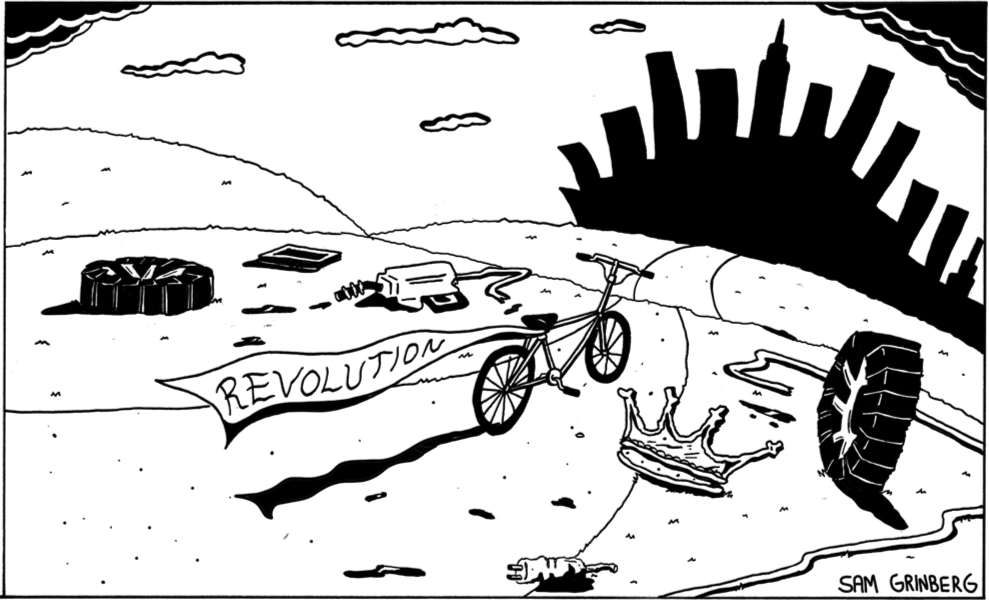
With the city resurgent, and even resilient to economic and environmental shocks, Komanoff now finds the livable-streets movement outgrowing the “mobilize the faithful” stage. Observing Miami Heat players LeBron James and Dwyane Wade videotaped with bikes, he says, “I wanted to say to my wife, ‘The revolution is here.’” The inference is tongue-in-cheek, but the association of urban cycling culture with celebrities is a step toward the mainstream. “To move to the next level,” Komanoff continues, “especially in parts of the United States that can never have the kind of transit system we have here, bikes are going to have to be the engine.”
Beyond the Sprawl Machine
Stephen Verderber, professor of architecture and public health sciences at Clemson University and author of Sprawling Cities and Our Endangered Public Health, links Motorism to a confluence of beliefs and interests. Despite many arguments linking sprawl to adverse effects on well-being, its style of individual transportation meshes with “the American ideology of unfettered expansion and freedom to move,” he says. “Mobility’s so important in the American psyche… we’re a highly mobile society, not so much at the moment, but we have been for the last 30 to 50 years. That’s something that goes back to the country’s origins.”
Analyzing the stages and mechanisms of sprawl, Verderber locates clusters of economic stakeholders, or “sprawl machines,” as motivating forces behind the style of development that requires universal automobility. “A sprawl machine is a set of interconnected parts that begins with zoning,” he says. Tax incentives to developers encourage a “mothership,” typically a big-box store, to colonize a site; “other smaller boats begin to circle around it, a whole range of chains: gas stations, hotels, motels, and steak outlets, you name it,” leapfrogging over previous sites. The resulting unwalkable environment inverts suburbia’s original purpose (Ebenezer Howard’s garden cities were intended to promote health); Verderber calls sprawl “environmentally insensitive, ecologically crazy, and counterproductive from a health standpoint.”
Certain interests benefit from such environments, but the assumption that non-drivers are economically irrelevant may be specious as well as undemocratic. Recent studies indicate that pedestrians and cyclists outspend drivers because they visit businesses more frequently, outweighing drivers’ higher spending per visit. After undergoing pedestrianization, Times Square became one of the planet’s top 10 retail locations. Individually, transit riders save over $9,000 per year over car commuters, according to a report by the American Public Transportation Association.
Economically, one could argue that Motorism takes everybody for a ride, hitting non-drivers far harder than drivers. Transportation economists, adding up subsidies and externalities—including infrastructure expenses (outstripping “user fees” like gasoline taxes), person-hours wasted in traffic, over 250 government subsidies to fossil-fuel industries, real-estate value squandered on parking, environmental damage, collision-related emergency medical care, and the proportion of military expenses securing fuel supplies and extractor/producer regimes—make a strong case that King Car doesn’t come close to pulling its own weight. Estimates vary: if fuel prices reflected all these costs, they would rise by $4.35 to $10.49 a gallon, according to Mark DeLucchi of the Institute of Transportation Studies at the University of California-Davis (other projections reach $20/gallon).
Expanding on Edward Abbey’s quip that “growth for the sake of growth is the ideology of the cancer cell,” Verderber sees sprawl as a national metastatic tumor. Though he is not optimistic about carbon taxes or other reforms aimed at recouping Motorism’s full costs, he sees the design of more dense, efficient, diverse spaces (not just on New York’s scale, but in college towns and other sites with strong central institutions) as “the equivalent of radiation therapy.”
Journalist and novelist James Howard Kunstler, envisioning a perfect storm of energy, environmental, and economic crises once oil-extraction costs become prohibitive, speculates that auto-dependent places will become obsolete, and that small towns will be the last bastions of civilization. If Kunstler’s provocations prove accurate, future generations may look back at Motorism as a grievous error, and the nation’s love affair with the car will appear in history’s rear-view mirror as a road we took for far too long.