



Abstract
What is seductive about casino gambling? Sociologist Jacob Avery reviews the books Addiction by Design and Gambling for Profit in a desperate attempt to win some answers.
Keywords
Gambling for Profit: Lotteries, Gaming Machines, and Casinos in Cross-National Focus by Kerry G.E. Chambers University of Toronto Press, 2011 298 pages

Addiction by Design: Machine Gambling in Las Vegas by Natasha Dow Schüll Princeton University Press, 2012 456 pages
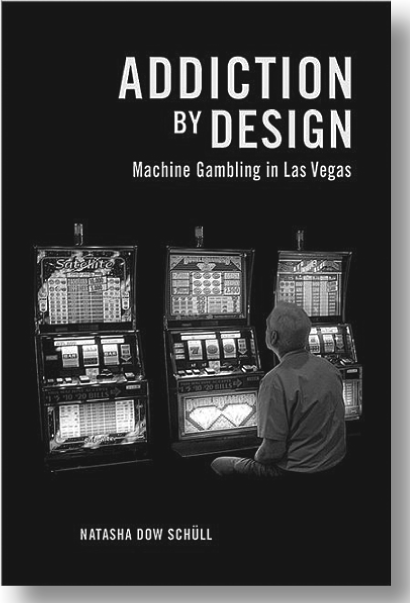
If you ever find yourself in a casino, look carefully at the folks seated at digital slot machines. Observe their faces, their eyes, and their bodily movements. Chances are, many of these folks are so engrossed in their own activities that they will not notice you staring. So, go ahead and stare. But consider for a moment what you are witnessing. If you’re like me, perhaps you’ll catch yourself wondering, what is so seductive about these machines?
But you might also ask, what is seductive about a casino? During the past four decades, the legalization and taxation of casino gambling profits has become an increasingly seductive option for state and municipal leaders. But this shift is not without its critics. Some focus on the ways casino gambling effectively takes more money from the least well-off citizens and transfers those benefits to elites. Others explore the actual act of gambling and the dire consequences for those individuals who overindulge.
The books under review here tackle these and other fundamental questions about what casino gambling reveals about contemporary life. Both books explore how the separate, though interrelated, phenomena of casino market growth, technological innovations in gaming, and gambler’s preferences for digital slot machines have become efficiently intertwined. While both books examine interconnections between the market, the state and its citizenry, the two books take strikingly different approaches.
Sociologist Kerry Chambers’s Gambling for Profit examines the big picture of gambling, using a comparative approach to assess historical variation in the adoption of legalized gambling across 23 industrialized nations. The book addresses differences in the legalization of gambling, examining in depth the cases of Australia, Canada, and the United States in order to develop a “likelihood” model for the shift toward corporate, legalized gambling.
As Chambers notes, gambling for profit has been around for much of recorded history. Historically, state governments have legalized gambling when doing so has served the political and economic elite’s interests, and blocked legalization when it threatened them. “Those with the most resources,” he notes, “are generally more successful in altering the legal status of gambling through legitimation.” In other words, when elites deem it politically expedient to do so, it is increasingly likely that gambling for profit will become legally and culturally legit.
During the period of broad legalization and normalization of gambling, which began during the 1970s, Western countries contended with post-industrialization and globalization. For example, deindustrialization increased capital flight to third world countries, decimating local economies, and driving up unemployment rates. Consequently, national and state governments entered a period of fiscal restraint, and depressed local economies turned to alternative forms of development and revitalization. Essentially, the changing global economic conditions enticed state governments to transfer the cost of maintaining welfare states directly to their citizens. As governments rolled back taxes on corporations and the wealthy, they rolled out legalized gambling, which became a voluntary tax on individual citizens and the less well-off. Casino gambling for profit became a viable solution to square budgetary balances and counteract thorny political problems.
Chambers contends that the global recession and budgetary shortfalls of the 1970s through the 1990s created a “legitimacy crisis,” which created “strong inducements” for states to adopt casino gambling. But does a reliance upon casinos actually buttress the legitimacy of state governments, and if so, how? Chambers leaves that question unaddressed. Certainly, the adoption of casino gambling indirectly allows state governments to collect tax revenues from gamblers, and for politicians to successfully campaign under the pledge of “no new taxes.” But why do people line up to voluntarily pay that tax?
The legalization of gambling advances the economic and political interests of elites.
According to Natasha Schüll, the answer to that question lies in changes in gambling technology. Casino gambling has morphed into a global multi-billion dollar industry, and today’s gaming floor looks markedly differently than it did just a few generations ago. No longer are casinos primarily populated with people shooting dice, folding cards, and fiddling with plastic chips. Green felt table games no longer dominate the casino floor. Today, digital gaming machines rule.
As Schüll compellingly describes them, these machines are both super slick and insidious. Unburdened by the stigma of traditional card and dice games and not as boring as the clunky “one-arm bandit” slot machines, digital machines, which have quietly taken up the majority of casino floor space, beckon people to play with vivid video graphics, intense sound systems, and ergonomic consoles. Players seated at these machines look as if they’re playing arcade or computer games, rather than losing their money. They are the hypnotized gamblers you’ll see at your local casino.
Addiction by Design is an extended anthropological examination of engagement between humans and digital gambling machines. Schüll’s book studies how humans engage with gambling machines and how that union reliably produces a subjective shift among the machine’s players. How this trance-like state is achieved—how gambling machines enshroud players in a zone-like bubble, safe from the human world surrounding them, and how those machines subtly manipulate players’ mental and bodily states to keep them playing faster and longer, to keep them popping more and more money into the machines—these are the animating concerns that drive Addiction by Design. While we might dismiss machine gambling as an absurd activity, where anti-social people partake in mere chance-type gambling, we can only do so by failing to grasp the full story of what is going on.
Consider Mollie, one of Schüll’s research subjects, who began playing video poker in Las Vegas in the 1980s. Her play started innocently enough, but eventually led her toward the brink of financial collapse. Was Mollie hoping to “win big” during all those years of heavy video poker play? “The thing people never understand is that I’m not playing to win,” Mollie says. And so, if not to win money, why would Mollie play at all? “To keep playing,” she says, “to stay in that machine zone where nothing else matters.” According to Mollie, to stay within the zone—that suspended but blissful psychological state where gamblers unite quasi-erotically with the machine—that becomes the entire point of machine gambling. To win money is not an end in itself, but rather a means to stay in the zone, to continue playing.
Researchers who focus exclusively on gamblers’ motivations and psychiatric profiles, as prior investigations into gambling addiction have tended to do, miss the action. While it’s true that if we look solely at individual attributes of heavy gamblers—age and occupation, mental health history, stress level—gambling addiction looks like the practice of compulsive or “sick” individuals who fundamentally differ from the rest of us. However, if we emphasize the traditional object of gambling—winning money—another practice emerges: casinos that fraudulently sell “dreams for cash” to their exploited patrons.
Green felt table games no longer dominate the casino floor. Today, digital gaming machines rule.
The story of gambling addiction, then, is more than a story about problematic gamblers, games, or business practices. Addiction by Design provides a necessary corrective to the limited ways we have previously understood gambling addiction. Schüll’s unique, relational approach to gambling addiction is centered neither on the players, nor the gaming machines, nor the marketplace, but rather on the complex interactions between all three domains.
Schüll delineates with exquisite care how casino managers and game manufacturers subtly “script” the human-machine encounter to increase players’ “time on device.” For example, game manufacturers anticipate many conceivable desires a player could have, from physical discomfort and boredom to monetarily reloading their machines with credits. To prevent players from leaving, game designers position ergonomic seats in front of interactive, touchscreen gaming “menus.” In some cases, casinos set up rewards cards that ostensibly function as an ATM, ensuring that players stay in the action without interrupting play. Interrupting play reduces gambling profits, therefore interrupting play is bad for business. For game designers and industry insiders, the primary goal is to keep players playing longer, popping more money into the machines, not necessarily to win but to perpetuate the hypnotic experience of being in “the zone” until players’ funds are depleted.
What is happening here? Perhaps it’s only the most eager players who need to feed their pathological impulses that are pulled in by the zone. Or maybe it’s the gambling industry exploiting a strong consumer desire to be held in suspense, in the zone, in that special state of nothingness, one that temporarily but effectively insulates them from the messiness of their daily lives. Or, just maybe, something even more subtle and sinister is afoot: a collusive relationship between gaming machine players and the gambling industry. On this important point, Schüll asserts that, the relationship between players and the industry “is not so much a clash between two systems of value as it is an asymmetric interdependency between a system of value extraction that plays by the economic rules of the market, and a fleeting zone of nonvalue in which those rules are, for the player, suspended.”
During the process of thoroughly unpacking that collusive relationship between the players and the industry, Schüll discovers what would elude the grasp of a less dedicated researcher: how the players’ desires and the industry’s interests collaborate seamlessly and efficiently with one another, masking the fact that casinos get the better deal, time and time again. The house always has the edge, and players pay cash for an extended time-out from the unpredictability of the human world. The engagement with the gaming machine, operating and controlling the machine, becomes a seductive pursuit because it allows people to manage their uncertainty. Both the casino and the player want the same thing: to keep the machine’s reels spinning.
For sociologist Erving Goffman, gambling was not an escape from the hassles of daily life. Instead, gambling games and casinos are near perfect reflections of the larger social order, ones that provide a platform for the masses to rehearse the volatile social dramas of winning and losing in America. But if Goffman’s gamblers sought to test their character by partaking in risky, chancy activities that brought them to a threshold of being both in and out of control, Schüll’s gamblers are doing something decidedly different: they are desperately seeking out an “insulated zone” where the volatility Goffman talked about is held at bay.
Schüll asks how machine gambling’s rise provides clues about the contemporary character of American culture. “Human-machine” encounters that occur within casino walls, she shows, effectively erase social connections, value, time, and even social status among the machine’s players. The gambling for profit enterprise may seem fraudulent to its core, but that characterization ignores the creative practices of human beings who appropriate the experience that digital gaming machines provide in order to navigate a complicated social world. By zeroing in on players’ desperate cravings to operate the digital machine, to stay in the zone where nothing else matters, Schüll reveals a powerful irony: Americans have become so inundated by the nagging demands of consumerism that we pay good money for the emotional experience of controlled nothingness.