



Abstract
Sociologist Gretchen Purser reviews the books The Temp Economy, Intern Nation and The Precariat. These books explore recent transformations in the labor market and the increasingly precarious nature of work.
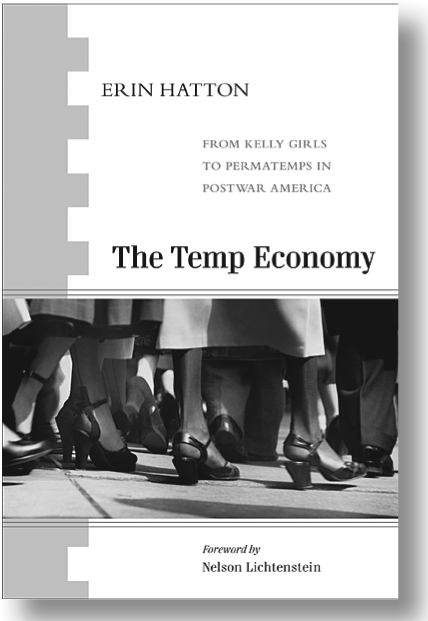
The Temp Economy: From Kelly Girls to Permatemps in Postwar America by Erin Hatton Temple University Press, 2011 232 pages
Intern Nation: How to Earn Nothing and Learn Little in the Brave New Economy by Ross Perlin Verso, 2012 286 pages

The Precariat: The New Dangerous Class by Guy Standing Bloomsbury Academic, 2011 192 pages

The temporary nature of jobs, the dismantling of social assistance programs, and the deepening of social inequality have made our work lives precarious. These three books speak to the foundations, features, and future of this precarity. Erin Hatton shows how the temporary staffing industry redefined conventional thinking about work, Ross Perlin investigates internships and their role in the devaluation of labor, and Guy Standing explores the political possibilities and pitfalls of the widespread erosion of security. Together, their work makes important contributions to our understanding of recent transformations in the labor market.
The Temp Economy is an especially original and compelling study. Hatton, a sociologist, draws upon a vast historical archive of advertisements, industry publications, popular media, court cases, and government reports to trace the social history of the temporary staffing industry and explain how it became so important, employing more than three million workers each day and utilized by an estimated 90 percent of employers each year.
Hatton focuses upon the “process of persuasion” through which temporary staffing industry executives marketed their services. “They had to penetrate not only the economy,” she argues, “but also the economy of ideas.” To manufacture and popularize demand for its product, the temporary staffing industry promoted a paradigm shift, rejecting the notion of workers as “profit-boosting assets,” and promoting instead the notion of workers as “profit-limiting liabilities”—costly, bothersome impediments to corporate success. Through the liability model, the temp industry helped chip away at employers’ obligations to workers and legitimate the managerial practices that have exacerbated the insecurity and vulnerability all workers now face.
Throughout the 1950s and 1960s, industry leaders promoted the Kelly Girl, marketing temporary work as “women’s work,” suitable for housewives seeking self-fulfillment or extra money. (They did so despite the fact that the ranks of temps included significant numbers of men.) The “women’s work” frame enabled the industry to distance itself from the vampiric and widely-condemned private employment agencies as well as from labor unions, which were overwhelmingly concerned with male workers in the industrial sector and saw little threat in this new category of respectable, but marginal or secondary, work.
By the 1970s, this gendered strategy fell by the wayside. Industry leaders were promoting the notion that all workers could (and, indeed, should) be replaced by temps. Dismantling the very strategy that had facilitated their early success, industry leaders framed the use of temps as a matter of sound business sense. Hatton shows how the industry’s marketing efforts came to target employers, rather than employees. Industry leaders tried to sell expertise in workforce management, convincing employers that their obligations to workers were an avoidable headache and that “overstaffing” was too costly. The temp industry promoted the idea that it made more sense to “rent” rather than to “buy,” to hire “half” rather than “whole” workers. By the 1990s, the temporary staffing industry—and the downstaffing, permatemps, payrolling, and outsourcing it facilitated—was firmly institutionalized.
Hatton’s sophisticated and succinct book justly positions the temporary staffing industry as a leading protagonist in the story about the transformation and degradation of work in the United States. Its greatest accomplishment is in documenting the fact that there was nothing inevitable about the “temping” of America and the resurgence of the liability model of workers; these were the result of deliberate and dogged efforts, waged in the realm of culture, to reshape conventional thinking about work.
Ross Perlin makes the same argument with respect to the explosion of internships. He documents how companies, universities, and government officials actively created and promoted a new job category. Like temp work, internships have become a principal gateway to the world of paid employment, shaping both the operations of and the opportunities within the labor market. Intern Nation is a much-needed addition to the critical scholarship on work, offering an engrossing journalistic investigation into what has become a thoroughly accepted feature of the neoliberal landscape of employment.
Like The Temp Economy, Intern Nation is primarily about cultural models and mindsets, as well as the ways we conceptualize and collectively devalue work and workers. It provides a biting indictment of our widespread complicity in the pernicious spread of perverse and exploitative employment arrangements. In this way, internships are a kind of smokescreen, shrouded in what Perlin calls a “useful ambiguity” that strips interns of workplace protections and holds them in legal limbo. Solid statistics on the internship phenomenon, he points out, are elusive because they aren’t tracked by government agencies.
Confined to the medical profession prior to World War II, by the 1990s internships were ubiquitous—the decade the “liability model of work” described by Hatton had become firmly entrenched. Today, millions work under the label of “intern,” and employers in both the private and the public sectors rely upon this cheap (often unpaid) army of aspiring laborers.
The temporary staffing industry transforms and degrades work.
Perlin provides a particularly poignant account of the role of colleges and universities in the seemingly inexorable spread of internships. In an aptly-titled chapter, “Cheerleaders on Campus,” he documents how schools lend their moral and intellectual authority to educationally dubious, even illegal, internship arrangements. By offering academic credit to students who take on internships, schools effectively “outsource” education and facilitate a pay-to-work scheme. Some colleges and universities go so far as to require that students take on an internship as a condition of graduation, turning campuses into feeding troughs for employers in search of disposable, entry-level workers. These arrangements help students pad their résumés, but they also teach them the insidious lesson that their labor is worth little or nothing. Perlin argues that there “exist[s] little moral compass in the Academy surrounding the value of work” and insightfully dissects the rhetoric of service learning, civic engagement, and experiential education through which colleges and universities legitimate their role in the internship frenzy.
Beyond its corrosive impact on work and higher education, the internship boom amplifies social inequality. Internships are now a barrier to entry in many professions, shutting out those who lack the personal or institutional connections to broker these positions and those who cannot afford to work without pay. What happens to the non-interns? Though Perlin refers to the hardening of divides along lines of class, race, and gender, these issues do not receive the attention they deserve. This patchy—but path-breaking—book calls for rigorous scholarly research on internships. It also prods us to rethink our complicity in a phenomenon that so fundamentally devalues work. “What has to change is more than a policy or a law,” Perlin concludes. “It’s a mindset.”
Perlin’s insight that “intern,” like “temp,” is a “status hopefully vaulted over as soon as possible” raises a set of questions and concerns that lie at the heart of Guy Standing’s The Precariat. Standing, a former official with the International Labour Organization, the United Nations’ agency for labor issues, argues that the neoliberal gospel of “flexible” labor and the consequent normalization of insecurity have shifted the class structure, giving rise to the precariat as a new social class. According to Standing, this class includes all the temps, interns, freelancers, contract workers, low-wage workers, welfare recipients, and unemployed who lack security, opportunities, sufficient income, opportunity for skill development, and representation in the workplace. Though far from homogeneous, what unifies these groups is the lack of a work-based or occupational identity and their experiences of anger, anxiety, anomie, and alienation borne from unattainable aspirations, blocked opportunities, and interminable insecurity.
Rife with sweeping and unsubstantiated generalizations that will irk some readers, The Precariat still includes important provocations and insights. Standing argues that the precariat are forced to devote a growing amount of time to what he calls “work-for-labor”—the unremunerated and time-consuming work that goes into navigating one’s way through the labor market. This includes registering with temp agencies, waiting for assignments, filling out forms, interning, sending out résumés, and networking. Living at the beck and call of potential users of their labor, the precariat are mired in “work-for-labor” and deprived of opportunities for more creative and inventive uses of their time. As Perlin put it, “internships are boring us, and they’re making us boring… [t]hey have come to embody the ethos that all free, unstructured time should be harnessed for résumé-building and career development.”
The neoliberal gospel of “flexible” labor has given rise to the precariat: a new social class.
Standing’s book should be read as a rhetorical and political intervention, rather than a theoretically-nuanced rethinking of class structure. It’s aimed at mobilizing workers against the social and economic structures that produce their shared vulnerabilities. At present, he argues, the precariat is a “class-in-the-making,” since fear and insecurity have generated all kinds of scapegoating and scorn that have weakened the bonds of class solidarity. This is why Standing calls the precariat an “incipient and dangerous political monster,” capable of being caught up in the “politics of inferno.” He advocates for a progressive and even utopian “politics of paradise” that could bring about economic and representational security for all. Standing claims “moving from symbols to a political programme is what this book is about.” Yet, while the book does a great job of promoting the precariat as a politically-potent symbol, a rhetorical umbrella to cover workers in disparate situations across the globe, it falls short of examining the concrete obstacles to building alliances and of outlining how the politics of paradise might be achieved.
These three books offer an array of proposals for ameliorating the most egregious forms of worker exploitation, mitigating the worst instances of precarity, and ending the corrosion that stems from the devaluation of labor. What they collectively make clear is that culture matters: the concepts and frameworks we use to think and talk about work have real consequences for the economy we create.