



Abstract
The share of jobs that are low-skill declined by 15% from 1960 to 2005, yet low-wage jobs have made up an increasing share of total job growth over that period. Scholar Matt Vidal discusses how the manufacturing-based, nationally bound economy of the postwar years allowed employers to pay decent wages for low-skill jobs, but in today’s postindustrial, internationalized economy, wage-based competition has returned with a vengeance.
Keywords
The Occupy movement brought the topic of economic inequality into mainstream political discourse with the simple slogan: “We are the 99 percent.” The outrage of Occupy was directed at the top 1 percent of the population, an elite class consisting mainly of investment bankers, corporate executives, and lawyers who currently own 35 percent of total net wealth in the United States.
After 45 years of technological progress and globalization, low-skill jobs continue to account for 35 percent of total employment.
But to fully understand economic inequality in America, we need to account for the stagnation of living standards experienced by tens of millions of Americans over the last three decades. To do that, we need to examine the growth of bad jobs.
The standard explanation for rising economic inequality is that computer-based technology has generated growing demand for highly skilled workers. That demand has outpaced supply, leading to a wage premium for such skilled workers. The cure is for the rest of the workforce to get more education. This is the perspective of mainstream economists, who focus their explanation almost exclusively on technology. The central problem with this analysis is that it ignores the fundamental issue of structural demand for low-skill occupations such as retail sales, food service, building maintenance, personal service, and healthcare support.
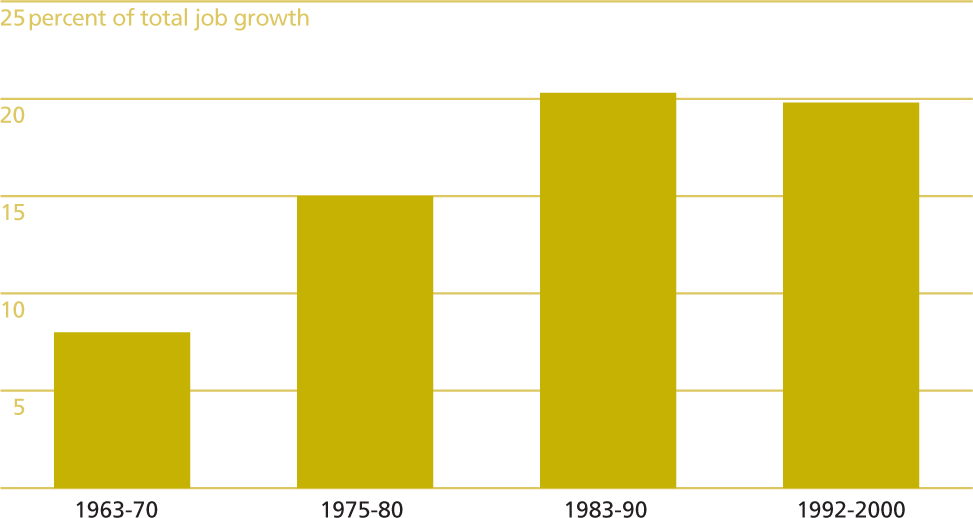
In 2005, fully one-quarter of the U.S. workforce was working in a low-wage job (based on the standard definition of a job paying less than two-thirds of the median wage). As Erik Wright and Rachel Dwyer showed in a 2003 article in Socio-Economic Review, low-wage work has accounted for an increasing proportion of total job growth in recent decades. They divided all jobs into five wage quintiles and examined periods of job expansion over four decades, finding that the lowest-wage quintile accounted for just 8 percent of total job growth in the 1960s expansion, but 20 percent in the expansions of the 1980s and ‘90s (see chart on bottom left).
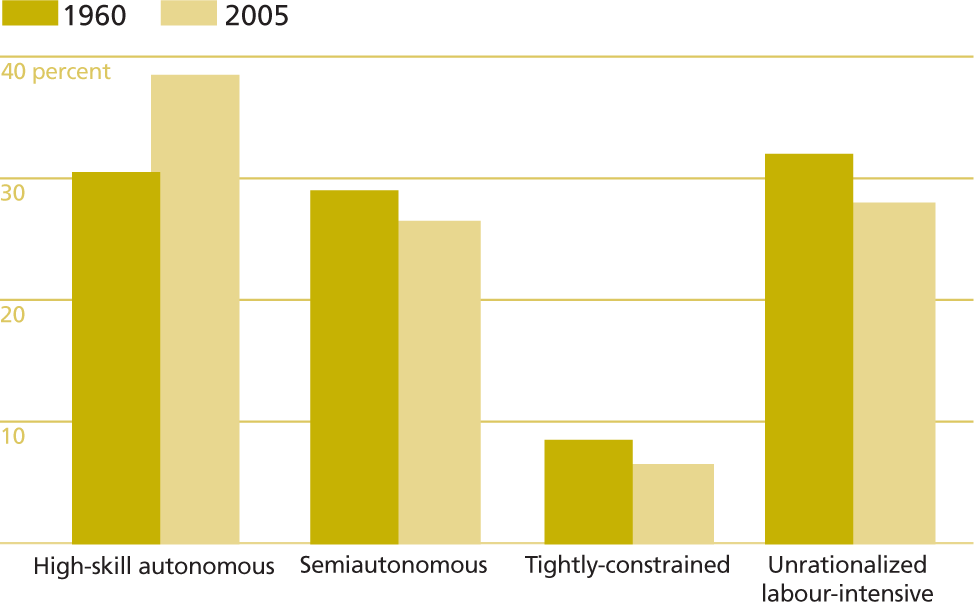
To help explain this trend, I examined shifts in the employment structure using a typology developed by Stephen A. Herzenberg, John A. Alic, and Howard Wial in their book New Rules for a New Economy. They distinguished four generic job types: high-skill autonomous work (e.g., executives and professionals), semiautonomous work (e.g., supervisors and secretaries), tightly constrained work (e.g., clerks, cashiers, assemblers, and machine operators), and unrationalized labor-intensive work (e.g., waitstaff, cooks, nursing aids, and janitors).
The latter two types—tightly constrained and unrationalized labor-intensive jobs—are low-skill by definition. They are the most likely to be low-wage jobs. Based on the growth of low-wage jobs, then, we would expect to see a rise in low-skill work. However, when I coded 840 detailed occupations from Census data into the four types for 1960 and 2005, I found a 15 percent decrease in low-skill jobs’ share of the workforce (see chart on bottom right).
There are two key findings here. First, low-wage work has risen despite a decline in low-skill jobs. This may imply that some higher-skill jobs have become low-wage, but here I want to emphasize how the economy used to provide decent pay for low-skill jobs in a way that it no longer does. Second, after 45 years of technological progress and globalization, low-skill jobs continue to account for 35 percent of total employment.
In a sluggish economy, new jobs often mean low-wage jobs.
AFP/Getty Images

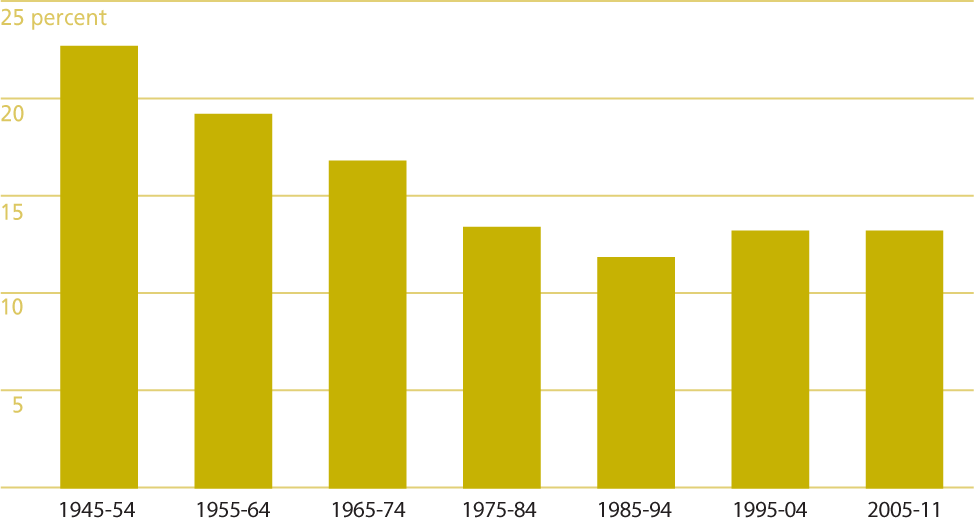
The corporate profit rate in the United States dropped from a postwar high of 26.8 percent in 1951 to a low of 9.4 percent in 1982.
The Breakdown of the Postwar Class Compromise
To understand the growth of low-wage work, it is helpful to analyze the underlying class dynamics of the U.S. economy over time.
The average profit rate is central to the health of the capitalist economy. However, as Karl Marx argued, there is a tendency for the profit rate to decline because labor is the source of profit, and competition spurs capitalists to substitute machines for labor. Indeed, while the corporate profit rate in the United States was high during the 1950s and ‘60s, it dropped from a postwar high of 26.8 percent in 1951 to a low of 9.4 percent in 1982 (see chart on page 72, top left).
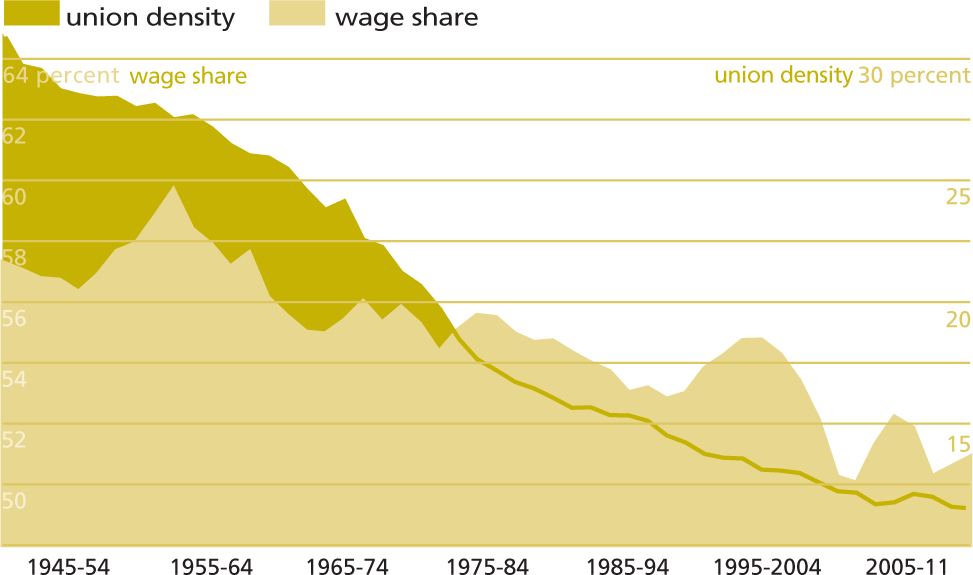
Under intensified international competition and a declining profit rate, capital embarked on a wave of corporate restructuring. One outcome has been a decline in the wage share (total national income can be divided into profits and wages) from a high of 59.9 percent in 1970 to just 50.7 percent in 2011. The high profit rate of the 1950s and ‘60s allowed a class compromise between capital and labor. Real wages rose. As the profit rate began dropping under intensified competition and increasing capital intensity in the economy, capital abandoned the class compromise and began to recover profits by reducing wages.
As the chart on the top right of the next page shows, deunionization and the declining wage share are highly correlated. This does not imply causality, but our standard understanding of what unions do strongly suggests that deunionization played a key role in the declining wage share. Deunionization, however, is best thought of one indicator of a broader shift in employment relations. Specifically, in the 1950s and ‘60s, business operated under a dominant logic of employment internalization, in which “best practice” was understood to include internalizing activities, developing internal labor markets, and protecting workers from market forces. As a result, a large percentage of low-skill jobs provided security, opportunities for training and promotion, and decent pay through administratively-determined wages associated with positions rather than individual workers (and patterned on union contracts in the auto sector).
Growth in lowest-wage job quintile during job expansions
Source: Wright and Dwyer (2003)
Employment by job type
Source: IPUMS Census microdata
Corporate profit rate since WWII
Source: BEA data (corporate profit/corporate net capital stock)
The wage share of national income and union density
Source: Wage share: BEA; Union density: OECD
The high profit rate of the 1950s and ‘60s allowed a class compromise between capital and labor.
Employment internalization and the good wages it brought were made possible by the institutional context of a nationally-bound economy with a core of large manufacturing employers engaged in oligopolistic competition.
Under the pressure of declining profits and rising international competition, the dominant logic of employment became one of externalization. This included outsourcing, downsizing, and lean staffing strategies (which reduced opportunities for training and promotion); deunionization; part-time and temporary employment; and a return to market-determined wages even for full-time, long-term jobs.
After the corporate restructuring of the 1970s and ‘80s, the core of the now-internationalized and reconfigured domestic economy was service-based—among the 10 largest employers in 2005 were Wal-Mart, UPS, McDonalds, Yum! Brands (Taco Bell, KFC, and Pizza Hut), Kroger and Home Depot. In the context of a postindustrial, internationalized economy, wage-based competition returned with a vengeance, hitting core sectors of the economy, even those not subject to international competition.
This analysis suggests that mainstream economists, and the politicians who echo them, are missing the mark. Increasing education levels across the population is a good in its own right. But with the postindustrial economy generating an occupational structure in which 35 percent of all jobs produced are low-skill jobs, education is no panacea.
We must develop institutions that allow workers who are willing to fill the demand for long-term employment in low-skill jobs to receive a living wage. As Annette Bernhardt argued in a 2012 article in Work and Occupations, establishing such institutions will require a multipronged, multi-level effort. Necessary interventions include reforming labor law to make it easier for workers to organize unions (based on something like the Employee Free Choice Act) and establishing a strong floor standard for wages (and health and safety). Critically, such standards need to be vigorously enforced; as Bernhardt notes, there is “a growing body of research suggesting that wage theft and other workplace violations are on the verge of becoming common business strategy in low-wage industries, impacting millions of workers—from hotel room cleaners, dishwashers, retail sales workers, and home health aides to garment factory workers, taxi drivers, janitors, and construction laborers.”
There have been some notable successes at the local level, including living wage ordinances in Baltimore, Boston, Los Angeles, and San Francisco. And much of the enforcement of a higher floor of basic workplace standards must occur at the local and state level. Ultimately, though, fixing the American economy so that all workers willing and able to put in a full day’s work are lifted and remain out of poverty requires progressive federal legislation on labor law and a living wage covering all workers.