




Abstract
As media outlets move away from the term “illegal immigrant,” Edwin F. Ackerman uses media analysis to track the rise of the term–and others–since the 1920s.
“It is illegal to cross into this country illegally, it is illegal,” Representative Duke Cunningham (R-CA) stressed in a Congressional debate in 1996. The circular logic in statements like these signaled an end-point of sorts in public discussion. The language of illegality has permeated the conversation about immigration in the past decades to the extent that arguments have become tautological: illegal aliens should not be legalized because they are illegal. In the country’s last full-blown debate on the issue—the Senate’s contemplation of an “amnesty bill” in 2006—both sides of the aisle argued whether granting legal status to undocumented immigrants constituted a “reward” for law-breakers.
Journalist Lawrence Downes described the problem with this way of thinking in a 2007 piece for the New York Times: “America has a big problem with illegal immigration, but a big part of it stems from the word ‘illegal.’ It pollutes the debate. It blocks solutions… Since the word modifies not the crime but the whole person [as in “illegal immigrant”], it goes too far. It spreads, like a stain that cannot wash out. It leaves its target diminished as a human, a lifetime member of a presumptive criminal class… The paralysis in Congress and the country over fixing our immigration laws stems from our inability to get our heads around the wrenching change involved in making an illegal person legal.”
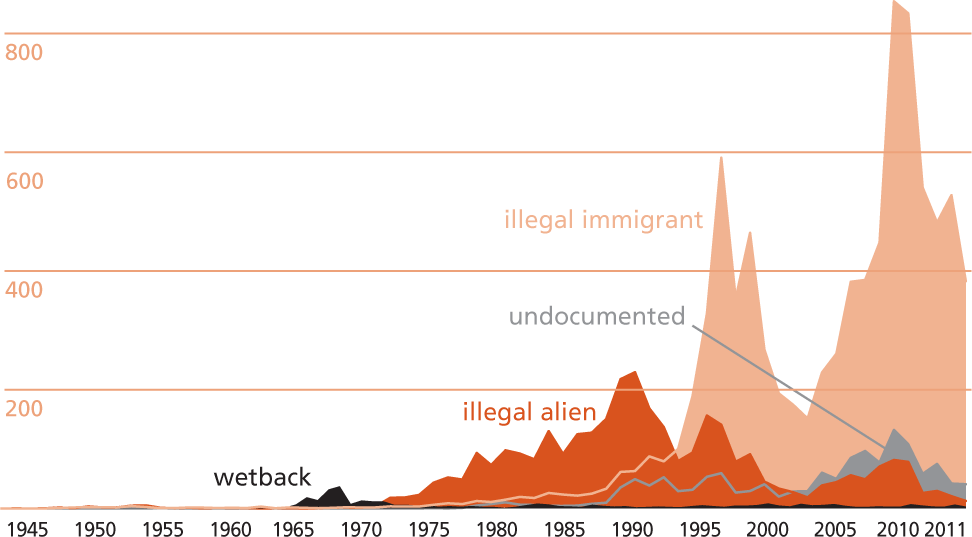
Media terms 1945-2011 per 100,000 news articles
Source: The New York Times, The Los Angeles Times, and The Chicago Tribune
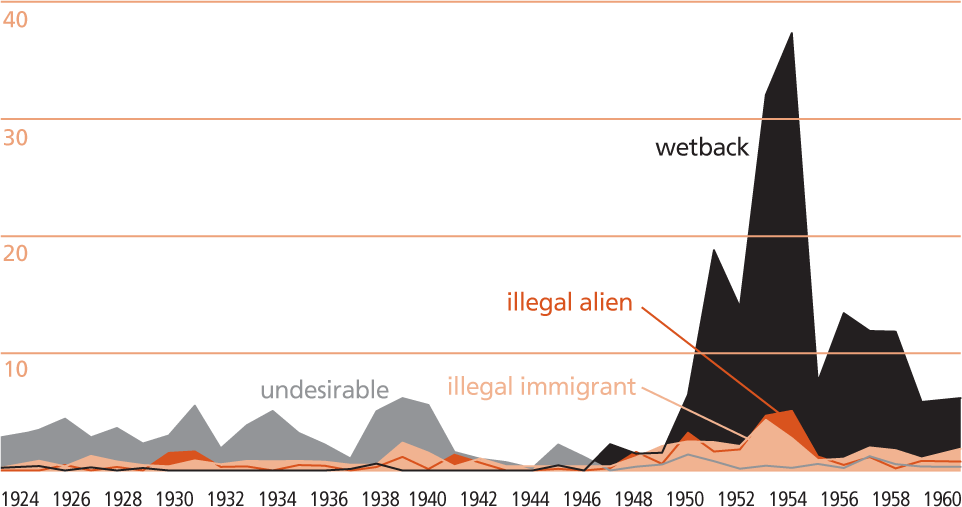
Media terms 1924-1960 per 100,000 news articles
Source: The New York Times, The Los Angeles Times, and The Chicago Tribune
“Drop the I-Word,” a public education campaign launched in 2010, generated a national controversy last year when it pressured the Times and Associated Press to drop the use of the phrase “illegal immigrant.” The pressure increased in April 2013 when Pulitzer Prize-winning journalist José Antonio Vargas (who came out publicly as an undocumented immigrant) and Cesar Chavez’s son, Fernando Chavez, delivered a “Drop the I-Word” petition with 70,000 signatures to the Times. Later that month, the AP announced it would modify its stylebook to specify that “illegal” could refer to an action, but not to a person. And in May, the Los Angeles Times issued a statement that it intended to modify its use of “illegal immigrant” similarly. However, Margaret Sullivan, the Times’ public editor, recommended the continued use of the term, citing its practical qualities (being “brief and descriptive”) and agreeing with the newspaper’s immigration reporter Julia Preston that the term was essentially “neutral.”
Framing Trends in Unauthorized Immigration
The concept of “illegal immigrants” and what the words connote may seem standard today, but it wasn’t always that way. Unauthorized immigration has existed in the U.S. since the inception of immigration laws in the late 19th century and early 20th century. And it has been the subject of heightened public attention before: during the Great Depression, for example, or in the mid-‘50s, when the federal government deported over one million immigrants through “Operation Wetback.” But the way we’ve talked about unauthorized immigration—the way we’ve framed what we see as the problem with it—has changed over the course of the past century. Earlier eras were not any more “pro-immigration”: eugenics, closed-minded notions of “moral turpitude,” and suspected affiliation to feared political currents determined what the country saw as undesirable about unauthorized immigration. Still, the breaching of immigration law was not considered, in and of itself, a central issue.
The prevalence of the adjective “illegal” to describe unauthorized immigration is a fixture of the last quarter of the 20th century. According to legal scholar Gerald Newman, prior to 1950, there is no mention of the word “illegal” in judicial decisions concerning immigration. A look at Gallup poll questions going back to 1936 shows that “illegal” immigration was not part of any questionnaire until 1977. And, as social geographer Joseph Nevins has documented, in 1924, when the Border Patrol was born, the most commonly used term in major newspapers was simply “aliens.” By 1954, during the time of Operation Wetback, “illegal” was used in only a quarter of references to unauthorized immigration. In 1977 the term “illegal alien” was present in 76% of the references. It was in 1994, during the controversy over Proposition 187 in California, that the term reached saturation. With the law, which called for suspension of public services to persons lacking documentation, we saw the term “illegal” in 90% of the cases.
Cassandra Conlin

I’ve traced the year-to-year incidence of terms like “illegal alien,” “illegal immigrant,” “illegals,” “undesirable alien,” “alien,” “undocumented immigrant,” “undocumented alien,” “wetback,” and others in the LA Times, the New York Times, and the Chicago Tribune from 1924-2011. These newspapers are prominent media sources and are located in areas of the country that have received a significant number of immigrants. I began my analysis in 1924, when the current deportation laws were first established. The left graph shows the total number of articles (every type of piece, except ads) that mentioned the words “illegal alien,” “illegal immigrant,” “wetback,” and “undocumented.”
Illegality was not a framework for public debates about unauthorized immigration for the better part of the 20th century.
The data represented in the graph reflect the total number of articles containing one of the searched-for words divided by the total number of newspaper articles per year in order to control for the changing number of articles throughout the period and to know the rate of use of the term at different points of time. The rise of the term “illegal alien” begins around 1969 and has a large and constant increase throughout the following decade; after reaching a highpoint in the late ‘80s, it wanes, replaced by the now-dominant “illegal immigrant”. We can also see the increased use of “undocumented” beginning in the late ‘90s, though this term remains marginal, used mostly by advocates and activists’ circles. In the righ-hand graph, we can see that from the ‘20s to the ‘40s “undesirable” held some sway, and that “wetback” was important during the ‘50s and ‘60s. “Illegal” was completely insignificant before 1960.
The prevalence of “illegality” as a frame is not simply the result of an increase in the total number of unauthorized immigrants in the country. During the 1970s, when the use of “illegal” was on the rise, the percentage of immigrants (including undocumented immigrants) relative to the total population of the U.S. was actually lower than in previous decades. The number of potentially deportable immigrants peaked in 1954, yet the language of illegality was largely absent from public debate at that time. The more recent rise in the focus on illegality is not the result of new laws being put in place or a simple spike in the number of unauthorized entries. “Illegal immigrant,” as a term, is the direct result of politicians, activists, and government agents working to shape the debate in this direction.
The 2006 Congressional debate saw the recasting of the foundational myth of America as a “nation of immigrants” as referring to a particular type of immigrant: “legal.” For instance, Congressman Lamar Smith (R-TX) exhorted, “We are the great nation we are today, the most prosperous, the freest country in the world, because of the contributions legal immigrants have been making for generations…” Robert Goodlatte (R-CA) was more succinct: “While we are a nation of immigrants… we are also a nation of laws.”
The conceptual parameters of illegality stalled the debate about undocumented immigration in the U.S. Previous ways of looking at the issue weren’t any better, but the basic lesson learned from this overview of terminology is that there is nothing automatic about the category of the “illegal immigrant.” There is no obvious reason why we should frame the debate over unauthorized immigration as fundamentally an issue of lawfulness. To this day, unlawful presence is considered only a civil offense (entry without inspection is a misdemeanor; repeated entry without inspection is a felony). As a socially constructed category, the notion of the “illegal alien” is unstable—and that means change is always possible.