




Abstract
Sociologist Pamela J. Smock reviews two recent monographs on the topic of singlehood. One, Going Solo, is authored by sociologist Eric Klinenberg and the other, Single: Arguments for the Uncoupled, is authored by English professor Michael Cobb.
Keywords
Single: Arguments for the Uncoupled By Michael Cobb New York University Press, 2012 239 pages

Going Solo: The Extraordinary Rise and Surprising Appeal of Living Alone By Eric Klinenberg Penguin Press, 2012 288 pages
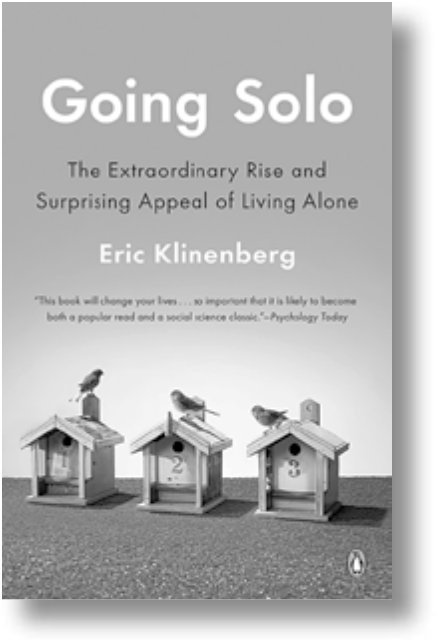
Eric Klinenberg’s new book, Going Solo: The Extraordinary Rise and Surprising Appeal of Living Alone, grapples with the upward trend in the proportion of “singleton” households—that is, households containing only one person. In 1960, 13 percent of all households in the United States were singleton, a percentage rising to 27.4 last year. Klinenberg views this trend as reflecting the “cult of the individual” that has flourished for a number of reasons. These include the rising status of women, the communications revolution (one can be home alone but socializing via social media), urbanization, and increased longevity. Cities, Klinenberg argues, allow people to connect by just stepping out of their apartments. And increased life spans, particularly for women who are likely to outlive their spouses, result in many older adults living alone for substantial periods of time.
Klinenberg takes us on a compelling journey that explores how various subgroups confront issues of living solo: young professionals, the divorced, disadvantaged men living in single occupancy residences, and the elderly. Going Solo is the result of a seven-year project involving hundreds of in-depth interviews mainly with “singletons,” but with caregivers, governmental officials, and activists too. It also draws on archival research, published studies, and ethnographic observations in settings where people live alone together, including assisted living facilities and apartment buildings. The seven years was well worth the author’s labors. Going Solo is a splendid achievement and a must-read for those interested in large-scale social and demographic changes that have significant impacts on individual lives and society.
Klinenberg masterfully weaves a narrative that is simultaneously accessible and deeply sociological. The result is a fascinating, lively and nuanced account of the meaning and lived experience of living alone. While the author acknowledges that living alone does not necessarily mean being alone or even being lonely, he also shows us that sometimes it does. This is particularly the case for the disadvantaged and some of the elderly. Throughout the book, Klinenberg acknowledges a social class divide that makes “going solo” easier, more manageable, and less isolating for the economically advantaged. To his credit, Klinenberg thoughtfully considers ways that social isolation can be remedied. Affordable and high quality assisted living communities as well as affordable housing for younger singletons would help.
But as someone who studies family patterns and change and how these intersect with various axes of inequality, I found it striking that Going Solo, while drawing on some of the demographic literature, appears disconnected to what many researchers are studying. Whereas Klinenberg presents a picture of increased solo-ness, family demographers are studying the increasing fluidity and flux in family life and the astounding rise in nonmarital cohabitation. Some scholars, in fact, use the term “cohabitation revolution.”
In 1960, 13 percent of all households in the United States were singleton, rising to 27.4 percent last year.
Consider the following: While only 10 percent of marriages taking place in the 1960s and 1970s were preceded by cohabitation, data from 2006 to 2010 suggest that over 60 percent of men and women cohabit prior to their first marriage. Cohabitation looms extremely large in the lives of young adults today. One of Klinenberg’s concerns is the trend in age at marriage. While it is true that marriage is increasingly delayed, as he tells us, it is also true that when cohabitation is taken into account, young people today are moving into coresidential intimate relationships at about the same age as earlier cohorts did. Cohabitation has “made up,” in some sense, for the delay in marriage. Today, nearly half of U.S. men and women have cohabited by age 25. Cohabitation is also replacing remarriage for divorced individuals.
You’d never know this from Going Solo. The book is nearly silent on cohabitation, and the word does not even appear in the index. Certainly, Klinenberg sampled singletons purposefully. Still, the book’s disconnection from the concerns of many family demographers is interesting and a bit disconcerting.
Why? I would speculate that many young singles, including the young professionals that constitute Klinenberg’s focus, are not actually living alone most of the time. They may not identify themselves as living with anyone, despite spending substantial time with partners. While these young adults are in the privileged financial position of not requiring a roommate or a partner for economic reasons, they may be practicing something more like “quasi-cohabitation,” keeping their own places but spending, say, three or four nights per week together with their partners. A related arrangement, first studied by European demographers, is a “Living Apart Together” relationship: committed relationships in which partners live separately much of the time.
A challenge for studying families and households is that things are always changing—even as I write these words. Therefore, I have a quibble with one of Klinenberg’s claims. In the introduction, he asserts that living single is a quite stable living arrangement. This is an important statement; Klinenberg uses it to enhance the significance of living solo. Living alone, in other words, is not just a brief spell; its duration makes it even more consequential. Yet the study on which this claim rests used data from 1968 through 1980. Survey data from three to four decades ago is far too old to be used to bolster claims about the length of living alone today.
This is a minor quibble in relation to Klinenberg’s outstanding work, to be sure. But when characterizing contemporary families or households, family demographers and sociologists know that we must draw on the most recent data. Otherwise, the odds are that we are not going to get the story quite right.
Michael Cobb, author of Single: Arguments for the Uncoupled, would agree with Eric Klinenberg that living alone, or at least being single, is a “public issue,” in the words of sociologist C. Wright Mills, and not simply a private one. But in almost every other way, Cobb’s book differs from Klinenberg’s.
Cobb seeks to unpack the meanings of coupledom and singleness in order to leave a space for singles that is not seen and understood simply in relation to couples. I cannot assess his arguments that speak to literary criticism and poststructuralist theory.
Living alone does not necessarily mean being alone or even being lonely, but sometimes it does.
Nonetheless, I found the book remarkably good and thought provoking. For me, it was also deeply affecting, catalyzing a number of memories and reinterpretations of experiences in my life. A case in point: around 1991, while I was in graduate school at the University of Wisconsin-Madison, the social science data librarian, who was probably in her mid-30s at the time, mentioned that she owned her own home. I knew she was single, and I was surprised. I pondered why she wasn’t waiting to buy a home as a couple. (Recently I learned she had owned that house since she was in her 20s. That may well have surprised me even more at the time.) Of course, I laugh at my response in hindsight, but my reaction is relevant to Cobb’s purpose and arguments.
Fast forward to 2007: soon after selling my condo and buying a house, I was chatting with my new neighbor. She asked, in a pleasant yet slightly scolding tone: “What are you doing living in a house like that all by yourself?” I was startled; it sounded as if I had a “problem.” Or there was a problem.
Or was I the problem?
Well, apparently I am not the problem—or at least I don’t have to be. Cobb writes, “Singleness is…always figured as a conundrum, and if all goes according to plan, a conundrum to be solved by coupling off, and as soon as possible.” (Ah, yes, the encouragement and advice I frequently receive about meeting “someone.”) Love predicated on the supremacy of the couple, Cobb notes, “insists that the whole world should be created, sustained, or connected by a relationship” with just one other person.
Cobb’s arguments draw on a vast array of materials. They range from HBO series Sex and the City and Big Love, to Georgia O’Keefe to Beyoncé to Herman Melville’s Bartleby the Scrivener, to his own five-hour hike in the Capitol Reef National Park in southern Utah.
Take Sex and the City, based on the novel by Candace Bushnell. As Cobb notes, the book and series were designed to address one burning question: Why are such fabulous women “still single”? It is not, as Bushnell purported, because they want to be, Cobb observes. In the end, the series (and film sequels) convey the message that being single is not really desirable; all the women are married or coupled off for significant durations. Indeed, having watched every episode of this series, it is clear to me that the characters are obsessed with relationships whether in one or not.
So how does Cobb argue for the value of aloneness and singleness? His approach is to “strip away the pathologizing dynamics of coupledom that attach to the individual a bitter affect we might call loneliness.” Being coupled, then, does not protect against loneliness, and may in fact increase these feelings because one lives in constant fear of the other’s death. One of Eric Klinenberg’s older interviewees said, “nobody worries about dying married.” Yet, Cobb argues, this is precisely what members of couples do fear.
Cobb drives home this point in his analysis of the film Love Story and the series Big Love. Rather than being the safe province of “forever,” coupledom is actually quite fragile, and one cannot find eternity in love. He posits that the durability of the couple requires that both survive; the death of one member of the dyad is not only his or her death, but also the death of the couple. As Cobb writes, “our loves will last forever only if we overlook a thing our bodies share—our bodies will die.” In his incisive scrutiny of a particular episode of Big Love, a series about a Mormon family that practices polygamy, Cobb concludes that it “disturbs one into a sense about how marriage and family, polygamous or not, religious or not, are relationships inflected with an overwhelming sense of worry about ‘forever.’”
Cobb’s book certainly disturbed, or rather upended, categories for this reader, clearing the space for singleness as something worthy in and of itself. It need not exist as a transitory state to coupledom, or as a category only to be understood in relation to being coupled. While I sometimes felt a bit dizzy reading Single, it was a great ride.