




Abstract
Fredric Jameson’s new reading of Marx’s Capital, vol. 1 uses Marx’s account of the accumulation of capital in the form of producer goods to argue that a rising rate of structural unemployment is a fundamental tendency of capitalism as Marx understood, thereby challenging a “workerist” view of how Marx though capitalism could eventually end. Scholar Robert Meister argues that Jameson fails to grasp the role financial thinking in Marx’s account of the dual role of producer goods as both means of production and financial assets, and uses this account to sketch a view of the role of financial asset markets in production that builds on a Marxian foundation.
Keywords
Representing Capital: A Reading of Volume One by Fredric Jameson Verso, 2011 176 pages
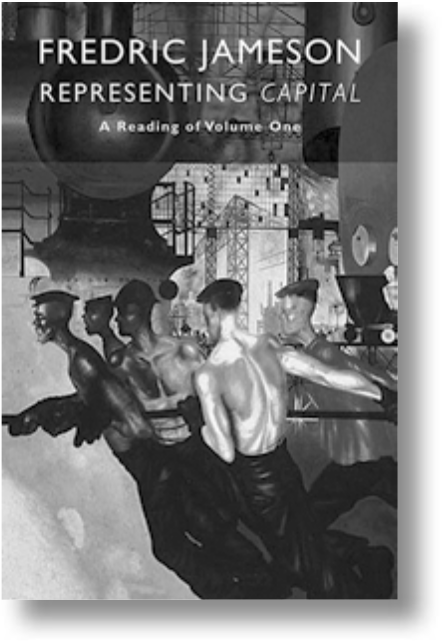
Is Karl Marx’s Capital needed to understand what’s wrong with capitalism today? Fredric Jameson, our foremost academic Marxist, argues that it is, and that the Capital we need is still Volume I. Put crudely, Jameson claims that Marx’s overarching achievement in Volume I is to show simultaneously that the capitalist system does and doesn’t work. The reason is that in capitalism, as Marx describes it, the proportion of capital reinvested in hiring workers declines even as the system of commodity production expands the total labor force. Capitalism thus “inevitably” produces a surplus population through the same process by which it creates economic growth. In Jameson’s formulation, “non-work” has always been as important as work in Marx’s account of capitalism because an increasing portion of the industrial labor force consists of a “reserve army” that includes “people who will never work and who are indeed incapable of working,” but who are nevertheless supported by the system.
According to Jameson, the “scandalous” message of Capital is that proletarianization and unemployment are integral parts of capitalism.
For Jameson the “scandalous” message of Volume I is thus that both proletarianization and unemployment are integral parts of capitalism seen as a whole. The whole of capitalism here acts upon these parts to produce what Jameson calls the “mechanical” result (in Marx an “absolute general law of capitalist accumulation”) that in successive rounds of production the relative amounts of capital that is reinvested in hiring workers must diminish so that the surplus value that was created in previous rounds can be accumulated in the form of producer goods and money. This is, Jameson claims, how capitalism works as a system for refinancing production on an expanded scale—and also how it doesn’t work as a system for supporting the labor force on which it depends. We here get an account of Capital, Volume I that would seem to explain the present decline of the industrial labor force in Europe and the United States as a fundamental tendency that was present from the beginning in capitalism “as such.”
The main flaw in Jameson’s approach lies in his assumption that Marx’s “absolute general law” can be mechanically applied to our present situation, a mistake that ultimately reflects a deeper misunderstanding of how and why much of Marx’s reasoning in Volume I is a valid starting point for the theory we need now.
Marx’s “general law” was meant to explain something that was not self-evident to previous theorists of the market mode of production—the specifically capitalist imperative to increase the productivity of labor through technology. He saw that the explanation could not lie in the assumed desire of the capitalist for a larger aggregate surplus value. If this were the driving force, why would he not just hire more workers for as long as they are available, instead of investing in expensive machinery that would eventually drive down his selling price per unit? Marx’s precursors, Adam Smith and David Ricardo thought that the capitalist would be biased in favor of higher employment for this very reason—a strategy that Marx called the production of “absolute surplus value,” which, as he pointed out, could also be increased by lengthening the working day of existing workers. Marx then went on in Volume I to distinguish “absolute surplus value,” which explained the mode of production described by Smith and Ricardo, from the capitalist’s production of what he called “relative surplus value.” It is the pursuit of “relative surplus value” that explains capitalism’s bias in favor of productive technologies that reduce rather than increase employment. Marx shows this by introducing the logic of finance into the market mode of production described by Smith and Ricardo and then by asking what effect this has on the reproduction of the social relation between labor and capital that they described.
By largely ignoring finance, Jameson misses the key to relative surplus value for Marx, which is that surplus created in a previous production cycle (if it is not simply hoarded as money) can be preserved in the next cycle only through expanded reinvestment in producer goods such as raw materials. The reason that producer goods, which are means of production, can also function as vehicles of capital accumulation is based on the financial principle that each identical unit of output must be sold at the same price. This principle (now called “the law of one price”) favors those who can produce more units in the same amount of labor time and thus compels investment in productive technologies that throw people out of work while increasing material output. From the standpoint of finance, capitalist investment in productive technology is, however, simply an example of how an arbitrage opportunity is created in one’s investment in the materials by creating a spread in the per unit cost of the finished product. By enabling the investor in technology to financialize that cost-spread producer goods do double duty as both means of production and as financial assets—that is, as vehicles for capital accumulation.
In Marx’s distinction between absolute and relative surplus value, we thus see the contrast between the capitalist as a financier who can increase his return on constant capital through technological innovation and the capitalist as employer who operates in the manner described in earlier accounts of the market mode of production, such as those of Smith and Ricardo. In summary, relative surplus value explains the effect of capitalism on technological change; absolute surplus value, the exploitation of wage labor, explains the effect of capitalism on population growth. Marx’s “general law” brings these two logics of surplus value together for the first time by showing the impact of finance on production.
Capitalism works as a system for refinancing production on an expanded scale—but doesn’t support the labor force on which it depends.
By not paying attention to finance, Jameson misses the historical specificity of Marx’s “general law.” That law describes the destabilizing financial logic of creating cost/price spreads through the use of labor-saving technologies, thus allowing real accumulation of capital to occur through growth in the total volume of producer goods and not in other ways. When Marx wrote, however, there were no technologies for valuing financial assets except producer goods (which were already priced as commodities) and of course money itself. Marx thus observed that emerging financial assets that were neither producer goods nor money were “fictitious” in the sense that they were not a form in which real, as opposed to merely speculative, accumulation had taken place. Following Marx’s treatment of non-productive assets, Jameson likewise insists that pure financial products, such as debt instruments and options, are fictitious in the sense of being “untheorizable.” But what if the germ of today’s financial asset markets was already present in the capitalism Marx described but could not yet fully theorize?
We can see that in embryo the pure financial asset was present at the very start of capitalism if we remember that capitalist commodity production could be financed (for the purpose of advancing rent, wages, etc.) and that its by-product was a debt secured against a future commodity. The ability of the capitalist to pledge his future commodity as collateral meant that his product, more precisely his right to appropriate the surplus from it, was already capital even before it was a commodity. This explains why he could always have financed commodity production and is one reason Marx called his book on the commodity form “Capital.” Another reason is that a capitalist can not generally borrow 100 percent of his investment costs against the commodity to be produced: he usually needs some initial capital to get credit, which explains why not everyone can be a capitalist.
Marx’s anticipation of modern finance theory in his account of relative surplus value provides the kernel for a theory of the role of capital within capitalism, which is what we now need. Capitalism is a distinctive socio-economic formation in which financial asset markets exist in tandem with commodity markets in goods and services. For Marx, however, the existence of a “money form” of capital introduces the risk that investments in producer goods will not be realized in the market price of end products in which case the process of accumulation is reversed. Today, however, non-productive technologies create financial products that can hedge by pricing (i.e., monetizing) the spreads in the return on investing in producer goods in much the way that investing in labor-saving technologies of production can do in Marx’s account of relative surplus value. The essence of these financial technologies is to create spreads and then to “capitalize” them by treating them as a form of collateral that can be used to secure and ultimately accumulate economic value. This is what happens when the logic that Marx applied to investments in raw materials when technology varies (and that Ricardo applied to farmland when fertility varies) is now applied to debt instruments, such as bonds, when credit risk varies in order to produce purely financial assets through which capital accumulation occurs without the intermediation of commodity production.
The germ of today’s financial asset markets was already present in the capitalism Marx described.
So, what is the long-term effect of financial asset markets on the production process for goods and services? Jameson recognizes that an account of finance is missing from his representation of Capital, Volume I. He addresses this with two footnotes about sociologist Giovanni Arrighi, whose 1994 book, The Long Twentieth Century, says that capitalism’s periodic turn to financial speculation is always a symptom of declining profits in production. While Arrighi is a fine place to start, surely there is more to say about the financial logic that makes productive investments literally optional for capitalists today. Marx described this as the problem of “realizing” anticipated value in today’s market price. Today we talk about the necessary gap between “historical” and “implied” volatilities in pricing. Connecting these concepts back to Marx’s realization problem might be a better place to start.