




Abstract
How did queens rule come to rule reality television? Sociologist Joshua Gamson argues that the rise of segmented cable television, and of consumption-friendly subgenres, have invited style gurus, best-gay-friends, and queer worlds into the refracted spotlight.
There was a time, long ago, when nary a queen could be found on American television. A flamboyant man occasionally appeared—Paul Lynde on The Hollywood Squares, Charles Nelson Reilly on Match Game—to provide double entendre and closeted camp. Or, as on Three’s Company, a straight character might feign neutered queeniness in the service of heterosexual pursuits. Those days are gone, as openly gay queens have found a comfortable, if sometimes controversial, spot on television ever since Jack McFarland jazz-handed his way onto Will and Grace. Effeminate men on sitcoms from Glee to Modern Family still provide some of the same bon mots and stereotypical gesturing as their predecessors, but they’re unapologetic, regularly eliciting respect from other characters. Reality television, even more, is now rife with queens, and they’re often in charge. It’s as if Paul Lynde jumped down from his center square, called in reinforcements from daytime talk shows, and took over the place.
Reality television has exaggerated the gay-man-as-style-maven role.
I am fiercely pro-queen, so I’m not complaining, but I am wondering: How did this happen? In the off-television world, despite the mainstreaming of much gay life, effeminate boys and men remain prime subjects of ridicule, marginalization, and violence. So how and why did such gay men become reality television fixtures, and what are we to make of their presence?
The answer lies more in the exigencies of television than in broad social and political changes. Reality TV developed within, and in response to, the decline of the mass-audience broadcast networks (which faced higher production costs and debt) and the rise of cable channels targeting narrower audience segments. Reality programming also bypassed many of the costs associated with scripted shows, including actors, writers, and unions. Some subgenres of reality television—style and makeover shows aimed at women, especially—have also offered new opportunities for alternatives to conventional advertising revenue. This environment has turned out to be a welcoming place for gays and lesbians, who have served as efficient sources of disclosure and self-acceptance drama, symbols of authenticity, and lessons in tolerance. It is also especially queen-friendly.
Consumption Gurus and Best Gay Friends
Consider, for instance, the gay style maven, a common figure on reality TV. Beginning with shows like Queer Eye for the Straight Guy, many reality programmers have used what scholar Katherine Sender calls “dualcasting” to target women and gay men simultaneously, while also promoting products, consumption, and class striving. Style shows (fashion, home design, and so on) proved useful for dualcasting, and the link between gay men and aesthetic professions—both in reality and as stereotype—moved the gay male style guru center stage.
Miss Jay coaches young women on their runway walks, while his counterpart, the heavily made-up Mister Jay, directs photo shoots on America’s Next Top Model. Michael Kors and Isaac Mizrahi dispense clever bitchery and fashion wisdom on Project Runway, while house-flipper Jeff Lewis moves into other people’s homes to “judge their flaws and redesign their space.” Clinton Kelly, on What Not to Wear, teaches makeover recipients and viewers “how to dress, speak, behave, eat, drink, entertain, decorate and generally be better than everyone else.”
Reality television has exaggerated the gay-man-as-style-maven role and its class meanings: playing up queenly insight into the consumption habits and cultural customs of the upper middle classes, and the ability to transform a dowdy, “taste challenged” man, woman, or space into a fabulous, “classy” one. This strategy reaches female viewers, and to a lesser degree gay male ones, in a product-friendly genre.
A second prominent gay role used to target female viewers is an update of the classic image of the straight woman’s “bachelor” sidekick: the gay-as-straight-girl’s-best-friend. Such men appear on style programs, where gay men pair and banter with straight women, but even more on “docusoaps,” where folks are filmed amidst organic and trumped-up interpersonal dramas. For instance, few of the wealthy Real Housewives are without such a Best Gay Friend. Atlanta “housewife” Sheree Whitfield had her hairstylist Lawrence Washington; Beverly Hills “housewife” Lisa Vanderpump had, until a falling out, houseguest/trainer Cedric Martinez; New York “housewife” Jill Zarin had her “gay husband,” Brad Boles. On reunion shows, they chat with the Chief BGF, Bravo executive Andy Cohen, who also hosts a talk show in which he dishes about the latest happenings on the shows he oversees. The BGF is often “feminine” in his tastes and manners—he is, after all, relevant primarily for his role as lady’s auxiliary, a loyal male “girlfriend” on the fringes of her social circle.
RuPaul’s Drag Race Trading Cards – one released each week – shows just how unfurled, campy and actively subversive a mini-world ruled by drag queens can be.
Logo TV™, © 2009-2011.
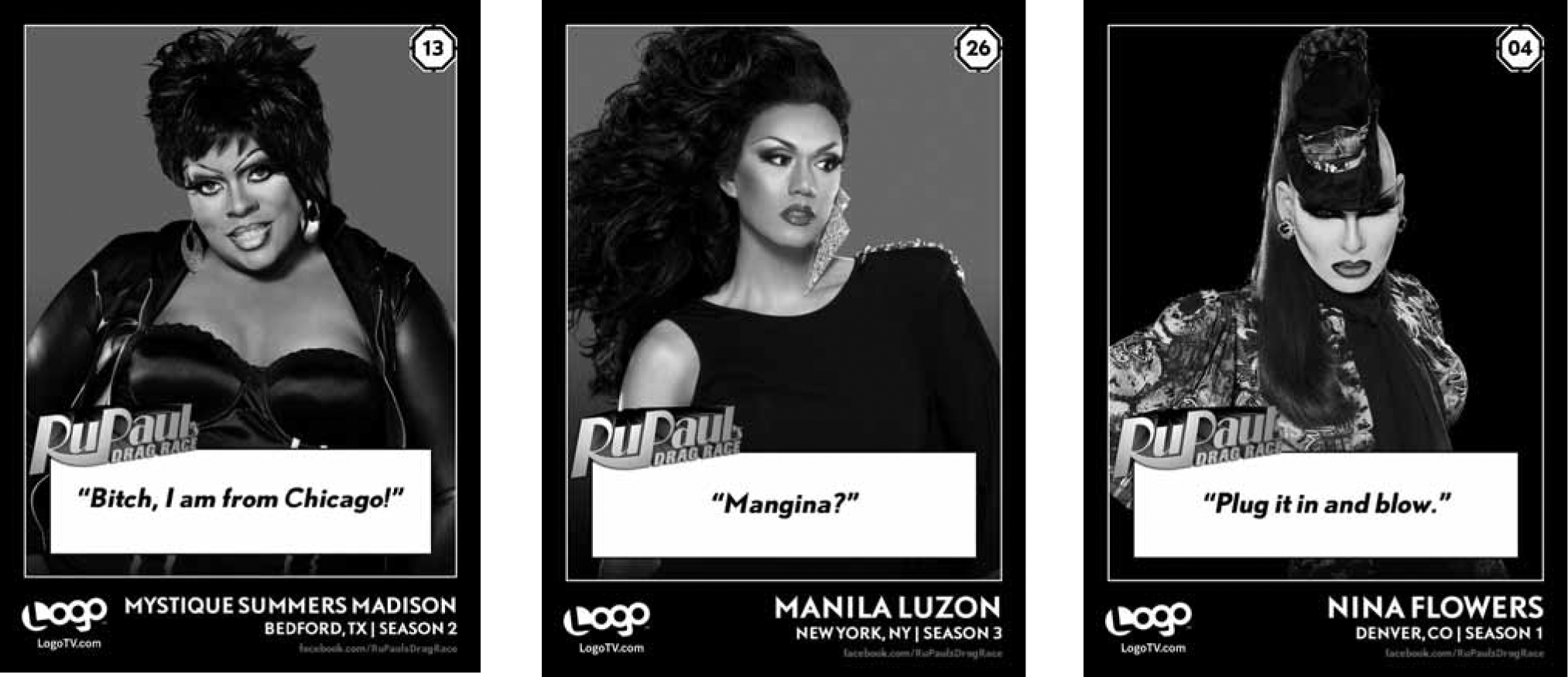
Queens on Top
It is tempting to see these two roles as subordinate, stereotyped representations of gay men, and to some degree they are. After all, the style maven serves the “client,” often by making her or him more conventionally feminine or masculine, and often with the attached implicit or explicit goal of assisting in heterosexual mating. The role of the BGF is to be, like a reverse “fag hag,” a straight woman’s support, shopping companion, or confidant. These are secondary characters, not central ones.
Yet this sort of channeled visibility is more complex. Gay style mavens—unlike style-oriented men off TV, who are typically denigrated as “fags”—operate from a position of power within the genre’s narrative conventions. On reality television, queens are not only ubiquitous, they rule. They tell you what not to wear and how to decorate your house, judge your taste or exhibit their own, decide if you’re the winner. They also bring a camp sensibility to the screen, which, as Sender points out, ironically “undermines values fundamental to its project: class aspiration, gender conformity, and heteronormativity.” Moreover, both the style maven and the BGF problematize the heterosexual man.
On reality television, queens are not only ubiquitous, they rule.
Off television, gay people have historically been seen as the ones who were in need of “fixing,” and heterosexual masculinity as the mark they were missing. On reality television—again, because of the conventions that have best served as dualcasting and consumption-friendly strategies—the logic has been reversed. When straight men appear in interaction with gay style mavens, it is because they need fixing; a queered, classed masculinity becomes the means by which heterosexuality is recuperated.
Off television, heterosexual intimacy reigns and the straight man remains the most powerful player. While most reality television enshrines the male-female pairing—housewives, matchmakers, bachelorettes, boozy hooker-uppers, and opposite-sex dancing couples—when the BGF is around the heterosexual man’s status becomes shakier. He is an outsider to intimacy, unqualified to participate in women’s friendships with male “girlfriends.”
Queer Worlds
Groups, with their internal conflicts and alliances, are central to almost all reality programming—Survivor tribes and Bachelorettes in their huts and compounds, Project Runway finalists, Real World youngsters and Jersey Shore partiers in their lofts and beach houses. Especially on cable networks like here! and Logo, which cater to lesbian and gay consumers, much of the original fare has also been inexpensive, group-based, unscripted programming. These shows expose queer worlds in which straight men are edged out even further. For instance, true to formula, The A-List (“housewives with balls”) depicts a narrow, rarified, bickering, competitive, status-hungry, consumption-oriented crew of attractive young professionals. But they’re a gay crowd; one in which homosexuality, including its sexual aspects, is assumed, central, and celebrated.
Logo TV™, © 2013 Viacom International Inc.
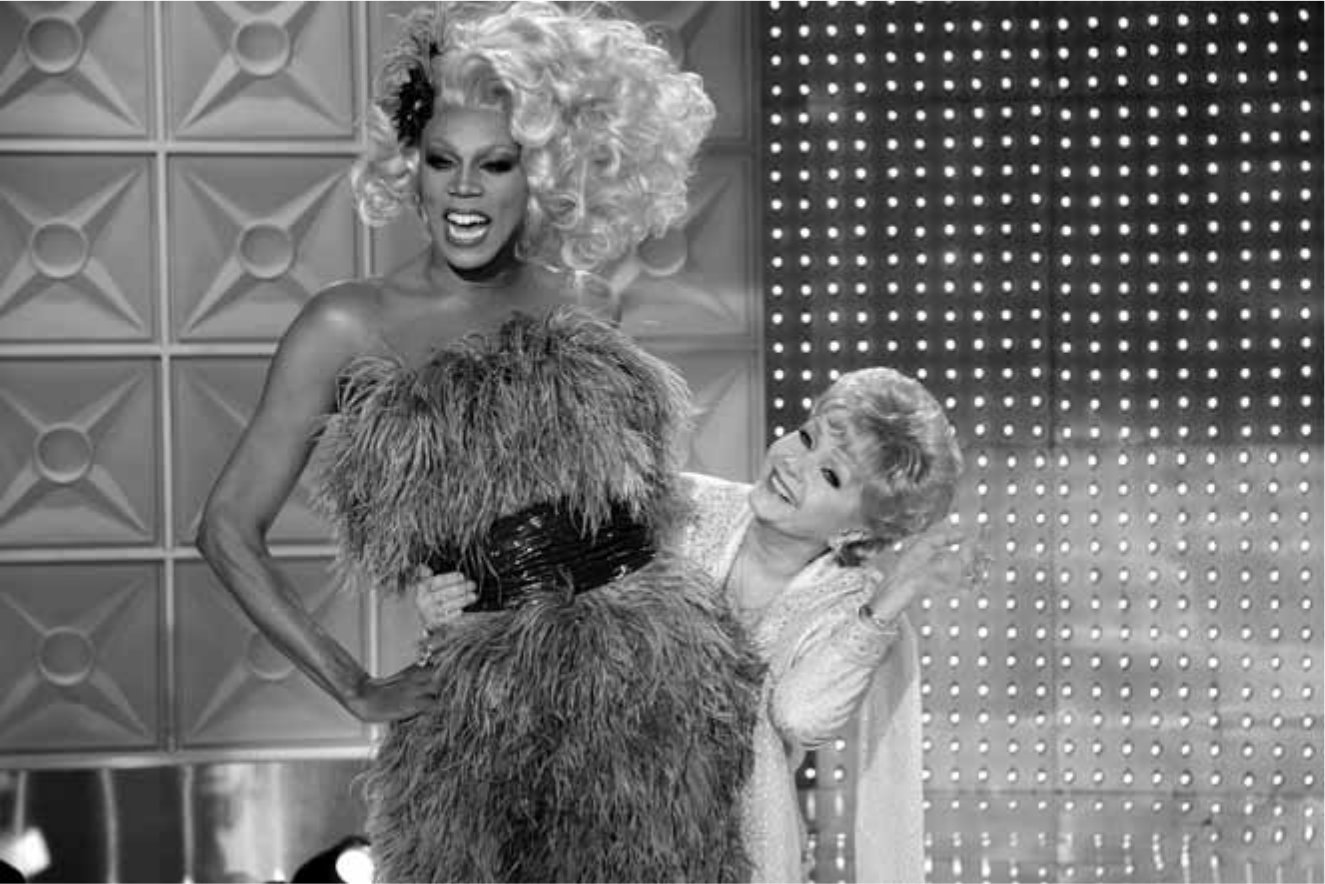
America’s Next Top Model goes drage. Top: Debbie Reynolds makes an appearance as guest judge on RuPaul’s Drag Race Season 5. Bottom: Stacy, Alexis and Shangela prep for a mini-challenge in Season 3: the scandalous red carpet photo.
Logo TV™, © 2010 Viacom International Inc.
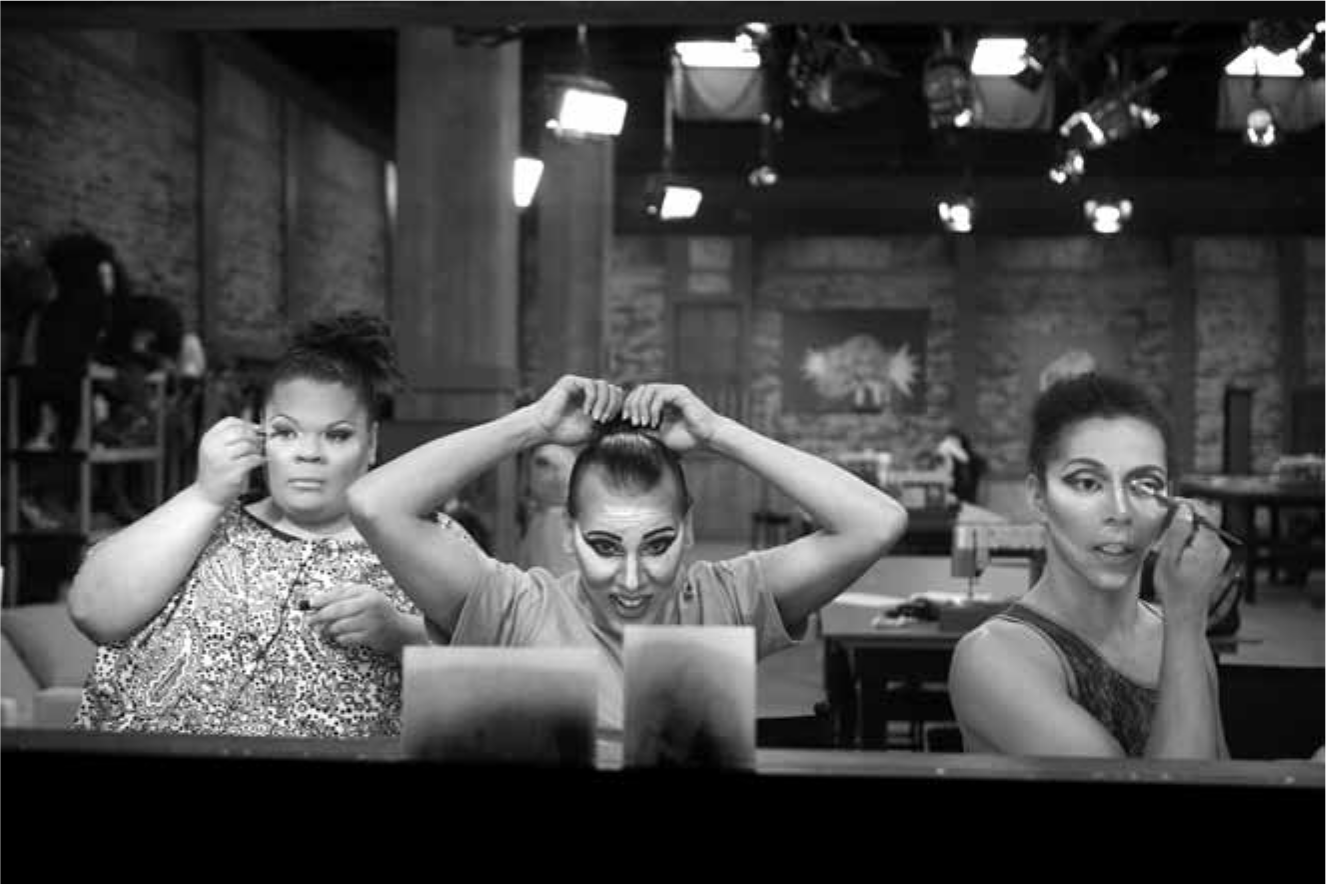
This programming, while often predictably homonormative, has also provided a televisual opening of queer worlds on a much grander scale. Take the Logo hit RuPaul’s Drag Race, which seeks to discover “America’s next drag superstar.” The show is a classic hedge-your-bets copycat: a drag America’s Next Top Model, including “mini challenges,” “major challenges,” runway walks, judging, and backstage drama, mixed with bits of Project Runway and American Idol. Within this framework, a mini-world ruled by drag queens is unfurled, campy and actively subversive.
Contestants must “read” each other (an art of comic-truthful insult) in challenges; viewers learn terms like “tucking” and “hot mess.” In this world, restrictive gender norms and stigma are overcome by the beauty and power, as RuPaul regularly repeats, of “Charisma, Uniqueness, Nerve, and Talent” (or C.U.N.T, for short). Such qualities are displayed in part by an ability to transform heterosexual athletes or elderly men into fabulous women. When straight men do appear in this world, it is for the exclusive purpose of being made over into drag queens.
This is no assimilationist fare. Gender and sexuality are critiqued, complicated, and undermined on Drag Race. For instance, in an episode of behind-the-scenes spin-off Untucked, the queens gossip and argue after a “jocks into frocks” makeover challenge, while the straight “jocks,” in dresses, wigs, and makeup, swap stories about tucking, or deciding not to tuck, their penises. One jock then admits he is attracted to the queen who transformed him, with whom he’s shown flirting; another is shown “getting a boner” while walking in high heels. Watching pairs of drag queens in an erotic “dance-off,” one of the straight guys confesses that he’s “getting so hot my tits are going to melt,” and another praises the sight of “two hot lesbian women going at it.” These moments of sexual and gender fluidity are as common on shows like Drag Race as they are rare outside television.
This unconventional spectacle—straight men entering a world ruled by queens and enjoying the confusion of categories—is brought to you by a conventional reality hybrid. Like their sisters, the gay style maven and the BGF, the Drag Race queens are called forward by the needs and habits of a reality TV industry seeking particular markets, safe bets, and consumption-suited fare. But once they’re there, you can sometimes start to see the straight man’s world through their eyes. And honey, watch out, ’cause it’s a hot mess.