




Abstract
SlutWalk marches have emerged to protest the blaming of women for their own sexual assault. Sociologists Kristen Barber and Kelsy Kretschmer consider the different ways men participate in SlutWalk, and how their participation at times both supports and undermines the feminist goals of the event.
Keywords
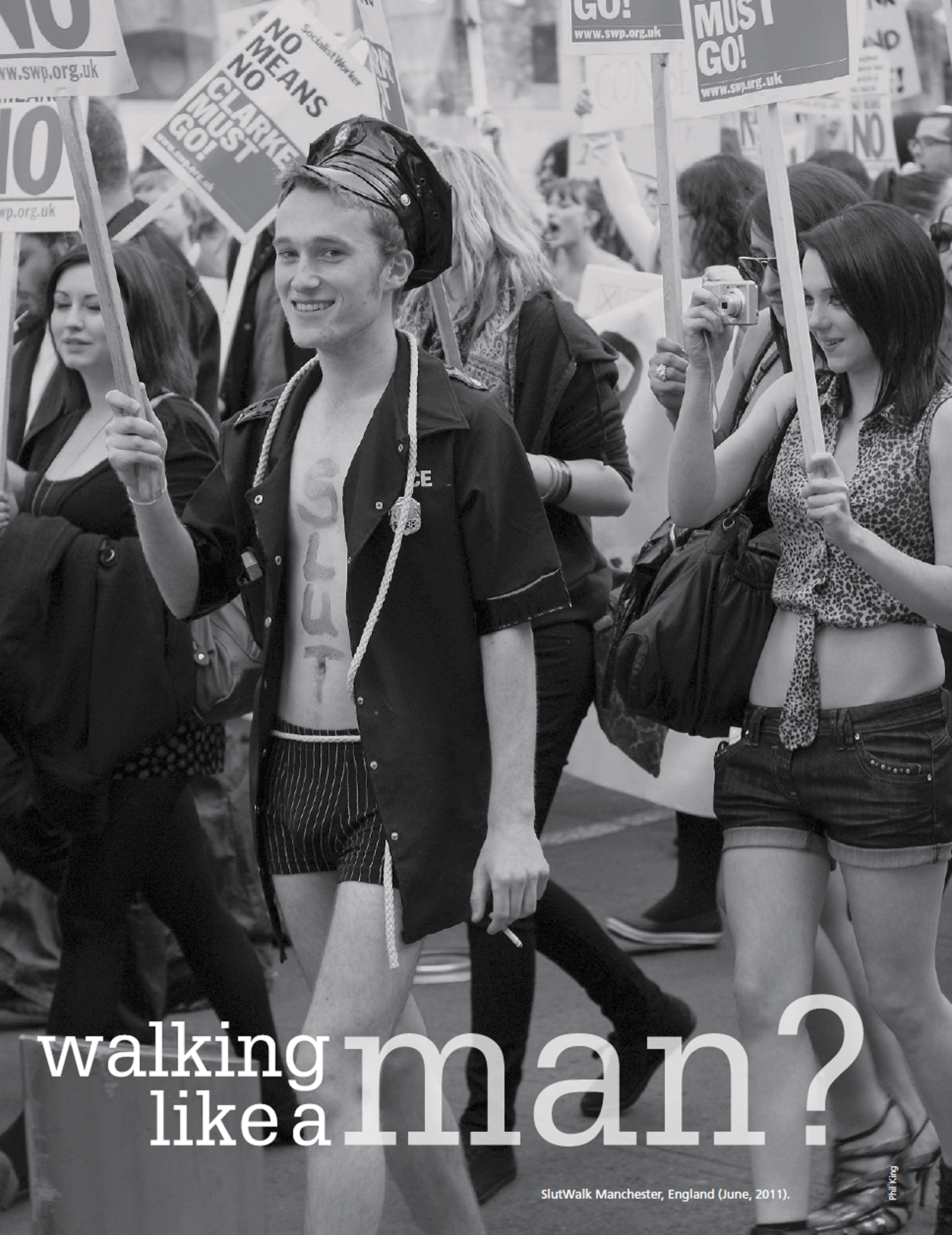
SlutWalk Manchester, England (June, 2011).
Phil King
Hundreds of people were gathered on the sidewalk outside of the Carbondale, Illinois community theatre, carrying signs and banners. Women were dressed in tutus, glitter, fishnet stockings, and waving signs that read, “Honk if you <3 sluts,” “My clothes aren’t consent,” and “I borrowed this outfit from your mom, do you still want to rape me?”
It was the town’s first SlutWalk, organized to protest men’s complicity in sexual assault. SlutWalk organizers challenge both the relative invisibility of male aggressors in sexual assault and the Madonna-whore dichotomy signified by the word “slut.” This dichotomy divides women into virgins or sluts, and supports a double standard where men are encouraged to have multiple sexual partners while women are stigmatized for doing so.
While the turnout for the Carbondale walk was larger than expected, most striking was the sizable number of men who attended. Comprising about a fifth of the over 450 participants, men were some of the most enthusiastic and eye-catching participants, wearing kimonos, green jumpsuits, and cut-off shorts with midriff-baring shirts. They were there with friends, fraternity brothers, and resident halls, or came on their own to support the cause.
Since assault against women is historically seen as a “women’s issue,” feminist organizers often consider men to be ill-equipped to understand, let alone challenge, women’s oppression. However, many scholars, activists, and organizers have come to see men’s participation in feminist movements as important. Sociologist Mark Cohan suggests that men have multifaceted and sometimes counterintuitive reasons for participating in feminist movements. Looking at men’s identification with feminist causes, Cohan finds that while men may have an awareness of gender inequality, they can symbolically undermine gender politics at the same time they participate in such movements.
Men negotiate their relationship to gender politics and women’s issues in both helpful and problematic ways, at times challenging sexism while also diverting attention from the central goals of the movement. With SlutWalk, these tensions emerge among a new generation of activists.
Slutwalk and its Critics
SlutWalk originated in 2011 after a Toronto police officer told a college audience that if women want to prevent becoming victims of sexual assault, they should “avoid dressing like sluts.” The Toronto walk was followed by marches in New York City, Washington, D.C., Boston, Tallahassee, and a handful of smaller cities across the United States, and around the globe.
Many young women see the marches as a way to reclaim the word “slut” and avoid victim blaming. Siobhan Conners, an organizer of the 2011 Boston SlutWalk, sees it as a way to “bring awareness to the shame and degradation women still face for expressing their sexuality.” In a 2011 interview, writer Alice Walker praised the SlutWalk as a “spontaneous movement that has grown around reclaiming this word [slut]” that “speaks to women’s resistance to having names turned into weapons used against them.”
SlutWalk is not without its critics, however. Some feminists have objected to the movement’s embrace of the pejorative term “slut.” Women’s studies professor Janell Hobson, writing in Ms. Magazine in 2011, suggests the term has a racial history that makes it easier for white women to reclaim than women of color, whose bodies “have inspired the dangerous rhetoric.”
SlutWalk Carbondale, Illinois (October, 2011).
Kristen Barber
Others have criticized the fact that while some SlutWalks were more somber events— where some women wore the clothes they were assaulted in—SlutWalks can at times resemble parties, exuding a carnival-like atmosphere. In Carbondale, people were dressed in costume and came for a good time. Many women came provocatively dressed in fishnet stockings and bras or bustiers, suggesting that they should be able to dress as they please, free from sexual assault.
Whether men should be permitted to participate has also been a source of contention. While approximately one in four women experience sexual assault, men are almost always the perpetrators. On first glance, men’s presence at the marches appears to be a sign of their growing concern about sexual assault. But when we consider the motivations of men who participate, as well as how they participate, a more complicated picture emerges.
Real Men Don’t Rape
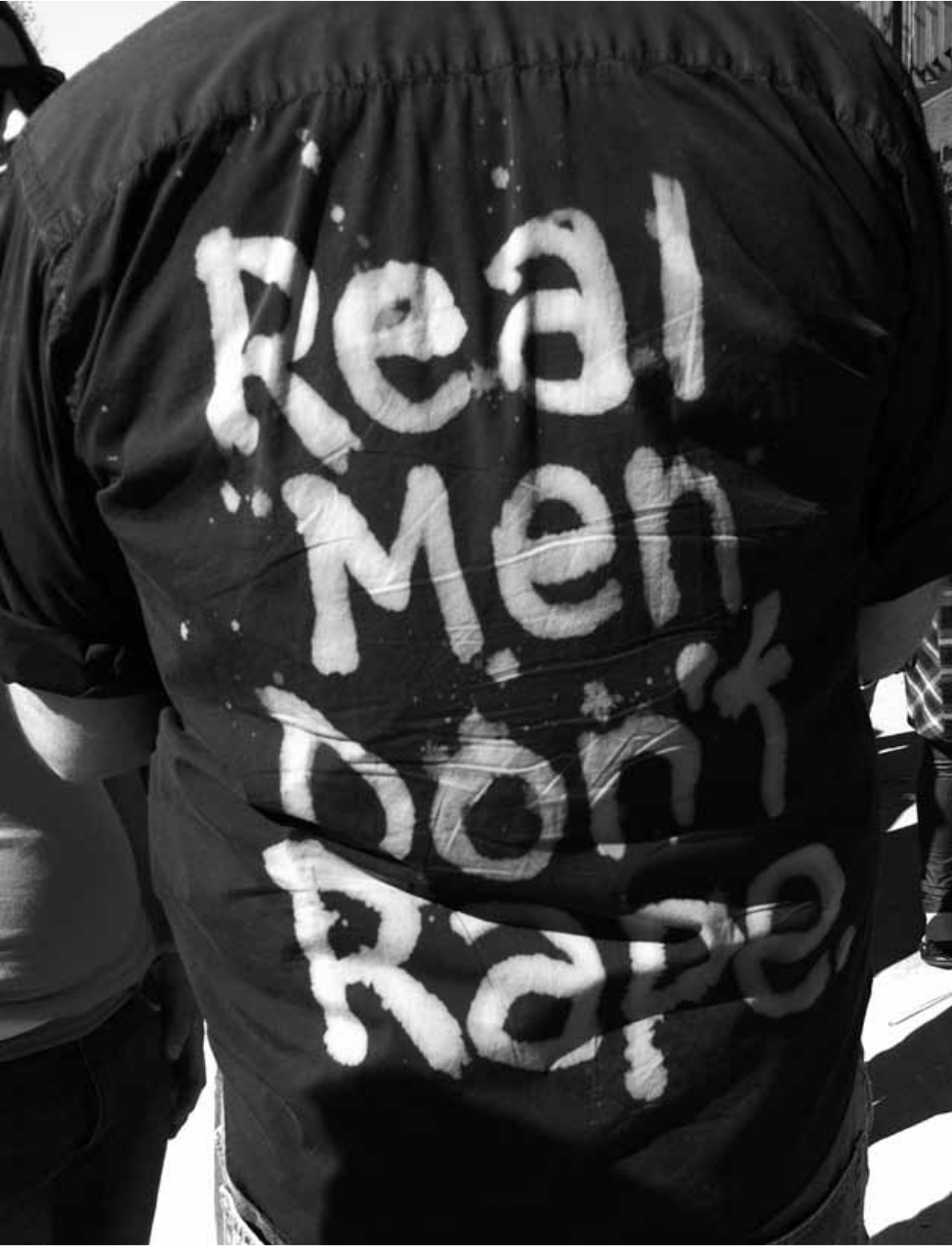
When men do participate in SlutWalk, they have varied reasons for doing so. In Carbondale, we encountered men who opposed traditional notions of masculinity, who wished to shake-up taken-for-granted ideas about what it means to be a “real” man. Several of them were dressed in black button-up shirts with big orange letters scrawled across the back that read, “Real Men Don’t Rape.”
The number of men who attended SlutWalk Carbondale was striking. Men were some of the most enthusiastic and eye-catching marchers.
A group of fraternity brothers marched together. “Fraternities get a bad rap,” one marcher said. He beamed proudly as he told us that his fraternity was planning to organize an event the following month to promote awareness about domestic violence. The walk provided an opportunity for them to challenge the idea that male-only social fraternities are inherently hostile toward women. While these fraternity men did not necessarily identify as feminists, their attempts to redefine all-male spaces and challenge the meaning of manhood suggest they were acting as feminist allies.
SlutWalk Carbondale, Illinois (October, 2011).
Jon Knobelock
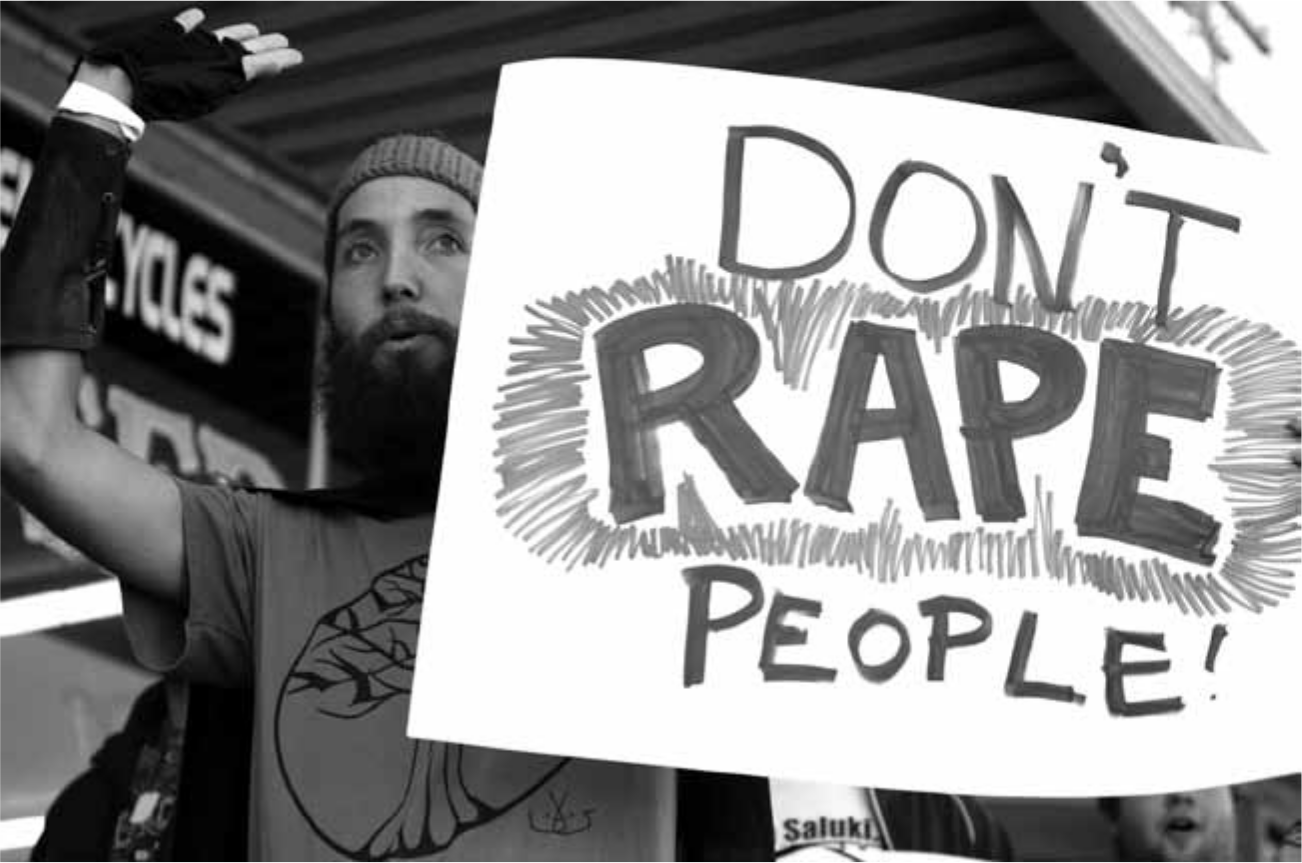
“There’s a perception that feminism is only for angry women who don’t like men,” said student Harpo Jaeger, who attended a Providence, Rhode Island SlutWalk. “But it should be possible for everyone to support women’s rights.” Yet, even when motivated by feminist concerns, men’s participation can have unintended negative consequences. Although many of the women involved in SlutWalk were thrilled to have men participate in the event, some believed their presence diverted attention from women’s experiences.
Gender studies scholar Hugo Schwyzer recognized this problem after helping to organize SlutWalk L.A. “I’d worried about going to SlutWalk as a man,” he said. He was concerned that it would seem as though he was “cashing in on the excitement/activism/sexiness or trying to prove my feminist cred.” He continued: “I won’t even pretend that I didn’t enjoy getting interviewed, but I was a bit worried that that too might be seen as stealing the stage.” As he and others acknowledged, men’s presence at SlutWalk can at times be helpful, and at other times can marginalize women.
In Boston, a group of men organized a “PimpWalk” that took place alongside the 2011 SlutWalk. These men dressed in colorful cowboy hats with feathers and held a boom box that played hip-hop and 1970s funk. Organizer Samuel Bilowski admitted it was a joke designed to “get some numbers” and to “talk to attractive women.” SlutWalk marchers in Boston loudly criticized the PimpWalk organizers “for glorifying violence against women,” since pimps promote and profit from the sale of women’s bodies.
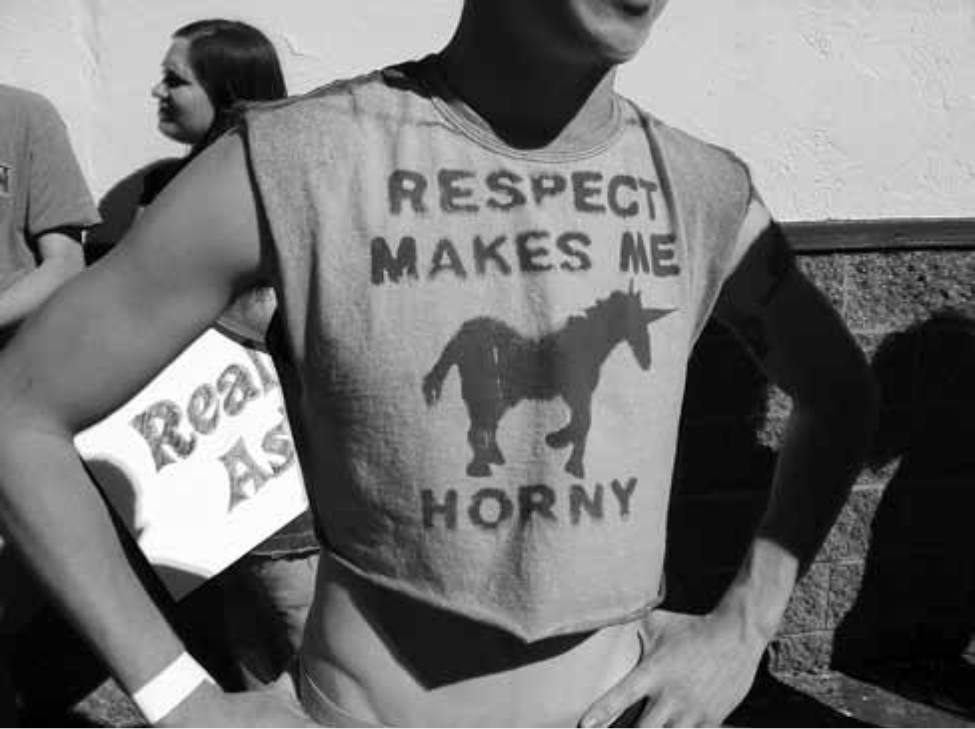
In Carbondale, we spoke with two men who marched in midriffs and cut-off shorts as a nod to the “slut” theme. One wore a t-shirt with the phrase “Respect Makes Me Horny” printed above a picture of a unicorn. He excitedly told us about how he and his friend had also participated in the Chicago SlutWalk a few weeks earlier. “Everyone got naked and jumped in a fountain!” he exclaimed. Other men contributed to the fun, party vibe by carrying signs that read, “Ruck Fape” or “Just because I have a nice butt doesn’t mean I’m a slut.” The march ended at a local bar, where of-age participants received bracelets upon entry and could continue the party.
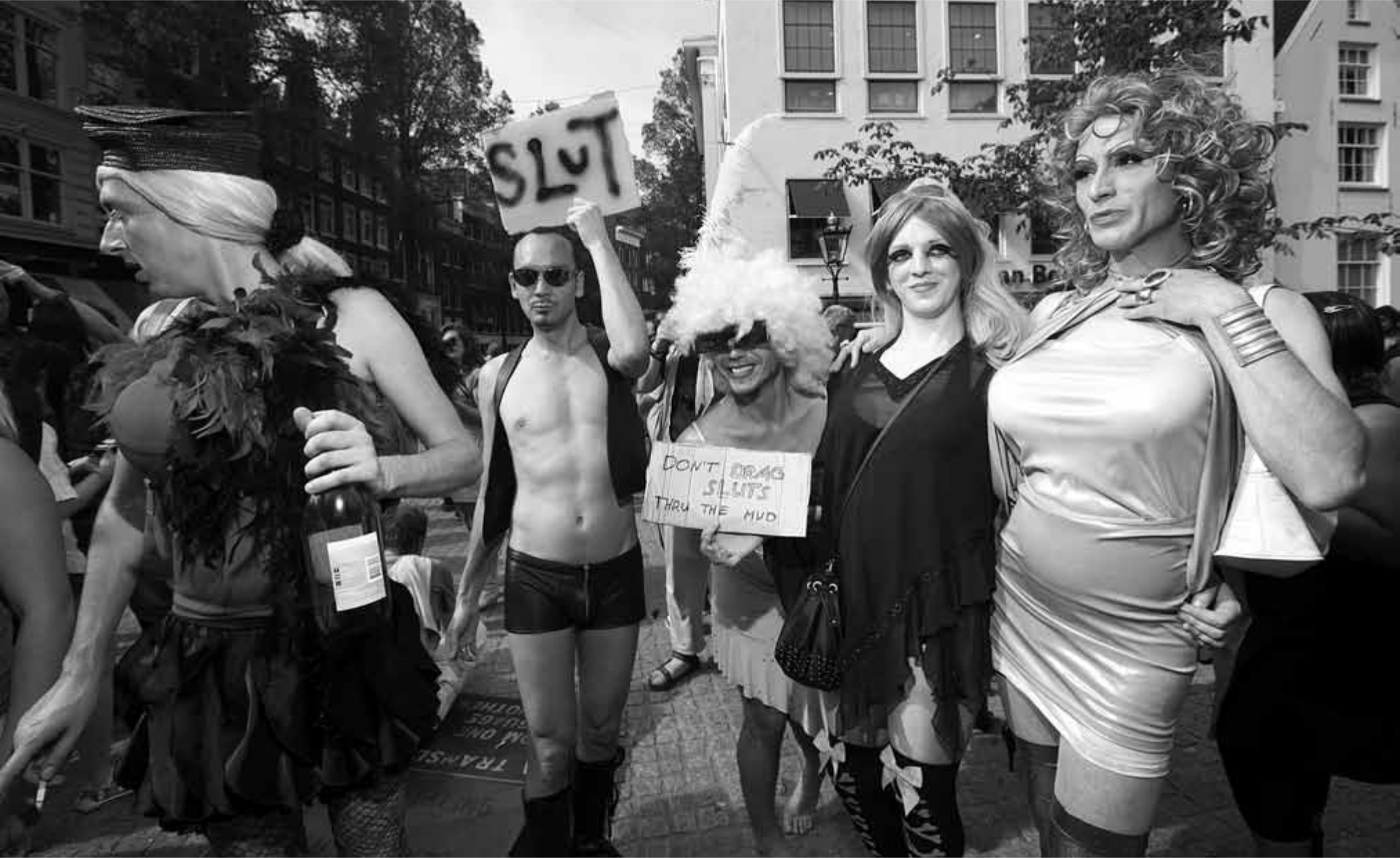
While irony can be deployed in progressive ways, it can also be reactionary and antifeminist. The costumed men created a festive atmosphere, luring more people to the march, attracting media coverage, and making participation less intimidating. But when men pretended to be pimps, made jokes about naked women, and presented themselves as heterosexual voyeurs, it was off-putting. This form of participation undermined the point of the march—that women are often sexually assaulted and then blamed for their own victimization. These male marchers partied at the expense of the message.
Victims and Sympathizers
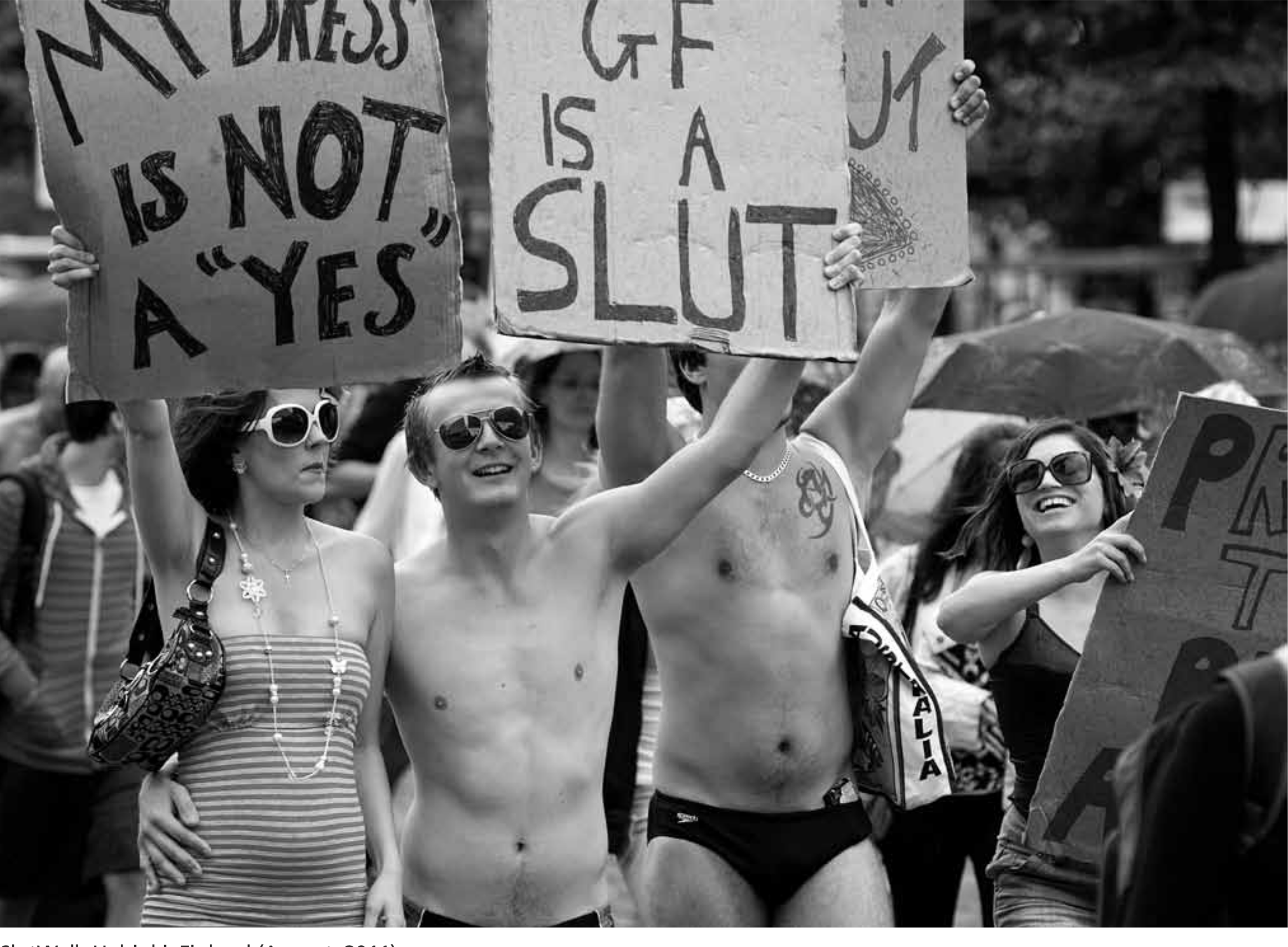
Many men participated in the SlutWalk because they wished to support a sister or a female friend who had been sexually assaulted. The SlutWalk provided them with an opportunity to march in solidarity with the women in their lives. When asked why he marched, one young man told us solemnly, “My sister was raped.” At the SlutWalk in Storrs, Connecticut, fraternity president Bryant Dominguez said, “I have a lot of female friends who have been called names [like slut]. I wanted to be here in support.” Another man who marched in Philadelphia while wearing a Superman costume said that he was “shocked” at how many of his female friends had experienced sexual assault.
When men pretended to be pimps, made jokes about naked women, and presented themselves as heterosexual voyeurs, it was off-putting.
By participating, these men demonstrated support for individual women. Some men came to learn how common sexual assault is, and how victims are often shamed after being raped. Some were exposed, too, to broader feminist ideas and values about gender equality.
SlutWalk Helsinki, Finland (August, 2011).
Tuomas Puikkonen
Because men tend to see rape largely as an issue that does not affect them personally, they are often reluctant to engage in rape education programs, according to researchers Elizabeth Scheel, Eric Johnson, Michelle Schneider, and Betsy Smith, noting in 2001 that rape prevention education does not tend to be “well-received by men,” who often become “defensive or indifferent” to “the movement to end rape.” As a result, men are often unprepared to support the women in their lives who are victims of assault. Yet, many men, they argue, are “truly interested” in being “positive supporter[s]” and wish to “learn more about the ‘correct’ method of responding to a woman who has experienced rape.” For men to become effective supporters of women, the researchers claim, they must learn how to stand by women.
For feminism to thrive, changing the hearts and minds of men is necessary—while keeping women’s experiences at the center.
For individual sympathizers who came to support a loved one at SlutWalk, marching alongside daughters, sisters, and friends who had been sexually assaulted was often a first step toward becoming feminist allies. However, being a sympathizer does not necessarily make one a politically conscious participant. Most men we spoke with did not make the connection between the sexual assault of loved ones and cultural definitions of masculinity that valorize competition, aggression, and the sexual conquest of women. Indeed, many framed their participation in SlutWalk in traditionally masculine terms: the man in the Superman outfit, for example, saw himself as a chivalrous protector of women.
As activist Jackson Katz noted in his 2006 book, The Macho Paradox, to move from the sympathizer role into the role of ally, men must recognize social structures that encourage victim blaming, and begin to acknowledge the role men play in perpetuating social problems such as sexual assault and violence. The “long-running American tragedy of sexual and domestic violence,” he wrote, “is arguably more revealing about men than it is about women. Men, after all, are the ones committing the vast majority of the violence. Men are the ones doing most of the battering and almost all of the rape.”
Still, some men used the SlutWalk as a vehicle for talking about their own victimization. In Tampa, Florida, a male college student came dressed in torn blue jeans, and told a reporter that they were the pants he was wearing when he was sexually assaulted years before. “Just because I’m dressed in torn-up jeans doesn’t mean you can hurt me,” he said. He went on to explain his motivation for coming to the event, making it clear that, “It does happen to men, too.” Similarly, a man attending the 2011 Denver, Colorado SlutWalk carried a sign indicating what he had been wearing when he was sexually assaulted, “I was wearing khaki shorts.”
Placing their own experiences at the center, they highlighted the fact that men, too, are victims of sexual assault—albeit at a lesser rate than women. While men who have been sexually assaulted are certainly invisible in discussions about sexual violence, when men use the SlutWalk to make claims about their own abuse, this dilutes the core message of the walk, according to some organizers. The march was organized to draw attention to how “slut” language is used to shame women who are sexually assaulted, and to control women’s bodies; if men are assaulted too, it is probably not due to their choice of clothes. If men are seen as victims, the event becomes a more generalized protest against rape, drawing attention away from women’s experiences.
Slutwalk Amsterdam, Netherlands (June, 2011).
Sebastiaan ter Burg
Jon Knobelock
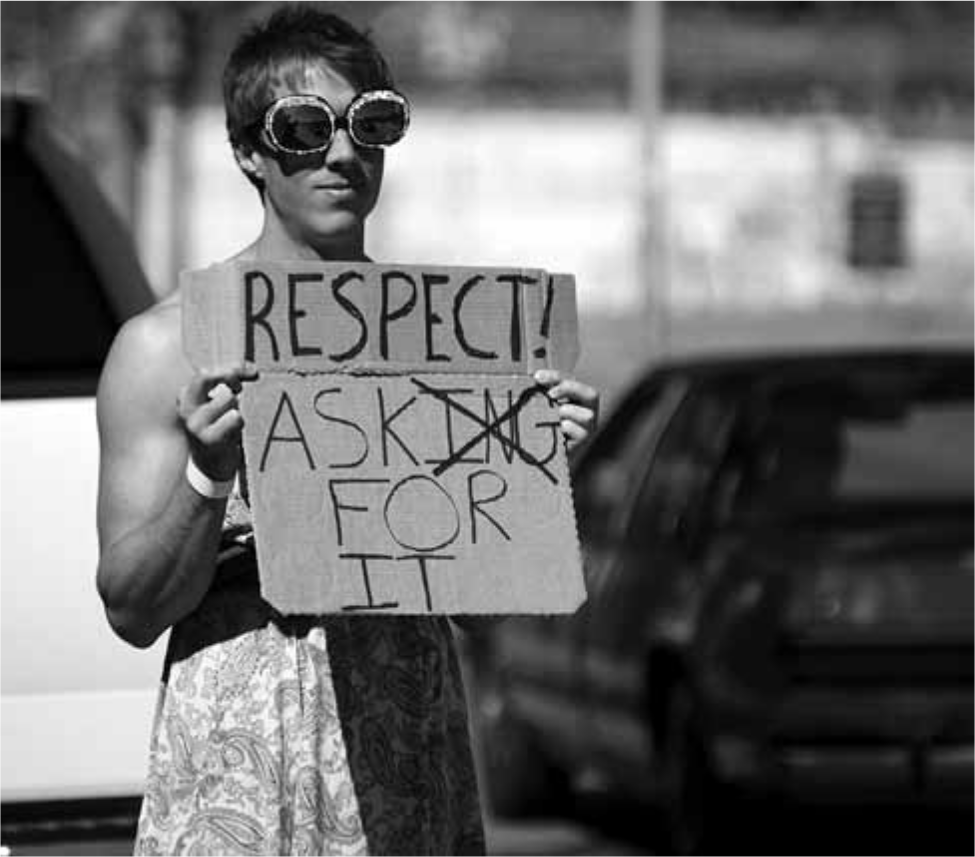
SlutWalk Carbondale, Illinois (October, 2011).
Kristen Barber
Men and Feminist Protest
Feminist activists struggle to involve men in social movements that work to improve the lives of us all. They agree that men’s participation is vital, and that without serious cross-gender discussions of sexism we cannot effectively tackle issues such as sexual assault. As Jackson Katz suggests, getting men involved in feminist agendas means holding them responsible, and encouraging them to recognize the links between masculinity and sexism. If we exclude men from the conversation, they remain invisible in discussions of social problems in which they are centrally implicated.
But how, and under what conditions, can men become effective participants and feminist allies? Many of the women we spoke to at our local SlutWalk were greatly encouraged by men’s attendance. Beyond the fact that they enlarged the crowd, activists hoped to change men’s attitudes toward women and sexuality. And while some men suggested they are not part of the problem, many participated in these events, risking stigmatization and ostracism from others.
The ways men participate in SlutWalk illuminates dilemmas feminist organizers face in creating inclusive protests. How do you get men involved in helpful ways without alienating them? How do you make the movement fun and engaging, as well as serious, and sensitive to those who have been assaulted? How might you build an anti-rape movement that is inclusive of both female and male rape victims?
It is clear that many men wish to be involved in the conversation on sexual assault. Activists must figure out how to include men without diluting the core message of feminist protest: to make the world a better, safer place for women. For feminism to thrive, changing the hearts and minds of men is necessary—while keeping women’s experiences at the center.