



Abstract
The term disaster porn has evolved over time, from an epithet directed at extreme depictions of suffering in the developing world, to a broader critique today of all sorts of disaster-related media—even fictional Hollywood blockbusters. Sociologist Timothy Recuber examines how disaster porn, in all its iterations and for all its flaws, is a vital political terrain in which publics are at least implicitly asked to struggle with the social significance of the suffering of others.
For many viewers, this scene from the film 2012, which recalled the Twin Towers’ collapse, was a bit too close for comfort.
“2012,” © 2009 Columbia Pictures Industries, Inc. All Rights Reserved. Courtesy of Columbia Pictures.

“When they tell you not to panic—that’s when you run!” Jackson Curtis screams into a cell phone as he speeds his limousine through suburban Los Angeles towards the home of his ex-wife and children. Arriving as a round of massive earthquakes begins, he shepherds his family out the door and into the limo mere seconds before their house collapses, then races towards the Santa Monica airport, where he has rented a small plane.
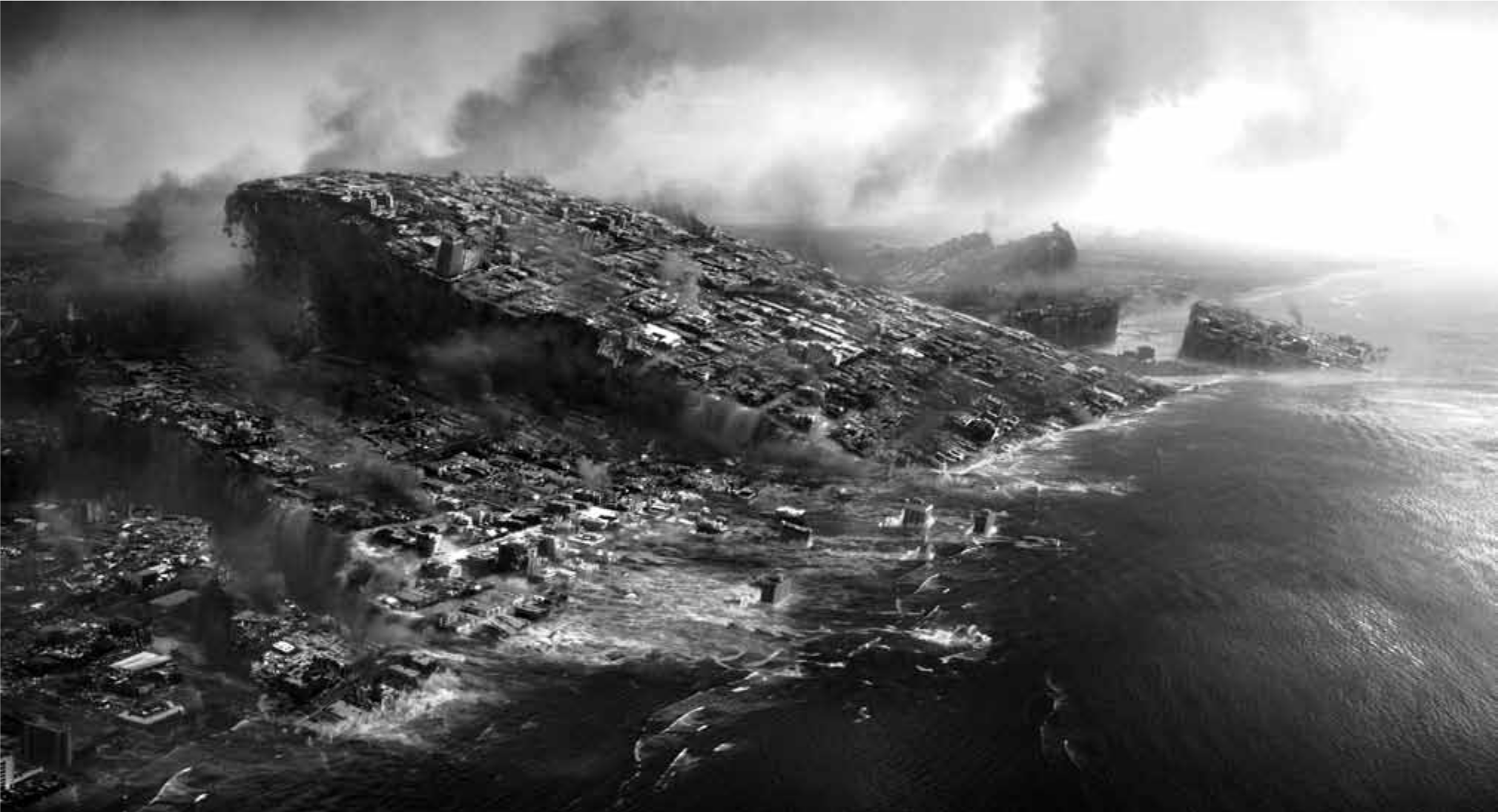
Driving at breakneck pace as the ground around them crumbles and his family gasps in terror, Jack weaves the car past toppling freeways, tumbling oil tankers, exploding gas stations, and at one point, literally drives through an office building in the midst of a slow collapse. Once at the airport, his plane takes off just as the entire runway implodes into an abyss behind it, and flying at low altitude, manages to dodge several crumbling, car-filled highway overpasses whose passengers can be heard screaming as they plummet into the widening chasm below. Once they’ve escaped safely into the sky, the family watches in muted horror as the city of Los Angeles, uprooted onto a massive, angled piece of the earth’s crust, slides block by block into the Pacific Ocean.
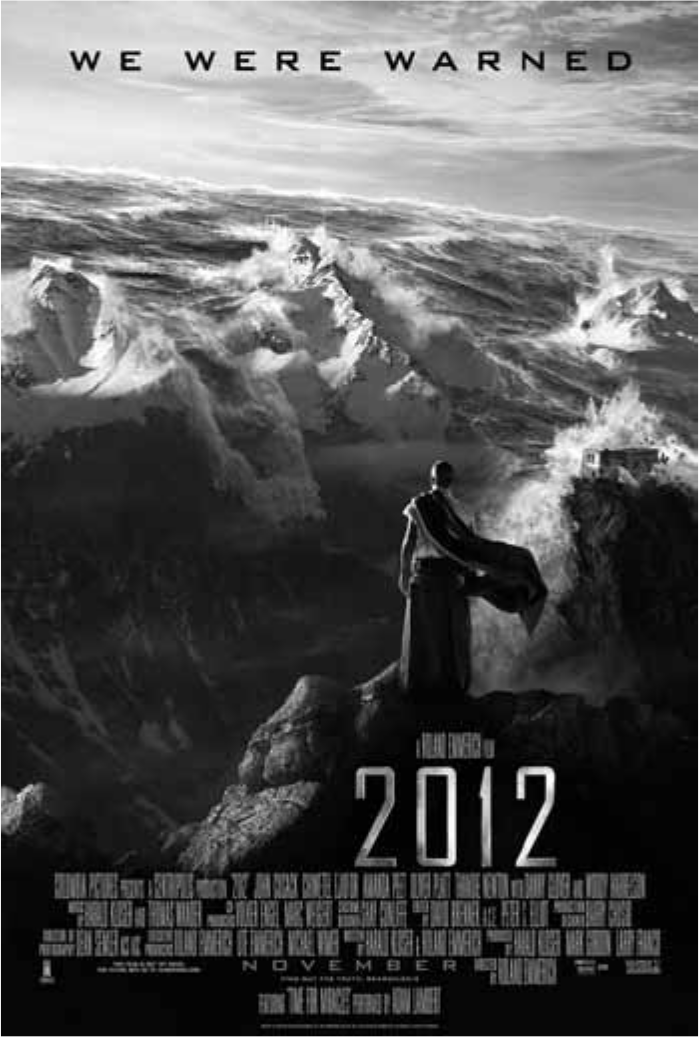
So ends one of the many apocalyptic action sequences in the film 2012. Though the film grossed over $166 million domestically, and another $600 million overseas, the critical response was mixed at best, and the film was labeled disaster porn. E! Online remarked that “2012 is Disaster-Porn Overload!” Another critic called it “the state-of-the-art in CGI disaster-porn.” And film critic Steve Persall suggested that “the real stars of 2012 are the countless billions of phony people crushed, drowned and incinerated without much time left for grieving. They are sacrificed for our enjoyment, an unsettling fact earning movies like 2012 the unflattering nickname ‘disaster porn.’”
The rise of disaster porn can be understood sociologically: as an effect of both the rise of modern mass media and globalization. Within all but the most tight-knit, face-to-face communities, people need to stay informed about the well-being of distant others. As cultural critics from Marshall McLuhan to Benedict Anderson have noted, nation-states cannot function without a mass media to help members imagine themselves as part of the larger group. Democracies require ways of relaying the misfortunes of distant community members, so the group can collectively decide whether to intervene and how to allocate resources to aid those less fortunate members. But this puts audiences in the uncomfortable position of witnessing the suffering of others, a discomfort that extends today to even fictional suffering like that portrayed in 2012.
Today, as global media, NGOs, and international humanitarian efforts expose us to expanding populations of unfortunate others, and when news of famines, earthquakes, wars, terrorist attacks, and other tragedies can come from almost anywhere on the planet, media producers and international aid organizations need to consider what kinds of stories and images elicit sustained public interest rather than indifference or condemnation. Similarly, individuals with access to mass media must make decisions about their levels of exposure to such reports, and about what they can or should do to help.
Although it is easy to write off such coverage as nothing more than disaster porn, this much-maligned media genre offers some potentially valuable lessons.
Roots of Disaster Porn
While the idea that images of war might be “pornographic” dates back as early as the end of World War II, a 1991 novel called Synner by cyberpunk author Pat Cadigan is sometimes credited with coining the term disaster porn. Cadigan’s novel inaugurated the tendency to use “porn” as a suffix denoting an excessive, overly aestheticized focus on a single topic. One of the novel’s narrators, during a visit to the home of a video-obsessed hacker named Valjean, relates seeing “a screen for every porn channel, jammed together in the wall so that food porn overlapped med porn overlapped war porn overlapped news porn overlapped disaster porn overlapped tech-fantasy porn overlapped porn she had no idea how to identify.” Such a usage of the word porn remains common today, in terms like food porn, gadget porn, ruins porn, and a host of others.
But an earlier example appeared in a 1987 Washington Post editorial about that year’s stock market crash. In the piece, entitled “Black Monday’s Reign of Terror,” Post editor Meg Greenfield wrote that “this is a society…that dotes on disaster porn: burning high rises, crashing express trains, population-devouring wild beasts, and all the rest of that cinematic hype.” Greenfield equated the term with a sensationalist political culture, in which pundits and politicians had been “crying so much wolf so much of the time…that it is possible no one any longer believes in the validity of any warning or profession of fear: it is all understood to be play.”
Democracies require ways of relaying the misfortunes of distant community members.
Over time, the labels disaster porn and disaster pornography became increasingly commonplace. Google searches for these phrases turn up well over 50,000 hits, and have become popular enough to warrant inclusion in Australia’s Macquarie dictionary, alongside neologisms of the Internet age like “photobomb” and “planking.” But the flippancy of the company the term keeps should not blind one to its serious implications. Macquarie’s own definition—media coverage of disasters which seeks to “satisfy the pleasure that viewers take in seeing other people’s misfortunes, as by constantly repeating vision of an event, often without commentary or context”—seems tailored more towards news coverage of actual disasters than to Hollywood action films, and in fact the term originated with and maintains that real-life connotation. For instance, writing in the January 19, 2005 edition of the Christian Science Monitor, journalist Susan Llewelyn Leach reported on accusations that media coverage of the 2004 Indian Ocean tsunami broadcasted “gratuitous gore, even as their ratings soared.”
Opinion polls have also suggested that even though they watch such coverage, the public believes that too much airtime is devoted to disasters and other human tragedies. Only a month after the September 11 attacks, 32 percent of those surveyed by the Pew Research Center for the People and the Press believed there was “too much coverage” of the attacks. The same question yielded about a 23 percent agreement when posed about coverage of Hurricane Katrina, and spiked to 50 percent after the 2007 Virginia Tech shootings.
Watching Others Suffer
A year after Cadigan’s novel was published, disaster porn was thrust into a growing debate around humanitarian and military interventions and the role of aid agencies in developing countries. On December 10, 1992, a Los Angeles Times editorial entitled “Disaster Pornography from Somalia” and a London Independent article entitled “Somalia: White House ‘steamrolled’ into intervention” framed the terms of the debate over disaster pornography in a way that would resonate for most of the rest of the decade. The articles were written by Rakiya Omar and Alex de Waal, former members of the human rights organization Africa Watch, who quit over its support for U.S. intervention in Somalia. The LA Times piece accused Western journalists of exaggerating the Somali famine in order “to compose the ‘right’ image”—one that justified U.S. involvement. The next year, in the September 29, 1993 edition of The Times of London, de Waal again deployed this term to describe the dilemmas faced by reporters hoping to inspire humanitarian action, but leery of creating false impressions or exacerbating stereotypes. “This is the dilemma for sensitive journalists,” he wrote, “disaster pornography and reassuring archetypes are needed to make a disaster into front-page news; then the journalistic pack follows, and coverage degenerates.”
In its first decade in print, then, disaster pornography was primarily employed as an epithet directed at depictions of extreme suffering in developing countries. Such depictions were identified as problematic because of their tendency to sensationalize and simplify complex geopolitical realities, and thereby encourage Western military adventurism under the guise of humanitarian action. However, this usage began to shift as the decade wore on and the Western world began to tire of such interventions. For instance, an April 11, 1999 Toronto Star article bemoaned the small number of television viewers tuning in to coverage of the war in Kosovo, and noted that, “We have all seen so much Disaster Porn, whether Somalian or Rwandan, Ethiopian or Biafran, that we’re almost numb to it.”
Four months later, in a New York Times piece entitled “The Precarious Triumph of Human Rights,” journalist David Rieff argued that “Human solidarity is a real fact of the world, but so is compassion fatigue. You can no longer build a political consensus for action, assuming you ever could, by showing yet another clip of disaster pornography on television.” While still applied primarily to images of suffering people in famine-stricken or war-torn corners of the globe, the essential problem associated with disaster pornography had taken a 180-degree turn. No longer accused of over-hyping tragic circumstances and leading to public overreaction, disaster porn, by the end of the decade, had come to be seen as a force that muted public reaction to important issues, rather than enflaming them.
Viewers witness the obliteration of billions of nameless, faceless others in 2012, prompting critics to label this film “disaster porn.” Here, Los Angeles slides, block by block, into the Pacific Ocean.
“2012,” © 2009 Columbia Pictures Industries, Inc. All Rights Reserved. Courtesy of Columbia Pictures.
Though sociologists Paul Lazarsfeld and Robert Merton had identified a general “narcotizing dysfunction” of mass media as early as 1948, in which increased media coverage of a topic tended to paradoxically decrease the likelihood of public action, today these alleged sympathy-deadening effects extend to media coverage of specifically global problems. With the growth of 24-hour cable news coverage and the increasing scope and sophistication of global news broadcasting during the 1990s, critics began to worry that Americans and citizens of other Western nations had seen their emotional reserves drained by an increasing procession of televised war and disaster victims from across the globe. But this view was about to change.
The September 11 Effect
The terrorist attacks of September 11, 2001 dramatically recast the problem of disaster pornography, expanding its definition and recalibrating American reactions to it. Fittingly for a world in which the influence of print news organizations had arguably already begun to decline, the website Slate led the way in this redefinition. In his column for Slate, film critic David Edelstein noted just three days after the attacks that Americans were renting movies and looking for escapist cinema, but avoiding any films having to do with disasters. Referencing the 1974 disaster epic The Towering Inferno, he suggested, “It will be a while, after footage of people fleeing clouds of lethal debris, before we surrender to disaster-porn like that again.” Similarly, a Time International article from October 1 of that year noted that “the purveyors of cinematic disaster porn [had begun] soul searching,” ultimately cancelling several big-budget action movies whose plots or visuals were too reminiscent of the 9/11 attacks.
While the reasoning behind the culture industry’s sudden post -9/11 sensitivity are obvious, it appears to have been accompanied by a new public distrust or disdain for entertainments previously seen as harmless. Thus, one sees after September 11 the expansion of disaster porn terminology to encompass not just news reports of actual disasters, but the kinds of fictional disaster films that had been uncritically consumed for decades. Criticism of Hollywood blockbusters such as 2012, which was more frequently labeled disaster porn than anything else in a Lexis Nexis and Proquest search of newspaper articles using this term, has indeed become commonplace. But this shift in meaning remains puzzling, given that the term was initially rooted in concerns over real-life disaster news coverage and genuine human suffering, not fantastic computer-generated graphics with actors running around in front of green screens.
We run the risk of ignoring the suffering of others and relieving our own anxieties about viewing their misfortunes.
While not deploying the term itself, film critic Anthony Lane’s September 24, 2001 essay in The New Yorker exposes one motivation behind this extension of disaster porn’s domain. Making the case that people “literally saw, and are continuing to see, as it airs in unforgiving repeats—that day as a movie,” Lane asserted that “it was the television commentators as well as those on the ground who resorted to a phrase book culled from cinema: ‘It was like a movie.’ ‘It was like Independence Day.’ ‘It was like Die Hard.’ ‘No, Die Hard 2.’ ‘Armageddon.’ And the exclamations from below, from the watchers of the skies caught on video, as they see the aircraft slice into the side of the tower: where have you heard those expressions most recently—the wows, the whoohs, the holy shits—if not in movie theatres, and even on your own blaspheming tongue?”
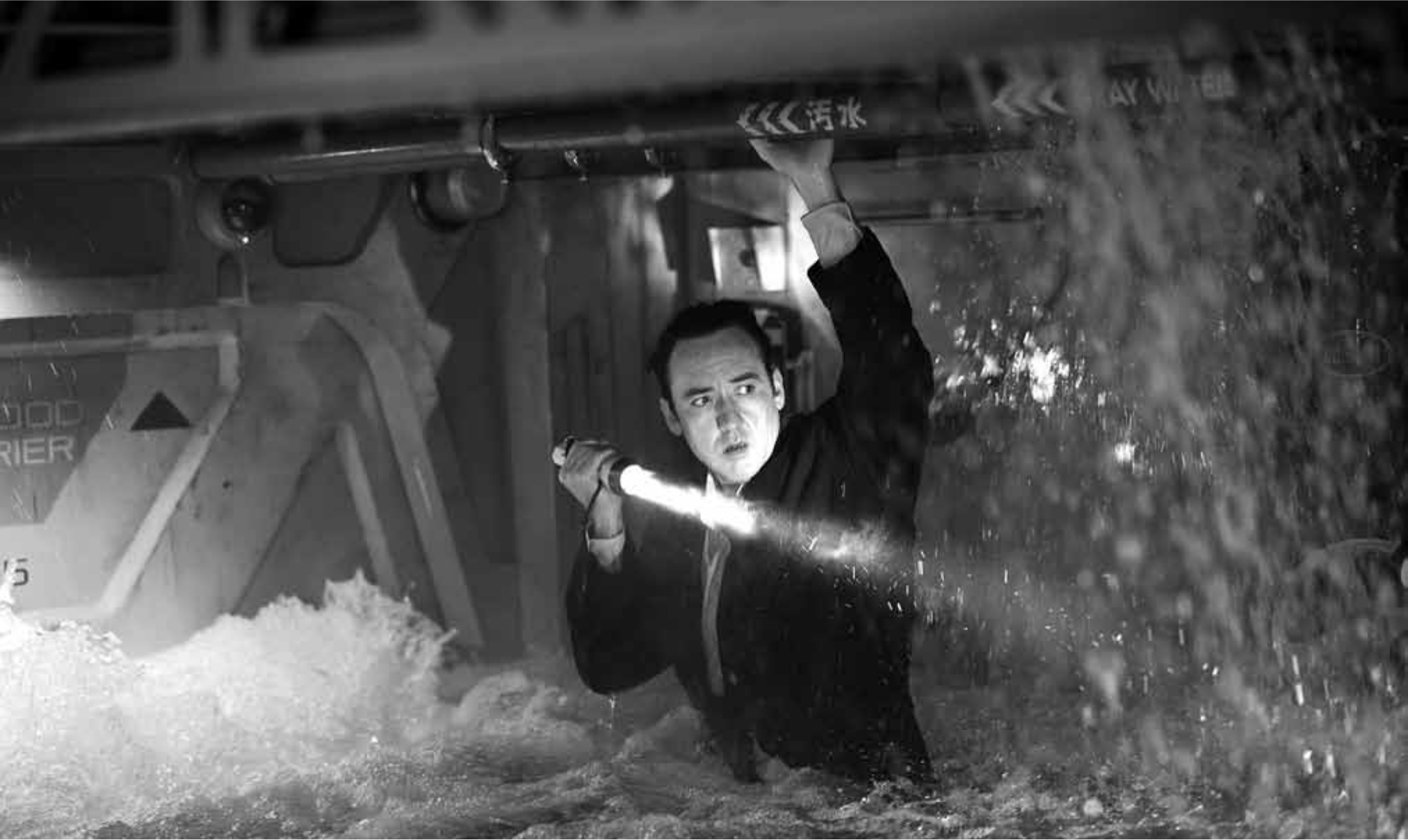
In 2012, protagonist Jackson Curtis performs some truly spectacular feats to save his family from destruction, including dodging balls of molten mantle rock propelled into the sky from the eruption of the Yellowstone Caldera—in a beat-up Winnebago, nonetheless.
“2012,” ©2009 Columbia Pictures Industries, Inc. All Rights Reserved. Courtesy of Columbia Pictures.
For Lane, such a heavily mediated understanding of suffering and tragedy—one gleaned from fictional, spectacular, and ultimately enjoyable representations of disaster and destruction—violated some emergent norm about the proper limits of spectatorship, or respect for the reality of human suffering. But this dimly understood norm was one we had, of course, all violated in a pre-September 11 world largely untroubled by consumption of the occasional big-budget disaster epic.
It is worth remembering that after September 11, many Americans came to see themselves as victims of an attack perpetrated against the entire nation, or at least, as potential victims of future terrorist attacks. A September 25, 2001 Pew poll found that 53 percent of Americans were very or somewhat worried that they or someone in their family “might become a victim of a terrorist attack.” As Americans came to see themselves as victims, they engaged in a kind of retroactive condemnation of Hollywood disaster epics that had, it turned out, quite accurately anticipated the audio-visual qualities of jetliner crashes and skyscraper collapses amid a bustling metropolis. When they suddenly hit much closer to home, it was much more difficult to simply enjoy such spectacles.
The Ethics of Watching
As early as 1993, in his book Distant Suffering, sociologist Luc Boltanski argued that an emerging, Western “crisis of pity” signaled not only a loss of confidence in the veracity of reportage on global humanitarian issues, but “also relieve[d] the anxiety, loss of self-esteem and sense of indignity which is often said to be provoked by seeing wounded, imprisoned, tortured, starving or even dead people, without being able to do anything.”
Prevailing notions of disaster porn today, in which any and every form of disaster-related media is potentially pornographic, exacerbate this tendency. If documentaries, news reports, filmed dramatizations of real events, and completely fictional Hollywood blockbusters can all be written off as disaster porn, we run the risk of ignoring the suffering of others and relieving our own anxieties about viewing their misfortunes. Those who decry disaster porn no doubt do so to preserve “the grieving of their privacy and the dead of their dignity,” as Susan Llewelyn Leach wrote in 2005. But the ideal of truly ethical or authentic spectatorship of disaster may be impossible, given the inherent inequity of watching the misery of others from a position of relative comfort.
The dangers of disaster porn—namely, the lack of compassion it is said to engender—have also been overstated. After all, alongside the increasing visibility of both disaster media and its critics, Americans appear to have donated more money to victims of disasters than ever before. According to the website Charity Navigator, Americans gave $1.6 billion to relief efforts for the 2004 South Asian tsunami, contributed $3.3 billion to Hurricane Katrina relief in 2005, and then in 2010, in the midst of a significant recession, gave $1.4 billion to victims of the Haiti earthquake. If donations to the Red Cross are a good metric, then Americans gave much more money for disaster relief in South Asia and Haiti than they had for any previous foreign disasters, especially those—like the 1984-85 Ethiopian famine and the 1985 Mexico City earthquake—that pre-date the term disaster porn itself. Whatever its deleterious effects, the supposed proliferation of disaster pornography over the last decade does not seem to have decreased Americans’ sympathy for disaster victims, at least as measured by their charitable donations.
If mass media is to be a force for good, then journalists, cultural critics, and especially social scientists should avoid broad-stroke condemnations of the disaster porn genre. Such condemnations encourage audiences to remain in the relative safety of ironic detachment—comfortably critical of media processes and effects, rather than struggling with the nature of their own discomfort over injustice and its potential claims on our emotions.
The Uses of Exposure
To cast something off as disaster porn is, borrowing the language of sociologist C. Wright Mills, to reframe a “public issue” as merely a “private trouble.” It substitutes aesthetic questions about one’s personal viewing preferences for ethical considerations about one’s actual ability to help. In the current media landscape, saturated with so-called disaster porn, this has not yet become the norm—as evidenced by high levels of charitable giving for even very distant disasters. But if graphic scenes of others’ suffering become subject to a widely held taboo, then viewers may feel absolved of the obligation to think and act on such suffering—or even to pay attention in the first place.
The desire to turn away from death and disaster is understandable in a media-saturated world where there is an endless surfeit of tragedies to display. But as sociologist Iain Wilkinson has recently argued, such moral engagement with the suffering of others, “in all its real-life perplexities, compromises, and difficulties is…an indispensable component of the quest for social understanding.”
Disaster porn, then, in all its iterations and for all its flaws, is a vital political terrain in which publics are at least implicitly asked to struggle with the social significance of the suffering of others. It connects public issues like war, famine, earthquakes, and terrorist attacks to the private lives of those they affect, and shows us how disruptions of social structure become disruptions in individual biographies. This is the case in even the most seemingly stereotypical news reports of suffering in the developing world, and in even the most outlandish Hollywood disaster epics as well.
True, the focus on individual acts of heroism in films like 2012 often shifts attention away from the suffering multitudes, and for this they have been rightly criticized. But the seemingly impossible odds that the protagonists of such disaster epics must overcome also serve to highlight our shared vulnerability to risk. By imagining ourselves in Jackson Curtis’s shoes, we recognize that we might not be so lucky, and likely not survive at all. Similar sentiments are aroused when we watch the evening news, or a documentary about survivors of some terrible real-life tragedy. Such sentiment should be cultivated, not condemned.
In disaster porn, for all its flaws, publics are at least implicitly asked to struggle with the social significance of the suffering of others.
Encouraging an awareness of the vicissitudes of fate helps to combat the common tendency to blame victims of chance and inequality for their own misfortunes, and to view one’s own good fortune as the result of special individual talents unaffected by larger social forces or privileges. In this way, so-called disaster porn may prove itself to be more of a virtue than a vice.