




Abstract
The phrase immigration reform has been around since the early history of the country, and its meaning varies according to different social perspectives of whether to admit more immigrants or limit their numbers. Sociologist Nestor Rodríguez argues that while immigration reform may open the door for some new immigrants, invariably it keeps other immigrants out, sometimes because of restrictive regulations adopted by the administering government agencies.
Keywords
People, organizations, and officials use the phrase immigration reform to mean a host of different things regarding immigration. However, one point on which all users of the phrase agree is that something needs to be done about the current state of immigration. But beyond this shared sense of the need to change the status quo, the meanings go in different, sometimes even opposing directions. On one hand, take the present debate about how to deal with the estimated 11 million undocumented immigrants in the United States. Proponents of a humanitarian approach conceptualize immigration reform as a policy that would grant amnesty for undocumented migrants, including the right to become citizens sometime in the future. On the other hand, opponents of wholesale amnesty view immigration reform in terms of a policy to restrict legalization to only a portion of the undocumented migrant population or to a relative few, arguing that the country has already admitted too many immigrants and that it is time to reduce immigration.
Government bureaucracies play a big role in determining what immigration reform laws actually look like when they are implemented.
The use of the word “reform” to mean the need to change immigration law can be traced back to at least the late 1800s. On January 11, 1899, for example, the New York Times ran the article “Ex-Commissioner Stump States His Views and Suggests Reform,” describing how the former commissioner of the Bureau of Immigration proposed amending immigration law to punish persons who helped paupers immigrate into the country. Another New York Times article on January 5, 1911, with the heading “Ask Immigration Reforms,” reported that President Taft was sympathetic to an association of foreign-language newspapers that was seeking legislation to remove “the hardships imposed upon arriving immigrants.” Taft also commented on the need “to administer the immigrant law not sternly but mercifully.”
To further illustrate the contrasting character of some legislated immigration reforms, consider two reform laws enacted by the U.S. government in the late twentieth century. One law was the Immigration Reform and Control Act (IRCA) of 1986, and the second law was the Illegal Immigration Reform and Immigrant Responsibility Act (IIRIRA) of 1996. IRCA gave amnesty to about 3 million undocumented migrants. Many of the legalized migrants subsequently enjoyed considerable prosperity as a result of their new legal status; they found decent jobs, stabilized their families, and had children who grew up with good educations and entered successful careers. By contrast, IIRIRA created a system of mass deportations that has been tearing up thousands of immigrant families. IIRIRA increased deportations by 700 percent from 1996 to 2010, annually hurling hundreds of thousands of migrants, including parents of U.S. children, back to Mexico, Central America, and other world regions.
Government bureaucracies play a big role in determining what immigration reform laws actually look like when they are implemented. Congress passes immigration laws, but the administering bureaucracies write the rules (“regulations”) for how to implement the laws. Bureaucratic regulations can create conditions for immigrants that go against the expectations of congressional lawmakers. In the IRCA reform, for instance, Congress specified that undocumented immigrants who had lived in the United States continuously since January 1, 1982, qualified for amnesty if they met other requirements, such as not being convicted of a crime. But what happened to migrants who had made brief trips out of the country, such as in times of a grave illness or death of a family member back home? The Immigration and Naturalization Service, which was the administering immigration bureaucracy at the time, disqualified a large number of migrants seeking amnesty because they had left for brief periods. It was not until several years after IRCA was implemented that an immigrant social movement convinced government policy makers to let thousands of bureaucratically disqualified immigrants apply for amnesty.
Brian McFadden
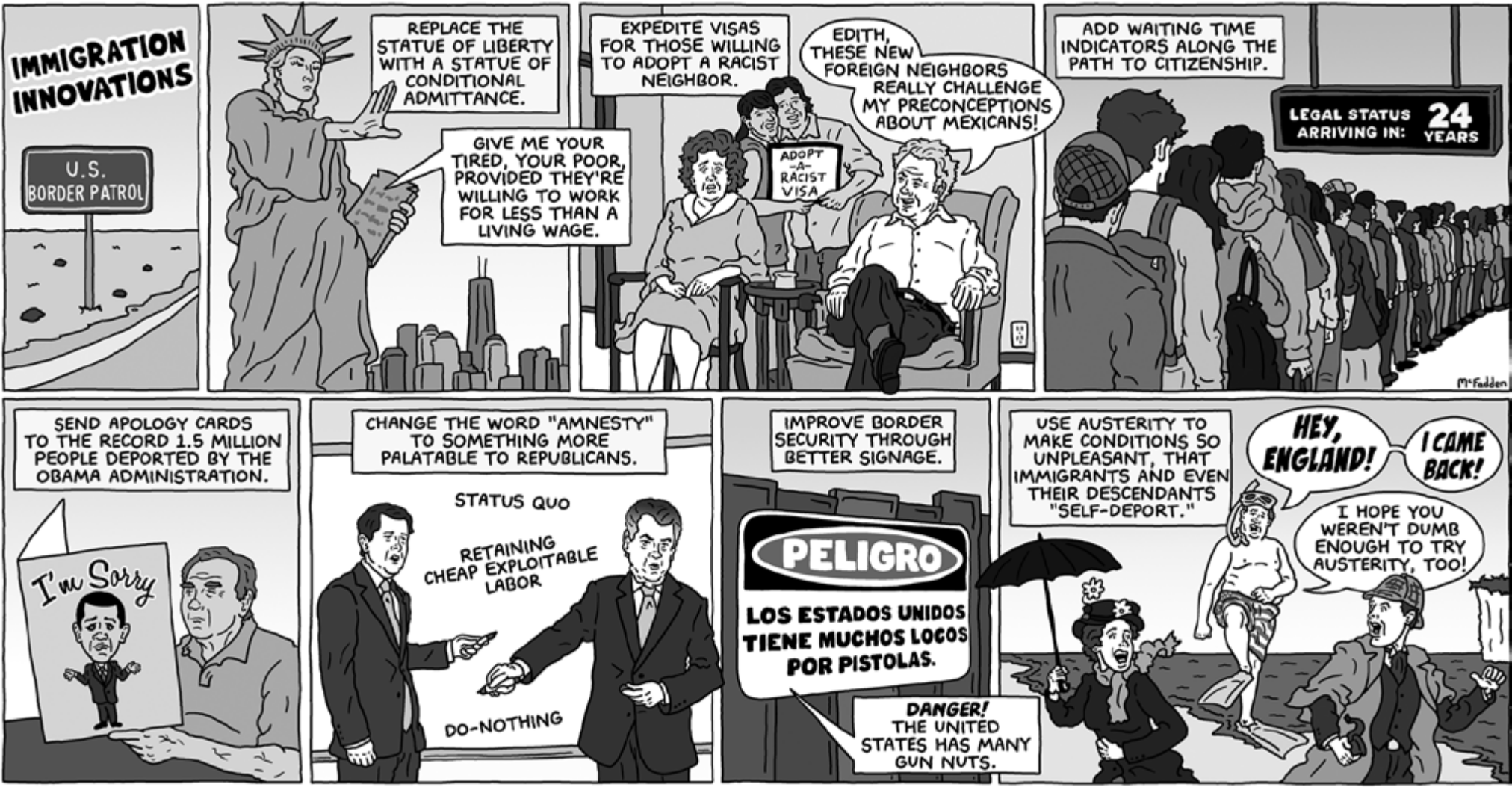
Moreover, bureaucracies that administer immigration laws can affect the ability of immigrants to adjust their legal statuses simply by changing the fees they charge for applications, or by making special demands concerning the personal documents (family letters, certificates, diplomas, etc.) that immigrants must provide for their applications. From time to time, the Department of Homeland Security (DHS), which since 2003 houses the immigration bureaus of the government, increases the fees of the many applications that persons use to sponsor immigrants or that immigrants use to adjust their status. For example, DHS has steadily increased the fees for a green card application to almost $1,000 today. While the present law for legal immigration was originally enacted to promote family unity, a fee of $1,000 is prohibitive for low-income families wanting to sponsor an immigrant family member. Some of the almost 3 million undocumented immigrants who received amnesty through IRCA could not afford to pay the application fees for their immigrant children; consequently, many of the children remained undocumented for years.
A new pattern of immigration legislation to regulate immigrants developed at the beginning of the twenty-first century when local and state governments began to enact ordinances and laws, respectively, mainly to restrict undocumented migrants in their jurisdictions. In some cases, analysts refer to the new local ordinances and state laws as “immigration reform.” Some city ordinances, for example, reinforced the federal requirement for employers to check the legal status of their workers, or required landlords to check the immigrant status of their renters. Some states began to enact measures to help undocumented immigrants gain greater institutional participation, such as by allowing undocumented students to attend state universities and colleges, but these reforms have been slow in coming.
Expectations for immigration reform grew after the re-election of President Obama. In his first term, he had shown support for the immigrant cause by halting the deportation of undocumented youth through an executive order. Moreover, since a large percentage of Latino voters supported his re-election, some advocates believed that Obama should give greater support to immigration reform to help the many Latino undocumented immigrants in the country. Soon after his re-election, many pro-immigrant groups began to publicize the idea of “comprehensive immigration reform” to legalize the estimated 11 million undocumented immigrants in the country. However, groups favoring immigration restrictions offered counter reform proposals that include eliminating the family-preference basis of the current immigration system, which these groups see as a source of the millions of immigrants in the country.
Congress will probably pass a new bill of immigration reform in 2013, since both Democratic and Republican Congressional members have joined the president in voicing support for such legislation. This joint support has not existed for almost two decades. But whatever reform is enacted, it will not satisfy all immigrants seeking relief. What may look like reform for some immigrants may look like a new barrier for others. Immigration reform is always in flux and at the whim of political negotiations and compromises that open the door for some immigrants and leave others waiting.